I'll admit something: my first attempt at home colouring, at seventeen, resulted in a shade best described as "aggressive tangerine." The box showed a warm auburn. Reality had other plans. What I didn't know then — and what nobody tells you on the back of the box — is that home colouring is 90% preparation and only 10% actual application. Get the prep right and you'll get results that genuinely rival a salon. Skip it and you'll be booking an emergency appointment to fix the damage. I've done both, extensively, and here's everything I've learned.
Understanding colour types: temporary, semi-permanent, permanent
Before you pick up a box, you need to understand what kind of colour you're actually buying. This decision determines everything — the result, the commitment, and the potential damage.
Temporary colour (washes out in 1–3 shampoos). These coat the outside of the hair shaft without penetrating the cuticle. Think colour-depositing shampoos, spray-on tints, and colour mousses. They can't lighten your hair — only add tone. Zero damage, zero commitment, perfect for experimenting. The downside: they can transfer onto pillowcases and clothing, especially when new.
Semi-permanent colour (lasts 6–12 washes). These use small dye molecules that partially penetrate the cuticle but don't reach the cortex. No developer needed, no ammonia, minimal damage. They're excellent for enhancing your natural colour, adding richness, or toning brassiness. They can't lighten hair or cover greys completely — at best, they'll blend grey hairs for a few weeks. Brands like Clairol Natural Instincts and L'Oréal Casting Crème Gloss fall in this category.
Demi-permanent colour (lasts 12–26 washes). A step up from semi-permanent — uses a low-volume developer to open the cuticle slightly, allowing deeper dye penetration. Better grey coverage, richer results, and a more natural fade pattern than permanent colour. This is the sweet spot for most home colourers who want noticeable results without the full commitment. Madison Reed and Wella Color Charm demi-permanent are excellent options.
Permanent colour (grows out, doesn't wash out). Uses ammonia (or an ammonia substitute) to open the cuticle fully and a developer (hydrogen peroxide) to both strip natural pigment and deposit new colour molecules deep in the cortex. This is what most box dyes are. Results are lasting and can lighten hair by up to three levels. But the chemical process is irreversible — once you've permanently coloured, that section of hair is permanently altered. It'll grow out, but it won't fade back to your natural shade.
Choosing the right shade (the part where most people go wrong)
This is where home colouring disasters begin — not during application, but during shade selection. The model on the box has different starting hair than yours, different lighting, different skin tone, and (let's be honest) probably has salon-coloured hair that was styled by a professional before the photo shoot. The shade on the box is aspirational, not predictive.
Here's how to choose realistically:
The two-level rule. Permanent home colour reliably goes up to two levels lighter or darker than your current shade. Going beyond that increases the risk of unexpected results exponentially. If you're a level 5 (medium brown) and want to go level 3 (dark brown), that's fine. If you want to go level 8 (light blonde), you need bleach — which is an entirely different process with entirely different risks, and I'd strongly suggest professional help for your first attempt.
Understand undertones. Every hair colour has warm (gold, copper, red) or cool (ash, violet, blue) undertones. When permanent colour lifts your natural pigment, it reveals warm undertones — this is called the underlying pigment. It's why dark hair often goes orange or brassy when lightened, and why "ash blonde" box dye on dark brown hair frequently produces "warm bronde" instead. If you want a cool result, you may need an ash-toned product to counteract your natural warmth.
Read the colour chart on the side of the box, not the front. Most boxes include a small chart showing expected results based on your starting shade — dark brown starting hair will get a different result than light brown, even with the same product. This chart is far more accurate than the model's glamour shot on the front.
When in doubt, go darker. It's much easier to correct a too-dark colour (with a few washes or a colour-removing product) than a too-light one (which typically requires professional correction). A shade that's one level darker than your target is a safer bet than one that's lighter.
Do the strand test. Every box instructs you to do this. Almost nobody does. It takes 30 minutes and tells you exactly what the colour will look like on your specific hair. Cut a small section from underneath (where it won't be visible), apply the product according to instructions, and process for the recommended time. Rinse, dry, and evaluate. This single step prevents approximately 100% of "it's completely the wrong colour" emergencies.
Before you start: the preparation checklist
Good preparation is the difference between salon-quality results and a bathroom disaster. Here's everything you need to do before you open the box:
48-hour patch test. Apply a small amount of the mixed colour behind your ear or on the inside of your elbow. Wait 48 hours. If there's no itching, redness, or swelling, you're clear to proceed. PPD (para-phenylenediamine), one of the most common ingredients in permanent hair dye, causes allergic reactions in about 1.5% of the population — and those reactions can be severe. Do the patch test even if you've coloured before, because sensitisation can develop at any point.
Don't wash your hair. Colour your hair on day-two or day-three hair — the natural oils on your scalp form a protective barrier that reduces irritation and helps the colour process more evenly. Freshly washed hair is more porous and can absorb colour unevenly, leading to hot spots (areas of more intense colour).
Protect your skin and surfaces. Apply a thin layer of petroleum jelly (Vaseline) along your hairline, ears, and the back of your neck — this prevents staining. Wear an old shirt or a colouring cape. Lay newspaper or old towels on the floor. Hair dye stains bathroom tiles, grout, and countertops permanently. Do not learn this the hard way.
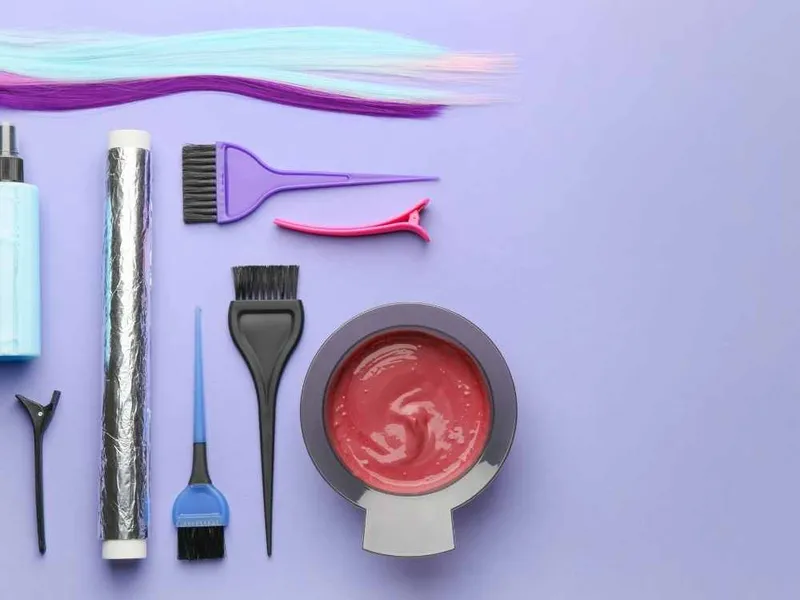
Gather your tools. You'll need: the colour kit (obviously), a non-metallic bowl and brush (if not included), sectioning clips, a wide-tooth comb, a timer (your phone works), old towels, and gloves (use the ones in the box or nitrile gloves from the pharmacy — never go gloveless, permanent dye stains hands for days).
Section your hair in advance. Divide your hair into four quadrants: two in front (left and right of the part), two in back (left and right). Clip each section. This makes application systematic rather than chaotic, and ensures even coverage. Professional colourists always section first — it's not optional if you want professional results.
Application technique: step by step
This is where precision pays off. Even, thorough application is what separates a professional-looking result from a patchy mess.
Step 1 — Mix the product. Follow the box instructions exactly. The ratio of colour to developer is formulated precisely — adding more developer doesn't mean "more colour," it means more lift and potentially more damage. Mix thoroughly until the consistency is smooth and uniform.
Step 2 — Start at the roots (for virgin hair, skip this if doing roots only). If this is your first time colouring, begin applying from the roots through to the ends. Apply to one section at a time, starting at the nape of the neck (back bottom) and working upward and forward. The nape is the coolest part of your scalp, so it processes slowest — starting there ensures even development.
Step 3 — Use the brush, not the bottle. Many box kits include an applicator bottle, but a brush gives you far more control. Dip the brush, apply a generous amount to a thin subsection (about 1 cm wide), then lay the strand flat and move to the next one. Think of it as painting — you're coating each strand completely, not just drizzling product and hoping for the best.
Step 4 — Saturate completely. The most common application mistake is using too little product. Every strand needs to be fully saturated — you should see colour on the hair, not just a light coating. If you have thick or long hair, one box may not be enough. Buy two. Having leftover product is infinitely better than running out halfway through.
Step 5 — Comb through. Once all sections are applied, use a wide-tooth comb to distribute the colour evenly from roots to ends. This ensures there are no gaps or uneven spots. Then gently pile your hair on top of your head (don't twist or knot it — that creates pressure points where colour processes differently).
Step 6 — Set your timer. The processing time on the box is not a suggestion. It's calibrated to the specific chemistry of that product. Under-processing gives you a weaker, less lasting result. Over-processing doesn't make the colour more intense — it damages the hair, dries out the cortex, and can actually cause the colour to appear muddy or dull.
Timing and processing: why the clock matters
Processing time is one of the most misunderstood aspects of home colouring. Here's what's actually happening chemically during those 25–35 minutes:
Minutes 0–5: The ammonia (or ammonia substitute) in the formula opens the cuticle scales, allowing the developer and colour molecules access to the cortex. You might feel a slight tingling — that's normal. Burning or sharp stinging is not normal and means you should rinse immediately.
Minutes 5–15: The hydrogen peroxide developer begins breaking down your hair's natural melanin pigment (this is how permanent colour lightens). Simultaneously, the dye precursors (small colourless molecules) start penetrating the cortex.
Minutes 15–25: The dye precursors react with each other inside the cortex, forming larger colour molecules that are too big to escape back out through the cuticle. This is the "trapping" phase — your new colour is literally being built inside the hair shaft.
Minutes 25–35: Final development. The colour reaches its target shade, and the chemical reaction begins to slow down. At this point, leaving it longer doesn't add more colour — it just continues to degrade the hair's structural proteins without additional benefit.
For grey coverage, some products recommend processing for an additional 5–10 minutes because grey hair has a tighter, more resistant cuticle that takes longer to open. But add time only if the product instructions specifically say so — not as a general strategy.
Temperature matters. Heat accelerates chemical reactions. If your bathroom is warm (freshly showered steam, for instance), the colour may process faster than expected. If it's cold, it may process slower. Some products suggest using a plastic cap during processing — the trapped body heat from your scalp helps maintain consistent temperature. Follow the product's recommendation on this.
Special cases: grey coverage, roots, and colour correction
Grey coverage. Grey hair is structurally different from pigmented hair — the cuticle is often tighter and more resistant, and the cortex contains air pockets where melanin used to be. For reliable grey coverage, you need permanent colour (semi and demi-permanent will only partially blend greys). Choose a shade that matches your natural colour or is one level darker — grey hairs can grab colour more intensely than pigmented ones, so going too dark creates a harsh contrast. Some brands formulate specifically for grey coverage (L'Oréal Excellence and Clairol Nice'n Easy have dedicated grey coverage ranges).
Root touch-ups. The process differs from full-head application. Apply colour to roots only for the first 20 minutes of processing time. Then, in the last 5–10 minutes, comb the remaining product through mid-lengths and ends — this refreshes the colour without double-processing hair that's already been coloured. Double-processing causes cumulative damage: each application lifts and redeposits, weakening the cortex progressively. Your ends have been through more processing cycles than your roots, so they need less exposure time.
Colour correction (when things go wrong). If the result is too dark: wash immediately with a clarifying shampoo mixed with a tablespoon of baking soda. Repeat 2–3 times. This won't completely remove permanent colour, but it can lighten it by a level or two. Vitamin C treatments (crush vitamin C tablets, mix with shampoo, apply for 30–60 minutes) can also strip some colour without the damage of bleach. If the result is too light or patchy: apply a demi-permanent colour in the target shade — it'll deposit without further lifting, filling in the gaps. If the result is significantly wrong (green tones, extreme orange, dramatic unevenness): book a professional. Trying to fix a major colour problem at home typically makes it worse.
Aftercare: making your colour last
The work doesn't stop when you rinse out the colour. Post-colour care determines whether your €12 box dye looks like a €12 box dye or a €120 salon treatment.
Wait 48 hours before shampooing. The cuticle needs time to fully close and lock in the colour molecules. Washing too soon opens the cuticle and allows colour to escape — that first post-colour wash that runs with colour? That's money (and vibrancy) going down the drain. Rinse with water if needed, but avoid shampoo for two full days.
Switch to colour-safe products. Sulfate-free shampoo is non-negotiable for colour-treated hair. Sulfates strip colour faster than anything else. Colour-safe conditioners contain ingredients that help seal the cuticle and maintain vibrancy — they're not just marketing gimmicks, they genuinely work. Brands like Pureology, Redken Color Extend, and L'Oréal EverPure are reliable options.
Cold water final rinse. After every wash, finish with the coldest water you can tolerate for 30 seconds. Cold water closes the cuticle, sealing in moisture and colour. It's uncomfortable but effective — your colour will last noticeably longer.
UV protection. Sun exposure fades hair colour — both natural and dyed. Use a leave-in conditioner or hair spray with UV filters, especially in summer. Wearing a hat at the beach or pool is the most effective protection, but UV-filtering products help for daily exposure.
Limit heat styling. Heat opens the cuticle and accelerates colour fade. When you do use heat tools, always apply a heat protectant spray first, and keep temperatures moderate — 180°C maximum for coloured hair, lower if possible. Ionic tools are gentler than standard ones.
Deep condition weekly. Chemical processing depletes the cortex of proteins and moisture. A weekly deep conditioning mask (look for ingredients like keratin, argan oil, and ceramides) replenishes what the colour process took. Your colour will look richer and your hair will feel healthier — win-win.
The 8 most common home colouring mistakes (and how to fix them)
1. Choosing colour based on the box model. Fix: use the shade chart on the side, do a strand test, and follow the two-level rule.
2. Not buying enough product. Fix: if your hair is past your shoulders or particularly thick, buy two boxes. Always. Leftover product costs €8; a patchy result costs considerably more to correct.
3. Skipping the allergy test. Fix: just do it. 48 hours and a cotton bud. PPD reactions can cause facial swelling, blistering, and in extreme cases, anaphylaxis. This isn't about aesthetics — it's about safety.
4. Applying colour to dirty, product-laden hair. Fix: don't wash the day of colouring (natural oils are good), but do avoid heavy styling products for 24 hours beforehand. Dry shampoo residue, hairspray, and oils can create a barrier that causes uneven absorption.
5. Uneven application. Fix: section properly, apply systematically, saturate fully, and comb through. Speed is not your friend here — thorough, methodical application beats fast application every time.
6. Processing too long or too short. Fix: set a timer the moment you finish applying and follow the recommended time exactly. Don't guess, don't estimate, don't get distracted.
7. Using the wrong developer volume. Fix: if you're buying salon-grade products separately (colour + developer), match the volume to your goal. 10-volume for depositing (going darker), 20-volume for matching or going one level lighter, 30-volume for two levels lighter, 40-volume for maximum lift (and maximum damage — professional use only).
8. Neglecting aftercare. Fix: the colour doesn't end when you rinse. Sulfate-free shampoo, cold rinses, UV protection, and weekly deep conditioning are what separate a colour that lasts four weeks from one that fades in ten days.
Frequently asked questions
Can I colour my hair if it's already damaged?
You can, but proceed with caution. Damaged hair is more porous, which means it absorbs colour faster and can end up darker or more saturated than expected — especially at the ends, where damage is typically worst. Consider using a semi-permanent or demi-permanent formula, which is gentler than permanent. And invest seriously in deep conditioning both before and after the colouring process. If your hair is severely compromised (excessive breakage, extreme dryness), a professional consultation is worth the investment.
How soon can I re-colour if I don't like the result?
Wait at least two weeks between permanent colour applications — your hair needs time to recover from the chemical process. Using another permanent colour immediately doubles the damage. In the interim, try washing with clarifying shampoo to fade unwanted intensity, or use a colour-depositing conditioner to adjust the tone. If the result is dramatically wrong, a professional colour correction is safer and more effective than a second DIY attempt.
Is home colour really worse than salon colour?
Not inherently. The active chemistry is similar — the difference is in application technique, product customisation, and professional expertise. A salon colourist can mix custom shades, adjust developer strength section by section, and correct in real-time. Box dye is one-size-fits-all. That said, for straightforward applications (darkening, root touch-ups, single-process colour), home products from quality brands deliver excellent results when applied correctly.
Can I mix two box dye shades together?
Yes, and it's actually a great technique for creating a more natural-looking result. Mix within the same brand and product line (the chemistry is formulated to be compatible). Combining a warm and a cool shade of the same level creates dimension that a single box can't achieve. Hairdressers do this routinely — there's no reason you can't do it at home.
Should I colour or highlight at home?
Single-process colour (all-over) is very achievable at home with practice. Highlights and balayage are significantly harder because they require precise placement, controlled lightening, and the ability to see the back of your head clearly. Cap highlights (the ones with the pull-through hook) are the most home-friendly highlighting method, but the results tend to look less natural than foils. For anything involving bleach and strategic placement, consider having a professional do it at least once so you can maintain the look with root touch-ups at home.
Sources
- Journal of Cosmetic Dermatology — Hair dye chemistry and oxidative colouring mechanisms
- British Journal of Dermatology — Contact allergy to hair dye ingredients
- International Journal of Trichology — Effects of chemical processing on hair structure
- European Commission SCCS — Safety of hair dye substances