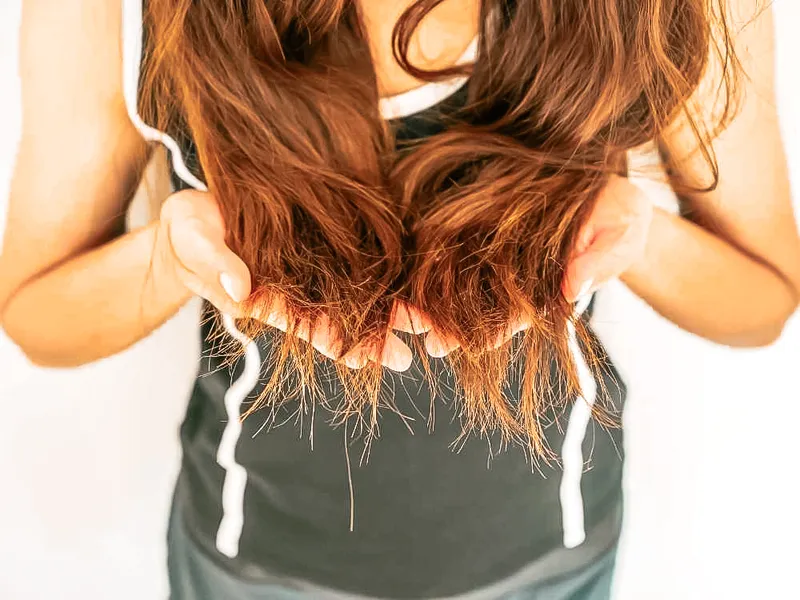
Let me be direct about something most hair articles won't tell you: once hair is truly damaged, you cannot "heal" it. Hair is dead tissue — there's no blood supply, no cellular repair mechanism, no miracle serum that regenerates destroyed keratin bonds. What you can do is repair the visible effects of damage (roughness, frizz, breakage, dullness), protect what's still intact, and ensure the new hair growing from your scalp is in the best possible condition. That's not pessimism — it's the realistic framework that actually leads to results, instead of wasting money on products that promise biological impossibilities.
What "dry hair" actually means at the structural level
When we say hair is "dry," we're describing a symptom, not a condition. The actual problem is cuticle damage — and understanding the mechanics helps you choose the right solutions instead of buying every product with "hydrating" on the label.
Healthy hair has a cuticle layer made of overlapping cells arranged like roof tiles — flat, tight, and smooth. This arrangement serves two critical functions: it reflects light (which is why healthy hair looks shiny) and it locks moisture inside the cortex (the thick middle layer where hair's strength and elasticity live). When the cuticle is intact, hair retains its natural moisture content of about 10–15%, which keeps it flexible, soft, and resilient.
Damage — from heat, chemicals, UV, friction, or environmental exposure — lifts, chips, and eventually erodes those cuticle scales. Once the cuticle is compromised, moisture escapes from the cortex freely. The hair shaft can't hold onto water, becomes rigid and brittle, and loses its ability to reflect light. Result: hair that looks dull, feels rough, tangles easily, and snaps instead of stretching.
The degree of cuticle damage determines the severity of dryness. Mild damage (slightly lifted scales) causes occasional frizz and a slight loss of shine — this is very repairable with proper conditioning. Moderate damage (significant cuticle erosion) causes persistent dryness, noticeable breakage, and difficulty styling — repairable with consistent treatment. Severe damage (cuticle largely destroyed, cortex exposed) causes extreme brittleness, elastic-like stretching when wet, and hair that simply will not hold moisture regardless of what you apply — at this point, the damaged lengths need to be cut.
Root causes: what's destroying your hair (and you might not realise it)
Fixing dry hair permanently means addressing the cause, not just the symptoms. Here are the most common culprits, ranked by damage potential:
Chemical processing. Bleaching is the most destructive thing you can do to hair — it strips melanin from the cortex by breaking open the cuticle with alkaline chemicals. Every bleaching session causes cumulative, irreversible cuticle damage. Permanent colour is gentler but still opens the cuticle chemically. Perms and relaxers alter disulfide bonds in the cortex. If your hair went dry after a colour treatment, this is almost certainly the primary cause.
Heat styling. Flat irons, curling irons, and blow-dryers at high temperatures dehydrate the hair shaft and can cause the proteins in the cortex to denature — literally changing their structure irreversibly, like cooking an egg. Temperatures above 200°C are particularly destructive. Daily heat styling without protection will visibly degrade even the healthiest hair within a few months. If you straighten regularly, using the right technique and products becomes essential.
Over-washing. Shampooing strips sebum — the natural oil your scalp produces that coats and protects the hair shaft. Washing daily with sulfate-based shampoos removes this protective layer faster than your scalp can replace it, leaving hair exposed and vulnerable. Most people wash far more often than necessary.
Hard water. Water with high mineral content (calcium, magnesium, iron) deposits mineral buildup on the hair shaft. These deposits make the cuticle rigid, prevent conditioning products from penetrating, and create a dull, rough texture that feels permanently dry regardless of what products you use. If you've moved to a new area and your hair suddenly changed, check the water hardness.
UV exposure. Prolonged sun exposure breaks down the proteins and lipids in the cuticle — the same way it damages skin. Hair that's chronically sun-exposed (especially blonde or lightened hair) becomes progressively drier and more brittle. This is why summer often accelerates existing damage.
Friction. Cotton pillowcases, rough towel-drying (rubbing instead of blotting), aggressive brushing, and elastic hair ties all create mechanical friction that chips and lifts cuticle scales. None of these is dramatic on its own, but the cumulative effect of years of daily friction is significant.
The porosity test: understanding your specific damage
Porosity is how readily your hair absorbs and retains moisture — and it's the single most useful thing to know when choosing repair products. It determines whether you need more moisture, more protein, or a different approach entirely.
The float test. Take a clean strand of shed hair (from your brush, not freshly pulled). Drop it into a glass of room-temperature water. Watch for 2–4 minutes:
- Floats on the surface: low porosity — cuticle is tight, products sit on top rather than absorbing
- Sinks slowly to the middle: normal porosity — healthy absorption and retention
- Sinks quickly to the bottom: high porosity — cuticle is damaged and open, absorbs everything but retains nothing
The slide test. Take a strand between your fingers and slide upward (from tip to root, against the cuticle direction). Smooth and easy = low porosity. Some resistance and bumps = normal. Very rough, catching, almost sticky = high porosity with significant cuticle damage.
Protein vs. moisture: the balance most people get wrong
This is the concept that transforms hair repair from frustrating guesswork into targeted treatment. Hair needs both protein (for strength and structure) and moisture (for flexibility and softness). Damage disrupts this balance, and you need to identify which side your hair is deficient on.
Signs you need more protein:
- Hair stretches excessively when wet (like a rubber band) before breaking
- Hair feels mushy, limp, or gummy when wet
- Curls have lost definition and look flat
- Hair won't hold a style — not even with products
- Hair is colour-treated or chemically processed (these deplete keratin from the cortex)
Signs you need more moisture:
- Hair snaps immediately when stretched (no elasticity)
- Hair feels stiff, straw-like, and rough
- Persistent frizz that no product tames
- Hair is dull despite being clean
- Ends are visibly frayed and splitting
Signs of protein overload (yes, too much protein is a real problem):
- Hair feels hard, brittle, and crunchy
- Increased breakage despite using "strengthening" products
- Hair feels dry even after deep conditioning
- Reduced elasticity — hair snaps rather than stretching
Most commercially damaged hair (heat and colour) needs both, but in a specific ratio. A common and effective protocol is: two moisture treatments for every one protein treatment, repeating this cycle weekly. Too much protein without enough moisture creates rigid, breakable hair. Too much moisture without enough protein creates weak, shapeless hair. The balance is everything.
The weekly repair routine: step by step
Here's a concrete, repeatable weekly routine that addresses both immediate symptoms and underlying damage. Adjust the specific products based on your porosity test results.
Day 1 — Wash day + deep moisture treatment.
- Pre-treatment: apply coconut oil or argan oil to dry hair 30 minutes before washing (this limits moisture swelling during washing, which stresses the cuticle)
- Wash with a sulfate-free, moisturising shampoo. One lather only — two rounds of shampooing strips more oil than necessary
- Apply a deep conditioning mask from mid-lengths to ends. Leave for 15–20 minutes under a warm towel or shower cap (heat opens the cuticle for better absorption)
- Rinse with cool water — cold water closes the cuticle and seals in the conditioning agents
- Apply a leave-in conditioner to damp hair. Focus on ends
- Air dry if possible. If blow-drying, use heat protectant and the cool-shot button to finish
Day 3 or 4 — Mid-week refresh.
- Don't wash — just refresh with a leave-in conditioner spray or a few drops of hair oil on dry ends
- If roots are oily, dry shampoo at the roots only
- Gentle detangling with a wide-tooth comb, starting from ends and working upward
Day 7 — Wash day + protein treatment (every other week).
- Wash with clarifying shampoo once a month to remove product buildup (not every wash — it's too stripping)
- Apply a protein treatment (keratin mask, bond-repair product like Olaplex No. 3 or K18) for the recommended time
- Follow immediately with a moisture-rich conditioner — protein treatments can leave hair feeling stiff if not balanced
- Leave-in conditioner and air dry
Timeline for visible results: with consistent weekly treatment, most people see noticeable improvement in texture and shine within 2–3 weeks. Significant repair (reduced breakage, improved elasticity, better moisture retention) takes 6–8 weeks. Full recovery — where new growth from the scalp is healthy and managed properly while damaged lengths gradually get trimmed away — takes 6–12 months depending on hair length.
Ingredients that actually work (and the ones that don't)
Proven effective:
Ceramides. These lipid molecules are naturally present in the cuticle — they act as "mortar" between the cuticle "bricks." Ceramide-containing products literally fill in gaps in the damaged cuticle, restoring its barrier function. This is one of the few ingredients with robust clinical evidence for genuine hair repair.
Hydrolysed keratin. Small protein fragments that penetrate the damaged cortex and temporarily patch structural gaps. Results are cumulative — regular use progressively strengthens the hair shaft. Found in most professional repair treatments.
Bond-repair technology (bis-aminopropyl diglycol dimaleate). The active ingredient in Olaplex — it works by reforming broken disulfide bonds in the cortex. This is genuine structural repair at the molecular level, backed by peer-reviewed research. Other brands have developed similar molecules (K18's bioactive peptide, Redken's citric acid complex).
Natural oils with proven penetration. Not all oils are equal. Coconut oil actually penetrates the hair shaft (its lauric acid molecule is small enough to pass through the cuticle), reducing protein loss during washing by up to 39% in clinical studies. Olive oil and sunflower oil also show penetration. Argan oil primarily coats the surface — excellent for shine and protection, but it doesn't repair internally.
Hyaluronic acid. In hair care (as in skincare), it attracts and holds water molecules. Low-molecular-weight hyaluronic acid can penetrate the cuticle and boost moisture content in the cortex. Higher molecular weights coat the surface and prevent moisture loss.
Don't waste money on:
Products claiming to "seal" split ends permanently. Once a hair strand has split, the only permanent fix is cutting. Products can temporarily glue the split closed (silicones do this), but the next wash or brush stroke reopens it. "Anti-split-end serums" are temporary cosmetic fixes, not repairs.
Beer or mayonnaise rinses. The internet loves DIY hair treatments. Beer's protein content is too dilute to have any meaningful effect on hair. Mayonnaise coats the surface (the oil content does smooth temporarily) but doesn't repair damage. Your fridge is not a hair laboratory.
Excessive essential oils. Some (rosemary, peppermint) may support scalp health, but their effect on hair shaft repair is negligible. They smell nice. That's about it for hair repair purposes.
Lifestyle changes that make a real difference
Products can only do so much — the environment you create for your hair matters just as much.
Reduce wash frequency. If you're washing daily, switch to every other day. If you're already at every other day, try every three days. Your scalp will adjust its sebum production within 2–3 weeks. Dry shampoo at the roots bridges the gap on non-wash days.
Lower your water temperature. Hot water strips oils and swells the cuticle. Lukewarm water cleans perfectly well. Save the cold rinse for the final 30 seconds — the thermal shock closes the cuticle.
Stop towel-rubbing. Wet hair is at its most vulnerable — the hydrogen bonds are broken and the cortex is swollen. Vigorous towel-rubbing creates friction that chips cuticle scales and causes mechanical breakage. Instead, gently squeeze sections with a microfibre towel or an old cotton t-shirt. The t-shirt method sounds bizarre but it's remarkably effective — the smooth jersey fabric creates almost no friction.
Brush gently, and only when necessary. Start from the ends and work upward, holding the section above to prevent pulling on the roots. Never brush wet hair with a standard brush — use a wide-tooth comb or a specifically designed wet-detangling brush (Tangle Teezer, Wet Brush). Force = breakage. Patience = preservation.
Eat for your hair. New growth reflects your nutritional status. Protein (hair is made of it), iron (carries oxygen to follicles), zinc (supports cell division in the follicle), biotin (supports keratin infrastructure), and omega-3 fatty acids (nourish the scalp) all contribute to stronger, better-hydrated new growth. You can't eat your way out of cuticle damage on existing hair, but you can ensure what grows in is the healthiest possible foundation. Specific foods that support hair health include salmon, eggs, spinach, nuts, and sweet potatoes.
Protect while sleeping. Eight hours of friction against a cotton pillowcase adds up to significant cuticle damage over weeks and months. A silk or satin pillowcase — or a loose silk wrap for longer hair — eliminates overnight friction almost completely. This is one of the highest-impact, lowest-effort changes you can make.
When to accept the scissors: knowing when repair isn't enough
There's a point beyond which no product, no mask, no oil, and no amount of patience will make damaged hair look or feel healthy. Recognising this point saves you money, frustration, and months of futile effort.
Cut if:
- Hair stretches like elastic when wet and doesn't spring back — this indicates severe protein depletion in the cortex
- Ends are visibly white or translucent — this means the cuticle and part of the cortex are gone, exposing the medulla
- Hair breaks off in small pieces during normal combing — not a few strands (normal shedding), but actual fragmented pieces
- No conditioning treatment holds for more than a day — this indicates porosity so extreme that nothing can seal the cuticle
- The damaged sections are more than 50% of your total length — at this point, you're maintaining more damaged hair than healthy hair
Cutting doesn't mean going drastically short if you don't want to. Even removing 5–8 cm of the most damaged ends can dramatically improve the look and feel of the remaining hair. A gradual approach — trimming 2–3 cm every 6 weeks while maintaining a repair routine for the remaining length — replaces damaged hair with healthy growth over time without a dramatic style change.
The new growth, protected from the start with proper care, will be in a completely different condition than the damaged lengths you're trimming away. In 12–18 months, the transformation is remarkable — not because a product fixed the damage, but because you replaced damaged tissue with healthy tissue while protecting it properly from day one.
Frequently asked questions
Can dry hair cause hair loss?
Dry hair itself doesn't cause hair loss (which originates at the follicle level), but the breakage caused by severe dryness can mimic the appearance of thinning. When brittle hair snaps at various points along the shaft, you end up with uneven lengths and visible gaps that look like loss. True hair loss — where fewer hairs grow from the scalp — has different causes (genetics, hormones, nutritional deficiencies, medical conditions). If you're seeing significant thinning at the roots, consult a dermatologist rather than relying on conditioning treatments.
How long does it take to repair damaged hair?
Cosmetic improvement (softer texture, better shine, less frizz) can be visible within 2–3 weeks of consistent treatment. Meaningful structural improvement (reduced breakage, better elasticity) takes 6–8 weeks. Full "recovery" — where you've grown out enough healthy hair to trim away all the damaged lengths — depends on growth rate and starting length, but typically takes 6–18 months. There is no shortcut to this timeline; products that claim instant permanent repair are exaggerating.
Is Olaplex really worth the price?
For genuinely damaged hair (bleached, permed, or severely heat-damaged), yes. The bis-aminopropyl diglycol dimaleate molecule it contains is one of the few ingredients proven to reform broken disulfide bonds in the cortex. It's not a miracle — it won't resurrect completely destroyed hair — but for moderate damage, the structural repair is measurably superior to conventional conditioning alone. For mildly dry hair that isn't chemically damaged, a good deep conditioner is likely sufficient and more cost-effective.
Should I use coconut oil or argan oil?
They serve different purposes. Coconut oil penetrates the hair shaft and reduces protein loss — use it as a pre-wash treatment (30 minutes before shampooing). Argan oil primarily coats the surface, providing shine and humidity protection — use it on dry hair as a finishing product. For dry, damaged hair, coconut oil delivers more internal benefit. For frizz control and shine, argan oil is more effective. Using both (coconut as treatment, argan as finisher) combines their strengths.
Does drinking more water help dry hair?
Adequate hydration supports overall health, including skin and scalp function, but drinking extra water beyond normal hydration needs won't directly moisturise dry hair. Hair is dead tissue — water reaches it from the outside (products, humidity), not from the inside via your bloodstream. If you're chronically dehydrated, increasing water intake may improve scalp health and sebum quality, which indirectly benefits hair. But if you're already normally hydrated, chugging extra water won't fix cuticle damage.
Sources
- International Journal of Trichology — Hair damage assessment and repair mechanisms
- Journal of Cosmetic Science — Conditioning agents and cuticle repair
- British Journal of Dermatology — Effects of chemical and thermal processing on hair
- Journal of the American Academy of Dermatology — Hair care practices and hair health
Keep on bubbling
- Top 10 foods that fight hair loss — nourish from the inside out
- Hair botox: is it worth it? — deep conditioning for damaged hair
- Body exfoliation tips — extend your care routine beyond hair