Last Tuesday, at 2pm on the dot, my friend Constance — self-declared porcelain skin — sent me a photo from Bournemouth beach. There she was, stretched out on the sand, finger pointing at a bottle of SPF 6. "Just need a bit of colour, that's all." I nearly choked on my tea. SPF 6. In July. In Bournemouth. The next day she was in Boots buying aloe vera gel for shoulders the colour of a postbox, swearing she'd "never do it again." We've all had a Constance in our lives — or we've been Constance ourselves.
This guide is for Constance. And for everyone heading off on holiday this summer knowing full well they're going to tan, whatever anyone says. The swimsuit's packed (if you're still dithering over the cut, choosing the right swimsuit for your body shape takes ten minutes), so on to the real question. A glow and properly looked-after skin aren't mutually exclusive, as long as you understand what you're doing.
The "healthy glow" myth we keep believing
Let's be honest: socially, we've worshipped tanned skin for decades. Coco Chanel on a yacht in the 1920s, and suddenly a tan meant holidays, health, vitality. For generations, "looking well" meant "looking bronzed."
That narrative is finally shifting. "There's no safe or healthy way to get a tan," reads the NHS page on sunscreen and sun safety. A tan is your skin's defence response to UV. It's not a sign of health — it's a sign of damage.
That doesn't mean hiding indoors all summer. It means no longer seeing a tan as the goal, and starting to see it as an acceptable side effect of well-managed sun exposure.
What happens when your skin tans
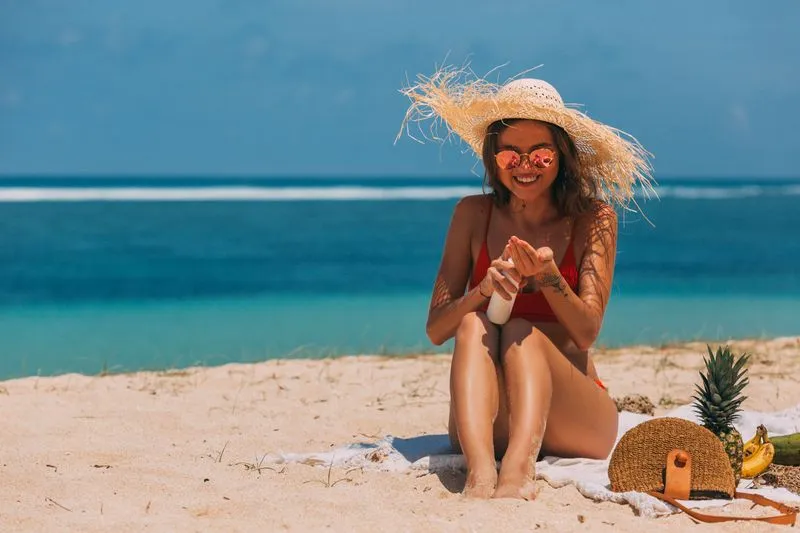
A bit of biology — promise it's useful. When UV rays reach your skin, melanocytes (pigment cells in the epidermis) start producing melanin. That melanin is what gives your skin its tan colour.
Two types of UV rays reach us through the atmosphere, and the British Association of Dermatologists links both of them to skin ageing and skin cancer:
- UVA: penetrate deep into the skin, drive premature ageing (wrinkles, sun spots) and play a part in skin cancer. They get through some kinds of glass: up to 50% of UVA can pass through a car's untreated side windows, according to the Skin Cancer Foundation.
- UVB: reach the epidermis, are largely responsible for sunburn and drive vitamin D production. Glass blocks them fairly well.
The "immediate tan", visible within hours of exposure, comes from oxidation of melanin that's already there. The "lasting tan" shows up later, once your skin makes new melanin — that's the one that holds for weeks. And the uncomfortable bit: UV can damage the DNA in your skin cells at doses too low to turn you red. No sunburn doesn't mean no damage.
When and how long to sit in the sun to tan without burning
In the UK, the sun is strongest between 11am and 3pm from March to October, says the NHS — that's the window to spend in the shade.
Timing is only half of it. The NHS lists who needs extra care in the sun, and two of those groups are you on holiday. One is anyone "only exposed to intense sun occasionally (for example, while on holiday)". The other is anyone "in a hot country where the sun is particularly intense". So a gradual tan means short, repeated stints outside the 11am to 3pm window, with sun cream on. Not a whole day flat out on the first morning of the trip. The rule for the rest fits in two words — never burn.
Watch for the conditions that fool you, too. Water reflects UV rays and increases your exposure, while its cooling effect can make you think you're not burning. Clouds are no shield either — you can burn in the UK on a grey day.
Last marker: the UV index, which most weather apps and the Met Office website show. The British Association of Dermatologists' sun protection fact sheet recommends sun protection from a UV index of 3 if you have white skin — in the UK, usually between April and September. The UK maximum is around 7 — abroad, the BAD warns, the index can be extreme.
Skin types: how your skin tone changes UK sun advice
The Fitzpatrick scale sorts skin into six types according to how it burns and tans. It's the first way to judge your sun risk: the closer you are to Type I, the more careful you need to be.
- Type I: very fair skin, often red or blonde hair and light eyes. Always burns, never tans.
- Type II: fair skin. Burns easily, tans minimally.
- Type III: light to medium skin. Sometimes burns, tans gradually.
- Type IV: olive or light brown skin. Rarely burns, tans easily.
- Type V: brown skin. Very rarely burns, tans quickly and deeply.
- Type VI: black skin. Almost never burns.
Here's where the UK advice gets interesting. The British Association of Dermatologists recommends sun protection from a UV index of 3 for people with white skin. For black and brown skin, its threshold is a UV index of 11+. Since the UK maxes out at around 7, routine sun protection is usually unnecessary here for black and brown skin. The exceptions matter — photosensitive conditions such as vitiligo or lupus, a high personal risk of skin cancer, or long days outdoors somewhere the UV index is extreme.
Which SPF to choose for your skin type
- Types I and II (very fair to fair skin that burns easily): SPF 50 or 50+, no debate.
- Types III and IV (you tan gradually or easily): SPF 30 minimum, 50 on the beach.
- Black and brown skin (roughly Types V and VI — the BAD talks about skin tone, not Fitzpatrick types): a different UK rulebook, with a UV index threshold of 11+ rather than 3. Abroad, under a strong sun, SPF 30 minimum too. Darker skin burns less — it isn't immune.
Olive and light brown skin (Type IV) stays on the white-skin advice: the NHS lists light brown skin among those who should take extra care.
SPF measures protection against UVB, the sunburn rays. It says nothing about UVA — in the UK, that's the star rating (the more stars, the better) or the letters "UVA" in a circle, the EU marking. The NHS minimum is SPF 30 with at least 4-star UVA protection. Filters, textures and formats are all covered in the complete guide to choosing and applying sun protection.
How much sun cream to apply: everyone's weak point
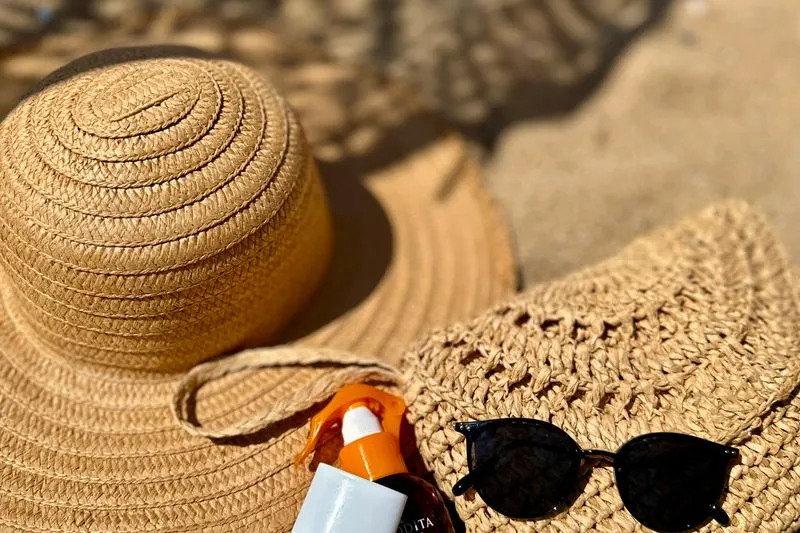
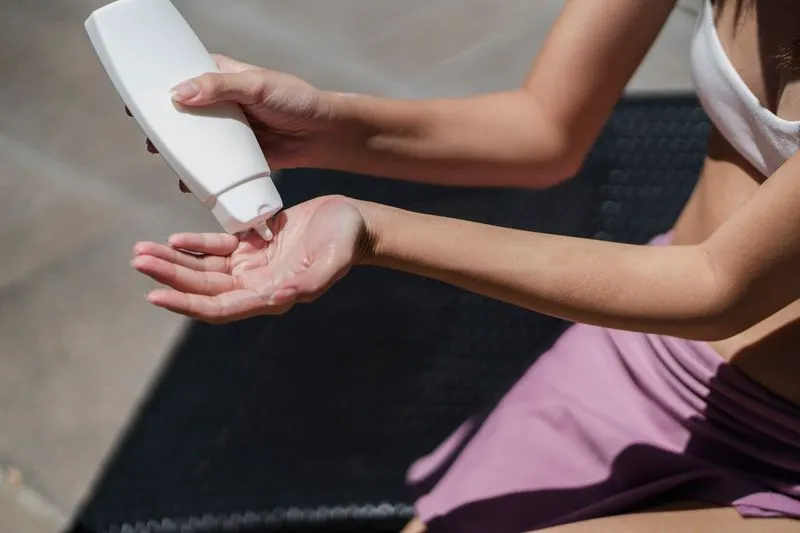
Sun cream only lives up to its number if you use enough of it. The European Commission spelled it out in its 2006 recommendation on sunscreen products: SPF is tested at 2mg of product per cm² of skin. For an average adult's body, that's 6 teaspoons of lotion — roughly 36g.
Most people don't apply enough, the NHS notes, and its routine is simple. If you'll be out long enough to burn, apply twice: 30 minutes before going out, then just before. Cover all exposed skin — face, neck and ears included. Reapply every 2 hours and straight after swimming, even with a "water resistant" formula.
Diet and tanning: what's proven and what isn't
Every summer, lists of "tan-boosting foods" do the rounds. There's a grain of truth in them, but far less than they promise: no plate replaces sun cream, and no food makes you tan faster.
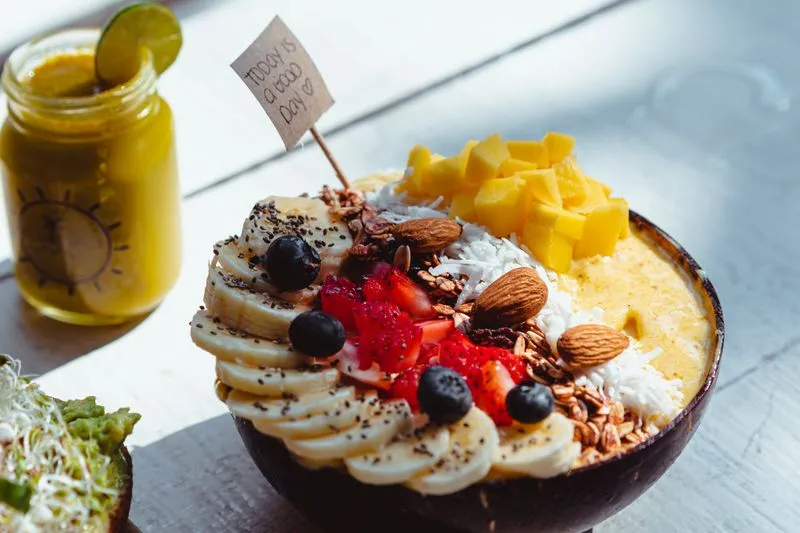
Beta-carotene: carrots, mangoes, apricots, red peppers, sweet potatoes. It's an orange pigment, and it's often what's inside the "glow" capsules sold before summer. Eat your carrots because they're good, not as a stand-in for SPF — a carotene tint is colour, not protection.
Lycopene: tomatoes (especially cooked), watermelon, pink grapefruit. This is the best-studied lead. In a randomised controlled trial published in the British Journal of Dermatology in 2011, a Manchester team randomly assigned 20 fair-skinned women (types I and II) to 55g of tomato paste in olive oil, or olive oil alone, every day for 12 weeks. The result: less redness after UV exposure, measured with an instrument, and fewer markers of skin damage than in the olive-oil-only group. The dose that triggered visible sunburn, however, didn't change significantly. A small bonus, not a shield.
Tyrosine and green tea also crop up on these lists. None of the official sources cited here treats them as a tanning aid, so I'm not selling them to you.
After-sun and fake tan: making your tan last without UV
A tan fades as fast as your skin renews itself. The colour sits in your epidermis, the outer layer of skin, and that layer never stops turning over: new cells reach the surface after about a month, then shed, according to Cleveland Clinic's guide to the epidermis. So making a tan last means two things — topping it up without burning, then handing over to a bottle. My three habits (habits, not studies):
- Keep up short stints in the sun with sun cream on. No sunscreen blocks 100% of UV, so under SPF 50 a tan still builds — slowly, and without the burn.
- Put the scrub away until the trip's over. Exfoliating strips off surface cells — the ones carrying the colour. I save it for prepping fake tan.
- Back home, switch to a gradual tan. It picks up where the sun left off, with no UV at all. Cancer Research UK calls fake tan "safer than sunbathing or using sunbeds".
After-sun won't make you tan. It's about comfort: it rehydrates skin that heat, salt and chlorine have left tight, and soothes it. Aloe vera, panthenol or calendula target that hot, prickly feeling, while glycerin and shea butter handle the hydration. What I avoid: alcohol (it dries in some gels) and fragrance on skin the sun has already sensitised. Clarins, Hawaiian Tropic and Boots Soltan all do after-sun ranges you'll find on the high street. Hydrated skin probably peels a little more slowly, which may help the colour hang on — that's reasoning, not proof.
If you did burn, the NHS advice on sunburn starts simple — get out of the sun, then cool your skin with a cool shower, bath or damp towel.
Your lengths have had sun, salt and chlorine too: if they come home feeling like straw, how to repair dry, damaged hair picks up where this guide stops.
Fake tan: your best ally for a UV-free glow
There was a time when fake tan meant orange palms and the smell of a stale biscuit. Today's formulas go on far more evenly (that's my bathroom-shelf opinion, not a study), and crucially: no UV, so no sunburn.
The active ingredient, DHA (dihydroxyacetone), reacts with the top layer of your skin to change its colour. No melanin, no UV exposure. Cancer Research UK's page on fake tan settles the safety question: "Using fake tan and spray tans does not cause cancer", and in 2020 the EU's Scientific Committee on Consumer Safety found DHA products are not a health risk. The same page warns off Melanotan "tan jabs" and nasal sprays: they haven't been tested for safety, and selling Melanotan injections is illegal in the UK.
For streak-free application:
- Exfoliate the day before — a proper body exfoliation gives you an even surface, so the tan doesn't cling to rough patches
- Moisturise dry areas (knees, elbows, ankles) 30 minutes before
- Apply in circular motions, working up from the feet
- Wash your palms with soap and water straight away
- Wait the indicated drying time before getting dressed
Names you'll find on the high street: St. Tropez, Bondi Sands, Isle of Paradise (drops you mix into your moisturiser) and plenty of gradual-tan body lotions for a lighter build-up.
Big tanning myths we're debunking
Myth 1: "A few sunbed sessions build a base tan that stops you burning"
False. A tan is a reaction to damaged skin cells, and Cancer Research UK is clear that a fake or natural tan doesn't protect your skin from UV — sunbeds included. The International Agency for Research on Cancer classified UV-emitting tanning devices as "carcinogenic to humans" (Group 1) back in 2009, and since 2010 it has been illegal for under-18s to use sunbeds in the UK.
Myth 2: "You can't burn on a cloudy day"
False. Clouds cut the heat far more than the UV. Cancer Research UK's sun safety advice puts a number on it: over 90% of UV rays can pass through cloud. A grey British afternoon is no excuse to skip SPF.
Myth 3: "With SPF 50 I can stay out twice as long"
False. Sunscreen buys you protection, not time: "Do not spend any longer in the sun than you would without sunscreen," says the NHS. SPF is tested at 2mg per cm², and halving the amount can cut protection by as much as two-thirds.
Myth 4: "Sun cream stops you tanning"
Not quite. No sunscreen gives 100% protection, which is why the EU recommendation told brands to drop claims like "sunblock" and "total protection". Proper protection slows your tan down; it doesn't stop it. You will still tan under SPF 50 — just more slowly.
Myth 5: "Dark skin never needs sun protection"
Not so fast. In the UK, the BAD's guidance means routine sunscreen usually isn't needed for black and brown skin. Abroad, under an extreme UV index, with a photosensitive condition, or when you're trying to stop dark patches getting darker, it's a different story.
Frequently asked questions
How long does a tan last?
A few weeks. The colour sits in your epidermis, which keeps renewing: new cells reach the surface after about a month and then shed, according to Cleveland Clinic. Short stints under sun cream keep a tan topped up on holiday. Back home, a gradual tan takes over.
Should you switch to a lower SPF once you've got a tan?
No. In the NHS's words, "A tan does not protect your skin from the sun's harmful effects." A tan isn't worth a single point of SPF — keep the same sun cream from the first day of the holiday to the last.
Can you use a different SPF on your face and body?
Yes — and it's often more pleasant. Facial formulas are usually lighter and designed for thinner skin. Body formulas are often richer and better value. As long as both have an SPF and star rating that suit your skin type, there's no issue.
Can sun cream cause spots?
It can happen. A very rich texture can bother acne-prone skin, and the BAD notes that, although uncommon, sunscreens can occasionally cause skin irritation or a skin allergy. On oily skin, try a fluid texture labelled "non-comedogenic". If a reaction comes back every time, switch formulas rather than stop protecting yourself.
Will sunburn turn into a tan?
Don't count on it. Any colour that follows a burn is still damage: Cancer Research UK describes a tan as a reaction to damaged skin cells. The NHS says sunburnt skin can flake or peel a few days later, and warns that getting sunburnt can increase your risk of skin cancer. If you've gone red, keep that skin covered from direct sunlight until it has fully healed.
Does coconut oil protect against the sun?
No. Coconut oil isn't a sun protection product: a bottle of pure coconut oil carries no tested SPF, unlike sun creams. It can moisturise your skin, but it doesn't replace sun cream in any way. Using coconut oil as a "natural sunscreen" is a dangerous idea that circulates widely on social media.
Which foods help you tan faster?
None, and that's the honest answer. Carotene "glow" supplements tint the skin but don't protect it from the sun. Lycopene from tomatoes showed a small protective effect against redness in a 12-week trial, which didn't measure tanning speed at all. Eat colourful food for your health, and let sun cream do its job.
What time of day is safest for sun exposure?
Before 11am or after 3pm. From March to October, the UK sun is at its strongest in between, so spend the middle of the day in the shade. How long you stay out and the UV index matter as much as the hour: see when and how long to sit in the sun to tan without burning.
Sources
- NHS — Sunscreen and sun safety
- NHS — Sunburn
- British Association of Dermatologists — Sun Protection Fact Sheet
- Cancer Research UK — Sun safety
- Cancer Research UK — Tanning, fake tan and Melanotan
- Cancer Research UK — How do sunbeds cause skin cancer?
- Cleveland Clinic — Epidermis: layers, function and structure
- IARC — Sunbeds and UV radiation (2009)
- European Commission — Recommendation of 22 September 2006 on sunscreen products
- Rizwan et al., British Journal of Dermatology (2011) — tomato paste rich in lycopene and photoprotection
- Skin Cancer Foundation — Driving your risk for skin cancer