It's bank holiday Monday, and if there's a single ray of sun anywhere near you, someone you know is already in a beer garden. You wear sunscreen on holiday. Maybe. On your face. When you remember. And you wonder whether the SPF in your foundation is enough (no), whether SPF 30 is really different from 50 (a little), and whether the half-used bottle from last summer is still any good (that depends on a tiny symbol nobody reads).
Sun protection is one of the best-documented anti-ageing steps there is. This isn't a beauty opinion — it's an Australian clinical trial involving 903 adults. And yet most of us use it wrong, too sparingly, or not at all outside of holidays. Let's fix that.
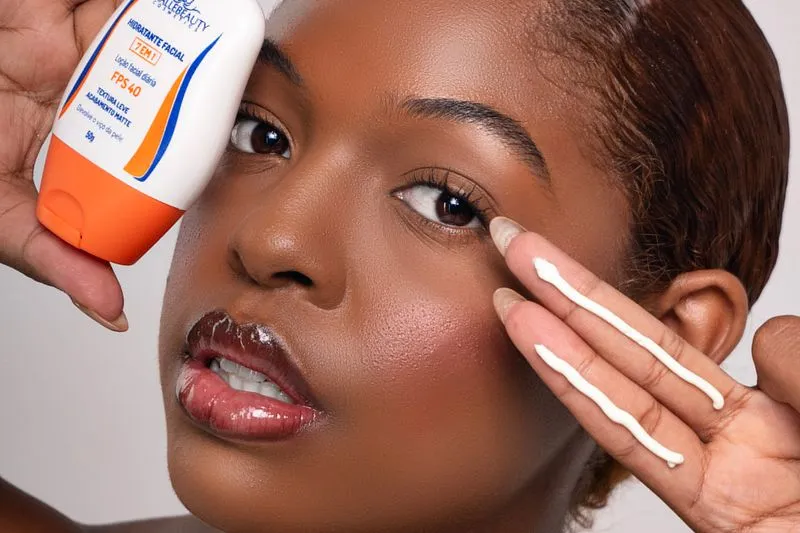
Why SPF is non-negotiable, even behind a window
Ultraviolet (UV) rays age skin early and damage its cells. Two types reach the ground, and they behave very differently:
- UVB: the ones behind sunburn. Window glass stops them.
- UVA: they go deeper into the skin and drive ageing (wrinkles, sagging, pigmentation). According to the World Health Organization, UVA makes up around 95 per cent of the UV reaching the Earth's surface. And it gets through windows. In the car, at a desk by the window, on the train — UVA gets through.
The stakes aren't just cosmetic. Cancer Research UK's 2024 analysis of melanoma cases projected a record 20,800 cases in the UK that year. It also says almost 9 in 10 are caused by too much UV from the sun and sunbeds. That makes melanoma largely preventable. And burning matters: Cancer Research UK notes that getting sunburnt just once every two years can triple the risk of developing skin cancer, compared to never being burnt.
On the anti-ageing side, solid evidence comes from Australia. In a randomised trial published in the Annals of Internal Medicine in 2013, 903 adults under 55 were split into two groups. Daily sunscreen for one. Sunscreen as and when for the other. The result: 24% less skin ageing in the daily group, which showed no detectable increase in skin ageing after four and a half years. For wrinkles, it's the ordinary days that count. I can't name many serums that can say the same (and I say that with love for your serums).
SPF, UVA, UVB, stars — understanding the label
A sunscreen label comes down to three markers: the SPF for UVB, the UVA rating, and "broad spectrum", which covers both.
SPF (Sun Protection Factor)
SPF measures protection against UVB only. In theory, SPF 30 lets you stay in the sun 30 times longer before going red than bare skin. In practice, forget that maths: the NHS is blunt about it — do not spend any longer in the sun than you would without sunscreen.
UVA protection: the stars and the circle
This is where British labels differ. According to the British Association of Dermatologists' sunscreen fact sheet, most sunscreens sold in the UK use a star rating for UVA, from one star up to five. The BAD recommends choosing 4 or 5 stars, with an SPF of 30 or above. You'll also see "UVA" in a circle, which the NHS explains means the product meets the EU standard for UVA protection. Some brands add a PPD figure (persistent pigment darkening), another measure of UVA protection: when it's there, higher is better.
"Broad spectrum"
This means the product protects against both UVA and UVB. It's what you want — and in a UK chemist, the star rating and the UVA circle tell you at a glance.
SPF 30 vs SPF 50: what's the real difference?
The maths is less impressive than the numbers suggest. In the lab, at the test dose, the share of UVB getting through is 1 divided by the SPF:
| SPF | % UVB blocked | % UVB that gets through |
|---|---|---|
| SPF 15 | 93.3% | 6.7% |
| SPF 30 | 96.7% | 3.3% |
| SPF 50 | 98.0% | 2.0% |
| SPF 50+ | 98.0+% | <2.0% |
Between SPF 30 and SPF 50, the gap is only 1.3 points of UVB blocked. Put another way: 3.3% of UVB gets through with SPF 30, 2% with SPF 50 — roughly 40% less. Not nothing. But not the absolute protection the number "50" implies either, and all of this assumes the lab dose, which almost nobody applies in real life.
Practical recommendation:
- Daily city life, little direct sun: SPF 30 minimum with 4 or 5 UVA stars — the NHS floor.
- Beach, hills, sport, a long afternoon in the garden or at the allotment: SPF 50.
- Very fair skin, freckles, you burn every single summer: SPF 50+, no debate.
- Retinol or acid routine (like the one in our round-up of this year's must-know beauty trends): SPF 50, as a precaution. Same goes for a body you've just scrubbed (see our guide to body exfoliation done right).
Chemical vs mineral filter: which to choose?
Chemical or mineral mostly comes down to your skin and how much white cast you can live with. Both protect against UV; what changes is the texture, how your skin tolerates it, and the open questions around some filters.
Chemical (organic) filters
They absorb UV rays and convert them into heat. Examples: avobenzone, octocrylene, Tinosorb S, Tinosorb M, Uvinul A Plus.
Their strength is comfort: lightweight texture, no white cast, generally well tolerated, broad spectrum possible with recent formulas.
Their weak spot: some filters raise open questions. In a randomised study published in JAMA in 2019, 24 volunteers were split between four commercial sunscreens (two sprays, a lotion and a cream), applied under maximal-use conditions. The verdict: blood levels of the filters went above the threshold (0.5 ng/mL) beyond which the US Food and Drug Administration asks for further toxicology studies. The authors saw that as a reason for further studies — not a reason to stop using sunscreen. On the environmental side, some filters are blamed for harming coral reefs, though the evidence is disputed.
Mineral (inorganic) filters
They reflect and scatter part of the UV. Ingredients: zinc oxide (ZnO), titanium dioxide (TiO2).
They're what pharmacy brands reserve for skin that reacts to chemical filters, and they cover a broad spectrum. The trade-off: they often leave a white or greyish cast (especially visible on deeper skin tones). The texture can be thicker. And a poorly made formula can clog pores.
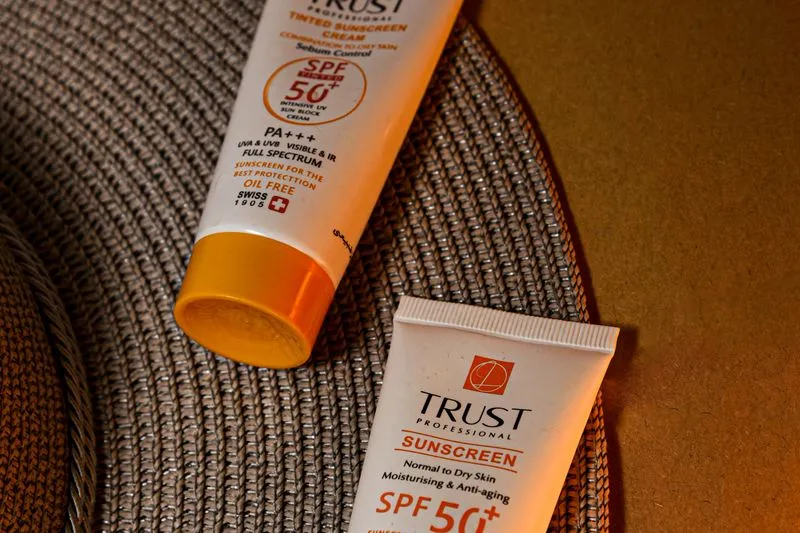
Choosing by skin type
Oily or acne-prone skin
Look for: "oil-free", "non-comedogenic", gel or fluid texture. Water-based gel sunscreens work brilliantly on oily skin. Avoid thick, oil-heavy formulas (some "luxury" SPFs feel more like a night cream than a sunscreen).
Dry skin
Look for: formulas with hydrating actives (glycerin, hyaluronic acid, niacinamide). A nourishing sunscreen can replace your day cream in summer. An SPF 50+ in a cream texture is ideal.
Sensitive or reactive skin
Mineral filters are the first thing to try, fragrance-free and alcohol-free. Avène, La Roche-Posay and Bioderma all have sun ranges built for intolerant skin.
Deeper skin tones (no white cast)
The white cast from mineral SPFs is particularly visible here — and frankly off-putting. Look for tinted formulas or clear chemical filters that leave no residue.
Under makeup
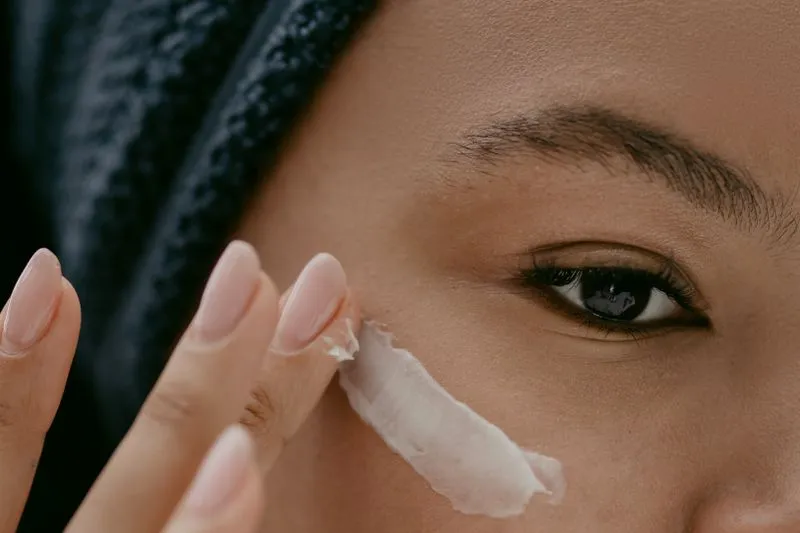
Look for: lightweight, fast-drying, a good base for makeup. Serum or fluid SPFs go on easily under foundation. Give it two or three minutes to settle before you start on your base.
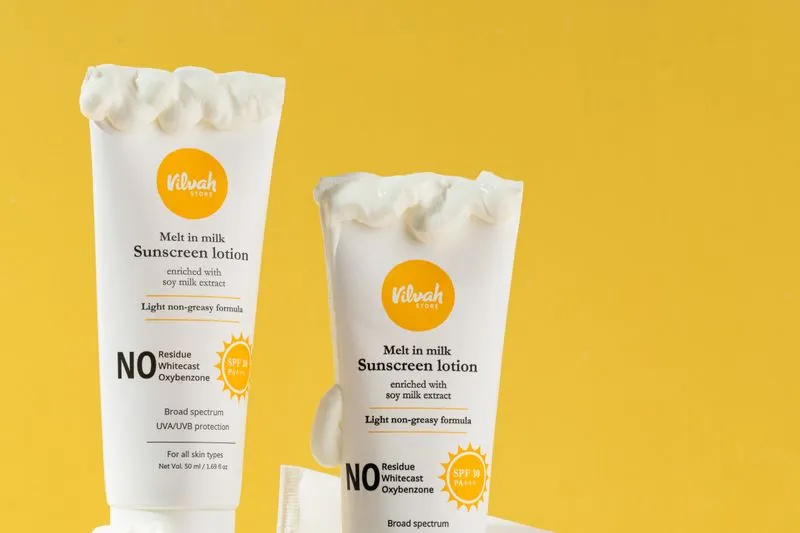
How to apply — the mistakes that cancel your protection
How you apply it matters as much as the number on the bottle. Three mistakes come up again and again, and the first one, quantity, is enough to slash your protection.
Mistake 1: not using enough
SPF is tested at 2 mg/cm² of product — the famous two-milligrams-per-square-centimetre rule. Real life is nowhere near. A 2014 review of sunscreen application, theory versus reality, by two dermatology researchers in Copenhagen, found people apply roughly 0.39 to 1.0 mg/cm². That's between a fifth and half of the test dose — and it cuts the protection considerably. As the NHS puts it, most people do not apply enough sunscreen. Its guide for adults: around 6 to 8 teaspoons of sunscreen to cover your entire body.
Mistake 2: missing areas
The usual suspects: ears, temples, the back of the neck, the backs of your hands and the tops of your feet. Add your décolletage and eyelid margins, and don't forget your lips (an SPF lip balm or stick).
Mistake 3: waiting until you're in the sun
Apply at home, before you go out. The BAD suggests putting it on about 15 to 30 minutes before you head into the sun. The NHS says 30 minutes before, and again just before going out. A first layer smeared on at the park is always too late.
Reapplication: why it's essential
SPF doesn't last all day. It comes off with sweat, sebum, the rub of a collar or a bag strap, and the towel after a swim.
The rule: the NHS guide to sunscreen and sun safety says to reapply every 2 hours. And straight after you've been in water, even if the bottle says "water resistant". It also reminds us that in the UK the sun is strongest between 11am and 3pm from March to October. Petersen and Wulf, the authors of that 2014 review, go further with a simple two-step rule. Apply before sun exposure. Then reapply once within the hour (a way to catch the bits you missed — and make up for the thin first layer).
Day to day, away from windows (office, commute, little direct sun), your morning layer does most of the work. If you're heading out for lunch in the sun or a walk in the park, a top-up is ideal. SPF mists and sticks are perfect for reapplying over makeup.
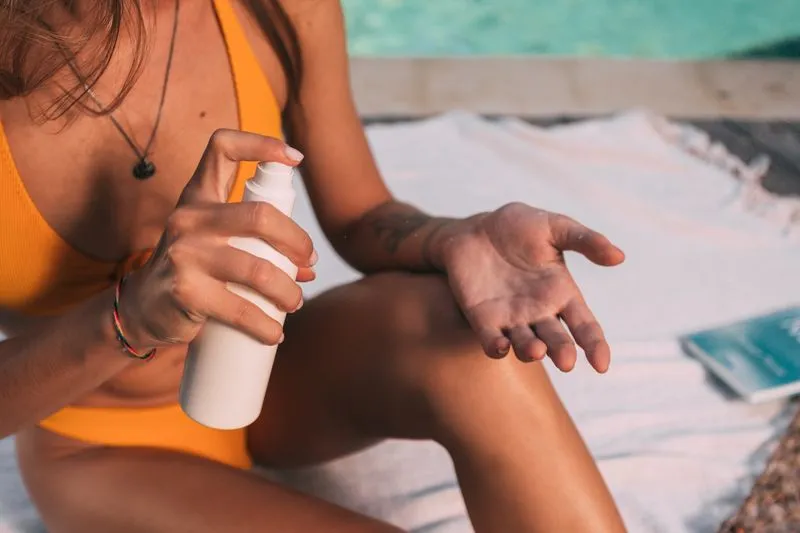
SPF in foundation: why it's not enough
Is the SPF in your foundation enough? No. This is a stubborn beauty myth — and a potentially harmful one. A foundation or moisturiser with SPF 15 or 20:
- Only delivers the stated protection at the lab dose (2 mg/cm²). A normal layer of foundation is nowhere near that.
- Goes on far more thinly than sunscreen. The BAD fact sheet says plainly that the protection you get from an SPF moisturiser is, in reality, much lower than the label (it adds that moisturisers with SPF sometimes only protect against UVB).
- Usually doesn't cover your neck, ears or décolletage.
SPF foundation can add a small top-up of protection. It never replaces a dedicated sunscreen applied generously underneath.
Indoors, cloudy British days, winter: do you still need SPF?
The short answer: yes for UVA, with some nuance.
- Indoors near windows: UVA passes through glass. If you spend several hours a day next to a window, a morning SPF makes sense.
- Cloudy days: the NHS puts it simply — you can burn in the UK, even when it's cloudy. The World Health Organization's questions and answers on ultraviolet radiation go further: light or thin cloud has little effect and can even increase UV levels through scattering. A grey sky is not a filter.
- Winter: UV is weaker in a British winter — but not zero. On a ski trip, everything changes. The WHO says UV levels rise by about 10 per cent for every 1,000 metres of altitude, and fresh snow almost doubles your exposure. SPF 50 belongs in the ski bag, right next to the goggles.
- Tropical destinations: daily SPF is as essential in December as it is in July.
Which sunscreens to look at for your skin type
No ranking, and no partnerships. Just well-known formulas that are easy to find at Boots, Superdrug or Space NK, and that protect against UVA and UVB according to their makers. Prices move from shop to shop (and from offer to offer), so compare before you buy.
Oily or combination skin
- La Roche-Posay Anthelios UVMune 400 Invisible Fluid SPF50+ — fluid texture, no white marks, also comes fragrance-free.
- Altruist Face Fluid SPF50 — the British dermatologist-founded brand, lightweight and easy under makeup.
- Kiehl's Ultra Light Daily UV Defense Aqua Gel SPF 50 — the gel version of the range, for normal to oily skin.
Dry skin
- Avène's SPF 50+ cream — a melting cream texture, with a fragrance-free version (it also claims blue-light protection, but that's not why it's on this list).
- Kiehl's Ultra Light Daily UV Defense SPF 50 — lighter, for skin that's dry without being very dry.
Sensitive or reactive skin
- Bioderma Photoderm Mineral SPF 50+ — 100% mineral filters, designed for skin allergic to chemical filters.
- Avène's mineral fluid SPF 50+ — fully mineral, fragrance-free.
Deeper skin tones (no white cast)
- Fenty Skin Hydra Vizor SPF 30 — designed to stay invisible on every skin tone. It's a moisturiser-sunscreen hybrid, so use it at a full sunscreen dose, not a thin moisturiser layer.
- Supergoop! Unseen Sunscreen — a clear gel with no white cast, stocked by Space NK.
Frequently asked questions
Can you still tan with SPF 50?
Yes — no sunscreen blocks 100% of UV. In the lab, SPF 50 lets through about 2% of UVB, enough for a slow, light tan. But a tan is not protection. Not even a "base tan" before your holiday. The NHS says it clearly: there's no safe or healthy way to get a tan. The "healthy glow" is a myth.
Is expired sunscreen still effective?
Check the little open-jar symbol on the pack: the BAD explains that the number printed in it shows how many months the product can be used once it's been opened. It adds that sunscreens are mixtures of oil and water that tend to separate over time, and that a typical shelf life is 30 months. If last summer's bottle is past its date, or has gone odd (separated texture, strange smell), bin it.
Do you need different SPFs for face and body?
In terms of UV protection, the formula can be the same. In practice, face SPFs tend to be lighter, non-comedogenic and tested on facial skin. Body SPFs are richer or come in bigger bottles for bigger areas. You can use a face SPF on your body (it's just pricier). The reverse isn't ideal if the formula is heavy or comedogenic.
Are spray SPFs as effective as creams?
Yes, provided you use enough. The trap with sprays is misting too lightly, without even coverage. The right method: spray until you can see an even film, then rub it in with your hands. Creams remain the easiest option for your face; sprays come into their own on the body.
Does sunscreen cause spots?
A comedogenic sunscreen, or one that's wrong for your skin, can trigger or worsen breakouts. If you get spots after starting an SPF, switch formulas — don't stop protecting yourself. Water-based gels, light fluids and non-comedogenic formulas are made for oily skin. And in the evening, take it all off properly — our piece on hot or cold water for washing your face explains why water temperature matters for removing SPF and makeup.
Can you use the same SPF in summer and winter?
Yes, with a bit of adjusting. In a British winter, UV is weaker, so SPF 30 can be enough for daily city life (if you spend little time outdoors). In summer or for outdoor activities: SPF 50. Consistency matters more than the exact number — a daily SPF 30 you really wear beats an SPF 50 forgotten half the time.
Can children use the same SPF as adults?
Children's skin needs more care, and sunscreen isn't the first line of defence. The NHS advice: keep babies under 6 months out of direct strong sunlight. For older children, cover up with suitable clothing, spend time in the shade (particularly from 11am to 3pm) and use at least SPF 30. Pharmacy brands make children's ranges — for a baby or toddler, ask your pharmacist or GP.
Is sunscreen bad for the environment?
It's a live debate. In 2018, Hawaii moved to ban sunscreens containing oxybenzone and octinoxate, on the grounds that they increase coral bleaching. But Terry Hughes of James Cook University argues in The Conversation that the evidence is insufficient. His point: the lab studies used far higher concentrations than have ever been measured on a real reef, and bleaching on a global scale is driven by ocean heating. If you're swimming over coral anyway, a UV rash vest cuts down the area you need to cover — good for your skin and for the reef.
Sources
- Hughes MC et al. — "Sunscreen and prevention of skin aging: a randomized trial" — Annals of Internal Medicine (2013)
- Cancer Research UK — Skin cancer cases reach all-time high (May 2024)
- NHS — Sunscreen and sun safety
- British Association of Dermatologists — The sunscreen fact sheet
- The Conversation — Can you get sunburnt or UV skin damage through car or home windows? (February 2025)
- Petersen B, Wulf HC — "Application of sunscreen — theory and reality" — Photodermatology, Photoimmunology & Photomedicine (2014)
- World Health Organization — Radiation: ultraviolet (UV)
- Matta MK et al. — "Effect of Sunscreen Application Under Maximal Use Conditions on Plasma Concentration of Sunscreen Active Ingredients" — JAMA (2019)
- The Conversation — There's insufficient evidence your sunscreen harms coral reefs (February 2019)