
Saturday 17 May, 3.40pm, fitting room four in the swimwear department of a big store on Oxford Street. Rosie, 32, a physio from Walthamstow, has hung six swimsuits on the hook and left her ten-month-old son asleep in his pushchair on the other side of the curtain, with her partner on guard. It's greenhouse-hot in there. It smells of new carpet and a vanilla reed diffuser — and the white ceiling light forgives nothing. First try: a triangle bikini in a 12, her size for as long as she can remember. The bottoms fit perfectly. The top looks like two hankies strung on a washing line — the triangles stop halfway across her bust, and the halter tie starts sawing into her neck after thirty seconds.
Second try — the black swimsuit in a 14, "to be on the safe side". This time the neckline gapes and the leg line cuts into the top of her thighs. Rosie sits down on the little stool, hygiene sticker half peeled off, and texts her partner: "I don't think my body exists in shops." She told me the whole story that evening (screenshot of the text included, obviously). And it is — almost word for word — the sentence I hear most often between late April and early July.
No. Rosie's body exists perfectly well — and it's absolutely fine. What went wrong was the question she was asking the rail: "what size am I?". You don't choose a swimsuit the way you choose a dress. You choose it on three things, in this order. The support your bust needs. The cut that balances your shape (if you want it balanced). Then a size checked with a tape measure — never guesswork. This guide matches each swimsuit style — triangle, bandeau, balconette, one-piece, high-waisted — to your body shape, then shows you how to get the size right when you order online.
Why a swimsuit is harder to choose than a dress
A swimsuit is the only garment that has to stay put wet, in motion, often with nothing adjustable — and it shows everything it fails to hold. A loose dress takes a belt. Long trousers get taken up. A swimsuit that's too big gapes, and one that's too small digs in. There's no in-between — and no cardigan to hide behind.
The second problem: most swimsuits are sold in a single size for top and bottom (10, 12, 14 or S, M, L) — as if your bust and your hips had signed an exclusive contract. And sizes aren't standard from one brand to the next. A 12 in one shop is a 14 in the one next door, and every one of us has a drawer that proves it.
The third problem is sneakier — size charts are built on bodies that have moved on. SizeUK, the UK National Sizing Survey, measured 11,000 women and men with 3D body scanners, and its headline results were announced in 2004. It was the first national survey of UK adults since the 1950s. It found that over 60% of UK shoppers had difficulty finding clothes that fit, and that the average female waist had grown by 16.5 cm since the 1950s. If trousers were already a struggle, imagine a garment with no seams to let out.
A bust measurement on its own tells you nothing about cup size. Two women with the same bust measurement can wear an A cup on a broad back and a D cup on a narrow one — same number, two swimsuits that have nothing in common. That's exactly where tops sold in S, M, L fall apart (and where Rosie's triangle fell apart with them).

Bikini tops: triangle, bandeau, balconette, underwired
The top is where support happens — and it decides whether you spend the summer swimming or readjusting. Each shape has its own mechanics — a triangle hangs from the halter tie, a bandeau from the elastic round your back, a balconette from its cups and underwires. Once you know what carries the weight, you know who the shape is for.
| Top style | Support | Great if… | Watch out for |
|---|---|---|---|
| Sliding triangle. | Light, very adjustable. | Smaller to medium bust, you want freedom. | All the weight goes through your neck. |
| Bandeau. | Low without straps, decent with boning. | Shoulders to show off, smaller bust. | It slides down at the first wave. |
| Balconette, plunge. | Good, structured cups. | Medium to fuller bust, you want shape. | It needs proper cup sizing. |
| Underwired top in bra sizes (34D, 32FF…). | The most solid. | Fuller bust, a bust that has changed. | The wire must sit on your ribcage. |
| Crop, sporty top. | Medium to good, wide elastic band. | Pool lengths, sport, comfort. | Can squash and flatten. |
| Asymmetric, one-shoulder. | Medium. | Breaking up a broad shoulder line. | One strap does all the work. |
The sliding triangle is the most adaptable of the lot: slide the triangles along the bottom string to change the coverage. Perfect on a smaller bust, lovely on a medium one. Beyond that, I'll be blunt — it's not that it's "forbidden", it's that everything rests on the back of your neck. After a full day on the beach, you feel it.
The bandeau frees your shoulders and gives you clean tan lines (no strap marks, joy). Without a detachable strap or boning, it stays up on a small bust — and that's about it. Brilliant for reading by the pool, far less so for jumping in.
The balconette and its relatives (plunge, moulded cups) work like a bra: structured cups, often an underwire, adjustable straps. It's the shape that lifts and supports. It needs real cup sizing, not an "M" that claims to cover everything from 32A to 36DD.
The crop top, finally, rules the local leisure centre. Nothing moves, nothing slips. On a fuller bust, though, a crop without cups tends to squash everything into one shelf (the infamous "uniboob").
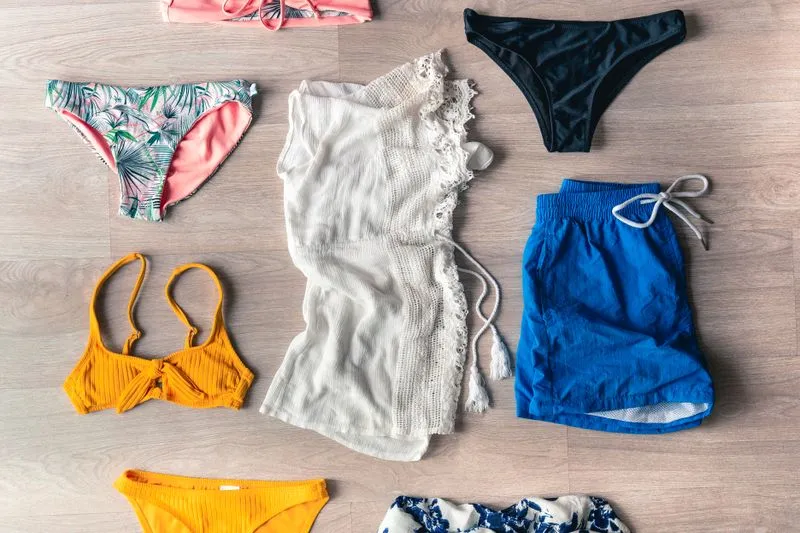
Bikini bottoms: classic, high-waisted, high-leg, shorts
Bottoms come down to two lines: the rise (where they stop on your tummy) and the leg (where they stop on your hips). Everything else — frills, ties, cut-outs — is decoration around those two lines.
- The classic brief: low or mid-rise, medium leg. The most neutral — the one that goes under and with everything.
- The high-waisted brief: it comes up to your belly button or just below. It covers the lower tummy, holds you in if it's lined, and draws a clean waist. With a high-cut leg, it lengthens your legs (hello, eighties).
- The high-leg: the cut rises high on the hip. The higher the line, the longer the leg looks — and the more your hips show, which is a plus or not, depending on what you're after.
- The Brazilian, the tanga: less fabric at the back, purely a matter of taste.
- Swim shorts: they cover the top of the thighs. Anti-chafing, handy for paddleboarding or a run on the sand — but they cut the leg at its widest point if the hem lands badly.
- Tie-side bottoms: adjustable at the hips. My go-to when I'm between two hip sizes.
The high-waisted brief is not a Pinterest invention. The V&A's blog on its swimming costume collection explains that wartime shortages encouraged increasingly revealing two-pieces, and that French designers Jacques Heim and Louis Réard "are often credited with introducing the modern bikini, characterised by its minimal size, in 1946". Heim called his version Atome; Réard's word — taken from Bikini Atoll — is the one that stuck. Today's high-waisted brief? It's roughly what the bikini did away with — the covered belly button. If the history hooks you, I've gathered the clothing revolutions that changed women's fashion in one place.
My view on high-waisted bottoms — they're the most comfortable bottoms in existence for a full day out (no sucking in your tummy as you get up off the towel). There's one condition. They must be lined and high enough not to roll down on themselves when you sit. A high-waisted brief that folds into a sausage under your belly button does exactly the opposite of its job.

The one-piece: high-leg, racerback, shaping or wrap
The one-piece spent years filed under "swimsuits for hiding in". Big mistake. It's the most engineered swimsuit of all — it can define a waist, lengthen a silhouette, support a bust and survive a dive. You just have to pick the right engineering.
- High-leg: legs for days. Ideal on a straighter figure, spectacular on an hourglass.
- Racerback: Y or X back, fixed straps, maximum hold. Built for lengths of the pool.
- Wrap: crossover V-neck, ruching at the waist. It marks the waist where it should and lengthens the torso. In my opinion, it's the one-piece that suits the widest range of shapes, by a mile.
- Shaping: a firmer lining (often called power mesh) holds your tummy. Useful if you like to feel held — as long as it's your size.
- Cut-out (sometimes sold as a trikini): openings at the sides or waist. They create a waist on a straighter figure… and geometric tan lines (you've been warned).
- Underwired one-piece: a top in bra sizes built into a swimsuit body. The best option for a fuller bust that wants a one-piece.
Torso length matters as much as width. A one-piece is a closed loop between your shoulders and your crotch. If your torso is long, the straps drag, the crotch rides up and the swimsuit cuts in — even when the width is right. If your torso is short, the fabric wrinkles under your bust. To fix it, choose adjustable straps, or switch to a bikini (which couldn't care less how long your torso is). A few high street brands also do "long torso" swimsuits — worth hunting down if this is you.

Which swimsuit for your body shape: pear, inverted triangle, rectangle, hourglass, apple
If you're not yet sure which shape you're closest to, start with the guide to working out your body shape in two minutes in front of a mirror: it covers the five markers, from pear to apple. One point — and it matters: these shapes are there to help you choose, not to put you in a box. You can have inverted-triangle shoulders and pear hips. You can also have zero interest in "balancing" anything — and wear exactly what you love.
| Body shape | Tops that work | Bottoms and one-pieces that work | The trap |
|---|---|---|---|
| Pear (hips wider than shoulders). | Balconette, frilled bandeau, colour or print on top. | Plain, dark bottoms with a slight high leg; one-piece with an interesting neckline. | Swim shorts that cut the thigh at its widest. |
| Inverted triangle (shoulders wider than hips). | Thin-strap triangle, V-neck, plain top. | Printed, frilled or tie-side bottoms; patterned high-waisted brief. | A straight bandeau that widens the shoulder line. |
| Rectangle (shoulders, waist and hips aligned). | Frilled bandeau, triangle, centre-knot top. | Cut-out one-piece, wrap style, tie-side bottoms. | A straight one-piece with no detail at all. |
| Hourglass (clearly defined waist). | Balconette, structured top. | High-waisted brief, belted or wrap one-piece. | A loose tankini that erases the waist. |
| Apple (fullness around bust and tummy). | Cup-sized top, wide straps, V-neck. | Ruched or draped one-piece, tankini, lined high-waisted brief. | A too-small shaping suit that rolls. |
Pear: you draw the eye upwards — a light, printed or frilled top, with simpler bottoms. A slight high leg lengthens the leg without emphasising the hip. Inverted triangle: the opposite — a simple top with thin straps or a plunging neckline, and volume or pattern below. That's where frilled bottoms become your best friend.
Rectangle: you create the curve the swimsuit won't find on its own — cut-outs at the waist, a wrap, ties on the hips. Hourglass: follow the line. A balconette with a high-waisted brief? That's the pin-up silhouette — and it was made for you. Apple: you want support up top and softness through the middle — a one-piece ruched over the tummy, a lengthening V-neck, or a tankini (long top, separate bottoms) if you'd like to go to the loo without fully undressing. Not a small detail on a packed beach.
Support first: smaller busts, fuller busts
Smaller bust: you have the widest choice — and that's real freedom. Triangle, bandeau, crop, frilled top: everything stays put. If you want volume, look for removable pads (which you can take out to swim) or frills, which add shape without padding. Just watch out for moulded cups that are too big and leave a hollow above your bust as soon as you lean forward.
Fuller bust: your cup size decides, not your dress size. A top sold as an "L" is trying to cover a back size and a cup depth at the same time — it will miss one of them. Head for swimwear cut like lingerie (34DD, 36F, 32G…), with underwires, wide straps and an underband firm enough to carry the weight. Several lingerie brands make swimwear on the same fits as their bras — Panache, Freya, Fantasie and Curvy Kate among them — so your bra size becomes your starting point.
The fitting-room test costs nothing. Raise both arms above your head. Bend forward as if to pick up a towel. Jump twice on the spot (yes, in the fitting room, nobody's watching). If your bust escapes underneath, the wire lifts or the band rides up at the back, the top isn't your size — whatever the label says.

Swimwear after pregnancy: when your top and bottom stop matching
After a pregnancy, your bust and tummy change size without your hips following suit: that's Rosie's story, and it's completely ordinary. The NHS page on your body after the birth puts it plainly: "After delivery, your tummy will probably still be a lot bigger than before pregnancy." It adds that this is partly because your muscles have stretched. On the bust side, the same page notes that breasts can feel tight and tender when your milk comes in, and that "Wearing a supportive nursing bra may help." Swap "bra" for "bikini top" and the principle holds — support that fits the bust you have now.
In practice, in the months after a birth, a swimsuit sold in one size can't keep up with that gap between top and bottom. Three options, which ask nothing of you except dressing for the body you have this spring:
- Bikinis sold as separates, so you can buy the top in your current cup size and the bottoms to fit your hips.
- A tankini or a lined high-waisted brief, if you'd rather have your tummy covered and held, without compression.
- Nursing swimsuits, with cups that unclip or pull aside, if you're still breastfeeding and don't want to undress at the poolside.
For the record, Rosie walked out with a balconette top in her bra size and high-waisted bottoms in a 12, from two different brands. The black swimsuit "to be on the safe side" stayed on its hanger. She's off to Cornwall in mid-July, and she's promised me a photo — taken from behind, facing the sea.
Checking swimsuit sizes online before you order
Ordering swimwear online means buying without a fitting room. With five minutes of method, you rule out most of the nasty surprises. Here's the order I work in, every time.
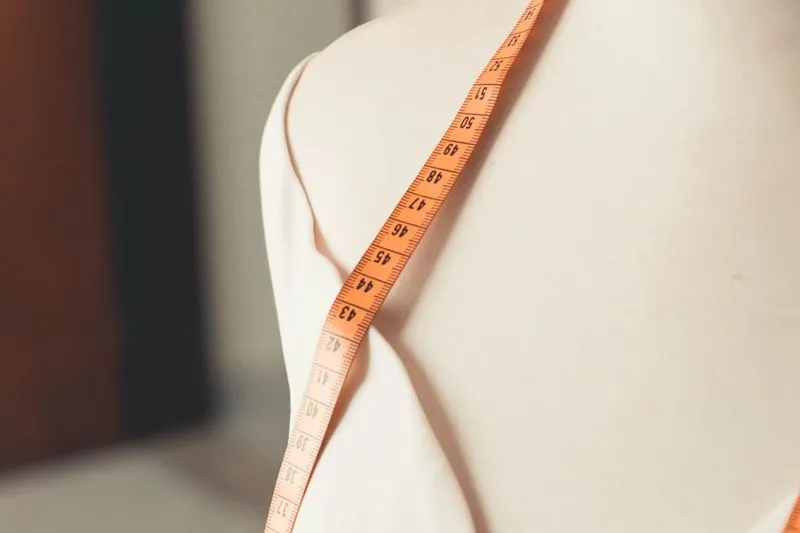
- Measure yourself in your underwear, tape flat, without pulling tight: bust at the fullest point, underbust just below your breasts (snug, this one), waist at the narrowest, hips at the widest. In front of a mirror, to check the tape stays level across your back. Redo them every spring: bodies move faster than size charts.
- Open the brand's own size guide. Every brand sizes its own way — and generic conversion charts are a rough guide at best.
- Choose top and bottoms separately: the top on your bust, the bottoms on your hips. For a one-piece, go with the larger of the two and check the straps adjust.
- Read the product page like a contract: the model's height and the size she's wearing, whether it's lined, removable pads or not, adjustable straps, the level of support claimed.
- Read the fibre content. Under the textile labelling rules that still apply in Great Britain, the fibre composition must be "clearly visible to the consumer before the purchase, including in cases where the purchase is made by electronic means". No composition on the page, no sale from me.
- Read the reviews looking for your shape: "runs small", "runs large", "bust", "long torso". Three reviews saying the same thing beat a star rating.
- Check the returns policy before you pay. Return costs, deadline, condition required: it's all written down — you just have to read it.
Returning swimwear bought online: your rights in the UK
Swimwear bought online can be returned like any other clothing. Citizens Advice explains the 14-day cooling-off period: it starts the day after you receive your order, and nothing needs to be wrong with the item for you to get a refund. Once you've told the seller, you have another 14 days to send it back. The refund is due within 14 days, counted from the day after the seller receives the item or your proof of postage, whichever comes first. Standard delivery is refunded too; if the seller never told you who pays for return postage, they have to cover it.
And hygiene? The law does carve out an exception. Regulation 28 of the Consumer Contracts Regulations 2013 ends the right to cancel for "sealed goods which are not suitable for return due to health protection or hygiene reasons, if they become unsealed after delivery". If your swimsuit arrives in a sealed bag, opening it can cost you the right to cancel; otherwise, it's the hygiene liner stuck in the bottoms, plus the shop's own returns policy, that set the rules for trying on.
Fabrics, prints and care: what makes a swimsuit last
You also judge a swimsuit by its label. Most combine nylon (polyamide) or polyester with elastane, the fibre that gives it stretch. It wasn't always so. The same V&A collection notes point out that wool was usually the fibre of choice in the nineteenth and early twentieth centuries, and that highly elastic, durable swimsuits were widely available by the 1970s — so much so that, "thanks largely to nylon/elastane", numerous swimming records were broken at the 1972 Olympics. Grateful, frankly. Above all, check the lining — an unlined pale swimsuit goes see-through when wet, and unlined high-waisted bottoms hold nothing in. Ribbed, textured or crinkled fabrics are more forgiving than smooth, shiny jersey, which picks out every contour (including the seam of your knickers, hence trying it on over them… and wearing it without).
For prints, the rule is simple — and optical: a pattern draws the eye, a dark block lets it slide past. Put the pattern where you want people to look. Small, dense prints read like a plain colour, huge motifs take over the whole space. And horizontal stripes mainly widen when they're broad and high-contrast — on a V-neck top, they do their job beautifully.
My care routine comes down to four habits, and they're also what most of the care labels I've read say. Rinse in clean water after every swim (salt, chlorine and sun cream left to dry are a slow death for the fabric). Hand wash, cold. Never wring it — press it in a towel instead. Dry it flat, in the shade, never in the tumble dryer or on a radiator. Looked after like that, a swimsuit lasts several summers instead of one.
And if longevity is on your mind, swimsuits made from recycled nylon now exist across very different price points. I've looked at affordable ethical fashion brands and what they're really worth to help you sort through them. The most responsible swimsuit is still the one you wear five summers in a row — because it truly fits.
Frequently asked questions
Which swimsuit is best if I want to cover my tummy?
It depends on how you want to feel. For a tummy that's covered and held without compression, lined high-waisted bottoms or a tankini work very well. For a smoother look, a one-piece that's ruched or draped over the tummy uses the folds of the fabric rather than squeezing. A shaping suit? An option — as long as you buy it big enough to breathe sitting down.
Triangle or balconette for a smaller bust?
Both work. A triangle looks natural and adjusts in coverage; a balconette, with or without pads, adds shape. If you want volume without padding, frills and knots do the job nicely. Just check the cup doesn't gape when you lean forward.
Should I buy the same size in swimwear as in lingerie?
For a top sold in bra sizes, your bra size is a good starting point, to double-check against the brand's size guide. For a top sold in S, M, L, there's no reliable equivalent: start from your measurements (bust and underbust) and compare them with the brand's chart.
Does a one-piece suit every body shape?
Yes, as long as you pick the right cut: wrap to define the waist, high-leg to lengthen the legs, cut-outs to create a curve, underwired to support a fuller bust. Its only real limit is torso length. If the straps drag or the crotch rides up, look for adjustable straps or a long-torso style, or switch to a bikini.
How can I tell if my swimsuit is too small?
It digs in (elastic biting into your hips or back), it rides up when you walk, the underwire presses on your bust instead of sitting on your ribcage, or you have to hold your tummy in to feel comfortable. One of these signs is enough — go up a size.
Can I return a swimsuit I bought online?
Yes. You have a 14-day cooling-off period starting the day after delivery, then another 14 days to send it back once you've told the seller, and the refund is due within 14 days of them receiving it or your proof of postage. Try it on over your knickers without removing the hygiene liner or tags, and read the shop's returns policy before you order.
Do high-waisted bikinis make petite women look shorter?
Not if they're cut high on the leg: a high-cut side lengthens the leg and balances out the high rise. What shortens a petite frame is a high-waisted brief with a low, straight leg that cuts the thigh horizontally. Go for a high leg, in a plain colour or a small print.
Sources
- Sizemic — SizeUK, the UK National Sizing Survey (survey data overview)
- legislation.gov.uk — Regulation (EU) No 1007/2011 on textile fibre names and labelling, Article 16
- Citizens Advice — Changing your mind about something you've bought
- legislation.gov.uk — The Consumer Contracts (Information, Cancellation and Additional Charges) Regulations 2013, regulation 28
- V&A Blog — The Twelve Days of Christmas at Clothworkers': Seven Swimming Costumes (2018)
- NHS — Your body after the birth (reviewed April 2024)