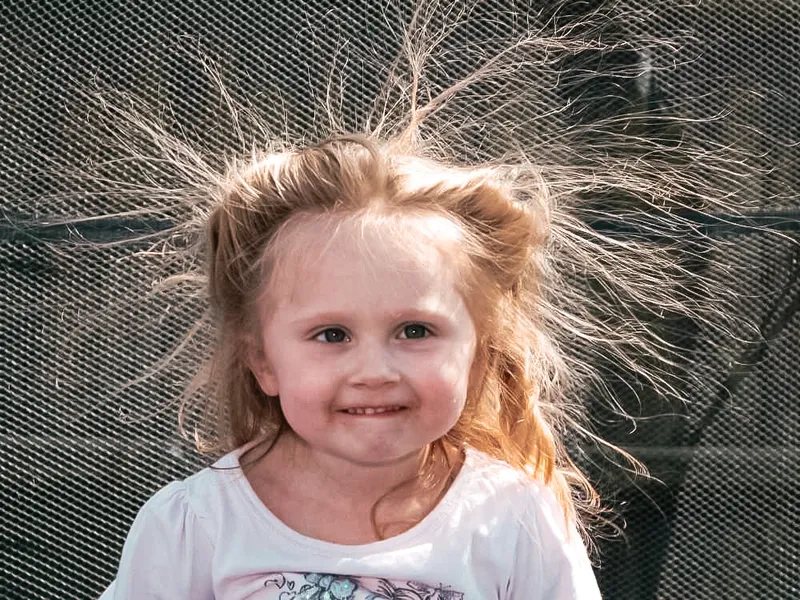
There's a particular kind of humiliation reserved for winter mornings: you've spent twenty minutes getting your hair exactly right, you step outside, pull on your scarf, and by the time you reach the office every single strand is floating in a different direction like you're auditioning for a Tim Burton film. Static hair isn't dangerous, it's not a sign of damage (necessarily), and it's not permanent — but it is incredibly, consistently annoying. And the usual advice of "just use conditioner" barely scratches the surface of what actually works. So let's go deeper.
Why hair goes static: the physics you never asked for
Static hair is, at its core, a physics problem — specifically, an imbalance of electrical charge. Every object carries both positive and negative charges in its atoms. When two surfaces rub together (your hair against a hat, a pillow, a scarf, a jumper), electrons transfer from one surface to the other. This is called triboelectric charging, and it's the same phenomenon that lets you rub a balloon on your head and stick it to a wall.
Human hair sits high on the triboelectric series — meaning it tends to lose electrons easily, becoming positively charged. When multiple hair strands all carry the same positive charge, they repel each other (like two magnets with the same pole facing). The result is that floating, fanning-out effect we know and despise.
Several factors amplify this effect dramatically:
Low humidity. This is the big one. Water molecules in the air act as natural conductors, allowing excess charge to dissipate from your hair into the atmosphere. When humidity drops below 30–40% — which happens routinely in winter, in air-conditioned offices, and on aeroplanes — there's nowhere for the charge to go. It accumulates, and your hair starts staging a rebellion.
Damaged cuticle. Healthy hair has a smooth cuticle layer that reduces friction during contact with other surfaces. Damaged hair has a rough, lifted cuticle that creates more friction, generates more charge transfer, and holds onto that charge longer because the rougher surface has more contact points. If your hair is dry and damaged, it's exponentially more prone to static.
Fine hair texture. Thinner individual strands have less mass relative to surface area, making them more susceptible to the repulsive force between charged strands. Fine hair literally lifts more easily because each strand weighs less. Coarse, thick hair can carry the same charge but stays put through sheer weight.
What makes static hair worse (you're probably doing several of these)
Before we get into fixes, let's identify the behaviours and conditions that actively make static worse. You might be unknowingly creating the perfect storm.
Over-washing. Every time you shampoo, you strip away sebum — your scalp's natural conditioning oil. Sebum coats the hair shaft, reducing friction and helping to conduct away excess charge. Washing daily (especially with sulfate-heavy shampoos) leaves your hair stripped of this natural anti-static layer. If you're washing every day and wondering why your hair is electric by noon, that's your answer.
Skipping conditioner. Conditioner deposits a thin film of cationic (positively charged) surfactants onto the hair surface, which smooth the cuticle and reduce triboelectric charging during contact with other surfaces. Skipping it — especially in winter — removes one of your most effective defences.
Plastic combs and brushes. Plastic is near the opposite end of the triboelectric series from human hair. When a plastic comb runs through your hair, it creates one of the most efficient electron-transfer scenarios possible. Every stroke literally charges your hair further. Switching to a wooden comb or natural bristle brush can reduce static by 60–80% — it's one of the single most impactful changes you can make.
Central heating. Radiators and forced-air heating systems dry out indoor air dramatically. A heated room in winter can drop below 20% relative humidity — drier than the Sahara. Your skin, lips, and hair all suffer. If you don't have a humidifier, you're fighting static with one arm tied behind your back.
Synthetic fabrics. Polyester, nylon, and acrylic are all excellent at generating triboelectric charge against hair. That cozy fleece pullover? It's essentially a static electricity generator. Wool is slightly better but still problematic. We'll cover fabric choices in detail later.
Emergency fixes: tame flyaways in 30 seconds
Sometimes theory doesn't matter — you need your hair to stop floating right now. These are the fastest fixes, ranked by effectiveness:
1. Dryer sheet. Keep one in your bag. Run it lightly over your hair, and the anti-static agents (quaternary ammonium compounds) in the sheet neutralise the charge almost instantly. It sounds absurd. It works absurdly well. One sheet lasts multiple uses — just fold it and tuck it back in your pocket. This is the single fastest fix available.
2. Hand cream or moisturiser. Rub a tiny amount between your palms and smooth them over the surface of your hair. The moisture and oils in hand cream add weight and conductivity to the hair surface, killing the static. Don't use too much or you'll end up looking greasy — a pea-sized amount for shoulder-length hair is plenty.
3. Water mist. Mist your hair lightly with water from a spray bottle. The water molecules immediately increase surface conductivity, allowing the charge to dissipate. The effect is temporary (it'll return as the water evaporates), but it buys you 30–60 minutes. Adding a drop of leave-in conditioner to the spray bottle extends the effect significantly.
4. Metal touch. This one's more about prevention: before touching your hair, touch a metal object (doorknob, railing, keys) to discharge any static from your hands. Then smooth your hair with your now-neutral hands. This is especially useful after removing a hat or scarf.
5. Hairspray. A light mist of hairspray creates a film on the hair surface that prevents electron transfer. It's a decent fix but leaves residue that needs washing out. Use a light-hold formula — heavy hairsprays can leave hair crunchy, which trades one problem for another.
Daily prevention: products and habits that keep static at bay
Emergency fixes are useful, but the real goal is not needing them. These daily habits and product choices prevent static from developing in the first place.
Switch to a sulfate-free shampoo. Sulfates (SLS, SLES) are aggressive detergents that strip natural oils far more thoroughly than necessary. A gentler, sulfate-free formula cleans effectively while preserving more of the sebum layer that protects against static. This single change makes a bigger difference than any anti-static spray.
Use a leave-in conditioner. After washing, apply a lightweight leave-in conditioner or detangling spray to damp hair. This maintains a conditioning layer throughout the day — unlike rinse-out conditioner, which gets partly removed during towel-drying and styling. Focus on mid-lengths to ends, where hair is oldest and most porous.
Apply a few drops of hair oil. Argan oil, jojoba oil, or a dedicated hair serum smooths the cuticle, adds weight to fine flyaways, and creates a slightly conductive layer that prevents charge buildup. Two to three drops warmed between your palms and applied to dry hair, avoiding the roots. More than that risks greasiness — less is genuinely more here.
Deep condition weekly. A weekly deep-conditioning mask (10–15 minutes under a warm towel) repairs cuticle damage and restores the smooth surface that resists triboelectric charging. If your hair is colour-treated or heat-damaged, this is non-negotiable during winter months. Look for masks containing ceramides, which literally fill in cracks in the cuticle like grout between tiles.
Invest in a humidifier. This is the infrastructure play. A cool-mist humidifier in your bedroom (running overnight while you sleep) keeps ambient humidity at 40–50%, which is the sweet spot for both skin health and static prevention. Your hair, your skin, your sinuses, and your wooden furniture will all thank you. Aim for a model that covers at least 30–40 square metres — the small desktop ones are basically decorative.
Sleep on silk or satin. Cotton pillowcases create friction against your hair all night long — eight hours of continuous triboelectric charging. Silk and satin have much smoother surfaces that generate dramatically less static. They also reduce mechanical damage (friction breakage and frizz) as a bonus. A silk pillowcase is one of those rare purchases where every claimed benefit is actually real.
Styling tools that fight static (and ones that cause it)
Your tools can be your biggest allies or your worst enemies. Here's the breakdown:
Ionic blow-dryers. These emit negative ions during operation, which neutralise the positive charge on hair strands. The result is faster drying (ionic technology helps water molecules break apart and evaporate more efficiently), less frizz, and dramatically less static compared to conventional dryers. If you blow-dry regularly, upgrading to an ionic dryer is one of the best investments you can make. BaByliss, Dyson, and GHD all make excellent ionic models.
Ceramic and tourmaline flat irons. These plates emit negative ions when heated, similar to ionic blow-dryers. They also distribute heat more evenly than metal plates, reducing hotspot damage that roughens the cuticle. If you straighten your hair, a good ceramic iron with adjustable temperature is essential — both for maintaining your smoothing results and for preventing static.
Natural bristle brushes. Boar bristle brushes are the gold standard for static-prone hair. Natural bristles sit closer to hair on the triboelectric series, generating far less charge transfer than plastic or nylon. They also distribute sebum from roots to ends with each stroke — natural conditioning that reduces both dryness and static. Mason Pearson is the classic (and yes, expensive) choice, but Denman and Kent make excellent alternatives at lower price points.
Wooden combs. Same principle as natural bristle brushes — wood generates minimal triboelectric charge against hair. Wide-tooth wooden combs are particularly good for detangling wet hair without creating static. Sandalwood and neem wood combs also have the bonus of leaving a subtle, pleasant scent.
What to avoid: plastic brushes and combs (especially fine-tooth plastic combs), metal brushes (these conduct charge directly into hair), and any brush with rough or damaged bristles that creates extra friction. If your brush has any broken or split bristles, replace it — those damaged tips snag on the cuticle and generate significantly more static.
Fabric choices: the clothing factor nobody talks about
This is the most underrated factor in static hair. Your clothing is in constant contact with your hair — especially collars, scarves, hats, and hoods — and the fabric's position on the triboelectric series determines how much charge transfer occurs.
Worst offenders:
- Polyester — the single worst fabric for hair static. It sits at the extreme negative end of the triboelectric series, creating maximum charge differential with positively-charged hair
- Nylon — almost as bad as polyester, and commonly used in winter hat linings
- Acrylic — cheap, warm, and a static nightmare. Those affordable acrylic beanies are basically flyaway generators
- Fleece — which is just brushed polyester, combining the worst triboelectric properties with maximum surface friction
Better alternatives:
- Cotton — nearly neutral on the triboelectric series, generating minimal charge
- Silk — low friction, minimal charging, and the smoothest surface of any natural fabric
- Cashmere — slightly better than regular wool for static, and far softer against hair
- Bamboo fabric — naturally anti-static, moisture-wicking, and increasingly available in hats and scarves
If you love your polyester coat but hate the static, here's a compromise: line the collar area with a silk scarf or cotton bandana that sits between the synthetic fabric and your hair. This creates a buffer that dramatically reduces charge transfer. You can also treat synthetic garments with anti-static spray (sold in most supermarkets near the laundry products) — one application lasts several washes.
For hats specifically, look for silk-lined options. Several brands now make wool or cashmere beanies with silk linings specifically marketed for hair health — they're more expensive, but they completely eliminate the hat-removal static explosion that haunts every winter commute.
Your seasonal anti-static strategy
Static is primarily a cold-weather problem, but it can strike year-round in air-conditioned environments. Here's a season-by-season approach:
Autumn (preparation phase). Start deep conditioning weekly as humidity begins to drop. Switch to a richer conditioner if your summer formula was lightweight. Get a hair botox treatment — the sealed cuticle provides excellent static resistance for 6–8 weeks, carrying you into the worst of winter. Set up your bedroom humidifier before you need it, not after you're already dealing with dry skin and flyaways.
Winter (maximum defence). This is when you need the full arsenal: sulfate-free shampoo, leave-in conditioner, hair oil, silk pillowcase, humidifier running nightly, natural bristle brush, and strategic fabric choices. Wash your hair less frequently (every 2–3 days maximum). Keep a dryer sheet in your coat pocket for emergencies. If you wear a hat daily, invest in a silk-lined one — you'll recoup the cost in saved styling time within a week.
Spring (transition). As humidity rises, you can scale back. Drop the hair oil to once or twice a week instead of daily. You can return to a lighter conditioner. The humidifier becomes less necessary as outdoor humidity climbs above 40%. But maintain the good habits you've built — your hair's general health benefits year-round.
Summer (maintenance mode). Static is rarely a problem in summer unless you live or work in heavily air-conditioned spaces. If you spend eight hours a day in aggressive AC (offices, cars, aeroplanes), treat those environments like indoor winter — leave-in conditioner, hair oil, and consider a small desk humidifier. Otherwise, your focus shifts from static to UV protection, chlorine damage, and salt water — different problems, different solutions.
Frequently asked questions
Why does static hair happen more in winter?
Cold air holds less moisture than warm air, and heating systems dry out indoor environments further. When relative humidity drops below 30–40%, there aren't enough water molecules in the air to conduct away the electrical charge that builds up on your hair through friction. The charge accumulates, strands repel each other, and you get flyaways. It's physics, not bad luck.
Does hair type affect how much static you get?
Yes, significantly. Fine hair is most susceptible because individual strands weigh less and lift more easily. Dry, damaged, or colour-treated hair is also more prone because the rough cuticle surface creates more friction and charge transfer. Coarse, thick, naturally oily hair tends to resist static better — the weight of each strand and the natural sebum coating both work against charge buildup.
Can anti-static sprays damage hair?
Most commercial anti-static hair sprays are silicone-based and won't damage hair with normal use. However, heavy daily use without proper washing can lead to silicone buildup — a coating that prevents moisture and nutrients from reaching the hair shaft. Use them as an occasional tool, not a daily crutch, and clarify your hair once a week if you rely on them frequently.
Is the dryer sheet trick safe for hair?
The quaternary ammonium compounds in dryer sheets are the same class of ingredients used in many hair conditioners, so occasional use is generally safe. However, some dryer sheets contain added fragrances and chemicals that could irritate a sensitive scalp with prolonged direct contact. Use it as a quick surface pass over flyaways, not as a leave-in treatment rubbed directly into your scalp.
Will cutting my hair shorter reduce static?
Somewhat. Shorter hair weighs relatively more per length (it hasn't been subjected to as many months of damage) and is less likely to contact clothing surfaces like collars and scarves. But the primary drivers of static — humidity, cuticle condition, and fabric choices — don't change with a haircut. Cutting won't solve the problem on its own, but it can reduce its severity.
Sources
Keep on bubbling
- How to repair dry, damaged hair — fix the root cause of frizz and static
- Hair botox: is it worth it? — a deep-conditioning solution for winter hair
- Tips to keep your smoothing all day long — maintain sleek hair in any weather