Sunday 30 March, the day the clocks went forward: first beer-garden afternoon of the year, round the corner from my flat, and the first skirt without tights. Jumper off, sleeves up, legs crossed — and a pair of chalky, flaky shins that had dropped out of my routine the day the tights went on in October (we've all been there).
You might have a face routine down to a fine art: your skin type, your favourite serum, the difference between AHA and BHA (and if the order still trips you up, I've laid out every step of a face routine in the right order). But your body? Your body gets a quick squirt of shower gel and a layer of lotion when you remember. Which is roughly once a week. In winter. When it starts to feel tight. Your body deserves better than that, and the end of March is the moment to sort it out.
Body skin takes friction from clothing, central heating, shaving, the gym — and yet it almost always comes second to your face. This guide covers the lot, head to toe, zone by zone: cleanse, moisturise, exfoliate, protect.
Why your body deserves a proper routine
Body skin ages too, and UV does a lot of that work. One detail from the British Association of Dermatologists' sun protection fact sheet matters for your body lotion: moisturisers with an SPF "may not contain any UVA protection and as a result will not protect against UV ageing". So the SPF 15 body lotion on your arms is not doing a sunscreen's job. The zones your clothes stop covering first in spring (shoulders, forearms, the backs of your hands, your chest) are the same ones people rarely think to look after.
In practice, body skin left to its own devices looks like this:
- shins that turn chalky and flaky by the end of winter;
- small rough bumps on the backs of your arms (keratosis pilaris, more on that below);
- heels that snag your tights;
- a chest and backs of hands that give away every summer spent without sunscreen.
The good news: it doesn't take much. An effective body routine takes about ten minutes a day.
The shower as a foundation (not just cleaning)
A warm (not hot) shower and a gentle wash: that's the base, and two very common mistakes undermine it.
Mistake 1: water that's too hot
A hot shower feels wonderful — especially on a grey March morning before the heating has kicked in. The catch: it strips away part of the surface lipids — the ones that keep water in your skin. The result is skin that feels tight and dries out faster. I've gone into what hot water actually does to your skin barrier for the face, and the same logic applies to your body. Warm, not scalding. And not twenty minutes under the spray.
Mistake 2: a shower gel that's too harsh
A very foamy, heavily scented shower gel does its job as a detergent — sometimes too well on skin that's already dry. The gentler options are cream washes, soap-free cleansers and shower oils. And if your skin reacts to everything, go fragrance-free — it's the first ingredient to drop when skin is sensitive.

Drying technique
Pat (don't rub) with your towel. Rubbing irritates sensitive skin — and takes away the moisture you're trying to keep. Pat dry, leave a little dampness, and go straight in with your moisturiser.
Body moisturising: humectants, emollients, occlusives
Moisturising straight after the shower is the basic move. But not all moisturisers are equal — and the formula matters as much as how often you apply it. Dermatologists sort moisturising ingredients into three families, which the 2016 review "Moisturizers: The Slippery Road" in the Indian Journal of Dermatology describes one by one.
Humectants
They draw water into the upper layers of the skin. Key ones: glycerin (which the review calls the most effective humectant), urea, hyaluronic acid, lactic acid. You'll find them mostly in lightweight lotions. Ideal for normal to combination skin.
Emollients
They soften and smooth the skin's surface. Mostly lipids: ceramides, shea butter, squalane, fatty acids. More nourishing than humectants alone — and they're what gives skin that supple feel under your hand.
Occlusives
They form a film that slows water evaporating through the skin. Key ones: petroleum jelly, mineral oil, beeswax, lanolin. According to the same review, petroleum jelly at a concentration of just 5% cuts that water loss by more than 98%. That's why occlusives are so valuable on very dry skin and high-friction areas.

For normal skin: a glycerin or urea lotion (up to 10%) after the shower is enough. For very dry skin: a humectant first, an occlusive on top. Body oil (sweet almond, jojoba, squalane) goes on while your skin is still a little damp — the review says as much for occlusive oils, to be applied after patting yourself dry out of the bath.
Exfoliation: when, how, and why not too much
Once or twice a week, no more: body exfoliation makes a real difference to skin texture — I've written a full guide to body exfoliation, techniques and mistakes included. Here, it's just one step in the routine. And "more is better" does not apply.
Mechanical exfoliation (scrubs)
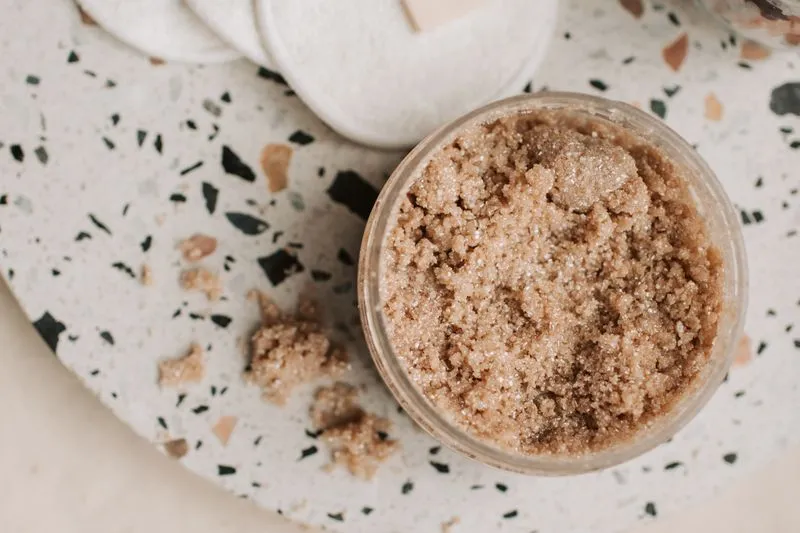
A DIY sugar-and-oil scrub, an exfoliating mitt, a soft body brush. Effective and cheap. Once or twice a week at most, on wet skin, with light pressure. Grains that are too big or jagged (crushed apricot kernels, for instance) irritate more than they smooth.
Chemical exfoliation
AHAs (glycolic acid, lactic acid) in a formula made for the body: lotion, gel or body wash. Gentler than a hard scrub — and particularly useful on rough areas like the backs of your arms or your bottom. Start with every other evening, and never on the same day as a scrub.
One thing not to skip in spring: AHAs make your skin more sensitive to the sun. The US Food and Drug Administration's guidance on labelling cosmetics that contain alpha hydroxy acids recommends a "Sunburn Alert" on the label, warning that the product "may increase your skin's sensitivity to the sun and particularly the possibility of sunburn", and telling you to use sunscreen, cover up and limit sun exposure while you use it and for a week afterwards. Treat the area at night — and put SPF on it in the morning whenever it's out.
Body care zone by zone: neck, back, chest, stomach, bottom, legs
Different parts of your body have different needs. Here's what changes, head to toe. Hair is a subject in its own right, with its own guide: a realistic plan for repairing dry, damaged hair.

Neck and back
Your neck gets the same care as your face, SPF included. Your back is the zone you can't reach: a moisturising spray or mist, or a long-handled applicator to spread your cream, and SPF whenever it's uncovered. Shoulders and upper back are hard to reach on your own — which makes them easy to miss.
Décolletage and chest
Thin skin, often in the sun, quick to show it. The simplest fix: take your face products down to your chest — SPF included, in the morning. At night, a richer cream will do.
Stomach and flanks
Prime territory for stretch marks. Massaging in an oil every day feels lovely and makes skin feel softer — but don't expect it to prevent or erase stretch marks. The NHS page on stretch marks is blunt: "Many creams and lotions claim to prevent, reduce or remove stretch marks. But there's very little evidence these work." The same page notes that stretch marks "usually fade over time but may not disappear completely", that laser treatments aren't available on the NHS, and that "you should not use retinoid creams if you're pregnant as they may harm your baby". If the massage makes you feel good, keep it for that.
Bottom
Often forgotten, and prone to keratosis pilaris and ingrown hairs. A gentle chemical exfoliant and a urea cream keep the skin smooth — without scrubbing like you're cleaning a roasting tin.
Legs
Friction from jeans, shaving or waxing: legs take a beating. Moisturiser after every shave (skin always comes out a bit raw), and SPF whenever they're out in the sun. Yes, even for an afternoon in a pub garden.
Hands and feet: the zones routines forget
Your hands take everything: water, soap, cold, sun on the steering wheel or the handlebars. And yet most routines stop at the wrist.
Hand routine
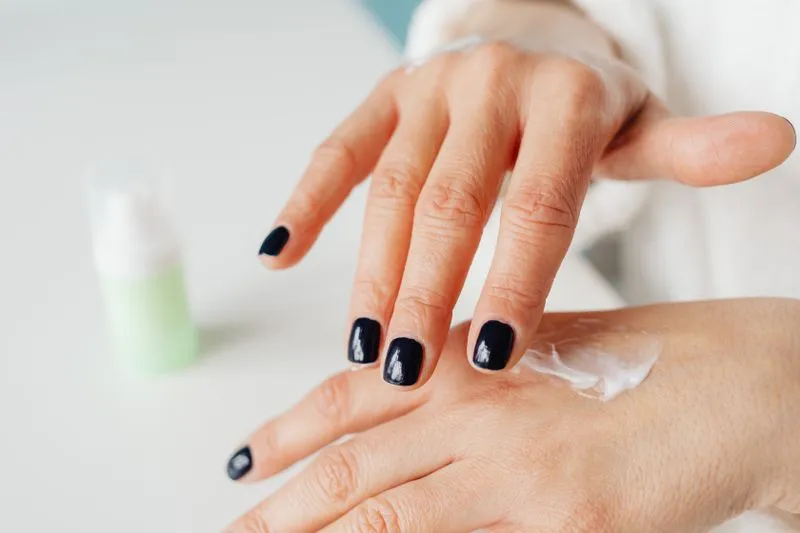
- Hand cream after every wash: water and soap are drying, so the cream goes on straight after, while your hands are barely dry. Keep a tube by every sink.
- SPF on the backs of your hands: whenever they're in the sun. The backs of your hands catch light all year round — even when the rest of you is under a coat.
- A rich night cream: pure shea butter, an ultra-rich hand cream, or a layer of petroleum jelly under cotton gloves — "slugging" for your hands.
Foot routine
- Weekly exfoliation: a pumice stone on damp skin, gently. Avoid rasps that tear dry skin and leave little cuts.
- High-strength urea: for very thick heels. Above 30%, the urea review files it with the keratolytics — it softens hard skin rather than simply moisturising.
- Overnight treatment: a thick foot cream and cotton socks. Two or three nights a week is already plenty — and your tights will thank you.
- Breaks between gel pedicures: give your toenails a few bare days before the next set.
SPF on your body
On your body, sunscreen follows the same rules as on your face. What changes? The surface area — and the spots people forget: shoulders, backs of hands, forearms, chest, feet in sandals. They're also the ones that catch the sun as soon as the good weather arrives.
The three rules:
- SPF 30 or above, with 4 or 5 UVA stars (or the circled UVA logo) on every patch of skin that's out;
- A fresh layer every two to three hours if you're staying out, and after swimming, towelling off or a sweaty session;
- Ears, the back of your neck, the tops of your feet: the three spots people skip even when they think they've covered everything.

The same BAD fact sheet explains why the number on the front can mislead: in real life, people apply less sunscreen than the amount it's tested at, and spread it less evenly, so "the protection you may actually receive is about one-third to one-half of the labelled SPF". That's the whole case for SPF 30 rather than 15. Body sunscreens often come in big bottles — which is just as well, because you need a lot.
Frequently asked questions
In what order should I apply body care products?
The order that works: exfoliation (once or twice a week, in the shower), gentle cleansing, pat dry, then, on still-damp skin, a humectant (lotion), an emollient (cream, butter), and on very dry zones an occlusive on top (petroleum jelly, balm). In the morning, SPF goes last on exposed areas. Simple version: a lotion and an oil after every shower. That's already a proper routine.
Do I need different products from head to toe?
Not necessarily. A good body moisturiser works from neck to toes. But some areas benefit from their own formula: feet (high-strength urea for hard skin), hands (rich cream and SPF), chest (your face products and SPF). The minimum kit: a body moisturiser, a hand cream, a foot cream.
Can I use face products on my body?
Yes, especially going downwards: face serums and creams work nicely on your neck, chest and the backs of your hands. Face sunscreen can go on your body (you'll just need a lot of it). The other way round, be careful: a body exfoliant isn't formulated for the thinner skin on your face.
Do body oils replace creams?
Partly. Pure oils (jojoba, sweet almond, argan, squalane) are excellent emollients — they soften and slow evaporation. But they don't bring water to the skin. For complete moisturising, pair them with a humectant: a light lotion first, oil on top. Or use a shower oil to wash, then your lotion once you're out.
Can keratosis pilaris be cured?
No. The American Academy of Dermatology's page on treating keratosis pilaris is plain that treatment cannot cure it, only keep the bumps under control — so no cream can honestly promise otherwise. But it's very manageable: gentle regular exfoliation (lactic acid, urea), lukewarm rather than hot showers, and moisturising straight after every shower. The NHS notes it may eventually clear up by itself. What to avoid: scratching, picking and harsh scrubs, all on the NHS's list of things not to do.
How long does a complete body routine take?
The daily routine (shower and moisturising): about ten minutes. Exfoliation days: another fifteen. The "I don't have time" argument rarely survives a look at the time it really takes. Hand and foot care can happen in front of the telly in the evening.
Are organic or natural products better for body skin?
Not necessarily. "Organic" tells you where the ingredients come from, not whether they work. Urea, for instance, is present naturally in your skin as part of its natural moisturising factor, which doesn't stop it being made in a lab for your creams. What matters is the ingredients and their concentration, not the label. Meanwhile, essential oils are one hundred per cent natural and can irritate sensitive skin: if that's you, choose products without them and patch-test on a small area first.
Sources
- British Association of Dermatologists — Sun Protection Fact Sheet
- NHS — Emollients
- NHS — Keratosis pilaris
- NHS — Stretch marks
- Sethi A., Kaur T., Malhotra S. K., Gambhir M. L. — Moisturizers: The Slippery Road, Indian Journal of Dermatology (2016)
- Piquero-Casals J. et al. — Urea in Dermatology: A Review of its Emollient, Moisturizing, Keratolytic, Skin Barrier Enhancing and Antimicrobial Properties, Dermatology and Therapy (2021)
- American Academy of Dermatology — Keratosis pilaris: diagnosis and treatment
- U.S. Food and Drug Administration — Guidance for Industry: Labeling for Cosmetics Containing Alpha Hydroxy Acids (2005)