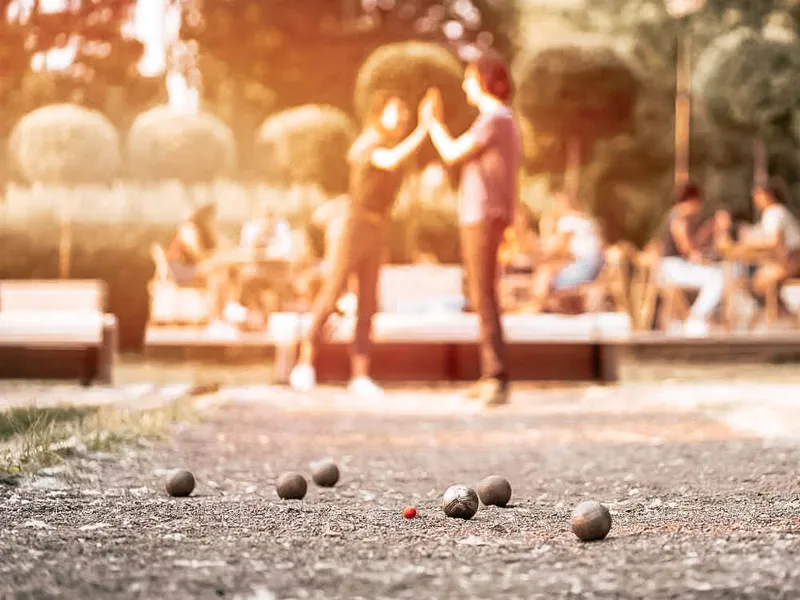
I watched it happening for three days before I joined in. We were at a campsite in Provence — the kind with a pool, a bar, and the mandatory gravel pitch under the plane trees where, every evening from about 6 p.m., a group of deeply tanned French families assembled to throw silver balls at a smaller ball while discussing things with tremendous seriousness and occasional theatrical outrage. It looked, from the outside, like the gentlest possible sport — a game for grandparents, a pleasant but fundamentally low-stakes activity that filled the gap between afternoon swimming and evening dinner.
On the fourth evening, someone handed me a set of boules (heavy, cold, oddly satisfying in the hand) and said "you play?" in the particular tone that French people use when they've already decided the answer is yes. Ten minutes later I was crouching over a dusty patch of gravel, calculating angles I didn't know existed, trying to knock my opponent's boule away from the cochonnet (the little target ball), and experiencing a level of competitive intensity I hadn't felt since my university days. Two hours passed. I missed dinner. My back hurt from crouching. I was hooked.
Pétanque — properly pronounced pay-TONK — is one of those rare activities that is simultaneously extremely simple and infinitely complex. The rules take two minutes to learn. The strategy takes years. The social dimension — the arguing, the celebrations, the post-game analysis over a drink — is as important as the game itself. It is, in the most complete sense, the perfect summer activity, and if you've never played, this is your introduction.
What is pétanque (and what isn't it)?
Pétanque is a French boules game in which players throw hollow metal balls (boules) toward a small wooden target ball (the cochonnet, meaning "piglet" — the French name everything charmingly). The objective is to get your boules closer to the cochonnet than your opponent's. That's it. That's the game.
The name comes from the Provençal expression "pès tancats," meaning "feet together" or "feet planted" — because unlike the older game of jeu provençal, where players take a running start before throwing, pétanque is played standing still, feet planted in a small circle drawn on the ground. This adaptation was reportedly invented in 1907 in the town of La Ciotat, near Marseille, to accommodate a player who had rheumatism and couldn't take a running start. The game was literally redesigned around someone's bad knees, which is perhaps the most French origin story possible.
Pétanque is not:
- Bocce: The Italian cousin. Similar concept but played on a flat, groomed court (often enclosed) with larger, lighter balls. Pétanque is played on any terrain — gravel, sand, grass, hard earth — and the uneven surface is part of the game.
- Lawn bowls: The English version. Played on manicured grass with asymmetric (biased) bowls that curve. Pétanque bowls are round and don't curve — they go where you throw them, which is both simpler and harder than it sounds.
- A gentle game: Do not be fooled by the pace. Pétanque involves intense concentration, precise motor control, spatial reasoning, and — at its best — ruthless competitive strategy. It looks calm because all the action happens inside the players' heads.
The rules: simpler than you think
You can learn the rules of pétanque in three minutes, which is one of its most appealing qualities. Here's the complete ruleset for a casual game:
Setup:
- Two teams. Either singles (3 boules each), doubles (3 boules each), or triples (2 boules each).
- Flip a coin. The winning team draws a small circle on the ground (30–50 cm diameter) and stands in it.
- A player from the starting team throws the cochonnet 6–10 metres away. It must be at least 1 metre from any obstacle (wall, tree, etc.).
Playing:
- The team that threw the cochonnet throws the first boule, trying to land it as close to the cochonnet as possible.
- The opposing team then throws until they have a boule closer to the cochonnet than the first team's closest boule — or until they run out of boules.
- Then the first team throws again, and so on, alternating whenever a team takes the lead.
- All throws are made standing inside the circle, with both feet on the ground.
Scoring:
- After all boules have been thrown, the team with the boule closest to the cochonnet scores.
- They score one point for each of their boules that is closer to the cochonnet than the opposing team's nearest boule. (So if three of your boules are closer than any of theirs, you score 3 points.)
- First team to 13 points wins.
That's it. The subtleties — measuring disputed distances, dealing with boules that move the cochonnet, what happens when the cochonnet leaves the playing area — are handled by common sense and, in the absence of common sense, by enthusiastic argument.
Technique: how to actually throw
There are two fundamental throws in pétanque, and understanding them is the difference between flinging metal at gravel and actually playing the game.
Pointer (placing): A gentle, arcing throw that aims to land the boule as close to the cochonnet as possible. The boule is thrown underhand with backspin, which causes it to slow down and stop relatively quickly after landing. A good pointer can land a boule within centimetres of the cochonnet from 8 metres away — and doing so is one of the most satisfying sensations in casual sport.
Technique: Hold the boule in your palm, fingers together, palm facing down. Swing your arm like a pendulum, releasing at the forward point of the swing. The boule should arc upward, land about two-thirds of the way to the cochonnet, and roll the remaining distance. The height of the arc and the point of release control the landing spot. Practice on consistent terrain first — a gravel car park is ideal — until you can reliably land within a metre of your target.
Tirer (shooting): A hard, flat throw aimed at knocking an opponent's boule away from the cochonnet. This is the aggressive, dramatic shot — the one that draws gasps from spectators and swearing from opponents. A good tir (shot) replaces the opponent's boule with yours, gaining a massive positional advantage.
Technique: The boule is thrown harder and flatter than a point, with the aim of hitting the target boule directly or landing immediately in front of it and rolling into it. This requires significant accuracy and confidence — missing a tir is embarrassing and wastes a boule. In casual games, attempting a tir and missing is called "making the landscape" because your boule ends up somewhere in the distance, serving no purpose except existing.
The key insight: Pétanque is a game of controlled touch, not power. The most common beginner mistake is throwing too hard. The boule needs to land in a specific spot and stop — power without control sends it sailing past the cochonnet and off into the evening.
Stance matters more than most beginners realise. Your feet must stay inside the circle and on the ground until the boule lands. This means you can't take a step or jump — all your momentum comes from the arm swing and body rotation. Many experienced players develop a distinctive crouch-and-release motion, bending their knees slightly as they swing and rising as they release, which provides additional loft and backspin.
Strategy: the part that makes it addictive
Here is where pétanque transforms from a pleasant throwing game into a genuine strategic contest. The decisions you make about when to point, when to shoot, and where to place your boules are what separate players who enjoy the game from players who win it.
Boule management: You have a limited number of boules per end. Using them wisely is critical. If you're ahead, you might choose to throw conservatively — making your opponent use their boules trying to beat you, then placing your remaining boules after they've exhausted theirs. If you're behind, you need to decide whether to try delicate pointing or aggressive shooting.
Reading the terrain: Because pétanque is played on natural ground, the terrain is never flat or consistent. Gravel, roots, slight inclines, patches of harder or softer ground — all of these affect how your boule rolls. Good players "read" the terrain like golfers read a green, choosing landing spots and angles that use the terrain's irregularities to guide the boule toward the cochonnet.
The cochonnet as strategy: The team that wins an end throws the cochonnet for the next end. This means you choose the distance and direction — which is a significant advantage. If your team are good pointers, throw the cochonnet far. If you have a strong shooter, throw it closer. If your opponents are standing in an awkward position, throw the cochonnet behind a tree. (This is legal and frequently hilarious.)
Defensive pointing: Sometimes the best strategy isn't to get close to the cochonnet — it's to place boules that block your opponent's path. A well-placed boule between the circle and the cochonnet forces the opponent to either throw over it (difficult) or around it (also difficult). This is called "making a guard," and it's the pétanque equivalent of a chess defensive formation.
Moving the cochonnet: If your boule hits the cochonnet and moves it, the cochonnet's new position counts. This opens up a deliberate strategy: if your boules are clustered in one area, you can try to knock the cochonnet toward them, turning a losing position into a winning one. It's high-risk, high-reward, and when it works, it's the most satisfying play in the game.
Equipment: what you need to start
One of pétanque's great virtues is minimal equipment requirements. You need boules, a cochonnet, and some ground. That's genuinely all.
Boules:
- Leisure boules: Typically sold in sets of 6 (enough for two players at 3 boules each) or 8 (for three players per team). Prices range from £15–30 for a decent set. These are usually chrome-plated steel or stainless steel, lighter than competition boules (around 650–700g), and perfectly adequate for casual play. Available from Amazon, Decathlon, sports shops, and increasingly from supermarkets in summer.
- Competition boules: Must weigh between 650g and 800g, be between 70.5mm and 80mm in diameter, and be made of specific metals (usually carbon steel or stainless steel). Competition boules are personalised — each set has a unique pattern of grooves (stries) that help with grip and identification. Prices range from £40 to £300+ depending on quality and customisation. Not necessary unless you're playing seriously.
- Children's boules: Smaller, lighter plastic or light metal sets designed for children. Important safety note: standard competition boules are heavy enough to cause injury if dropped on a foot or thrown carelessly. Always supervise children playing with adult boules.
Cochonnet: A small wooden or synthetic ball, typically 25–35mm in diameter. Usually included with boule sets. If you lose yours (they're small and easy to misplace), a golf ball or even a tightly crumpled ball of foil works for casual games.
Measuring device: A tape measure, a piece of string, or a dedicated pétanque measure. Optional for casual play but essential once you start caring about close calls — which you will, approximately three minutes into your first game.
Playing surface: Gravel is traditional and ideal — the boules land with a satisfying crunch and roll predictably. Hard-packed earth works well. Sand is too soft (the boules bury themselves). Grass is playable but the boules roll less predictably. Concrete and tarmac work but the boules bounce unpredictably and the surface damages them over time.
Where to play in the UK and France
In France: Everywhere. Every village, every campsite, every public park with a gravel area. Pétanque is to France what football is to Brazil — it's woven into the social fabric so deeply that dedicated facilities are almost unnecessary because any flat-ish patch of ground becomes a terrain de boules when someone produces a set. The Fédération Française de Pétanque et Jeu Provençal has over 300,000 licensed players, making it one of France's largest sports federations — and licensed players represent only a fraction of the people who play casually.
The best pétanque experiences in France happen in the south — Provence, Languedoc, the Côte d'Azur — where the game originated and where it's integrated into daily social life. Evening games under plane trees, watched by spectators nursing pastis, with the distant sound of cicadas and the close sound of metal on gravel, are among the most evocative French summer experiences.
In the UK: Pétanque has a small but growing presence. The English Pétanque Association organises leagues and competitions across England. Many French-themed restaurants and bars in London have pétanque pitches (including several along the South Bank). Public parks in London, Brighton, Bristol, and other cities have designated pétanque areas. Some pubs — particularly in areas with French community presence — have gravel pitches in their beer gardens.
Clubs welcome beginners enthusiastically — the sport is always looking for new players, and the learning curve is gentle enough that you can enjoy your first game without embarrassment. Most clubs have spare boules for newcomers.
The culture of pétanque: why it matters
What makes pétanque special — what elevates it beyond "throwing metal balls at a wooden ball" — is the social dimension. Pétanque is fundamentally a communal activity. It's designed to be played in public, watched by spectators, accompanied by conversation, and followed by drinks. The game creates a structure for social interaction that is genuinely egalitarian — age, fitness, gender, and class are largely irrelevant on the terrain de boules.
A typical game involves as much talking as throwing. You discuss strategy with your teammates. You comment (loudly) on opponents' throws. You debate close measurements with passionate conviction. You offer advice to beginners (whether they want it or not). And after the game, you share a drink and replay the key moments with the kind of analytical intensity usually reserved for post-match football punditry. The game is the excuse for the gathering, and the gathering is the point.
This is why pétanque is often described as "the great equaliser" in French society. On a pétanque terrain, a retired postman plays alongside a CEO, a teenager competes against a grandmother, and the local plumber's devastating tir earns the same respect as any professional achievement. The game doesn't care who you are outside the circle — it only cares whether your boule is closer to the cochonnet.
For travellers visiting France, joining a game of pétanque is one of the most direct and genuine ways to connect with local culture. The French are generally delighted when foreigners show interest in pétanque, and the universal language of pointing at a cochonnet and making hopeful gestures transcends any language barrier. Bring a set of boules to a campsite or public park, start playing, and you will almost certainly attract company within fifteen minutes.
Frequently asked questions
How many boules do you need to play pétanque?
A minimum of 6 boules for two players (3 each), or 8 for two teams of two (3 each plus 2 spare for rotation). For three-player teams (triples), each player uses 2 boules, so you need 12 total. Standard sets for casual play come in 6 or 8 boule packages. You also need one cochonnet (target ball).
Can you play pétanque on grass?
Yes, though it's not ideal. Short, dry grass works reasonably well. Long or wet grass makes rolling unpredictable. Gravel is the traditional and preferred surface — the boules roll consistently and the terrain is part of the game's strategy. Hard-packed earth and packed sand also work well. Most parks in France have gravel areas specifically maintained for pétanque.
What's the difference between pétanque and boules?
"Boules" is a generic French term for any ball-throwing game — it's like saying "ball sport." Pétanque is a specific game within the boules family, with specific rules (feet planted, 6–10 metre throwing distance, metal boules). Jeu provençal is another boules game with different rules (running approach, longer distances). In casual English usage, "boules" and "pétanque" are often used interchangeably, and no French person will correct you.
Is pétanque an Olympic sport?
Not yet, but it's recognised by the International Olympic Committee. The Fédération Internationale de Pétanque et Jeu Provençal (FIPJP) has been campaigning for Olympic inclusion for years. Pétanque was included as a demonstration sport at various events and has over 600,000 licensed players worldwide across 160 countries. Its inclusion in future Olympics remains possible but uncertain.
How long does a game of pétanque take?
A casual game to 13 points typically takes 30–60 minutes for singles or doubles. Triples can take longer. Tournament matches may be time-limited. The pace is relaxed — there are natural pauses between throws for measuring, discussion, and strategic contemplation. A single end (one round of throwing all boules) takes 5–10 minutes depending on the number of players and the intensity of debate.
Sources