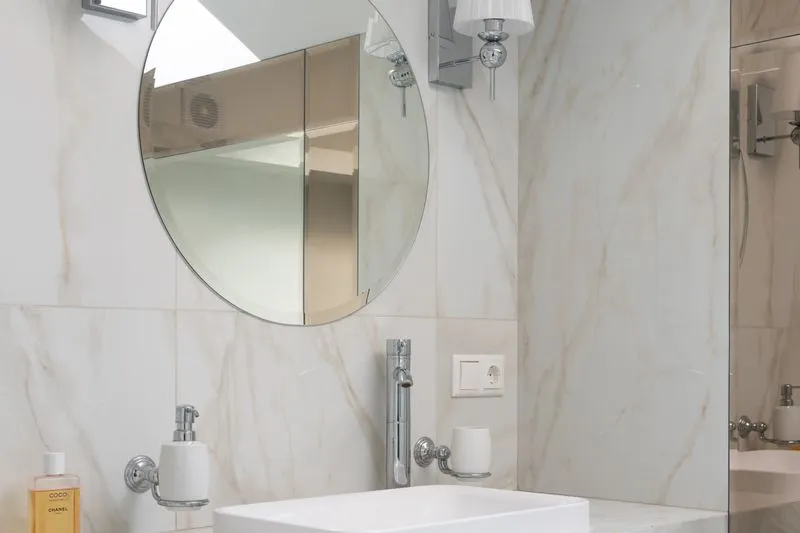
In 1967, a quarter of the homes in England were missing at least one basic amenity. Not a heated towel rail or a rainfall shower — a bath or shower, an indoor WC, a washbasin, or hot and cold water at three points. According to the government's report marking 50 years of the English Housing Survey, some 2.5 million homes (19%) had no indoor WC at all. By 1991, only 1% lacked one of those basics.
The same report slips in a second number, and it's the one that made me put my tea down. There were 14.8 million homes in England in 1967 — and roughly 14.4 million of them were still standing fifty years later. I have no statistic for what follows, but the conclusion writes itself. In plenty of older British homes, the bathroom wasn't part of the original plan. It was squeezed in later — into a box room, onto a landing, behind the kitchen. Wherever there was a scrap of space left.
I got the tape measure out for mine on a Saturday in late May. One metre seventy by one metre ninety: barely more than 3 square metres (about 35 sq ft, for anyone who thinks in feet). A shower, a basin, a loo, and a bath mat my cat treats as a holiday home. And no window at all — steam from the shower takes a good half hour to clear. If your bathroom sounds like that, you're in the right place.
So here are 12 ideas for a small bathroom under 5 square metres, in the order I'd tackle them. Colour, mirrors, wall storage, lighting, materials that can handle damp: each one goes through two filters. Will it survive the steam? And can you undo it on the day you hand the keys back?
Small bathroom, three problems: space, light and moisture
A small city bathroom nearly always comes with three problems: very little floor space, very little daylight and a lot of moisture. You can't change the floor space (not without knocking down a wall, which isn't what we're doing here). The other two are fixable — and they're the ones that make the room feel like a cupboard.
Light first. A room with no window (or a frosted pane the size of a shoebox lid) only has your bulbs to go on. Every colour, every glossy or matt surface, reacts to that light and nothing else. That's why a paint chart studied under the strip lights at B&Q tells you almost nothing about how the colour will look at home.
Moisture next. A hot shower in 3 square metres saturates the air in minutes. The steam settles on the ceiling, the sealant, the backs of your bottles, the bottom of the door. And moisture that hangs around is how damp starts. In the English Housing Survey chapter on dwelling condition, 4% of homes in England — around 1 million — had a problem with damp in 2022, up from 3% in 2019. In privately rented homes, the figure rose from 7% to 9%.
That's why I never talk about bathroom décor without talking about air. A pretty room that goes black at the edges after one winter isn't a pretty room. It's a room you'll be redoing.
Ideas 1 and 2: clear the room, then check the air is moving
Idea 1: empty it before you buy anything
The first way to gain space costs nothing: take things away. In early April, I took everything out of my bathroom (my big clear-out of out-of-date cosmetics) and lined it up on the tiles. Thirty-one products. I binned fourteen — out of date, or forgotten for months. I hadn't bought or drilled a thing — and the room already looked bigger.
A small room gets read in a single glance, so every object sitting on a flat surface — the edge of the basin, the top of the cistern, the corner of the shower tray — adds to the sense of clutter. Ten mismatched bottles (even neatly lined up) make more visual noise than a whole shelf of identical boxes.
What stays in the bathroom is what you use every day. The rest — spares, Saturday-night make-up, perfume — can live somewhere else. My Shalimar, for one, has never met the bathroom shelf. It lives in its box, in a bedroom drawer.
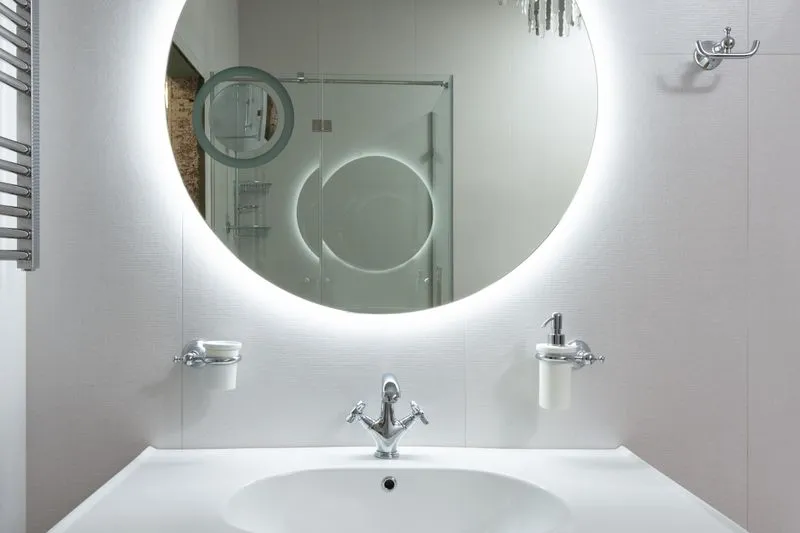
Idea 2: check the air is really going out
The second idea looks like nothing. It's the one that protects all the others, though: making sure the room can breathe. For new building work in England, Approved Document F on ventilation says bathrooms should have extract ventilation to the outside, and sets a minimum of 15 litres per second for an intermittent bathroom fan. It adds a line that could have been written for my flat: "In a room with no openable window, an intermittent extract fan should be provided with controls which continue to operate the fan for at least 15 minutes after the room is vacated."
Those rules apply to building work, so an older conversion may have been fitted to a different standard (or to none). You don't need to measure anything. What you can do in ten seconds is check the fan is pulling: hold a sheet of loo roll up to the grille while it's running. If it clings, air is going out. If it just hangs there, something's wrong — a clogged grille, a blocked duct, a dead motor.
I did the test one evening, straight after a shower. The paper stuck to the grille, but the grille itself was grey with fluff (I'd never once looked at it, let's be honest). Ten minutes with the hoover and a damp cloth later, the mirror was clearing noticeably faster. That's not a scientific measurement. It's a bathroom observation, and it was enough for me.
Ideas 3 and 4: which colours make a small bathroom feel bigger?
Idea 3: one pale colour, from skirting to ceiling
A small bathroom feels bigger when the eye doesn't snag on a single line. The easiest way to get there — one pale shade on the walls and the ceiling, no border tiles, no dado, no change of colour halfway up. The corners fade, the ceiling lifts, and the room stops looking like a box (a shoebox, still).
Pale doesn't have to mean hospital white. Off-white, greige, the palest sage or a dusty pink give the same airy feeling — just softer. What decides it is your light. With no window, everything depends on the bulb: a warm shade under warm light can turn butter yellow, and a grey under cold light can look like a multi-storey car park.
Your own colouring matters more than you'd think, too, because that's the mirror you look into every morning. Since the at-home colour analysis I did with Clara at the end of April, I know I have a cool undertone. A white that's too yellow around my mirror gives me a morning-after-the-party complexion. A slightly greyed white doesn't do me any harm at all.
Idea 4: one dark colour, in the right place
Is a small room doomed to white? No. A deep colour (navy, bottle green, terracotta) can create a sense of depth, on one condition — you use it everywhere, or nearly. Across all four walls and the ceiling, it blurs the corners and feels cocooning. On one badly lit wall, it just punches a black hole in the middle of the room.
If you're torn, keep the dark shade for something easy to swap: the unit under the basin, a stool, the towels, the shower curtain. You get the contrast without committing a whole weekend to painting — or a conversation about it at check-out.
For paint, pick one sold for kitchens and bathrooms, in a soft sheen rather than flat matt, because it wipes clean when the steam leaves marks (the full method is in my guide to painting a room yourself with a professional finish). And in a small room with no window, I go for the lowest-VOC option on the shelf — the fewer solvents hanging in 3 square metres of air, the happier I am.
Idea 5: the mirror, the accessory that doubles the room
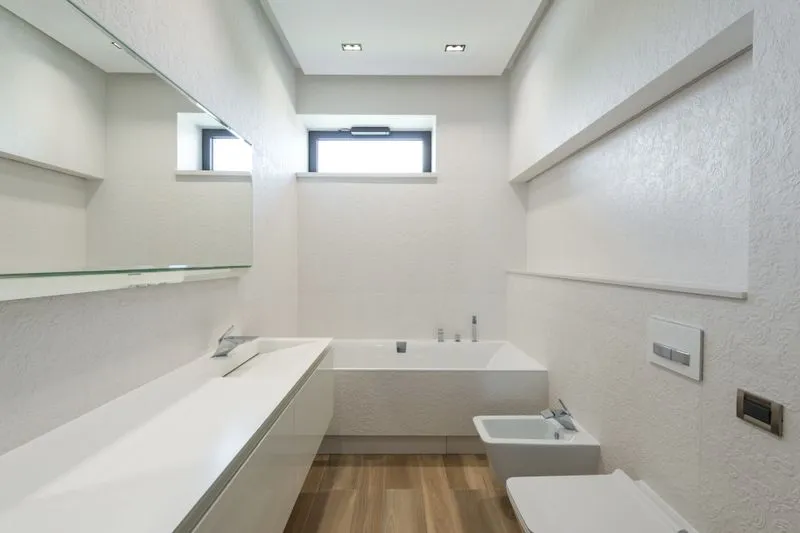
For the least effort, this one does the most: swap the little mirror above the basin for the biggest one the wall will take. A mirror bounces light around and stretches the room in your eye. In a windowless bathroom (like mine), it's the closest thing you'll get to a window.
Three formats work particularly well in a small bathroom:
- A mirror the full width of the basin, up to the ceiling if you can. It's the most dramatic version — and the brightest.
- A mirrored cabinet, hiding a shelf behind its door. Fewer bottles on show, same reflective surface.
- A full-length mirror, leaning against the wall opposite the door, if the room allows. It adds depth the moment you walk in.
Where you put it matters as much as how big it is. A mirror facing a light source doubles it. A mirror facing a cluttered wall doubles... the clutter. Before you fix anything, get someone to hold it up in different spots (my boyfriend endured twenty minutes of "bit more to the left") — then check what it reflects from the doorway.
If you rent, think about the fixings as well. A heavy mirror on tiles means drilling — and a hole in a glazed tile is hard to hide. A lighter mirror, resting on an existing shelf or hung from the old one's screws, saves a lot of grief when your deposit is on the line.
Ideas 6 and 7: wall storage that saves space without crowding it
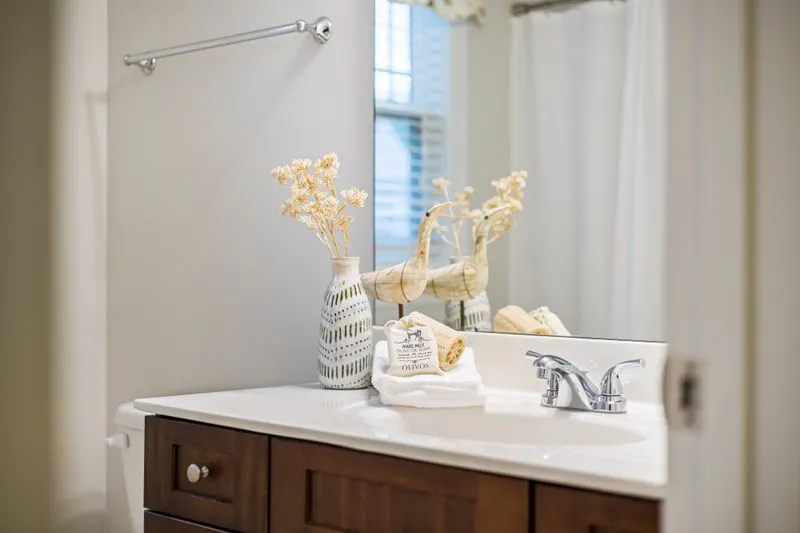
Idea 6: go up — above the loo and over the door
In a small bathroom, the floor is taken. The walls, on the other hand, are almost bare above shoulder height. That's where the storage goes, following the same rule as my tips for making the most of a small flat: think vertical, not horizontal. Above the loo, a shelf or a tall slim unit takes towels and spares. Above the door, a shelf holds the things you use once a month (hair dye, the travel wash bag, the backup hairdryer).
Don't want to drill? Tension shelving units wedge between floor and ceiling — or between two walls — with nothing but pressure. They go up without tools. And they leave with you. Add an over-the-door hook rail for your dressing gown, towel and wash bag. I put one up after my big April clear-out, and it's the purchase of the year I use most.
Idea 7: close up what you can
Open shelving looks lovely on Instagram. In real life, it needs shop-window discipline — bottles lined up, labels facing out, not a single half-squeezed tube lying around. If you don't fancy playing shopkeeper every morning, go for closed storage: matching boxes on the shelf, a lidded basket for skincare, a small tray for jewellery.
One material and one colour for every container: that's what makes it work. Three wicker baskets and two blue plastic tubs make five objects. Five identical white boxes make one line. The eye counts lines, not objects.
The last underrated storage spot is inside the shower. A caddy that hangs from the riser rail, or a corner shelf that fixes by tension, clears the edge of the tray. My pumice stone lives there now — it comes out every spring for my cracked-heels routine before sandal season, and it has no business sitting next to the hand soap.
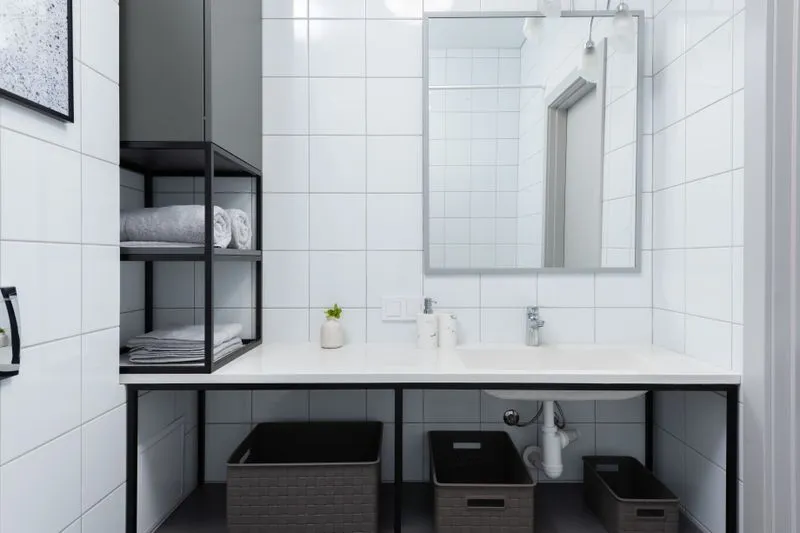
Idea 8: light your face, not just the ceiling
Most small bathrooms have a single light source (a ceiling light in the middle, or a strip above the mirror). The result: shadows under your eyes, a grey complexion and a room that feels lower than it is. You need more than one source of light.
Ideally, three sources work together. General light on the ceiling, for the room. Front light for your face — on either side of the mirror, or all the way round — so there are no shadows. And, if you love a late-evening shower, something softer for mood. In 3 square metres, two sources are already enough to change the room.
For the tone, don't trust the word "white" on the box. Warm white flatters the room. Neutral white is more truthful for make-up. I keep neutral at the mirror and warm on the ceiling — the only way I've found to stop my foundation surprising me once I'm outside. I also look for a high colour rendering index (CRI) on the packaging. The higher it is, the more faithfully the bulb shows the real colour of your skin — and of your lipstick.
On safety, a bathroom isn't like any other room. The wiring rules split it into zones around the bath or shower. NICEIC's guide to bathrooms and electrics defines zone 0 as the inside of the bath or shower tray, and zone 1 as the area above it up to the highest fixed shower head or 2.25 m from the floor, whichever is higher. Zone 2 stretches 600 mm beyond that. Lights in zones 1 or 2 need an IP rating of X4 or X5. Ordinary sockets are only allowed more than 2.5 metres from the edge of the bath or shower tray (shaver sockets being the exception).
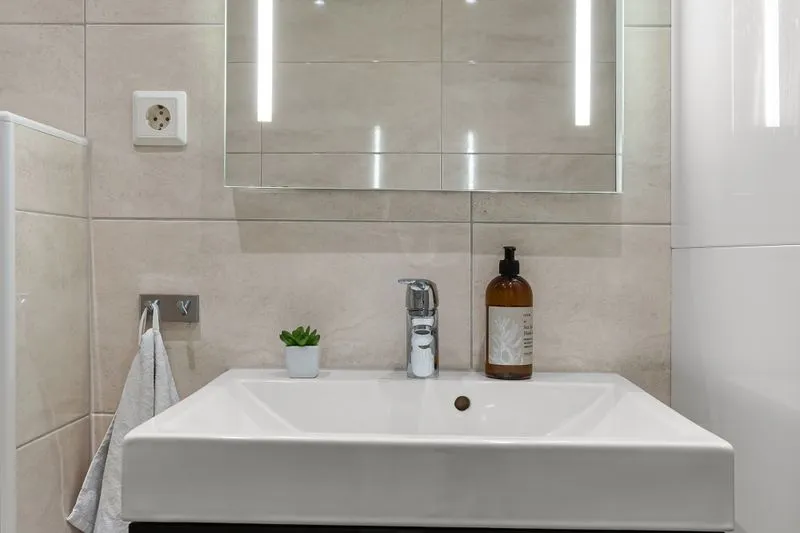
Idea 9: a shower that lets the light through
In a small bathroom, the shower takes up a big share of the room. Close it off with an opaque curtain or a frosted door and all of that space vanishes from view. The rule to live by: whatever surrounds the shower should let light through.
If you own, a fixed clear glass screen with a slim frame (or none) is still the most effective option — the eye travels straight through and the room gets its depth back. If you rent, a curtain does the job perfectly well, on two conditions: a pale or even translucent fabric, and a rail fixed as high as it'll go. A curtain hung close to the ceiling makes the walls look taller — exactly as it does in a living room.
This spring, I swapped my printed curtain (flamingos, and I won't be taking questions) for a translucent white one. It took two minutes. The room gained a whole wall — at least in the eyes of anyone opening the door.
Think about upkeep, too. A fabric curtain that goes in the washing machine ages better than a plastic one (which keeps a record of every splash). And a squeegee hung in the shower, run over the tiles or the screen after each use, gets the water off before it evaporates into the room.
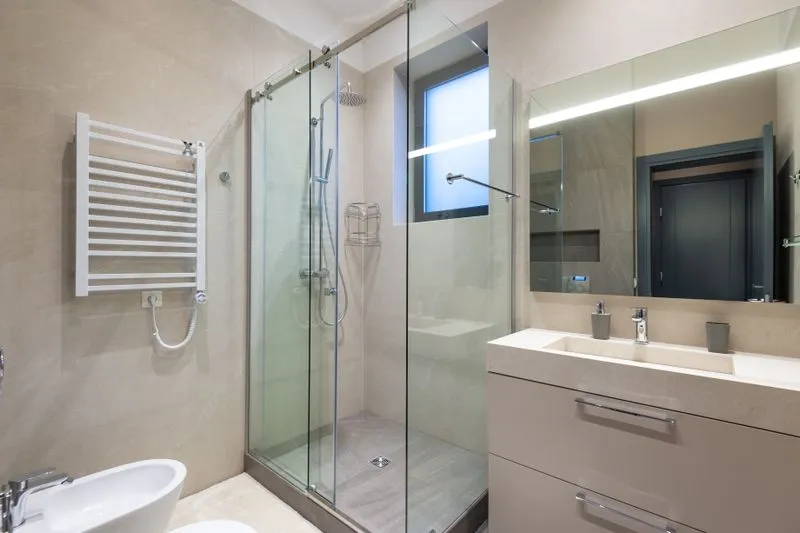
Idea 10: materials that can handle the steam
A 3-square-metre bathroom with no window is a tiny steam room twice a day. Everything you put in it has to cope with vapour, splashes and swings in temperature. Otherwise the décor lasts one winter and not a day more.
- Wood: yes, if it's made for wet rooms (teak, bamboo, oiled or varnished wood). A raw chipboard unit swells fast once water gets to it.
- Metal: stainless steel or aluminium. A towel rail in simply painted metal ends up rusting at the joins.
- Textiles: waffle or lightweight cotton towels dry faster than very thick ones. As for the bath mat, machine-washable beats natural fibres.
- Wallpaper: possible if it's sold for bathrooms (vinyl or washable non-woven) — and kept well away from direct shower spray.
- Sealant: the silicone round the shower tray and the basin is often the first place mould moves in. Blackened sealant gets redone — it doesn't get hidden under a bath mat.
The habit that saves me from bad buys? Looking for "suitable for bathrooms" or "moisture-resistant" in the product description — not just the word "bathroom" in its name. Plenty of things sold as bathroom accessories are made for the photo — not for the steam.
Mould isn't just a cosmetic problem, either. The same government guidance on damp and mould lists respiratory effects such as cough, wheeze and shortness of breath, along with the development or worsening of conditions like asthma and allergic rhinitis. If black patches keep coming back despite ventilating and cleaning, it's no longer a décor question. Report it to your landlord. The cause (poor ventilation, a leak, a cold wall) has to be dealt with at the source.
Idea 11: floor, textiles and plants for a small bathroom
The floor of a small bathroom shows more than you'd think — when you walk in, it fills most of your field of vision. Dark or very busy tiles close the room in. A pale, plain floor stretches it.
Are your tiles from another era (speckled beige, a border of seashells, I know the ones)? You can buy self-adhesive vinyl floor tiles that go straight on top (some are even sold as repositionable). They hold better in the dry part of the room than in the shower, so keep them to the floor in front of the basin.
Textiles are the ideal place for colour. Towels all in the same shade, a matching bath mat, and the room looks planned rather than accumulated. When you get bored, you change the lot — no sanding, no undercoat. My cat has no opinion on the colour of the bath mat, by the way. Only on how thick it is.
Which leaves plants. My mother grows orchids in her bathroom (a proper plant witch), and they flower there like nowhere else. But a plant needs light before it needs humidity. In a room with no window, a living plant slowly fades, whatever the label promises. I've already killed a cactus by overwatering — I don't intend to sacrifice a fern to total darkness.
If your bathroom has a window (even a small one), a plant that likes humid air will be happy there. Without one, there are two honest options: a plant that commutes (a week on a windowsill, a few days in the bathroom), or a few dried stems — eucalyptus, lavender, pampas grass — that bring the green in without asking for anything.
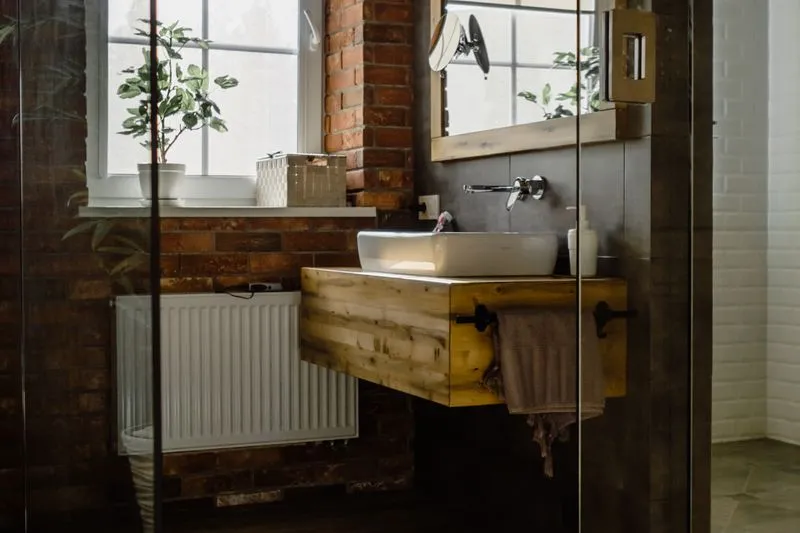
Idea 12: the one-weekend plan for renters
Everything above fits into one weekend — no major works — and can be undone on the day you move out. Here's the order I'd do it in.
- Friday evening: take everything out, sort it, bin what's out of date. Do the loo-roll test on the extractor fan and clean the grille. Tape the paint samples to the wall, check them that evening, then again after your shower.
- Saturday morning: look at the samples one last time under the mirror light and clean the sealant. Late morning, go shopping (paint, matching boxes, over-door hooks, a pale curtain, new bulbs).
- Saturday afternoon: paint, if you've decided to and your tenancy allows it — walls and ceiling in the same shade, leaving the drying time on the tin between coats.
- Sunday: put up the tension shelving, the mirror, the high curtain rail and the matching textiles. Put things away, leaving only the everyday on show.
Before you open the tin, take a photo of the original walls and, if you can find it, note the name of the existing colour. That way you can get back to it before you hand the keys over, if the check-out ever calls for it.
And if you only remember one of these twelve ideas? Start with the air, finish with the light. A bathroom that breathes and is properly lit looks bigger before you've even picked up a brush.
Frequently asked questions
What colour should I paint a small bathroom with no window?
A soft, pale shade (off-white, greige, the palest sage or pink) on both the walls and the ceiling, so the corners disappear. Choose it under the room's own light rather than in the shop, and use a paint sold for kitchens and bathrooms in a soft sheen that wipes clean.
How can I make a small bathroom look bigger without renovating?
Clear the surfaces first, then use four reversible tricks: a large lightweight mirror resting on a shelf or hung from the existing fixings, a pale curtain on a tension rail set high, wall storage on a floor-to-ceiling tension unit or an over-door rail, and towels and textiles all in one colour. None of these has to involve a drill.
How do I stop mould in a bathroom with no window?
Check the extractor fan is pulling (a sheet of loo roll should cling to the grille) and clean it regularly. Squeegee after showering, leave the curtain spread out to dry and keep an eye on the silicone sealant. If black patches keep coming back, tell your landlord in writing: the cause needs fixing at the source.
Can I paint my bathroom if I'm renting?
It depends on your tenancy agreement, so read the clause on decorating first. If it's unclear, ask your landlord and keep the answer in writing. Keep a photo of the original walls and the name of the colour, so you can put it back before you move out if needed.
What lighting works best above a bathroom mirror?
Front lighting on either side of the mirror or all the way round, in neutral white with a high colour rendering index. Lights in zones 1 and 2 around the bath or shower need an IP rating of X4 or X5, and any new light fitting or socket is a job for a registered electrician.
Can you use wallpaper in a small bathroom?
Yes, as long as it's sold for bathrooms (vinyl or washable non-woven) and kept away from direct shower spray. A single feature wall is often enough to give the room character without crowding it.
Which plant can survive in a bathroom with no natural light?
No living plant lasts long in total darkness. Rotate a plant between a windowsill and the bathroom, or go for dried stems (eucalyptus, lavender, pampas grass) that bring in some green without needing light.
Sources
- Ministry of Housing, Communities and Local Government — 50 years of the English Housing Survey (2017)
- GOV.UK — English Housing Survey 2022 to 2023 headline report, chapter 4: dwelling condition
- GOV.UK — Approved Document F: Ventilation, volume 1, dwellings (2021 edition)
- GOV.UK — Understanding and addressing the health risks of damp and mould in the home (2023)
- NICEIC — Bathrooms and electrics: what you need to know