
"And what's this?"
The inventory clerk had put one finger on the bedroom wall, just above the desk. A small rectangle of bare plaster, the size of a stamp — the spot where the white paint had come away with an adhesive hook. Lottie (23, halfway through a master's, my neighbour across the landing for two years) stared at that wall as if it had personally betrayed her. "It's a hook… a no-drill one. It says so on the box." The clerk nodded, tapped something into his tablet — and moved on to the window.
It was a Saturday in April, quarter past ten — in a one-bedroom flat emptied of everything except the smell of the previous night's deep clean. Lottie had asked me to come along "because you're the one who does DIY". In the box marked "decor" on the landing: seventeen adhesive hooks peeled off without a mark, three posters, a string of fairy lights and a "no-drill" shelf that had survived two years on four foam pads (yes, two years). Seventeen successes, one rip. Guess which one made it into the check-out report (go on, guess).
That's the whole paradox of renter-friendly decor: it protects your deposit — provided you know how to take it down. A screw hole fills with a tube of filler. A patch of paint torn off the wall means touching up the paint (and a touch-up on an off-white wall almost always shows). My step-by-step guide to building a gallery wall gave renters a single paragraph on adhesive strips. This one goes all the way: what the check-out can hold against you, then 15 reversible decor ideas — each with the right way to put it up and take it down.
What a check-out report can hold against you (and what it can't)
A check-out report can only hold one thing against you: a difference from the check-in inventory that time and normal living don't explain. The flat is compared with itself — room by room — between the day you got the keys and the day you hand them back. It isn't a taste test (cleanliness, on the other hand, very much counts). A wall repainted with your landlord's say-so isn't damage — a wall full of holes might be.
The key phrase is "fair wear and tear", and the government's own definition is short. The Tenant Fees Act guidance for tenants puts it like this: "Fair wear and tear is considered to be defects which occur naturally or as part of the tenant's reasonable use of the premises." The same guidance says you are responsible for returning the property in the condition you found it, aside from fair wear and tear. Screenshot that sentence (you'll want it one day). Shelter's page on who pays for damage in a rented home makes the same point: your landlord shouldn't keep deposit money for normal wear and tear.
Where's the line? Shelter's page on deductions for damage lists what you could be charged for — including "holes in walls or doors" and "stained or burned carpets". Accidental damage counts too. Holes in walls — the very thing drill-free decor spares you.
The money at stake is real. In England, the Tenant Fees Act 2019 (Schedule 1, paragraph 2) caps a tenancy deposit at five weeks' rent when the annual rent is less than £50,000 (six weeks' at £50,000 or above). If you're a student paying rent from a loan, five weeks of it — that's not something you let go without a fight. (These are the rules for England; Wales, Scotland and Northern Ireland each run their own versions.)
Here's how the rules translate into decor decisions:
| What the rules say | What it means for your decor |
|---|---|
| Shelter: you could be charged for holes in walls or doors | Every screw hole is a potential deduction unless you fill it neatly before you leave (and check what your agreement says about fixings). |
| Shelter: you could be charged for stained or burned carpets | A plant saucer that overflows onto the carpet or floorboards leaves a mark you may pay for. |
| Tenant Fees Act guidance: fair wear and tear is not your responsibility | Paint that has simply faded or scuffed over years of normal living isn't damage. |
| Shelter: your landlord can't keep your deposit just because it's time to redecorate | A tired wall at the end of a long tenancy is the landlord's cost — not yours. |
| Shelter: redecorating without consent can lead to deductions | Painting a wall a new colour without permission is a risk; peel-and-stick is the safer route. |
Before you decorate: the check-in inventory and dated photos
You protect a deposit on the day you move in — not the day you move out (the move-out is just when you find out). A screw hole nobody wrote down at check-in is a hole someone can blame on you at check-out. The reverse holds too: a mark noted on day one can't be pinned on you later.
Read the inventory line by line before you sign it (nobody spots everything while the agent is checking their watch). If something is missing or wrong, email the agent straight away and ask for it to be added — then keep the email. Then take your own photos, because Shelter's guide to evidence in a deposit dispute is clear on one point: "The schemes prefer digital photos because they can check the dates and they are often clearer."
My method, in four moves:
- Every wall, straight on, at eye level. Room by room, in the same order as the inventory.
- Every mark, close up, with something for scale. A coin or a ruler next to a hole says more about its size than a sentence.
- Floors from floor level. Light raking across the floor picks up scratches you can't see from standing height.
- An email to yourself the same day. All the photos attached, the address of the flat in the subject line.

Renter-friendly decor: what your tenancy lets you do
This is where renting in England gets strict. What you can change depends on your tenancy agreement — and the safe default is "ask first". Shelter's page on cleaning and decorating deductions says your landlord could keep money if you redecorate or make significant changes without consent — and "paint walls a different colour" is on its list of significant changes.
The same page reassures you that a landlord can't hold on to your deposit simply because the place is due a repaint. Then comes the line that stings: "Put the property back how it was when you moved in to avoid deposit deductions." Even if you think you've improved it (a beautiful sage green included).
So: want to paint? Ask in writing (and keep the reply) — my guide to painting a room yourself for a professional finish has a whole section on what to check first as a renter. For everything else, here are the 15 ideas that need neither a drill nor a landlord's blessing.
Ideas 1 to 3: dressing your walls without a single hole
1. Adhesive hooks and strips, used properly
Adhesive hooks and picture-hanging strips are the backbone of renter-friendly decor — as long as you treat them as a technical product, not a sticker. They'll hold light frames, a coat hook, a tea towel, a string of lights (not your grandmother's mirror). Every pack lists a maximum weight, the surfaces it works on and how to remove it (it's all on the back of the card). Lottie's story fits in one line: seventeen hooks removed by the instructions, one yanked off in a hurry on a packing morning.
Three rules I follow every single time:
- A smooth, clean, dry surface. A dusty or greasy wall grips badly — and an adhesive that grips badly either drops off… or rips off.
- A real weight, not a guess. Weigh your frame on the kitchen scales (glass included — it's usually the surprise).
- A hidden test. One hook behind a door for three weeks, then off by the instructions. If the paint comes with it, you know before you put up seventeen.
I learnt rule three the hard way. At 26, in my wonky studio in East London, I stuck a poster up with double-sided carpet tape (yes, carpet tape). The day I peeled it off, a chunk of paint came with it — roughly the shape of Cornwall. I've tested everything since.
2. Frames that lean instead of hang
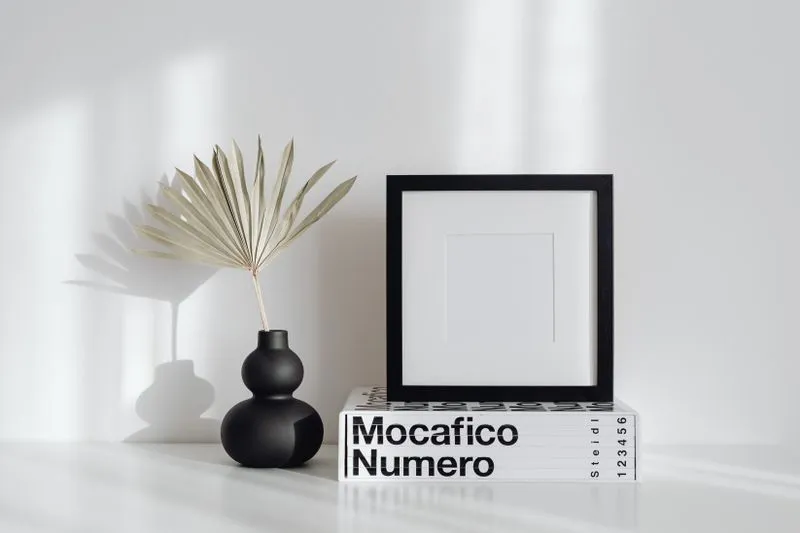
Leaning frames mean no adhesive, no holes — and still a gallery look. On a chest of drawers, a shelf, a mantelpiece — or even on the floor against the wall — layer two or three frames of different sizes, biggest at the back. The rules from the gallery-wall guide work just as well horizontally: one shared colour, a common thread, one frame that breaks the line. Charity-shop frames are perfect for this (a mismatched stack looks deliberate when it leans).
One renter detail that matters: stick two small felt pads on the back of each frame, at the bottom. A leaning frame that rubs the wall every time you dust will eventually mark the paint — and that's the kind of scuff a check-out picks up.
3. Light posters: washi tape and magnetic hangers
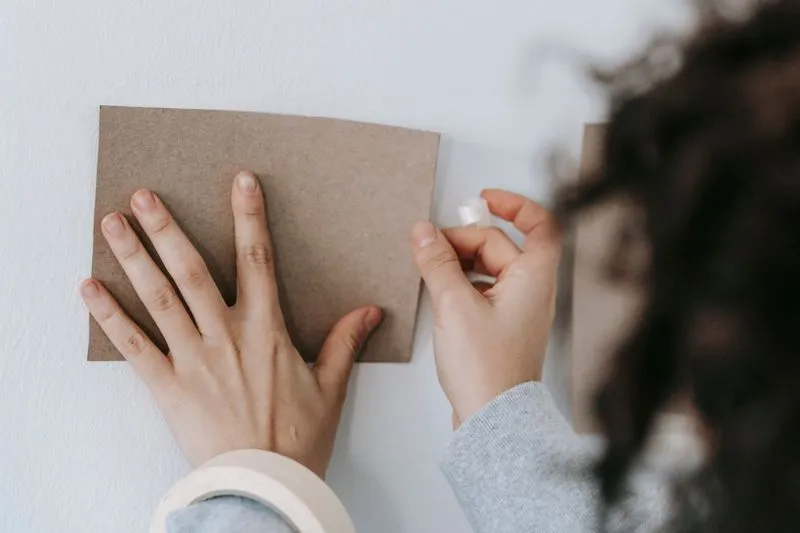
For a light poster, there are two drill-free options. Decorative washi tape on the four corners holds a thin print and usually comes off cleanly — but "usually" isn't "always", hence the hidden test. A magnetic poster hanger (two wooden strips that clamp the top and bottom of the print) hangs from a single adhesive hook: one point of contact instead of four. I'm a bit obsessed with the second one — you can swap posters in thirty seconds without touching the wall.
Ideas 4 to 6: peel-and-stick wallpaper, on the wall or elsewhere
4. One feature wall in peel-and-stick wallpaper
Peel-and-stick wallpaper changes a room without a brush or a bucket of paste. One wall is enough (behind the bed, or the desk corner), and the rest of the room stays white. You see the result that evening — and it peels off when you leave. In theory.
In practice, everything depends on the wall underneath — and on patience. Sandberg's peel-and-stick guidance is one of the clearest I've read. It says: "You must give freshly painted walls 4-6 weeks to cure fully." It rules out textured surfaces, high-gloss paint and rooms with big swings in temperature and humidity, such as bathrooms. And it adds the line renters should underline: "A previous wallpaper, matte or flat paint may absorb adhesive, making removal trickier." If your walls have that chalky, flat finish, test first.
5. Peel-and-stick on furniture instead of the wall
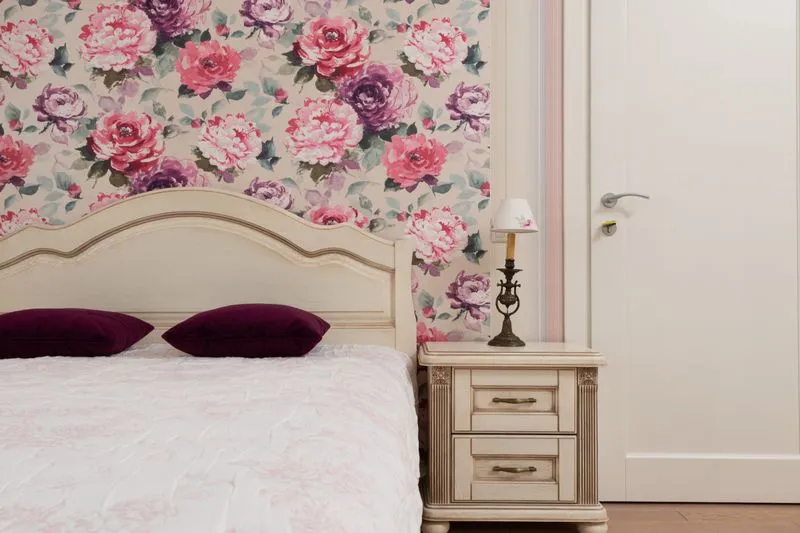
My favourite idea: paper the furniture instead of the wall. The back of an open bookcase, the drawer fronts of a chest, the inside of a wardrobe door. The pattern is there, the room changes character — and the wall is never touched. On moving day the furniture leaves with you (papered).
One condition — and it's a big one: the furniture has to be yours. In a furnished let, that chest of drawers is on the landlord's inventory, just like the walls. You don't paper someone else's furniture without asking.
6. The leaning panel: a headboard that never touches the wall
A third version, for anyone who'd rather not stick anything at all: a panel that stands on the floor against the wall. A large sheet of painted plywood, fabric stretched over a frame, a folding screen opened out behind the bed as a headboard. The wallpaper effect, one hundred per cent removable — and it moves house with you. Just remember the felt pads, as with leaning frames.
Ideas 7 to 9: freestanding shelves and furniture that replaces a fixing
7. The ladder shelf and the freestanding bookcase
A freestanding shelf replaces the wall shelves you're not allowed (or don't fancy) putting up. A ladder shelf leaning on the wall, an open bookcase, stackable cubes: you store, you display, you take it apart when you go. For small spaces, my 15 tips for making the most of a small flat go further on the art of building upwards.
Except "freestanding" doesn't mean "never fixed". RoSPA's advice on preventing accidents to children says furniture at risk of being pulled over should be secured to the wall, and puts it bluntly: "Sets of drawers, in a child's eyes, make ideal climbing frames but, if unsecured, they pull over easily." The anti-tip kit in your flat-pack box isn't there for decoration.
8. The floor-to-ceiling tension pole
A tension pole holds itself between floor and ceiling by pressure alone, like a telescopic shower rod. You can hang shelves, trailing plants or a lamp from it (a trailing pothos looks brilliant on one). It marks out a desk corner — or splits a room in two. Two common-sense precautions: a felt pad at each end so the ceiling isn't marked, and a monthly check on the tension (old flats move, timber shifts). Skip it under a suspended or cracked ceiling.
9. A clothes rail instead of a fitted wardrobe
No wardrobe, no rail, no permission to screw one in? A freestanding clothes rail sorts it. Choose a sturdy one with a low bar for shoes — and style it like furniture: matching hangers, ten pieces you genuinely love, a basket at its feet. In the hallway, a coat stand does the same job — without a single screwed-in hook.

Ideas 10 to 12: rugs, curtains and soft furnishings
10. The rug that decorates and protects
A rug does two jobs at once. It warms up a white room in seconds — and it protects the flat's carpet or floorboards. Shelter lists stained carpets among the damage you could be charged for. A rug under the desk, where the office chair scrapes everything, is a floor you'll never have to explain. Add a non-slip underlay (it stops the rug sliding, and some rugs can mark varnish without one).
11. Curtains on a tension rod
A tension rod wedges inside the window reveal by pressure alone — no screws. Washed-linen curtains or a pair of fresh voiles — and the room stops looking like a let. Keep any original curtains in a labelled bag with the room's name on it. They go back up the night before check-out.
12. Throws, cushions and covers: colour without touching the walls
Soft furnishings bring colour into a rented flat without touching a thing. A sofa cover, two cushions, a throw, bedding in a bold shade: that's your sage-green wall, in reversible form. My rule — one main colour, one accent colour, and white or wood to let it breathe. The day you get bored, it all changes in a single Saturday (and it all moves with you).

Ideas 13 to 15: lighting and plants
13. Table lamps and fairy lights
The single ceiling light in the middle of the room is the enemy of every cosy rented flat. Replace it with lamps, not with a new ceiling fitting: a lamp on the chest of drawers, a floor lamp by the sofa, a small bedside lamp. Three sources, three heights — and the room changes mood in the evening. Fairy lights on clear adhesive hooks (featherweight, so ideal) finish the job.
14. Swap the shade, keep the original fitting
Is the landlord's light fitting hurting your eyes? Start with the shade, which usually just sits on or clips in. If you want to change the whole pendant, ask first — and get an electrician if you're not qualified to do it. Keep the original in a labelled box (screws in a bag taped to the lid). On moving-out day, the original goes back up — and yours leaves with you.
15. Plants, with saucers
Houseplants are living decor — and they need no holes at all. New to them? Start with nearly unkillable houseplants for beginners. A big plant on the floor in a corner, two or three small ones on the ladder shelf, one trailing from the tension pole. The only renter risk? Water. An overflowing saucer leaves a ring on the floorboards or a stain on the carpet, and stains are exactly what deductions are made of. Put a watertight saucer under every pot, and small feet under the saucer so the floor can breathe.

Moving-out week: taking everything down without a trace
Start preparing for moving-out day a week ahead, not the night before. Anything stuck up comes down slowly, following the instructions — never on a morning when you're rushing (packing mornings are the worst). That's exactly where Lottie lost her little rectangle of paint.
For peel-and-stick wallpaper, peel from a top corner and pull slowly and steadily, keeping the peeled section close to the wall rather than yanking it towards you. If you want to reuse it, keep the backing paper to protect the adhesive side.
Then the final-week checklist:
- Take everything down, room by room, list in hand.
- Fill any holes with filler, sand, and touch up with the original paint if you have it.
- Put the originals back: light fittings, curtains, hooks.
- Clean — top to bottom. Shelter notes that cleaning charges are the most common reason landlords keep money from a deposit, and that you only need to clean to the standard the home was in when you moved in.
- Retake your photos of every wall, in the same order as at check-in.
Deposit deductions: how to challenge them
Your landlord works to a clock — and it's written down. According to GOV.UK, your landlord must return your deposit within 10 days of you both agreeing how much you'll get back. If you're in a dispute, the deposit stays protected in the scheme until it's sorted out.
Every deduction should come with evidence. Shelter suggests comparing your check-in inventory with the check-out report and noting every change — and being there for the check-out inspection if you can. You can dispute the amount even if you accept you caused the damage, and get your own quotes for repairs if a charge looks too high. A line saying "redecoration" with no invoice or quote proves very little. And paint that has simply worn over time is fair wear and tear — which your landlord can't charge you for, even if they redecorate.
Not happy? Three steps, in order:
- Write to your landlord or agent asking for a breakdown of the deductions and the evidence behind each one.
- Use the scheme's dispute service. Shelter points out that each deposit protection scheme offers free dispute resolution if you and your landlord can't agree. Send your dated photos, your check-in inventory and your emails.
- Court, as a last resort, if nothing else works.
Lottie never needed step two (lucky her). The transfer landed three weeks after she handed back the keys, minus the bedroom touch-up — with a quote attached, all above board. Nothing to argue about — fair's fair. In her new flat, the first adhesive hook lives behind the bathroom door, three weeks into its test. Do the same tonight: one hook, one hidden corner, one date in your phone. By the time you peel it off, your wall will have given you its answer.
Frequently asked questions
Is a nail hole counted as damage at check-out?
It can be. Shelter lists holes in walls or doors among the damage a tenant could be charged for. A few small holes filled neatly before you leave rarely cause trouble; lots of holes, or large wall-plug holes, can lead to a deduction backed by a quote. Check your tenancy agreement too, since it may say what you can fix to the walls.
Do adhesive hooks damage paint?
They usually come off cleanly if you respect the weight limit, the recommended surfaces and the removal method printed on the pack. Rips mostly come from pulling too fast or from fragile paint. Hence the test: one hook in a hidden corner for a few weeks, then off by the instructions.
Can I put peel-and-stick wallpaper on a freshly painted wall?
Not straight away. Sandberg says freshly painted walls need four to six weeks to cure fully. It also warns that matte or flat paint may absorb the adhesive and make removal trickier, and it doesn't recommend textured walls, high-gloss paint or bathrooms.
Do I need my landlord's permission to paint?
In England, usually yes — check your tenancy agreement. Shelter says your landlord could keep money from your deposit if you redecorate or make significant changes without consent, and painting walls a different colour counts as a significant change. Ask in writing and keep the reply.
Can my landlord charge me because the walls look tired?
Not for fair wear and tear. Government guidance defines it as defects that occur naturally or through the tenant's reasonable use of the property, and Shelter says a landlord can't withhold your deposit just because it's time to redecorate.
How much deposit can a landlord take?
In England, the Tenant Fees Act 2019 caps a tenancy deposit at five weeks' rent when the total annual rent is below £50,000, and six weeks' rent at £50,000 or above. Your landlord must protect it in a government-approved scheme within 30 days.
How quickly should I get my deposit back?
GOV.UK says your landlord must return it within 10 days of you both agreeing how much you'll get back. If you disagree, the deposit stays protected in the scheme, and each scheme offers a free dispute resolution service.
Sources
- GOV.UK — Tenant Fees Act 2019: guidance for tenants
- legislation.gov.uk — Tenant Fees Act 2019, Schedule 1, paragraph 2
- GOV.UK — Tenancy deposit protection
- Shelter England — Deposit deductions for damage and missing items
- Shelter England — Who pays for damage to your rented home?
- Shelter England — Can landlords charge for cleaning and decorating?
- Shelter England — Evidence for a deposit dispute
- Sandberg — Peel & Stick wallpaper
- RoSPA — Preventing accidents to children