It's 10.40am, the team meeting is overrunning — and your stomach is rumbling loudly enough that the colleague next to you pretends to reread her notes. Yet you did have breakfast — a big glass of orange juice (the "not from concentrate" kind), a slice of white toast with marmalade, a cup of tea drunk standing by the kettle. On paper, it looked sensible (fruit, bread, no pastry). At 11.05, someone brings in a box of doughnuts for their birthday, and you take one "just to get to lunch".
That breakfast was missing two things — protein and fibre. The juice delivered the orange's sugar without its fibre; the white bread was made from refined flour (wholegrain varieties contain more fibre than white or refined ones, the NHS points out). And fibre is what most of us are short of. According to the NHS guide to getting more fibre into your diet, government guidelines say adults should eat 30g of fibre a day, but most adults manage an average of about 20g. A third of the target, missing every day.
A balanced breakfast doesn't need scales or a recipe book. It comes together in four parts: protein, fibre, whole fruit and a drink with little or no sugar. This guide takes each part in turn, then offers 20 combinations (ten sweet, ten savoury), most of them ready in under ten minutes. It draws on NHS guidance and the government's Eatwell Guide (the official picture of a balanced diet) — and it's clear about what the research doesn't show.

Do you really need breakfast?
Breakfast isn't a weight-loss tool, but it is a very useful slot for foods that tend to go missing later in the day. Both statements hold — and both come from serious sources.
The NHS takes a clear line. In its eight tips for healthy eating, the last one is "Do not skip breakfast". It notes that "Some people skip breakfast because they think it'll help them lose weight", then adds that "a healthy breakfast high in fibre and low in fat, sugar and salt can form part of a balanced diet, and can help you get the nutrients you need for good health."
The research is less tidy. In January 2019, a meta-analysis published in The BMJ pooled 13 randomised controlled trials from high-income countries (seven on weight, ten on calorie intake). Participants who skipped breakfast ended the trials 0.44kg lighter on average (a small difference, with some inconsistency between trials); those who ate it took in about 260 more calories a day. The authors concluded that "the addition of breakfast might not be a good strategy for weight loss, regardless of established breakfast habit" — while warning that the trials were of low quality and short (seven weeks on average for weight, two for calories).
These two messages clash less than they seem to. The BMJ review says breakfast won't make you slimmer, not that it's pointless. It remains a handy moment of the day to fit in some dairy, a wholegrain and a piece of fruit.
- You're hungry when you wake up — eat, using the four-part grid.
- You're not hungry until 9 or 10am — nothing says you must force something down at 7. A later breakfast does the same job (the NHS guidance doesn't set a time).
- You skip it, then raid the biscuit tin at 11 — this is where going without works against you, because the improvised snack is rarely balanced.
If meal timing interests you, the science of chrononutrition, and what it does and doesn't prove looks at an approach that puts a lot of weight on the morning.
The four-part method for a balanced breakfast
A balanced breakfast brings together a source of protein, a source of fibre, a piece of whole fruit and a drink with little or no sugar. The grid follows the NHS's own suggestion closely: "A wholegrain lower sugar cereal with semi-skimmed milk and fruit sliced over the top is a tasty and healthier breakfast." That's fibre, protein and fruit in one bowl — add a glass of water or a cup of tea, and every box is ticked.
Why name the parts rather than the foods? Because the NHS example describes one breakfast, not a method: swap the cereal for toast, or the milk for an egg, and you need to know which job each food was doing. "Protein" also opens the door to savoury breakfasts and to people who don't drink milk — an egg, a slice of cheese or a spoonful of hummus play the same anchoring role.
| Part | What it brings | Examples |
|---|---|---|
| Protein | A meal that isn't just carbohydrate (plus calcium if it's dairy). | Plain yoghurt, milk, cottage cheese, eggs, cheese, hummus. |
| Fibre | Easier digestion; linked to a lower risk of heart disease and type 2 diabetes. | Wholemeal or granary bread, porridge oats, plain wholewheat cereal. |
| Whole fruit | Fibre, vitamins, one of your 5 A Day. | Apple, banana, 7 strawberries, frozen berries. |
| Drink | Fluid without hidden sugar. | Water, tea, coffee, lower-fat milk (which then counts as protein). |
Four parts doesn't mean four plates. A bowl of porridge made with milk and topped with berries covers three; a cup of tea covers the fourth. The aim: check at a glance that nothing is missing. The one limit: the grid doesn't set amounts, so the combinations in this guide follow standard portions (a pot of yoghurt, 80g of fruit).
Protein at breakfast: dairy or not
The protein at breakfast is most often dairy. The Eatwell Guide recommends some dairy or dairy alternatives (such as soya drinks and yoghurts), and asks us to "go for lower-fat and lower-sugar products where possible" — which rules out a surprising number of fruit yoghurts and flavoured milk drinks. Milk, cheese, yoghurt and fromage frais, it adds, are good sources of protein and an important source of calcium.
What counts, and what to check
Plain yoghurt, Greek-style yoghurt (unsweetened), a glass of semi-skimmed milk, cottage cheese or a small piece of cheese all count. The sugar on the label can mislead you here. The NHS points out that plain yoghurt may contain as much as 8g of sugars per serving, "but none of these are free sugars, as they all come from milk" — it's the sugar added to flavoured versions that counts against you.

Protein beyond dairy
No dairy, or a savoury tooth? Eggs are the most direct answer (boiled, scrambled, poached, in an omelette). The Eatwell Guide lists "beans, pulses, fish, eggs, meat and other protein foods" — so baked beans, hummus or mackerel all have their place. Unsalted nuts and 100% nut butter work well too.
If you use a plant drink instead of milk, pick an unsweetened one. Sausages are best kept for the occasional weekend fry-up rather than every morning — they appear, alongside butter and hard cheese, on the NHS list of foods containing saturated fat.
One honest caveat. You'll often read that protein at breakfast "keeps you going" better than anything else — and you may well have noticed it yourself. The NHS pages consulted for this guide don't make that claim. What they do say clearly concerns fibre.
Fibre at breakfast: wholegrains first
It's the part of breakfast most often missing, and the one with the best-documented shortfall: fibre. At breakfast it comes mainly from wholegrains — wholemeal or granary bread, porridge oats, plain wholewheat cereal.
Why wholegrain makes the difference
The NHS fibre guide is direct: "Eating plenty of fibre is associated with a lower risk of heart disease, stroke, type 2 diabetes and bowel cancer." Fibre can also help digestion and prevent constipation, and wholegrain starchy foods "can help you feel full for longer", the NHS notes in its eight tips for healthy eating — exactly what the 10.40am breakfast lacked. Yet most adults eat about 20g a day against a 30g target, and children fall short too — those aged 11 to 18 average 16g, when 11 to 16-year-olds need about 25g.
Breakfast is the obvious place to close that gap. The NHS suggests "a higher-fibre breakfast cereal such as plain wholewheat biscuits (like Weetabix)", or plain shredded wholegrain, and adds that porridge works too, "as oats are also a good source of fibre." Two slices of wholemeal toast with a sliced banana, or a bowl of porridge with berries, put breakfast to work on that 30g target before 9am.

Which wholegrains in the morning?
- Wholemeal or granary bread — the base that goes with everything, sweet or savoury. Higher-fibre white bread is a halfway house if wholemeal feels too dense.
- Porridge oats — cooked, soaked overnight or stirred raw into yoghurt.
- Plain wholewheat cereals — wholewheat biscuits or shredded wholegrain, without the frosted or honey-coated versions.
- No-added-sugar muesli — a mix of raw flakes, not to be confused with granola, which is usually baked with sugar (or honey, or syrup) and oil.
- Rye crackers and oatcakes — both appear on the NHS list of fibre-rich snacks, and they work for a savoury breakfast too.
At breakfast, whole fruit rather than juice
Breakfast fruit is best eaten whole (fresh, frozen or tinned in juice) — and that is where the morning glass of orange juice falls short.
What a portion looks like
An adult portion of fruit is 80g, explains the NHS guide to 5 A Day portion sizes: one apple, banana, pear or orange, two plums or satsumas, or seven strawberries. Frozen fruit counts too — two handfuls (four heaped tablespoons) of frozen blueberries make a portion, which is handy in February. Choose tinned fruit in natural juice rather than syrup.
Dried fruit counts, at around 30g a portion (about a heaped tablespoon of raisins) — but it can be high in sugar and bad for your teeth. The NHS says it's best eaten as part of a meal, so breakfast is a good home for it (in small amounts).
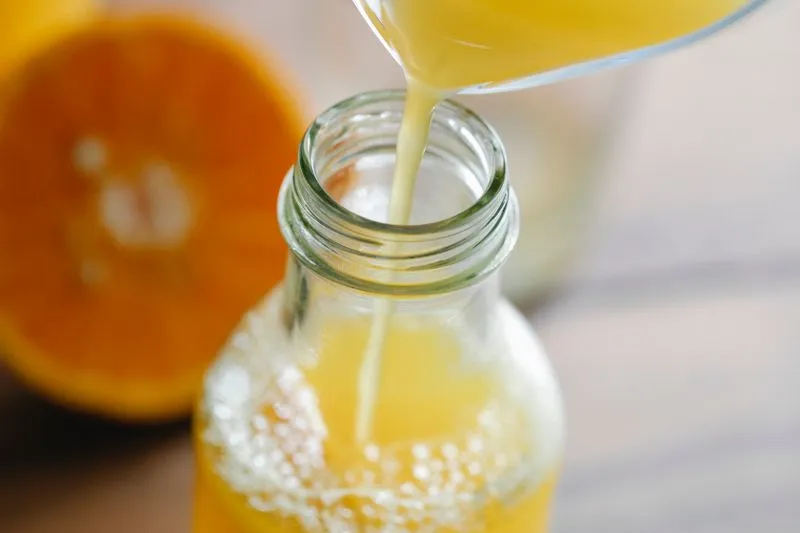
The trouble with juice
Unsweetened 100% fruit juice and smoothies "can only ever count as a maximum of 1 portion of your 5 A Day", however much you drink. Your combined total of juices and smoothies shouldn't exceed 150ml a day — "which is a small glass". When fruit is blended or juiced, the NHS explains, it releases its sugars, which raises the risk of tooth decay; whole fruit keeps its sugars inside the structure of the fruit.
That's why the sugar in juice counts as "free sugar", in the same category as the sugar you stir into tea. The NHS sugar guidance puts the limit for adults at no more than 30g of free sugars a day, roughly seven sugar cubes.
So-called detox juices are no exception; what actually works in a detox, and what is just marketing goes through those promises one by one.
The breakfast drink: unsweetened
Water, tea or coffee without sugar, or lower-fat milk: that's all the ideal breakfast drink needs to be. It's the easiest part to get right — and to get wrong without noticing.
The government recommends 6 to 8 glasses of fluid a day, and the NHS names water, lower-fat milk and lower-sugar drinks, including tea and coffee, as the healthier choices. The NHS gives a useful sense of scale: a can of cola "can have as much as 9 cubes of sugar – more than the recommended daily limit for adults." Few of us drink cola with breakfast. Many more pick up a syrup-flavoured latte on the way in, or put two sugars in their tea without thinking. That sugar adds up with the marmalade and the juice.
Milk is a special case — a milky coffee or a latte (unsweetened) already provides the dairy portion, so the drink ticks two boxes.
10 balanced sweet breakfasts
Each of these ten sweet combinations brings together all four parts. Amounts follow standard portions — a pot of yoghurt, 80g of fruit, one or two slices of bread or a few spoonfuls of oats, depending on how hungry you are.
- The express bowl. Plain low-fat Greek-style yoghurt, three spoonfuls of oats, a handful of frozen raspberries (they thaw while you get dressed), a cup of tea.
- Winter porridge. Oats cooked for five minutes in semi-skimmed milk, a sliced banana, a few chopped walnuts, a glass of water.
- The NHS classic. Two wholewheat biscuits with semi-skimmed milk and a sliced banana on top, a black coffee.
- Ricotta and strawberry toast. Two slices of wholemeal toast, ricotta, seven strawberries sliced on top, a green tea.
- Overnight oats. In a jar: oats, milk, plain yoghurt, frozen mango chunks. In the fridge overnight, in your bag in the morning, with a coffee at your desk.
- Sunday pancakes. Batter made with wholemeal flour, egg and milk, topped with blueberries; a herbal tea.
- Peanut butter toast. Wholemeal toast with 100% peanut butter, a medium orange, a glass of milk.
- Muesli and apple. No-added-sugar muesli, plain yoghurt, a grated apple with its skin on, a cup of tea.
- Cottage cheese and pear. Rye crackers, cottage cheese, a sliced pear, a sprinkle of cinnamon, a coffee.
- The station breakfast. A pot of plain porridge made with milk from a café (ask for no syrup), a banana, a bottle of water.
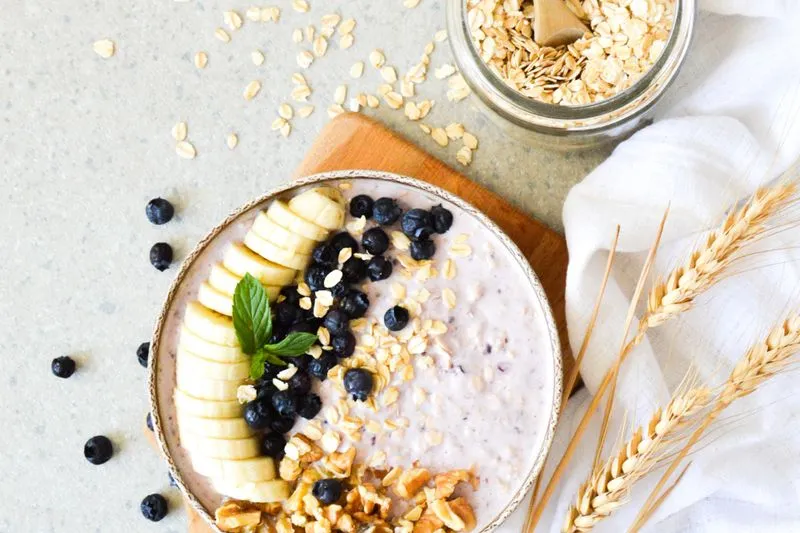
Honey, maple syrup and jam aren't banned — but honey and syrups count as free sugars in exactly the same way as table sugar. The NHS suggests swapping them on toast for sliced banana or lower-fat cream cheese; if you keep them, use a teaspoon for flavour and let the fruit do the rest.
10 balanced savoury breakfasts
The ten savoury combinations follow the same grid, with one flexibility: fruit can make way for a vegetable, since both count towards your 5 A Day. If you'd rather keep the fruit, it makes a very good pudding.
- Boiled egg and soldiers. One or two eggs, wholemeal toast soldiers, a satsuma or two, a cup of tea.
- Scrambled eggs. Two scrambled eggs on granary toast, seven cherry tomatoes, a coffee.
- Beans on toast. Reduced-sugar and reduced-salt baked beans on wholemeal toast, a glass of milk, an apple. Three heaped tablespoons of beans count as one of your 5 A Day.
- Hummus and crudités. Hummus on rye crackers, carrot and celery sticks, a pear, a glass of water.
- Spinach omelette. An omelette with baby spinach, a slice of wholemeal toast, a kiwi fruit, a cup of tea.
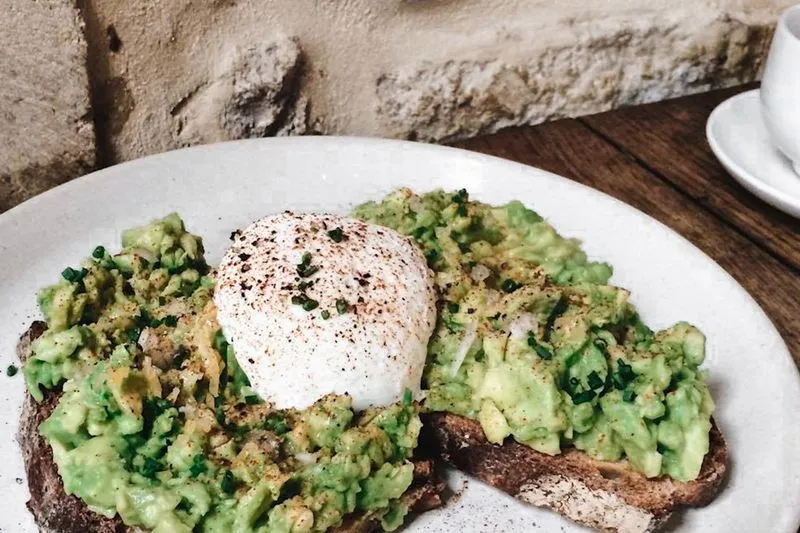
- Avocado and poached egg. Wholemeal toast, smashed avocado, a poached egg, a few tomatoes, a coffee.
- Cheese and oatcakes. A small piece of Cheddar, oatcakes, an apple, a cup of tea. Hard cheese is on the NHS list of foods containing saturated fat: keep the piece modest.
- Smoked mackerel on rye. Smoked mackerel on rye bread, a squeeze of lemon, sliced cucumber, a cup of tea. Smoked fish can be high in salt, the NHS notes, so keep this one for once in a while; it still counts towards the Eatwell Guide's target of at least two portions of fish a week, one of them oily.
- Yoghurt, cucumber and pitta. Plain yoghurt with grated cucumber and mint, a wholemeal pitta, a nectarine, water.
- A lighter full English. A poached egg, grilled mushrooms and tomatoes, reduced-sugar beans and wholemeal toast, a cup of tea — the weekend fry-up, grilled rather than fried.
Cereal, yoghurt, bread: reading the label in 30 seconds
In the supermarket, the quickest things to read are the red, amber and green colour coding on the front of the pack and the "of which sugars" line on the back. The NHS guide to sugar gives the thresholds: more than 22.5g of total sugars per 100g is high, and 5g or less per 100g is low. Anything in between is medium.
- Compare per 100g, not per serving. Serving sizes vary from brand to brand; the 100g column doesn't.
- Look for fibre too. Between two similar cereals or loaves, compare the fibre line per 100g and pick the higher one.
- Distrust words, not products. "Wholegrain", "lighter" or "fitness" aren't a sugar rating: a cereal can contain wholegrains and a lot of sugar. The NHS advice is to choose unsweetened wholegrain cereals "that are not frosted, or coated with chocolate or honey".
For yoghurt, the rule is simpler — buy it plain and add the fruit yourself. Remember, too, that the "of which sugars" figure includes milk and fruit sugars, which aren't free sugars (compare two similar products side by side rather than reading one in isolation).
Rushed mornings: prepare breakfast the night before or eat later
When time is short, breakfast shrinks to a cup of coffee. The fix rests on one principle — move the effort from the morning to the night before, or from home to your desk.
Oats soaked overnight in milk or yoghurt are the most efficient formula: three minutes in the evening, none in the morning, and a jar that travels well. Eggs can be hard-boiled while dinner cooks. A wholemeal loaf, sliced and frozen, goes straight from the freezer to the toaster. The same prepare-ahead habit works for the whole week — meal prep is one of the strategies for sticking to a diet long-term.
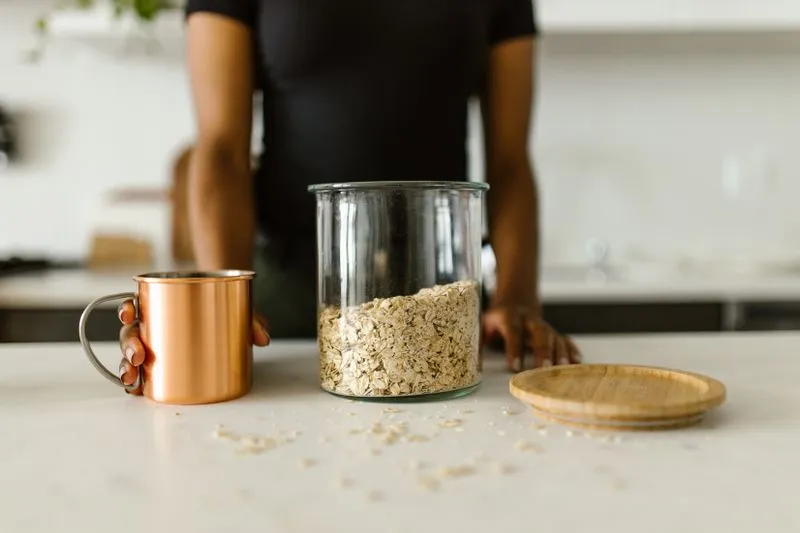
Nothing says you must eat the minute you get up. A proper breakfast at your desk at 9.30 beats a coffee at 7 followed by a pastry at 11. A pot of yoghurt and a banana picked up on the way in, a bag of oats kept at work: all four parts fit in a tote bag. And the croissant keeps its place as a weekend pleasure.
5 mistakes that unbalance a breakfast
The most common breakfast mistakes come down to a missing part.
- The all-liquid breakfast. A coffee and a juice: no protein, no fibre, and free sugars. Keep the coffee, swap the juice for whole fruit, add some dairy.
- The all-sweet breakfast. White toast, marmalade, juice and sugared tea — three sources of free sugars, refined bread and almost no fibre. Switch to wholemeal, keep one sweet item, add protein.
- Children's cereals. Frosted, chocolate-coated or honey-glazed cereals are exactly what the NHS advises against. Go for plain wholegrain cereal and add fruit.
- Nothing, then a doughnut at 11. Skipping breakfast isn't a problem in itself; the mid-morning pastry is. Move breakfast later rather than cutting it out.
- The overloaded "healthy" bowl. Granola, honey, dried fruit and chocolate chips: a bowl that looks virtuous can pack a lot of free sugar. Go back to a plain base, fresh fruit and a small handful of nuts.
These mistakes look a lot like the ones that derail any change of diet; the five diet mistakes that sabotage progress, and what to do instead puts them in the context of the whole day.
Frequently asked questions
What is the most balanced breakfast?
The answer is a grid: a source of protein (dairy, egg, cheese, beans or hummus), a wholegrain, a piece of whole fruit and an unsweetened drink. Porridge made with milk and topped with berries, with a cup of tea, fits it — and so do two eggs on wholemeal toast with an orange and a coffee.
Is it bad to skip breakfast?
Not for a healthy adult who isn't hungry and doesn't make up for it with a pastry at 11. A 2019 BMJ meta-analysis of 13 trials found no evidence that adding breakfast helps weight loss. If you're pregnant or live with diabetes, talk to your GP before changing when you eat.
Does fresh orange juice count as fruit?
Only as one portion of your 5 A Day, however much you drink, and the NHS recommends no more than 150ml of juice and smoothies combined a day. The sugars in juice count as free sugars, so whole fruit is the better choice.
How long after waking should I eat?
NHS guidance doesn't set a time. If you're hungry when you wake up, eat; if not, a proper breakfast later in the morning does the same job. The thing to avoid is the improvised mid-morning snack.
Are breakfast cereals unhealthy?
Not all of them. Plain wholewheat cereals, shredded wholegrain, porridge oats and no-added-sugar muesli have their place. Frosted or chocolate-coated cereals are often high in sugar: check the "of which sugars" line and aim for the lower figures per 100g.
Can I have a balanced breakfast without dairy?
Yes. Eggs, baked beans, hummus and a small handful of unsalted nuts can all provide protein. If you replace milk with a plant drink, choose an unsweetened one, and talk to your GP or a dietitian if you cut out dairy completely for the long term.