The summer I decided to drink two litres of water a day, I was in my twenties, on a holiday train that smelled of sun cream, with a women's magazine open on my lap. Between the swimsuit pages, a little box promised glowing skin to anyone who finished her bottle before evening. I took it at its word. The next day I bought a 1.5-litre bottle, refilled every afternoon, and drew a felt-tip line on it for every hour — 9am, 10am, 11am, all the way to 6pm. It came everywhere with me — to work, to the beach, even into the cinema.
What I remember most is the taste of warm plastic, the cap clicking under the table and a trip to the loo every forty minutes. Three weeks in? My skin looked exactly the same. All I had learnt was the location of every public toilet on my route (a skill no employer has ever asked me about).
Twenty-odd years later, the rule hasn't aged a day. It's printed on bottles marked hour by hour, and it comes back every summer as soon as the temperature climbs. Here's the twist for anyone in the UK — official advice doesn't tell you to drink two litres of water. The NHS talks about 6 to 8 cups or glasses of fluid, and tea counts. The European reference figure (2 litres a day for an adult woman, set by the European Food Safety Authority, EFSA) isn't what you should drink either. It adds up all the water you take in, including the water in your salad, your yoghurt and your morning cuppa.
Below: where the numbers come from, what they really cover, the signs that you're short of water and how to adjust when summer heat arrives or when you exercise. With one red line to keep in mind — more isn't always better.
Where does the eight-glasses-a-day rule come from?
The eight-glasses rule isn't based on any study. In a piece on the water myth for McGill University's Office for Science and Society, the physician Christopher Labos traces it back to 1945. That year, the US Food and Nutrition Board recommended 2.5 litres of water a day. The recommendation, he writes, "was not based on any research" — and it stated that most of that water could come from food. The second half of the sentence got lost along the way. The first half became gospel.
The most robust measurement we have points the same way. In 2022, an international team led by Yosuke Yamada published in the journal Science a study of daily water turnover in 5,604 people (aged from 8 days to 96 years, in 26 countries). Rather than asking people what they drank — the authors point out how imprecise those surveys are — the researchers tracked water labelled with deuterium, an isotope of hydrogen. That told them how much water really moved through each body every day. Their conclusion is blunt:
One size does not fit all for drinking water guidelines, and the common suggestion that we should drink 8 × 8oz glasses of water per day (approx. 2 L) is not backed by objective evidence.
The spread they measured is huge. Daily turnover runs from around 1 to 1.5 litres at the low end to around 6 litres at the top — with a few outliers near 10 litres. Their model gives a useful sense of scale. A non-athletic 20-year-old woman weighing 60kg, living at sea level with a mean temperature of 10°C, turns over about 2.7 litres a day. The same woman, athletic, at 2,000 metres, in 30°C heat and 90% humidity? About 6.8 litres.
One detail matters when reading these figures — turnover isn't the same as what you drink. It includes water the body makes itself (around 10%) and a few per cent taken in through breathing and the skin. Drinks and food supply roughly 85%. None of it translates into "glasses" to get down — which is exactly the problem with the rule.
How much water should you drink a day? What the NHS and EFSA actually say
In the UK, the benchmark is modest. The NHS page on water, drinks and hydration says the Eatwell Guide recommends aiming for 6 to 8 cups or glasses of fluid a day. Fluid, not water: "Water, lower-fat milk and sugar-free drinks, including tea and coffee, all count." The British Nutrition Foundation puts that at around 1.2 litres in total — six 200ml glasses or eight 150ml ones. The NHS adds that you may need more if you're pregnant or breastfeeding, in a hot environment, physically active for long periods, or ill or recovering from illness.
EFSA's figures look bigger — but they measure something else. For an adult woman, EFSA considers a total water intake of 2 litres a day adequate — 2.5 litres for a man. These values appear in EFSA's summary report on dietary reference values, which restates its 2010 opinion on water. The wording is explicit: the reference values include drinking water, beverages of all kinds and the moisture in food.
These are "adequate intakes", not needs measured to the last millilitre. Water requirements vary between individuals and with the environment, EFSA explains, so it based the values on intakes observed in populations whose urine had a desirable concentration. The same figures apply from 14 and into older age. And they only hold at moderate temperatures and moderate activity levels — not on a heatwave afternoon, and not on a lunchtime run in full sun. For a sense of the range, EFSA puts the 95th percentile of women's intakes at 3.1 litres.
So how much ends up in the glass? The British Dietetic Association (BDA) translates EFSA's values into water from drinks: 1,600ml a day for women and 2,000ml for men, with drinks providing around 70–80% of our water and food the other 20–30%. A mug holds about 250ml (BDA again), so 1.6 litres is roughly six or seven mugs of tea, water or milk. Even converted to drinks, EFSA's figure (1.6 litres for women) sits a little above the NHS's 6 to 8 glasses (about 1.2 litres) — the British Nutrition Foundation notes that EFSA's values "differ somewhat from UK recommendations". Both are guides, not targets, and neither asks for two litres of plain water.
| Group | Total water, food included (EFSA) | From drinks (BDA) |
|---|---|---|
| Women (14 and over, older adults included) | 2.0 L a day | 1,600ml |
| Men (14 and over, older adults included) | 2.5 L a day | 2,000ml |
| Pregnancy | +300ml a day | +300ml |
| Breastfeeding | about +700ml a day | +600–700ml |
| Girls aged 9 to 13 | 1.9 L a day | 1,520ml |
| Children aged 4 to 8 | 1.6 L a day | 1,280ml |
Water from food: the share of your intake you forget
Part of the water you need arrives on a fork — and it's far from trivial. According to Yamada's team (Science, 2022), dietary surveys around the world suggest food provides 20 to 50% of daily water intake. The authors think those estimates are probably too low, because such surveys tend to underestimate how much people eat. Conversely, a more energy-dense diet with less water in it means you need more from drinks.
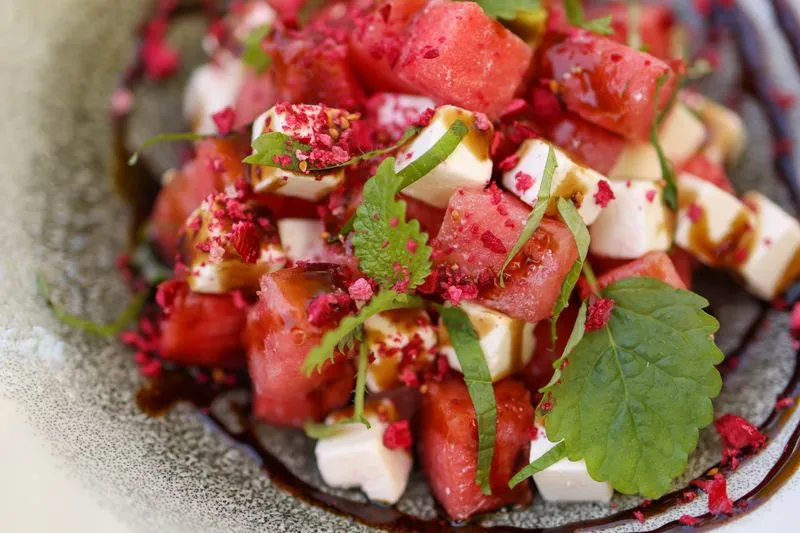
Fruit and vegetables are usually more than 80% water, according to the British Nutrition Foundation. The BDA lists soups, stews and many fruits and vegetables among the foods that contain a lot of water. The NHS, in its advice for carers, suggests soup, ice cream, jelly and fruit like melon to help someone you look after get enough fluid.
A summer day of chilled soup, a big salad and watermelon doesn't compare with a day of sandwiches and crisps. If you batch-cook on Sundays, a balanced meal prep plan with a sample week lends itself nicely to this — a chilled soup and a big salad in the rotation, and your water count climbs without you thinking about it.
Tea, coffee, milk, squash: which drinks count?
Every drink supplies water, and EFSA counts all of them. Tea, herbal tea, coffee, milk, stock — it all goes into the total. What changes from one drink to the next is what else comes with it — sugar, alcohol, caffeine.
Tea — reassuringly for most of us — counts. The BDA says caffeine has a small dehydrating effect, but the amount of water in a cup or mug of tea or coffee means the body benefits overall. The British Nutrition Foundation agrees that moderate amounts of caffeine don't seem to affect hydration. The best-known study on the question comes from the University of Birmingham. Published in PLOS ONE in 2014, it gave 50 regular male coffee drinkers (3 to 6 cups a day) four 200ml cups of coffee a day, then the same amount of water. Result — no sign of dehydration. Consumed in moderation by habitual drinkers, coffee hydrated about as well as water. Two limits, though — the volunteers were all men, and the intake was moderate.
Other drinks deserve a closer look — mostly because of the sugar. The NHS advises limiting fruit juice and smoothies to one small glass (150ml) a day, with a meal, because they're high in sugar. Squash and cordials should be diluted well. If you're not sure what's in a flavoured water or a bottled iced tea, learning to read food labels saves a lot of surprises (the NHS suggests looking for green or amber colour-coded labels). And if fizzy drinks are your weak spot, a step-by-step guide to cutting down on sugar helps you wean yourself off without misery.
Alcohol is the exception — and a big one in summer. The British Nutrition Foundation says alcoholic drinks don't count towards your fluid intake, because they make you urinate more than usual. And the NHS lists having drunk too much alcohol among the things that make dehydration more likely. None of that condemns your breakfast tea. It does mean the Pimm's in the beer garden and the afternoon iced lattes don't replace water on a hot day.
Signs of dehydration to look out for in adults
The early signs of dehydration are easy to miss — easy enough to blame on a long day. The NHS lists them as:
- feeling thirsty;
- feeling dizzy or light-headed;
- dark yellow, strong-smelling pee, and peeing less often than usual;
- feeling tired;
- a dry mouth, lips and tongue;
- sunken eyes.
Urine colour is the simplest day-to-day check. The NHS says most people should aim to drink enough during the day so their pee is a clear pale yellow colour; the BDA describes a pale straw colour. Dark yellow urine is often a sign of dehydration — although, the BDA notes, it can occasionally have other causes.
Thirst is a good guide for most healthy adults. The British Nutrition Foundation explains that thirst kicks in when the body is already a little dehydrated, so it's important to drink when you're thirsty. Christopher Labos, at McGill, goes further: thirst is the signal, and without it there's no need to force down six to eight glasses. My own reading (not official guidance): for a healthy adult in ordinary conditions, thirst does the job; for older people, whose thirst response is weaker, and for young children, who can't always say they're thirsty, regular drinks matter more — and on a hot day it pays to keep a drink within reach. The BDA adds a useful nuance: when you drink, you stop feeling thirsty before your body is completely rehydrated.
A small water loss is nothing to panic about — the body knows how to catch up. According to EFSA, losing about 1% of body weight as water is normally made up within 24 hours. Beyond that, without compensation, physical and mental performance drop, along with temperature regulation and heart and circulation function. A loss of 10% or more of body water can be fatal. The British Nutrition Foundation notes that a loss of as little as 2% (about 1.4 litres for a 70kg man) can impair thinking and athletic performance — roughly 1.2kg of water for a 60kg woman.
Hot weather: why your water needs go up
In hot weather the body cools itself by sweating — and that water has to be replaced. Yamada's team (Science, 2022) followed 72 people through spring and summer. Their water turnover rose on average from 3.0 litres a day (at 18°C) to 3.7 litres (at 29°C) — with no change in how much energy they burned. Across the whole sample, the researchers found around a litre more turnover a day at 30°C than between 0 and 10°C.
And you don't need a record-breaking heatwave for it to matter. In its summer briefing published on 11 June 2025, the UK Health Security Agency (UKHSA) reported 1,311 heat-associated deaths in England during four periods of heat in 2024 — 282 more than predicted from the temperatures. The highest death rates were among people aged 85 and over, then 75 to 84. Yet significant deaths occurred in three of the four heat episodes, even though only yellow Heat-Health Alerts (the lowest level) were issued. The agency is clear that "High temperatures can affect anyone, not just those traditionally seen as vulnerable." Its alerts, developed with the Met Office, run from yellow to amber to red — and, in its words, "Heat doesn't have to be record-breaking to be dangerous for some."
The NHS advice on preventing heat exhaustion is short. Drink more cold drinks, especially if you're active or exercising. Wear light-coloured, loose clothing. Avoid the sun between 11am and 3pm, avoid drinking too much alcohol and avoid extreme exercise. Indoors on a very hot day, close the curtains — and close the windows if it's hotter outside than in.
EFSA is plain about it: its reference values only apply at moderate temperatures and activity levels. Under extreme heat and exercise, water losses can reach about 8 litres a day. Lost electrolytes then have to be replaced too, to keep the blood's sodium balance steady.
Exercise and hydration: drinking before, during and after
Exercise pushes up sweat losses — all the more so in the heat. Yet the most striking advice for runners is about drinking less, not more. The London Marathon's medical advice tells runners to drink to thirst. It warns that drinking too much can cause hyponatraemia (water intoxication), which can lead to fits and even death. Runners need more fluid in the heat and less in cool conditions, and should rehydrate gradually over the 24 to 48 hours after the race.
For most workouts, water is all you need — no neon bottles required. The British Nutrition Foundation says water is fine for rehydrating after moderate exercise, and most active people don't need special sports drinks. Drinks containing some sugars and sodium (salt) become useful for high-intensity exercise lasting more than an hour or so — sports drinks or homemade versions. EFSA makes a similar point in an episode of its podcast on hydration: for heavy physical work or competitive sport, drink small amounts very often, and not only water but also electrolytes and sometimes sugars.
A Saturday-morning parkrun in June is not an ultramarathon — but a lunchtime 10k in a heatwave is a different story. The NHS lists extreme exercise among the things to avoid in hot weather, and advises staying out of the sun between 11am and 3pm. Move the session to early morning or evening, when the pavements have cooled.
Drinking too much water: hyponatraemia, rare but real
Drinking far too much, too fast, can be dangerous — the flip side of the eight-glasses rule. EFSA notes that adult kidneys can excrete at most about 0.7 to 1 litre of water an hour. Beyond that, the excess water dilutes the sodium in the blood. That's hyponatraemia, which can progress to water intoxication with swelling of the brain. EFSA describes it as rare, occurring in particular with over-rapid rehydration or excessive water intake.
The British Nutrition Foundation lists the symptoms as fatigue, dizziness, confusion and seizures. Some overlap with dehydration, which can mislead a runner who drinks "just in case" at every water station. The BNF adds that severity depends on how much fluid is drunk and how fast, and can be affected by sodium lost in sweat during endurance exercise.
None of the sources consulted suggests forcing down litres beyond the 6 to 8 glasses guide in ordinary conditions. And the idea of "flushing out toxins" with three or four litres a day doesn't hold up either. That job belongs to the liver and kidneys, as our guide to detoxing, what works and what's marketing explains.
Pregnancy, breastfeeding, age and medicines: when your water needs change
In pregnancy, EFSA adds 300ml a day to the reference value for women. It found no data on the usual intakes of pregnant women, so it raised the figure in line with the rise in energy needs. While breastfeeding, the extra is about 700ml a day. The NHS reminds pregnant women not to have more than 200mg of caffeine a day — worth keeping in mind if tea and coffee are your main fluids.
With age, the sense of thirst weakens — the British Nutrition Foundation and the BDA both flag it. The BNF says the thirst response may be weaker in older adults; the BDA says thirst isn't a useful measure in children and older adults, who should be encouraged to drink regularly. EFSA keeps the same reference value for older adults, noting that their water needs per calorie rise because the kidneys concentrate urine less well. If your parents or grandparents live alone, ring them during hot spells — and remind them to drink.
Some medicines and conditions change the picture. The NHS lists diabetes and medicines that make you pee more (diuretics) among the things that make dehydration more likely. And in some situations the advice runs the other way: if a doctor has told you to limit your fluids, that instruction comes before any general guideline. On a long-term treatment? Ask your GP or pharmacist how to handle hot weather before summer starts.

A simple hydration routine, no counting required
The best hydration strategy is the one you keep up without thinking — not the one that pings every hour. The BDA's advice fits on a sticky note: drink little and often, and keep a bottle or jug of water on your desk or meal table. A few habits complete the picture.
- Tap water first. It's free (as the British Nutrition Foundation points out) and it hydrates without calories or sugar.
- Flavour without sugar. If you don't like plain water, the NHS suggests sparkling water, no-added-sugar squash or a slice of lemon or lime.
- Milk counts. A glass of semi-skimmed milk adds fluid and calcium; our guide to essential micronutrients for women explains where else calcium comes from.
- Mind the air-conditioning. The BDA notes that warm, dry environments — hot sunny days, but also air-conditioned offices — can increase your need for water.
- A glance, not an app. Pale urine by mid-afternoon tells you more than a counter on your phone.

Frequently asked questions
Do I really need to drink 2 litres of water a day?
No, not as plain water. EFSA's 2 litres a day for an adult woman covers all the water you take in, food included. The NHS recommends 6 to 8 cups or glasses of fluid a day — around 1.2 litres, according to the British Nutrition Foundation — and more in hot weather or when you're active.
Does tea count towards my fluid intake?
Yes. The NHS counts tea and coffee as part of your daily intake, and the BDA says the water in a cup or mug outweighs caffeine's small dehydrating effect. Keep it moderate — and no more than 200mg of caffeine a day if you're pregnant.
Does squash count?
Yes, it's mostly water. The NHS advises diluting squash and cordials well, or choosing no-added-sugar versions, to keep the sugar down.
How can I tell if I'm drinking enough?
Three checks are enough: no lingering thirst, pale urine (the NHS says clear pale yellow), and no unusual tiredness or headaches.
Should I drink cold drinks in a heatwave?
Yes. To prevent heat exhaustion, the NHS advises drinking more cold drinks, especially if you're active or exercising — and avoiding too much alcohol.
Can you drink too much water?
Yes, although it's rare. Adult kidneys can excrete at most about 0.7 to 1 litre of water an hour, according to EFSA. Beyond that, the sodium in the blood becomes diluted (hyponatraemia), causing fatigue, dizziness, confusion and, in severe cases, seizures.
Can I drink water during intermittent fasting?
Yes. Water has no calories and is allowed during fasting hours. To fit a fasting schedule to your life, see our complete guide to intermittent fasting for women.
Sources
- NHS — Water, drinks and hydration
- NHS — Dehydration
- NHS — Heat exhaustion and heatstroke
- UK Health Security Agency — Heat Health: what you need to know for summer (11 June 2025)
- British Dietetic Association — Fluid (water and drinks), Food Fact Sheet (2023)
- British Nutrition Foundation — Hydration
- EFSA — Dietary Reference Values for nutrients, Summary Report (2017), water section
- EFSA — Podcast, episode 9: Thirsty work (17 August 2023)
- Yamada Y. et al. — Variation in human water turnover associated with environmental and lifestyle factors (Science, 2022)
- Killer S. C., Blannin A. K., Jeukendrup A. E. — No Evidence of Dehydration with Moderate Daily Coffee Intake (PLOS ONE, 2014)
- McGill University Office for Science and Society — The Water Myth (Christopher Labos, 2018)
- London Marathon Events — Medical advice