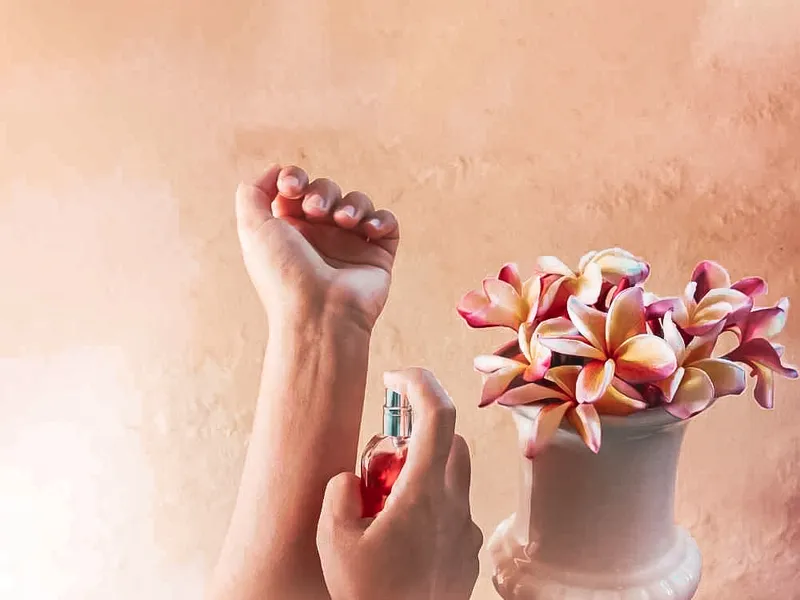
You spray your perfume on one wrist, press both wrists together, give them a quick rub — done. It's one of those things most of us learned by watching someone else do it, and we've been repeating it without a second thought ever since. I did it for years. It felt right, like some kind of fragrance activation ritual. Except it's not. And once you understand what's actually happening at the molecular level when you rub, you'll never do it again.
Where the wrist-rubbing habit actually comes from
The wrist-rub probably dates back to the mid-20th century, when perfume application was more theatrical than scientific. Department store counters encouraged customers to spray on blotter cards, then on their wrists — and rubbing became part of the demo ritual. It also made intuitive sense: if you spread the fragrance over a wider area, you'd smell more of it, right? The logic felt airtight. The chemistry, though, tells a completely different story.
There's also a cultural dimension. In many families, mothers taught daughters to rub their wrists together after applying perfume, and that gesture became embedded in our beauty routines alongside things like blotting lipstick on tissue or pumping the mascara wand (also a bad idea, by the way — it pushes air into the tube). Some habits survive not because they work, but because nobody questions them.
Perfumers themselves have been trying to debunk this one for decades. François Demachy, the nose behind some of Dior's most iconic fragrances, has mentioned in interviews that rubbing is one of the most common mistakes consumers make. Yet here we are, still doing it. Old habits don't die easily — especially the ones that feel like they should work.
What happens when you rub perfume — the chemistry
A perfume isn't just a nice smell in a bottle. It's a carefully engineered sequence of volatile organic compounds, each designed to evaporate at a specific rate. When you spray it on your skin, those molecules begin their journey — the lightest ones lift off first (that initial burst you smell), followed by progressively heavier compounds over the next several hours.
Rubbing disrupts this entire process. The friction generates heat — not a lot, but enough to accelerate the evaporation of the most volatile molecules. Those delicate top notes, the ones that give you that gorgeous first impression? They vanish faster than they should. Instead of a gradual, layered reveal, you get a compressed, muddled version of what the perfumer intended.
Think of it like opening a bottle of champagne by shaking it versus popping the cork gently. Same bottle, same contents, but one method gives you a controlled experience while the other wastes half the product. Your €120 fragrance deserves the gentle cork pop, not the Formula 1 podium spray.
The International Fragrance Association notes that modern perfumery relies on precise evaporation curves — each compound is chosen partly for its volatility index. Rubbing essentially flattens that curve, compressing what should be a six-to-eight-hour olfactory journey into something far less nuanced.
Top notes, heart notes, base notes — what's at stake
To understand why rubbing matters, you need to know how a fragrance unfolds. Every perfume is built in three layers, and each one serves a purpose:
Top notes are the opening act. They're light, volatile molecules — typically citrus, herbs, or light florals — that hit your nose within the first 15 minutes. They're designed to be bright and attention-grabbing, the fragrance equivalent of a firm handshake. Compounds like limonene (citrus), linalool (lavender), or bergaptene (bergamot) fall in this category. They evaporate fast by design.
Heart notes (or middle notes) emerge once the top notes fade, usually 20 minutes to two hours after application. This is the core personality of the fragrance — richer florals, spices, or fruits. Jasmine, rose absolute, ylang-ylang, cardamom. These molecules are heavier, so they linger longer and transition smoothly from the opening.
Base notes are the foundation. They're the heaviest molecules — sandalwood, musk, amber, vetiver, vanilla — and they can last eight hours or more on skin. They provide depth and anchoring, the part of the fragrance that's still detectable on your scarf the next morning.
When you rub, you're essentially sacrificing the top notes (and sometimes even the opening of the heart notes) for a brief initial burst of scent. The base notes survive because they're too heavy to be affected much by friction, but without the full olfactory arc leading into them, they can smell disconnected — like hearing the last movement of a symphony without the first three.
Pulse points: why wrists matter (but not like that)
Here's the thing — your wrists are still a great spot for perfume. That part of the advice is solid. The issue is exclusively the rubbing, not the location.
Pulse points are areas where blood vessels sit close to the skin's surface: the insides of your wrists, behind your ears, the base of your throat, the inside of your elbows, and behind your knees. The gentle warmth from your body heat at these spots helps fragrance molecules lift off your skin gradually, projecting the scent outward in a natural, continuous way. It's like a slow-release mechanism built into your own body.
The key word there is gently. Your body temperature does exactly what rubbing tries to do — accelerate evaporation — but at a pace that respects the fragrance architecture. Body heat operates at roughly 36.5–37°C, which is the range perfumers actually design for. Friction adds unpredictable spikes on top of that baseline, and those spikes are where things go wrong.
There's a reason why perfume ads (at least the ones with any basis in reality) show people spraying onto pulse points and then just… leaving it. No rubbing, no dabbing, no spreading. The application and the body's warmth do all the work.
Some perfumers even suggest spraying perfume into the air and walking through the mist — this gives you an even, ultra-light distribution across your skin, clothes, and hair simultaneously. It's wasteful (maybe 40% ends up on the floor), but the result is a subtle, all-encompassing scent cloud that's quite different from concentrated pulse-point application.
How to actually apply perfume for maximum longevity
Alright, enough about what not to do. Here's what actually works — a proper application routine that'll get you the most out of every spray.
Step 1 — Moisturize first. Fragrance clings better to hydrated skin. Dry skin absorbs and dissipates scent molecules faster. Apply an unscented body lotion or cream to your pulse points about five minutes before spraying your perfume. Some brands sell matching body lotions for exactly this reason — the lotion creates a "sticky" base that holds onto fragrance molecules longer.
Step 2 — Spray from 15–20 cm away. Too close and you get a concentrated wet spot that takes forever to dry and smells overwhelmingly of alcohol for the first five minutes. Too far and most of the mist never reaches your skin. Aim for about the length of your hand and forearm combined.
Step 3 — Apply to pulse points (no rubbing). Wrists, neck, behind the ears, and — this one's underrated — the inside of your elbows. If you're wearing a low neckline, the décolletage works beautifully too. Spray and let it sit. That's it. Walk away. The temptation to touch it will be strong; resist.
Step 4 — Consider spraying your hair. Hair fibres hold fragrance incredibly well, sometimes even better than skin. But spray from a distance (30 cm minimum) — alcohol can dry out hair if applied too directly. Some people spray onto a hairbrush and then brush through. Genius move.
Step 5 — Spray clothes strategically. Fabric is excellent at holding base notes — your scarf will still smell like your perfume two days later. But test on an inconspicuous area first, because some fragrances contain compounds that can stain lighter fabrics. Silk is particularly vulnerable.
And one more thing — don't overspray. Two to four sprays total is almost always enough for an Eau de Parfum. For Eau de Toilette, you can go up to five or six because the concentration is lower. More than that and you risk olfactory fatigue (your nose stops registering it) while everyone around you can't escape it. We've all been stuck next to that person on the train.
6 other perfume mistakes you're probably making
Since we're clearing up fragrance myths, let's tackle a few more while we're at it. These are surprisingly common — and surprisingly easy to fix.
1. Storing perfume in the bathroom. Heat, humidity, and light are fragrance's three worst enemies. That beautiful bottle sitting on your bathroom shelf is slowly degrading every time you take a hot shower. Keep perfume in a cool, dark, dry place — a bedroom drawer or closet shelf is perfect. Some collectors even store theirs in the fridge (the door shelf, not next to the milk).
2. Shaking the bottle before spraying. This introduces air into the liquid, which can oxidize certain compounds and alter the fragrance over time. Most modern spray bottles are designed to work without shaking. If yours has a splash opening, just tilt — don't shake.
3. Applying perfume right after a hot shower. Counterintuitive, I know — everyone says to apply after showering. And they're half right: you want clean skin. But wait about five minutes for your pores to close slightly and your skin temperature to normalise. Applying onto overheated skin has the same accelerated-evaporation problem as rubbing.
4. Spraying onto dry, unprepped skin. We covered this above, but it bears repeating. Unscented moisturiser is the single most effective thing you can do to extend your fragrance's lifespan. Think of it as primer, but for perfume.
5. Using the same fragrance year-round. Perfume interacts with your skin chemistry, and your skin chemistry changes with the seasons. Heavier, warmer fragrances (oud, amber, vanilla) work beautifully in cold weather because the dry air helps project them without becoming overwhelming. In summer, those same fragrances can feel suffocating. Lighter, fresher scents (citrus, aquatic, green) shine when it's warm.
6. Judging a perfume on the first spray. What you smell in the first 30 seconds is mostly alcohol and top notes. Give any new fragrance at least two hours before deciding if you like it — the heart and base notes are where the real character lives. Better yet, get a sample and wear it for a full day. You might hate the opening and love the dry-down, or vice versa. Knowing how to properly test perfume can save you from expensive regrets.
Fragrance layering: the advanced trick that changes everything
Once you've nailed the basics of application, there's a next level: layering. This technique, borrowed from Middle Eastern perfumery traditions, involves combining two or more fragrances to create something unique — a scent that's entirely your own.
The simplest approach is to start with a neutral, skin-like base — something with musk, sandalwood, or iso e super — and then spray your chosen fragrance on top. The base acts as a canvas that extends the longevity and adds depth to whatever you layer over it. Brands like Le Labo, Maison Francis Kurkdjian, and Escentric Molecules make fragrances specifically designed for layering.
A more adventurous approach is combining two full fragrances. Rules of thumb: pair contrasting families (floral with woody, citrus with oriental) rather than similar ones, and apply the heavier scent first so the lighter one can lift off the top. Spray one on your wrists and the other on your neck, or apply one directly on skin and the other on clothing — different surfaces release molecules at different rates, creating a shifting, multi-dimensional effect throughout the day.
Layering is also the answer when a fragrance you love doesn't last long enough. That gorgeous but fleeting Eau de Toilette? Layer it over a long-lasting musk or amber base, and you'll extend its presence by hours. It's not cheating — it's engineering.
The one rule: skip the wrist rubbing for layered fragrances too. Each layer needs to develop independently before they interact. Rubbing doesn't just flatten one fragrance — it scrambles the whole composition.
Frequently asked questions
Does rubbing actually "break" perfume molecules?
Not in the sense of shattering them, but friction generates localised heat that accelerates the evaporation of lighter volatile compounds. Certain ester bonds in top-note molecules can also be disrupted by mechanical stress. The result isn't molecular destruction per se — it's premature release and altered evaporation kinetics that change the scent profile and shorten the wearing time.
Is dabbing with your wrist okay, or is that the same as rubbing?
A single, very gentle press — wrist to wrist, no sliding motion — is generally fine. You're transferring liquid, not creating friction. The key is no lateral movement. Think of it as a stamp, not an eraser. That said, simply spraying each wrist individually eliminates any risk and only takes two seconds.
Why does perfume smell different on different people?
Your skin's pH level, microbiome composition, moisture level, temperature, and even diet all influence how fragrance molecules interact with your body. Skin with a more acidic pH tends to amplify sharper, citrus-forward notes, while alkaline skin often softens and rounds out a fragrance. This is why a perfume that smells incredible on your friend might be underwhelming on you — and why testing on your own skin is essential before buying.
How long should a good perfume last on skin?
An Eau de Parfum (15–20% concentration) should last 6–8 hours minimum on properly moisturized skin. An Eau de Toilette (5–15%) typically lasts 3–5 hours. Perfume extraits (20–40%) can last 12+ hours. If your fragrance disappears within an hour, the issue is usually dry skin, rubbing, or improper storage rather than the product itself.
Can you make cheap perfume last longer with better application?
Absolutely. Proper application technique can dramatically extend even a drugstore fragrance. Moisturize before spraying, apply to pulse points without rubbing, and consider spraying on clothes (test for staining first). You can also try applying a thin layer of unscented Vaseline to pulse points — its occlusive texture traps fragrance molecules against your skin. It won't transform a two-hour EDT into an eight-hour performer, but you might gain an extra hour or two.
Sources
Keep on bubbling
- How to apply perfume the right way — advanced tips for sillage and projection
- Best perfumes to gift a woman — curated picks across every fragrance family
- Best perfumes to gift a man — from fresh to oriental, the scents men actually love