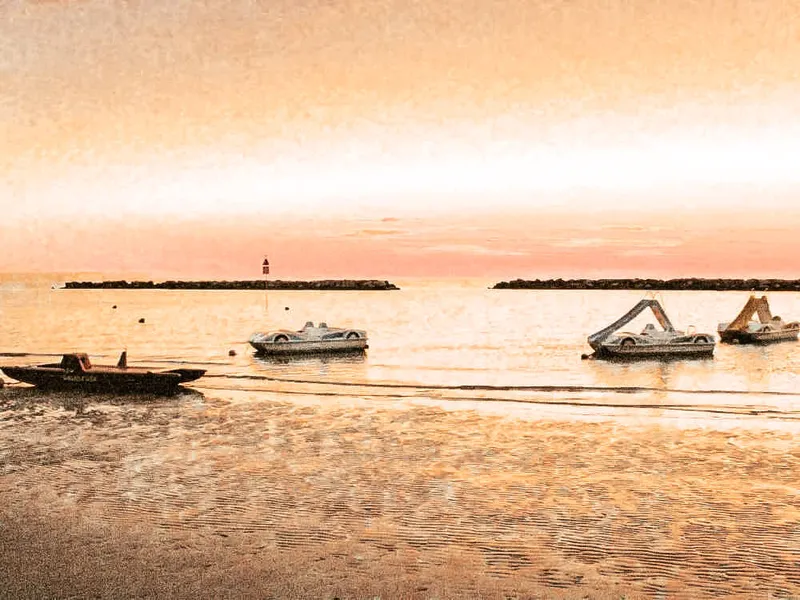
The last time I'd been on a pedalo I was eleven years old, on a family holiday in Majorca, and the experience was defined by three things: my father's increasingly red face as he pedalled against the current, my mother's calm refusal to help pedal because she was reading, and my own absolute conviction that we were going to capsize and be eaten by something. We returned to shore sunburned, argumentative, and somehow delighted. It was, in the way that all slightly chaotic family experiences are, perfect.
Twenty-odd years later, on a beach in the south of France, I saw the pedalos lined up on the sand — those cheerful, ungainly, vaguely swan-shaped vessels that look like they were designed by a committee that couldn't decide whether they were making a boat or a playground — and something in my chest contracted with a nostalgia so specific it was almost physical. Before I had consciously decided anything, I was handing over €15 to a tanned teenager who looked at me with the particular pity that beach rental employees reserve for adults who voluntarily choose the pedalo over the jet ski.
Forty minutes later, floating gently a hundred metres from shore, legs tired from pedalling, face warm from the sun, watching fish through the clear water beneath the boat while absolutely nothing was expected of me — no emails, no phone signal, no responsibilities beyond eventually pedalling back — I understood something. The pedalo is not a compromise water activity. It's not the thing you do because you can't afford the speedboat. It's the thing you do because, in its absurd, slow, leg-powered simplicity, it offers something that almost no other summer activity provides: uncomplicated, unironic, completely available joy.
Why pedalos deserve more respect
The pedalo occupies a strange position in the hierarchy of water activities. It sits somewhere below kayaking (which is considered athletic), far below sailing (which is considered sophisticated), and leagues below surfing (which is considered cool). The pedalo is considered, at best, quaint. At worst, dorky. It's the thing your uncle does at Center Parcs. It's the watercraft equivalent of wearing socks with sandals — functional, harmless, and socially uncelebrated.
This is profoundly unfair, and I would like to mount a formal defence.
The pedalo requires no skill. Unlike sailing (which requires knowledge), surfing (which requires balance and years of practice), and jet skiing (which requires a willingness to terrify nearby swimmers), the pedalo requires only the ability to sit down and move your legs. If you can use a bicycle, you can use a pedalo. If you can't use a bicycle, you can probably still use a pedalo, because there's no balancing involved — the thing is essentially unsinkable. This accessibility is not a weakness. It means that literally anyone — any age, any fitness level, any experience level — can enjoy being on the water. That's not quaint; that's democratic.
The pedalo provides genuine exercise. An hour of pedalling burns approximately 400–500 calories, which is comparable to a moderate cycling session. Your legs do real work against water resistance, and the effort is continuous but never overwhelming. You won't finish a pedalo session with aching muscles (unless you attacked it with inappropriate vigour), but you'll have done more exercise than most beach-goers manage between sunscreen applications.
The pedalo creates a unique perspective. Being on the water — even 50 metres from shore — transforms your view of the coast. Beaches look different from the sea. Cliffs reveal hidden caves. The water beneath you is clear enough to see the bottom, with fish and occasionally rays and small sharks (harmless ones, before the Jaws music starts in your head) passing beneath. It's a perspective that only boats and swimmers get, and the pedalo provides it without requiring you to get wet.
The pedalo is genuinely relaxing. Once you've pedalled to your desired spot, you can simply stop and float. The vessel drifts gently. The water laps against the hull. The shore is close enough to feel safe and far enough to feel removed. There is, in this small floating world of two or four seats, a remarkable sense of escape — from phones, from routines, from the low-level noise of daily life. The pedalo is, accidentally, a meditation vehicle with pedals.
What to expect: the pedalo experience decoded
If you've never rented a pedalo, the process is straightforward but has a few elements worth knowing about in advance so you can approach the experience with dignity rather than confusion.
The rental process: Pedalo rental stations are typically found directly on the beach, operated by a concessionaire who also rents sunbeds and parasols. You pay upfront — typically €12–20 per half hour or €15–25 per hour in France, and £10–15 per half hour in the UK. You'll usually be given a brief safety instruction (stay within the buoyed area, wear the life jacket, come back when the time is up) and pointed toward your assigned vessel.
Getting in: This is the least graceful moment. Pedalos sit partly in the water and partly on the sand. You wade in ankle-to-knee deep, attempt to board a floating platform that doesn't entirely want to cooperate with your weight distribution, and eventually achieve a seated position through a combination of determination and upper body strength. There is no elegant way to board a pedalo. Accept this. It gets better from here.
Pedalling: The pedals work like a bicycle but without gears. Both passengers pedal simultaneously, and the combined effort drives a small paddle wheel beneath the hull that propels the boat forward at a pace that can only be described as "leisurely." Against a current or a headwind, the pace downgrades from "leisurely" to "determined." Steering is achieved via a rudder controlled by a central handle — push left to go left, right to go right. One person pedals and steers while the other just pedals, or you can alternate.
The experience itself: Once you're clear of the shore and the initial awkwardness has passed, the pedalo settles into its true nature: a floating platform of calm. The rhythm of pedalling becomes automatic. Conversation flows easily because you're side by side facing the same direction. The coast slides by at a pace that allows you to notice details — the colour of the water changing over sand versus rock, the shape of the cliff face, other swimmers below you. It is, in a word, lovely.
Coming back: You'll hear a whistle or see a flag from the rental operator when your time is nearly up. Pedal back to the launch point, aim the nose toward the beach, and keep pedalling until the hull touches sand. Getting out is the reverse of getting in — equally ungraceful, equally irrelevant to the quality of the experience.
Where to find them: France, UK, and beyond
France: Pedalos are a fixture of French beach culture. Almost any resort beach on the Mediterranean or Atlantic coast will have them available from June through September. The Côte d'Azur, Languedoc, and Corsican resort beaches are particularly well-equipped. Many lakeside holiday centres in inland France also offer pedalos — the lakes of Annecy, Bourget, and the Gorges du Verdon are popular options where the water is calm and spectacularly clear.
UK: Pedalos are available at seaside resort towns (Brighton, Bournemouth, Weymouth, Torquay), lakeside parks (Serpentine in Hyde Park, Regent's Park boating lake, various country parks), and holiday parks (Center Parcs, Haven, Butlins). The UK pedalo experience differs from the Mediterranean version in one critical respect: the water is cold. Very cold. Don't fall in if you can help it. The payoff is that English coastal pedalos often come with the backdrop of dramatic chalk cliffs, Victorian piers, and seagulls attempting to steal your sandwiches.
Other top pedalo destinations:
- Italy: The Italian coast is pedalo territory — particularly the Amalfi coast, Sardinia, and the Italian lakes. Italian pedalos often come with a slide or diving platform attached, adding a element of aquatic entertainment.
- Spain: Costa Brava, Balearic Islands, and Canary Islands all have extensive pedalo rental. The combination of warm water, sheltered coves, and reliable sunshine makes Spanish resort pedalos particularly enjoyable.
- Greece: The Greek islands are perhaps the ultimate pedalo destination — crystal-clear water, hidden coves accessible only from the sea, and a climate that makes being on the water at any time of day pleasant. Pedalling to a secluded cove in Zakynthos or Corfu and swimming from the pedalo is a holiday memory that lasts.
- Croatia: The Dalmatian coast's extraordinary water clarity makes pedalling over the turquoise shallows near Dubrovnik, Split, or Hvar a visual experience as much as a physical one.
Types of pedalos (yes, there are types)
Not all pedalos are created equal, and knowing what you're renting helps manage expectations.
Classic two-seater: The standard. Two pedal positions side by side, a central steering handle, and a fibreglass hull. Seats two adults (or two adults and one small child wedged between them). Simple, functional, the original and most common type.
Four-seater with slide: A larger platform with four pedal positions (two pairs facing forward) and often a water slide or diving platform at the rear. These are heavier and slower than two-seaters but accommodate a family and provide built-in entertainment. The slide — typically a curved ramp ending about a metre above the water — is responsible for approximately 90% of pedalo-related joy among children under twelve.
Swan/animal-shaped pedalos: The iconic ones. Fibreglass swans, flamingos, dragons, or ducks. Functionally identical to standard pedalos but infinitely more photogenic and vaguely ridiculous. The swan pedalo on a calm Mediterranean sea is an image so archetypally "holiday" that it appears on approximately one in every three summer Instagram feeds. Embrace the ridiculousness. The swan does not judge you.
Transparent-bottom pedalos: A newer innovation — pedalos with a clear panel in the hull that allows you to see the seabed beneath you. Popular in areas with clear water and interesting marine life. Like a glass-bottomed boat you power yourself. In waters with good visibility, the effect is mesmerising — you pedal over sand, seagrass, and rocks while watching fish go about their business beneath your feet.
Electric-assist pedalos: Some modern rental operations offer pedalos with a small electric motor that supplements your pedalling. These are particularly useful for longer excursions, against currents, or for people who want the pedalo experience without the full cardiovascular commitment. The purist in me resists them, but the realist acknowledges that they make the activity accessible to people who would otherwise find the physical effort prohibitive.
Practical tips for maximum enjoyment
- Sunscreen, applied generously, before you board. On the open water, UV reflection from the surface effectively doubles your sun exposure. Your legs, which are visible and unshaded while pedalling, will burn faster than you expect. Factor 30 minimum, reapplied after swimming.
- Bring water. You're exercising in the sun on the open water. Dehydration is easy and unpleasant. A bottle of water per person for an hour-long rental is sensible.
- Secure your belongings. Pedalos occasionally get bumped by waves, and anything loose will slide, roll, or bounce into the sea. Phones go in waterproof pouches. Keys go in zipped pockets. Hats get held or abandoned to the wind gods.
- Wear appropriate footwear. The pedals can be uncomfortable on bare feet after 20 minutes. Water shoes, reef sandals, or old trainers make the pedalling experience significantly more comfortable. Flip-flops work but tend to fall off the pedals.
- Pedal in rhythm. If both riders pedal at different speeds, the boat doesn't go faster — it wastes energy through competing inputs. Establish a comfortable rhythm together. This is easier than it sounds and becomes natural within five minutes.
- Stop pedalling sometimes. The whole point of being on the water is to enjoy being on the water. Pedal to a nice spot, then stop and float. Look down through the water. Lie back if the seats allow it. Let the current drift you gently. The best pedalo moments are often the ones where you're not pedalling at all.
Pedalos with kids: the family dimension
Pedalos are one of the few water activities that genuinely work for families with children of all ages. The enclosed platform is stable enough for young children to sit safely (with life jackets — non-negotiable), and the slow pace removes the anxiety that accompanies faster water activities. For kids, the pedalo represents something rare: access to the open water, the feeling of being "at sea," in a context that's safe and parent-controlled.
What kids love about pedalos:
- The slide. If your pedalo has a slide, the children will use it approximately forty-seven times in thirty minutes. The process — climb out, slide down, splash, swim back, climb out, repeat — provides seemingly infinite entertainment and burns enough energy to guarantee an early bedtime.
- Looking at the water. Clear Mediterranean water seen from a pedalo is fascinating for children. Fish, seaweed, rocks, the occasional sea urchin — it's a natural aquarium viewed from a moving platform, and children who would normally be bored within five minutes on a beach will stare into the water from a pedalo for entire sessions.
- Helping to steer. Letting a child take the steering handle — under supervision — gives them an enormous sense of agency. They are driving a boat. This is huge when you're six.
- Jumping off. In appropriate depths and with life jackets, jumping from a stationary pedalo into the sea is a small, manageable adventure that children can repeat and gradually make braver. First from sitting, then from standing, then with a dramatic splash. Each iteration is celebrated as though they've conquered Everest.
Safety: the serious bit
Pedalos are one of the safest ways to enjoy the water, but they're not risk-free. A few minutes of awareness prevents the most common problems.
- Stay within the designated area. Pedalo rental areas are typically marked with buoys. These boundaries exist because the water beyond them may have boat traffic, stronger currents, or deeper water. Respect them.
- Wear life jackets. Required for children, strongly recommended for adults who aren't confident swimmers. Falling off a pedalo is uncommon but possible, particularly in choppier water or when the slide is in vigorous use.
- Watch the wind. Pedalos are large, flat-sided objects that catch wind like sails. An offshore wind (blowing from land toward sea) can push a pedalo out faster than you can pedal back. If the wind picks up while you're out, head back to shore promptly. If you can't make progress against the wind, wave to the shore operator — most have safety boats for exactly this scenario.
- Sunstroke and dehydration. Open water with no shade in summer sun is a sunstroke risk. Wear hats, drink water, take breaks in the shade between sessions. Children are particularly vulnerable to heat exhaustion and may not recognise the symptoms themselves.
- Don't stand on the seats. The seats and platform of a pedalo are designed for sitting, not standing. Standing raises your centre of gravity and increases the risk of falling — particularly problematic on choppier water or when other passengers are moving around.
In an actual emergency — if the pedalo capsizes, if someone falls in and can't swim, if you're being carried out to sea — signal to the shore immediately (wave both arms above your head, which is the international distress signal) and, if you have one, call the coastguard. The RNLI non-emergency number is 0300 300 9990; in an emergency, call 999 and ask for the coastguard.
Frequently asked questions
How much does it cost to rent a pedalo?
In France, typically €12–20 per half hour or €15–25 per hour, depending on location and season. UK prices are similar at £10–15 per half hour. Tourist hotspots charge more. Some operators offer multi-session discounts. Pedalos with slides or transparent bottoms may cost more than standard models.
Can you fall off a pedalo?
It's uncommon but possible — particularly when boarding, using a slide, or in choppy conditions. Pedalos are very stable due to their wide, flat hull design, and capsizing is extremely rare. Wearing a life jacket removes most of the risk associated with an unexpected swim. The main hazard is minor bumps and awkward scrambles, not serious falls.
What age can children go on a pedalo?
Most rental operators accept children from around age 2–3, provided they wear a life jacket and are accompanied by an adult at all times. Younger children can sit on a parent's lap. The key requirement is that they must wear a properly fitted buoyancy aid — no exceptions. Children old enough to pedal (typically around age 8–10) can contribute to propulsion, which they usually do with enormous enthusiasm and wildly inconsistent rhythm.
Do you need to know how to swim to use a pedalo?
You don't need to be a swimmer to use a pedalo, but you should wear a life jacket if you can't swim. The risk of ending up in the water is low but not zero. Non-swimmers should stay seated, avoid the slide if there is one, and ensure their life jacket is properly fitted. Many people who can't swim enjoy pedalos perfectly safely — the key is appropriate precautions.
Are pedalos good exercise?
Surprisingly yes. An hour of steady pedalling burns approximately 400–500 calories, which is comparable to moderate cycling. It's a low-impact cardiovascular workout that engages the legs (quadriceps, hamstrings, calves) without the joint stress of running or the skill requirements of cycling on roads. The fact that it doesn't feel like exercise — because you're on the water, enjoying the view — is precisely what makes it effective. You pedal longer than you'd cycle because you're having fun.
Sources