
"Men's skin is thicker. It looks after itself."
My dad came out with that on a Sunday at the end of May — in my parents' kitchen, somewhere between the roast and the crumble — rubbing a jaw still pink from that morning's shave. He has shaved in the shower for as long as I can remember (so, forever), with a cartridge razor and whatever shower gel is sitting on the ledge. You know the one: it promises "extreme freshness" and smells like a changing room. Afterwards? Nothing. No moisturiser, no balm, no sunscreen — except "on the beach, when your mum insists". The only bottle in his bathroom that isn't soap is his CK One. He's worn it since 1994.
No. Or rather — not in the way he thinks. The layer of skin his razor scrapes almost every morning (the epidermis) is the same thickness in men and women. What's thicker in him is the dermis, the layer underneath. And his face produces more oil than mine. Skin that shines by lunchtime, goes red after every shave and has never met a bottle of SPF isn't bulletproof skin. It's skin nobody has ever looked after.
This one is for you if you want to pass the message on — to your dad, your boyfriend, your flatmate — or wrap it up for Father's Day on Sunday 15 June. The routine is three steps: cleanse, moisturise, protect. Not ten. Three — built around a razor, a beard and skin that tends to shine.
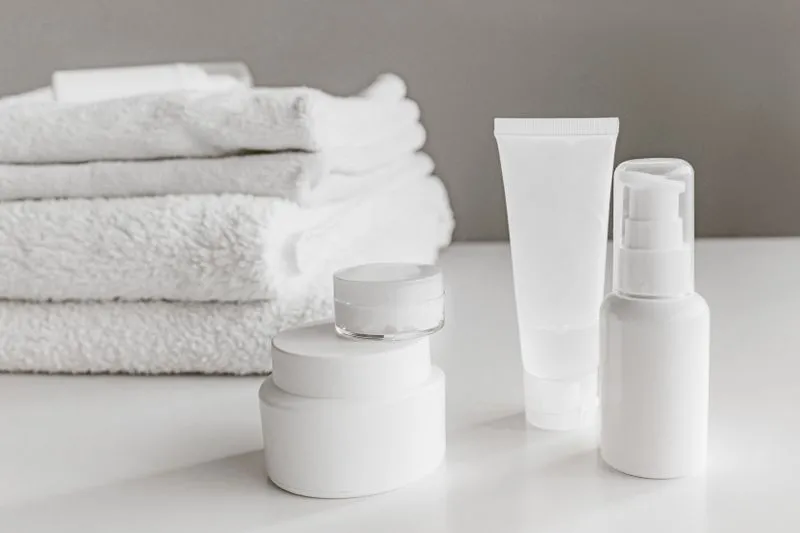
Is men's skin really different?
Yes, but not where you'd expect. A 2023 review of sex and gender in dermatology, published in the Journal of Cutaneous Medicine and Surgery, sorts what really differs from bathroom folklore. The epidermis (the surface layer) is the same thickness in both sexes. Its outermost part — the stratum corneum, the bit that holds on to water — has the same mass, thickness and hydration in him as in you.
The dermis, on the other hand, is thicker in men, because their collagen is denser. The authors add a caveat my dad should read twice: whether that difference has any clinical significance is unknown. In other words, "thicker" doesn't mean "tougher against razors, sun and soap".
The difference that counts for a routine is oil. According to the same review, men have higher sebum content — especially on the face — and higher sweat rates. The authors note that this predisposes men to diseases involving the oil glands. Translated for the bathroom: a man's face gets shiny faster, and light textures usually feel better on it than the rich creams on your shelf (keep those for yourself).
Then there's the razor. A blade running over the same patch several times a week — sometimes every day — is a mechanical stress your own face never deals with. Nobody would describe skin that gets sanded every morning as skin that "looks after itself".
| What you hear | What the 2023 review says | What it means for the routine |
|---|---|---|
| "His skin is thicker." | Same epidermis, thicker dermis. | The surface the razor scrapes is no better armed. |
| "It doesn't need moisturiser." | Same hydration in the outer layer. | His skin is no better hydrated than yours: nothing exempts it from moisturiser. |
| "It's oilier." | More sebum, especially on the face. | Light textures, gentle but regular cleansing. |
Why three steps are enough for a men's skincare routine
A routine nobody does is useless. That's the only rule when you're building one for someone who has never had one: it has to fit into the time it takes the kettle to boil. Cleanse, moisturise, protect — about two minutes in the morning, shaving not included. In the evening? One step is often enough.
I know what you're going to say. What about serum? Eye cream? A Sunday scrub? Later. Maybe. Among the men I know (not a study, just bathrooms I know well), the ones who went from zero to six products overnight had all given up within the month. The ones who added one step at a time — one, and you wait until it's automatic — sometimes ended up quite enjoying it.
Here's what the full routine looks like:
- Morning: cleanser (or just a lukewarm rinse if his skin is dry), shave if there is one, moisturiser, then sunscreen.
- Evening: cleanser, then moisturiser if his skin feels tight.
You'll notice there's no separate "aftershave" step. That's deliberate: a good moisturiser does exactly that job — without the alcohol in some splashes. You'll also notice nothing here is "for men". Gunmetal packaging and a name in capital letters tell you nothing about the formula; the ingredients list does, and it reads the same for him as it does for you.
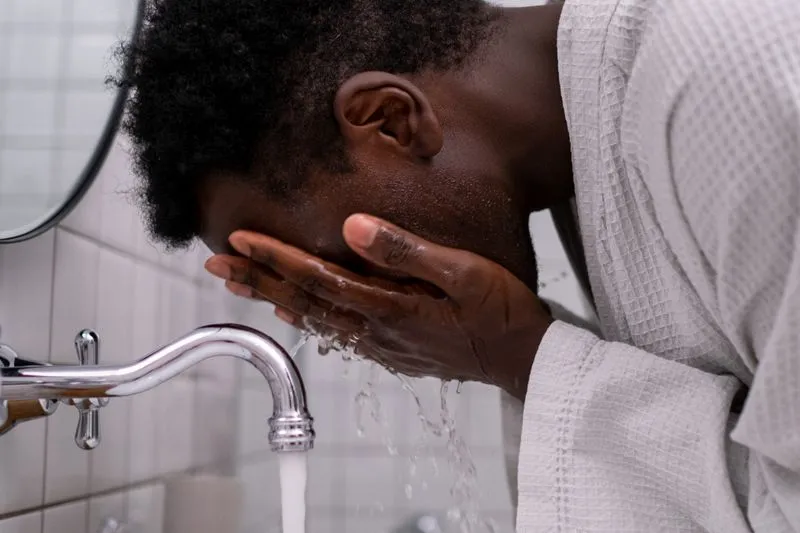
Step 1: a gentle facial cleanser, not shower gel
The first step is a cleanser made for faces: a gentle gel or foam, no scrubby bits, ideally fragrance-free. The three-in-one "hair, body and face" shower gel foams like mad and smells strong (the scent is more or less the selling point). It also tends to leave that tight, squeaky feeling — exactly what you don't want on a face that's about to meet a blade.
Water temperature makes almost as much difference as the product. Lukewarm, not scalding — I've gone through what dermatology recommends about hot or cold water for washing your face, and the verdict applies to him as much as to you. A very hot morning shower is lovely (I'm not taking that away from him). His face just doesn't need to enjoy it as much as his back does.
How often? Twice a day at most — morning and evening. Oily skin doesn't need three washes a day; it needs one that doesn't strip it. If his skin is on the dry side, a lukewarm rinse can do in the morning, with the cleanser saved for the evening (and for gym days).
In the evening, someone always asks about double cleansing. For a man wearing a light SPF to the office, one round of cleanser is usually plenty — that's my view, not a rule carved in stone. Double cleansing earns its place when there's water-resistant sunscreen on his face (a day at the seaside, a sunny weekend on the bike): the method, and who really needs it, is all in my complete guide to double cleansing.
Step 2: moisturiser, the real aftershave
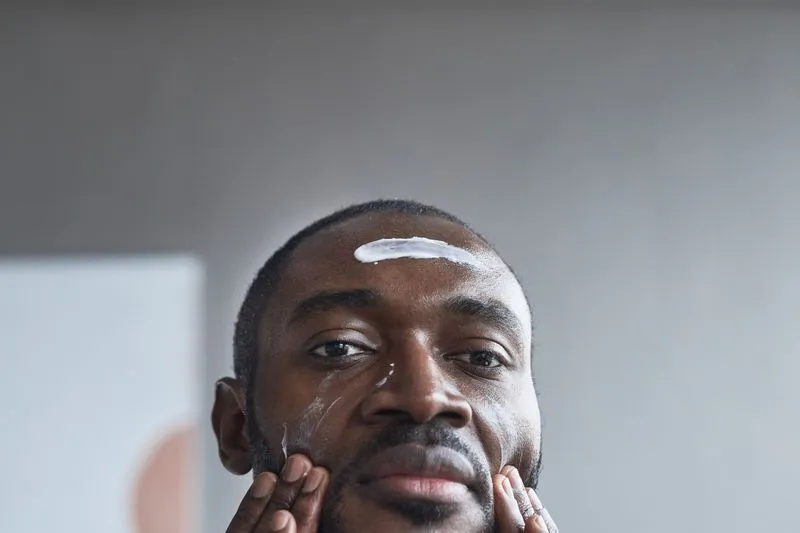
Moisturiser is the step that changes how his face feels day to day. Straight after shaving, it calms the tightness (and the heat that comes with it). For the rest of the day, it stops that dull look and the little flakes on the sides of the nose (or on the forehead, for anyone who's washed with soap for twenty years).
It all comes down to texture. For skin that shines by midday, a gel-cream or a light fluid labelled "non-comedogenic" — meaning it's formulated not to clog pores. For skin that feels tight — itchy cheeks, flakes by the nose — a proper cream. And if shaving leaves him red, go fragrance-free and alcohol-free. Both show up on the ingredients list: "alcohol denat." is often near the top of a splash, "parfum" usually near the end, so read it all the way down.
Order matters too. Moisturiser goes on shaved, rinsed skin that's been patted dry with a clean towel — patted, not rubbed. A pea-sized amount covers face and neck (not a handful; he's not buttering toast). He starts with the shaved areas — cheeks, chin, neck — then spreads what's left up to the forehead.
So what about the aftershave splash? The bottle that stings and smells strong is mostly fragrance. If your dad is attached to his ritual, he can keep it for the base of his neck, away from freshly shaved cheeks. The rules for applying scent are the same as for you, by the way: I've explained why you should stop rubbing perfume between your wrists, and it holds for a man's neck too. Alcohol-free aftershave balm, meanwhile, is simply a moisturiser: it replaces step 2 rather than adding to it.
Step 3: SPF, the step men skip
If you could only win your dad over on one step, make it this one. Cancer Research UK's analysis of where melanomas appear, published at the end of May, found that men were almost twice as likely as women to be diagnosed with melanoma on the head or neck (24% versus 13%). The same piece points out that, since the early 1990s, skin cancer rates have doubled in women and almost tripled in men.
The problem isn't ignorance so much as habit. In a 2022 survey of 2,000 UK men, run by NIVEA Sun as part of its partnership with Cancer Research UK, 84% knew that sunburn raises the risk of skin cancer — yet less than a quarter said they always protect themselves from the sun. Knowing, then not bothering: the classic dad move.
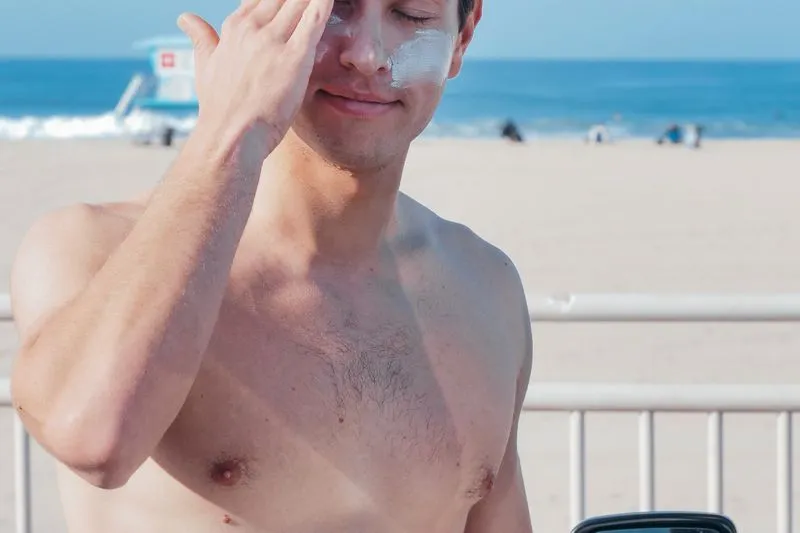
The rules are clear enough. The NHS advice on sunscreen and sun safety is at least SPF 30, with at least 4-star UVA protection, applied to all exposed skin — face, neck and ears included. It needs reapplying every two hours, and straight after being in water, even if it's water resistant. Cancer Research UK says the same in shorter form: at least SPF 30 and 4 or 5 stars, applied regularly and generously.
Day to day, in town, it's simple. A facial sun fluid, applied in the morning after moisturiser — over the whole face, the ears and the neck. For a man who's losing his hair, the top of the head needs it too — the NHS specifically mentions the head if you have thinning or no hair (a sun stick is easier there than a cream). And if he hates the "white mask" look, steer him towards a fluid texture sold as invisible rather than a thick beach cream.
Shaving: the tweaks that stop razor burn
Post-shave redness often comes from technique — not skin. Bumps on the neck and hairs growing back under the skin have a medical name: pseudofolliculitis barbae. Razor burn is a separate, milder irritation. The British Association of Dermatologists' patient leaflet on pseudofolliculitis describes it as inflammation of hair follicles and surrounding skin, caused by hairs trapped beneath the surface — "shaving bumps" or "razor bumps" to most of us.
It's more common in men of sub-Saharan African lineage, but it can affect anyone with coarse hair that gets shaved. The BAD's advice is refreshingly practical: shave in the direction of hair growth, avoid stretching the skin tight, use single blades, and shave every second day rather than daily if possible. It even suggests aiming for a stubble length of 1 mm.
- Shave after the shower (or after a minute with a warm flannel on the face). The NHS page on ingrown hairs says to wet the skin with warm water and use shaving gel.
- Gel or foam — never a dry blade on bare skin (yes, even "just for the neck").
- With the grain, especially on the neck, where hair often grows in every direction. Run a hand against the grain first to find out which way it goes.
- A sharp blade: a blunt one forces extra passes, and the NHS advises as few strokes as possible.
- Not too close: the baby-smooth shave — the one some men are proudest of — is exactly what the 1 mm stubble advice is trying to avoid.
- Rinse, pat, moisturise — in that order, and without anything that burns. The NHS also suggests a cool, wet cloth on the skin afterwards to reduce irritation.
For reactive skin, an electric razor or a trimmer is a good option. The BAD notes that wet shaving usually gives a closer shave than an electric razor, which is precisely the point here. And if nothing works, there's always the oldest fix in the book: stop shaving and grow the beard. Some men have been waiting years for that permission — I can think of at least two colleagues.
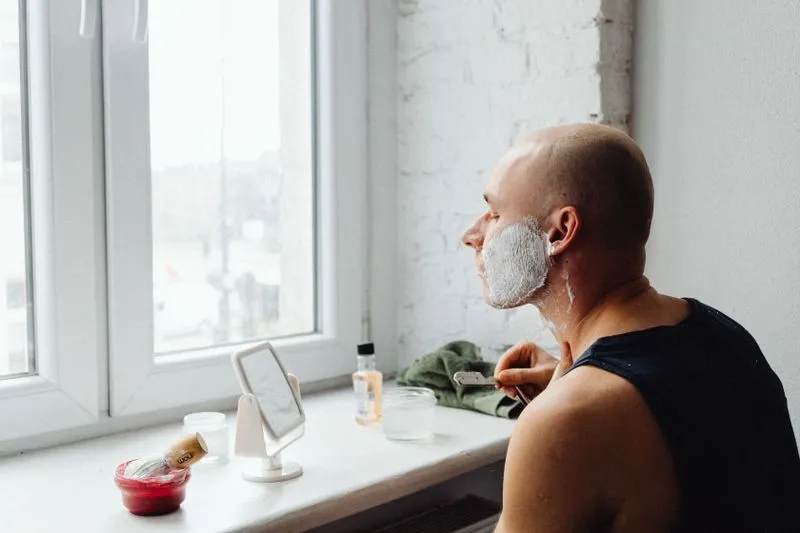
Skincare with a beard: what changes
A beard doesn't cancel the routine — it moves it. The skin under the hair keeps producing oil and renewing itself; you just can't see it any more. So the step 1 cleanser gets worked right down to the roots — not only over the cheekbones — then rinsed out properly (leftover foam trapped in a beard itches all day).
My boyfriend has a short beard, which he tidies up with the trimmer on Sunday evenings (over the sink, naturally). For months he scratched his chin, insisting that "beards itch, it's normal". What was itching, in his case, was the skin underneath — dry, never moisturised. A pea-sized amount of moisturiser worked in against the grain, then smoothed back down, was all it took. No need for the "oil, balm and beechwood comb" gift box. Beard oil softens the hair, but in my view it doesn't replace moisturiser on the skin.
An itchy beard can hide something else, though. The British Association of Dermatologists' leaflet on seborrhoeic dermatitis says it is slightly more common in men than in women and often shows up between the ages of 30 and 40. On the face, it often affects the eyebrows and the creases around the nose and cheeks — areas a moustache can partly hide.
What does it look like? Skin that's red, lighter or darker than the skin around it, with yellow flaking on the surface. Flares can be triggered by tiredness, stress and cold, dry weather (hello, January). The BAD's self-care advice will sound familiar: a gentle soap-free wash, then a light moisturiser.

Matching a men's skincare routine to his skin type
The three steps stay the same; only the textures change. To work out the skin type of a man who has never thought about it, one question will do: "At lunchtime, is your forehead shiny or does your skin feel tight?" The answer tells you almost everything.
| Skin type | The lunchtime sign | Cleanser | Moisturiser | Sunscreen |
|---|---|---|---|---|
| Oily | Shiny forehead and nose. | Gentle foaming gel. | Non-comedogenic gel-cream. | Fluid or gel, matte finish. |
| Combination | Shiny in the middle, tight on the cheeks. | Gentle gel. | Light fluid. | Fluid. |
| Dry | Tight, flaky. | Cream or milk cleanser, lukewarm rinse in the morning. | Cream. | Cream or lotion. |
| Reacts to shaving | Redness, stinging. | Fragrance-free, soap-free. | No fragrance, no alcohol. | Sensitive-skin formula. |
Skin type shifts with the seasons. Central heating in winter can make skin that shines in July feel tight — and the reverse is true as well. If your dad complains in December that "the gel's not enough any more", he hasn't changed skin (or dads): he just needs a slightly richer texture until spring.
And if you really can't tell? Go for combination. It's the most common type among the men I know (again, nothing scientific), and a light fluid is easy to adjust: add a cream if it feels tight, stick with the fluid if it shines.
Giving the routine for Father's Day, without offending anyone
Father's Day falls on Sunday 15 June. Giving skincare to a man who has never used any — that takes some care. Presented badly, the gift says "your skin is terrible" or "you're getting old". Presented well, it says "I want you to feel good". The difference comes down to three details.
- Three products, not a box of ten. A cleanser, a moisturiser, a facial sunscreen. Anything beyond that ends up at the back of the cupboard, next to the shaving set nobody ever opened (every family has one).
- Instructions in one line. Number the bottles with a marker: 1, 2, 3. On a Post-it stuck to the mirror: "Morning: 1, 2, 3. Evening: 1." Nothing else.
- Sell it as health, not beauty. Plenty of men hear "protect yourself from the sun" more easily than "look after your skin". Sunscreen is the Trojan horse of the whole routine — a "health" present is much harder to turn down.
This year, that's what I'm putting next to my dad's bottle of CK One. Nobody touches the CK One: he's had it since 1994, it already features in my guide to choosing a perfume for a man, and no present is going to replace it. Three numbered bottles, a Post-it, and a promise not to ask him every other day whether he's using them.
And for a boyfriend? Same method — with a bonus argument: you'll stop finding your own moisturiser half empty. For a brother or a flatmate, the minimal version works a treat: just the sun fluid, handed over at the start of summer, with one sentence about ears.

Five mistakes that sabotage a men's skincare routine
1. Washing his face with shower gel. The starting mistake — and the easiest to fix. A gentle facial cleanser takes less effort than changing razors, and it sets up everything else: skin that's been stripped in the morning reacts more to the blade.
2. Saving sunscreen for the beach. The NHS advice (SPF 30 at least, reapplied every two hours outdoors) doesn't say "on holiday". The pub garden, Saturday five-a-side, mowing the lawn — that's sun exposure too.
3. Buying everything at once. Six products on day one, none by day fifteen (seen it in more than one bathroom). One step a week, starting with whichever he needs most: sunscreen if he's outdoors a lot, moisturiser if he shaves every day.
4. Stretching the skin and going over the same spot three times. That's the close-shave reflex — and the BAD specifically advises against stretching the skin tight, while the NHS recommends as few strokes as possible. A slightly less smooth shave without bumps is a good trade (nobody strokes his cheek at the office).
5. Mistaking an itchy beard for dry skin. Sometimes it really is just a lack of moisturiser. Sometimes the itch comes with red patches and yellow flakes around the nose or in the eyebrows — the picture of seborrhoeic dermatitis — and then it's a GP he needs, not another aisle at Boots.
Start with a tube of sun fluid next to the razor. The rest will follow, or it won't: the sun fluid on its own is already a lot.
Frequently asked questions
Can a man use his partner's skincare?
Yes. A cream doesn't have a gender: you choose it on texture and the ingredients list. The one precaution on skin that's shaved daily is to avoid fragranced or alcohol-heavy formulas, which sting more right after the razor. And get him his own tube, for the sake of household peace.
Does he really need aftershave?
No. An alcohol-free moisturiser does the same job: it calms tightness and the heat after shaving. The aftershave splash that stings is mostly fragrance; if it's part of a ritual he loves, he can keep it for the base of his neck, away from shaved skin.
What SPF should a man wear in the city?
The NHS recommends at least SPF 30 with at least 4-star UVA protection. Outdoors, it needs reapplying every two hours and straight after being in water. For everyday wear, a facial sun fluid applied after moisturiser in the morning is the easiest way to build the habit.
Is it better to shave before or after a shower?
After. The NHS advises wetting the skin with warm water and using shaving gel, and skin and hair that have been damp for a few minutes take the blade better. No shower? A warm flannel held on the face for a minute does the trick.
Should you shave with the grain?
Yes, especially on skin prone to bumps. Shaving against the grain gives a smoother result, but both the BAD and the NHS advise shaving in the direction of hair growth, and the BAD suggests leaving around 1 mm of stubble. On the neck, check which way the hair grows with your hand first.
Does a beard need special skincare?
It needs the same steps, taken all the way down to the skin: cleanser worked into the roots, a thorough rinse, moisturiser underneath. Beard oil is a bonus for the hair. Red, flaky patches that keep coming back, however, deserve a GP's opinion.
At what age should a man start a skincare routine?
There's no set age. Cleanser and moisturiser become useful as soon as shaving starts; sunscreen is useful at any age. For a man in his sixties who has never used anything, starting with sunscreen is the step that gives the most back.
Sources
- Journal of Cutaneous Medicine and Surgery (PMC) — The Role of Sex and Gender in Dermatology, 2023
- Cancer Research UK — Clothing choices could be linked to melanoma skin cancer (26 May 2025)
- NHS — Sunscreen and sun safety
- NHS — Ingrown hairs
- British Association of Dermatologists — Pseudofolliculitis (patient information leaflet)
- British Association of Dermatologists — Seborrhoeic dermatitis (patient information leaflet)