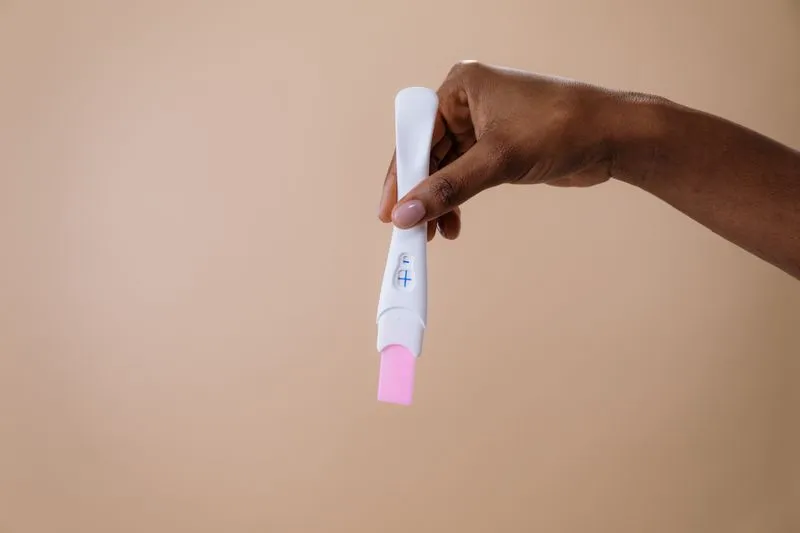
Tuesday, 7.40pm, the health and beauty aisle of a high-street chemist. Between the electric toothbrushes and the sanitary towels — the irony isn't lost on you — you're holding a pregnancy test in each hand. One box promises an answer several days before your period is due. The other costs half as much, holds two tests and promises nothing at all. Your period is due on Thursday. For three days your breasts have ached every time you take your bra off. On Sunday you slept for ten hours straight. This morning, the smell of reheated coffee in the office kitchen turned your stomach. Or it's PMS. Just like last month.
That hesitation rests on a stubborn idea: that your body knows before the test does. An American study that followed 221 women trying to conceive, day by day, suggests almost the opposite. Among those who went on to have a live baby, half had not noticed a single pregnancy symptom until day 36 after the start of their last period — about a week after a period would be due (in a 28-day cycle). Two days before your period is due, what you feel can't settle the question. This guide takes the signs of the first weeks in the order they really appear, what is known about how common they are, when a test becomes reliable — and when it can mislead you.

Before a pregnancy test: what has to happen in your body first
A pregnancy test doesn't detect a pregnancy — it detects a hormone. That hormone (human chorionic gonadotrophin, or hCG) is only made once the embryo has attached itself to the lining of the womb. Before that step, called implantation, no test can be positive. And no symptom driven by hCG can exist yet.
The sequence is always the same. Around the middle of your cycle, an ovary releases an egg; if it's fertilised, that happens in the fallopian tube. The fertilised egg then travels towards the womb for several days. According to the NHS guide to signs and symptoms of pregnancy, a missed period is the earliest reliable sign if your cycle is regular, and pregnancy sickness usually starts when you're around 4 to 6 weeks pregnant — the NHS dates pregnancy from the first day of your last period, not from conception.
The most precise measurement of that delay comes from the United States. In 1999, Allen Wilcox and his colleagues (National Institute of Environmental Health Sciences) analysed daily urine samples from 221 women who had just stopped using contraception. In pregnancies that lasted beyond six weeks, hCG first appeared between 6 and 12 days after ovulation — on day 8, 9 or 10 in 84% of cases. Implantation therefore usually happens only a few days before your period is due.
This changes how to read what you're feeling. Hormone levels shift during every cycle — pregnant or not — and the NHS links PMS to exactly those changes. It also describes tender breasts in early pregnancy as feeling just as they might before a period. The sensations of the days before a period come from an ordinary mechanism. Fertilisation or no fertilisation.
Early pregnancy symptoms: the real timeline, from sex to a missed period
Early pregnancy symptoms follow a fairly regular order — and a later one than most of us imagine. Because weeks are counted from the first day of your last period, a period that's due in a 28-day cycle falls at 4 weeks pregnant, even though conception happened barely two weeks earlier.
| When (28-day cycle) | What's happening | What you might feel |
|---|---|---|
| Around day 14. | Ovulation, possible fertilisation. | Nothing specific to pregnancy. |
| 6 to 12 days after ovulation. | Implantation, first traces of hCG. | The usual pre-period feelings. |
| Around day 29 (4 weeks). | Period due. | A missed period, sometimes light spotting. |
| Day 36 (about 5 weeks). | Half of pregnant women have noticed a first symptom. | Tender breasts, tiredness, peeing more. |
| Weeks 4 to 7. | Pregnancy sickness usually begins. | Nausea, food aversions, a sharper sense of smell. |
| End of week 8. | 89% of pregnant women have symptoms. | Symptoms well established. |
| By week 20. | Sickness has settled for 9 in 10 women. | Relief, for most. |
Half by day 36, 89% by eight weeks: those figures come from a prospective study published in 2002 by Amy Sayle and Wilcox's team, covering 136 births. It adds two details. Symptoms started later in pregnancies that went on to miscarry. And women who smoked (tobacco or cannabis) tended to notice them later than others.
For each individual symptom, the data is thin — and it's worth knowing that. The RCOG describes nausea and vomiting as symptoms that affect most pregnant women (without a single figure). For tender breasts, tiredness or a sensitive nose, the sources I checked (NHS, RCOG) describe common signs — without percentages.
A missed period: the most reliable sign of pregnancy (if your cycle is regular)
A missed period is still the earliest reliable sign of pregnancy — on one condition: a regular cycle. A period that's two days late after a month of travel and short nights may simply reflect the month you've had. Five days late, for someone whose cycle has run like clockwork for ten years, carries far more weight. That's why the date of your last period matters as much as anything you feel.
What if your cycle varies from month to month? The NHS offers a simple rule: if you don't know when your next period is due, do the test at least 21 days after you last had unprotected sex. That gives time for everything — fertilisation, implantation, the rise in hormone levels.
Sore breasts and tiredness: the early signs that feel most like your period
Sore breasts and tiredness are among the earliest signs — and they're the ones most easily mistaken for an approaching period. The NHS describes breasts that may become larger and feel tender, just as they might before a period, and that may also tingle. If your breasts are sore before every period, this sign can slip past you completely.
Some changes, though, have no pre-period equivalent. In early pregnancy, the NHS explains, the veins on your breasts may become more visible, and the nipples may darken and stand out. Neither appears on the NHS list of PMS symptoms.
The tiredness of early pregnancy is hormonal too. The NHS says it's common to feel tired, or even exhausted, especially during the first 12 weeks or so — hormonal changes at this time can leave you tired, sick, emotional and upset. Not the usual 4pm slump. More like the feeling of having run a half marathon after an ordinary day at your desk.

One word of caution, though. Tiredness has a thousand causes. Exhaustion that settles in without a missed period or any other sign is a reason to see your GP in the usual way — pregnancy is only one possible explanation among many.
Nausea, smells and a metallic taste: the signs that usually come after a missed period
Pregnancy sickness usually arrives after your period was due, not before. The patient information on pregnancy sickness from the Royal College of Obstetricians and Gynaecologists (RCOG) says it usually starts between the 4th and 7th week, and settles by 20 weeks in 9 out of 10 women. Despite the name "morning sickness", it can strike at any time of the day or night.
Most of the time it's unpleasant but manageable, and the NHS notes that it does not put your baby at any increased risk. For some women it's much more than that. Hyperemesis gravidarum (a severe form that stops you eating and drinking normally) may affect up to 3 in 100 pregnant women, according to the RCOG.
Around the nausea come other signs, which the NHS lists in detail.
- A strange taste in your mouth, which some describe as metallic.
- A new sensitivity to certain smells — food and cooking in particular.
- Cravings for new foods, or losing interest in tea, coffee or fatty food you used to enjoy.
- Needing to pee more often than usual, including at night.
- More vaginal discharge, without soreness or irritation.
- Constipation.
If constipation is one of your first signs, why constipation happens in pregnancy and what actually helps is covered in a separate guide.

Implantation bleeding or a period: how to tell the difference
Implantation bleeding is light bleeding linked to the embryo settling into the lining of the womb, and it can happen around the time your period is due. The NHS describes it as a bleed similar to a very light period — some spotting, or only a little blood. It's easy to take for an early, oddly light period.
Three clues can point you in the right direction, without ever giving a definite answer.
- The amount. A few spots on your underwear or on toilet paper, not enough to fill a pad.
- The timing. Around the date your period is due — which is exactly why it's so easy to confuse.
- What happens next. If your usual period doesn't follow in the next few days, it's time for a test.
None of the institutions I checked puts a figure on how often implantation bleeding happens. What the NHS is clear about is the next step: bleeding in pregnancy is relatively common and doesn't always mean there's a problem, but it can be a dangerous sign, so any bleeding means calling your midwife or GP straight away.
PMS or pregnancy: why your body sends the same signals
Premenstrual syndrome (PMS) and early pregnancy feel alike because both are driven by changing hormone levels. The NHS page on premenstrual syndrome is blunt about how common it is: most women have PMS at some point. Its most common symptoms include mood swings, feeling upset or irritable, tiredness or trouble sleeping, bloating, breast tenderness, headaches and changes in appetite or food cravings.
Read that list again with the pregnancy list beside it. Tender breasts, tiredness, cravings, mood changes — they appear on both. So the sensations start out very alike, then the paths diverge.
| Sign | PMS | Early pregnancy |
|---|---|---|
| Tender or sore breasts. | Yes, before a period. | Yes, from the first weeks. |
| Tiredness. | Yes. | Yes, often marked. |
| Bloating, tummy trouble. | Yes (bloating or cramping). | Constipation is possible. |
| Mood changes. | Yes. | Yes. |
| Food cravings. | Yes. | Yes, sometimes with aversions. |
| Vomiting. | Not on the NHS list. | Possible, usually from weeks 4 to 7. |
| Darker nipples, more visible veins. | Not on the NHS list. | Yes. |
The most reliable way to tell them apart isn't a symptom at all. It's time. PMS belongs to the weeks before a period; pregnancy signs carry on past the date your period was due. No list of symptoms, however detailed, will replace a test taken at the right moment.

When to take a pregnancy test so you can trust the result
A home pregnancy test is most reliable from the first day of a missed period — and more reliable still a few days later. That's the NHS position: you can carry out most tests from the first day of a missed period, and some very sensitive tests can be used even before. The hCG they detect, the NHS explains, starts to be produced around 6 days after fertilisation.
The difficulty lies in natural variation — in ovulation first, then in implantation. Wilcox's team measured it with an extremely sensitive laboratory assay. Out of 136 pregnancies, 14 (10%) had not yet implanted on the first day of the missed period. Even the best possible test could only have picked up 90% of pregnancies that day, and 97% a week later. With shop-bought kits, the authors add, the share missed on that first day is probably higher still.
And the "early" tests designed to be used before your period is due? They can give a positive sooner, if hCG is already there. A negative at that stage, however, tells you very little — if the embryo hasn't implanted, there's simply nothing to detect.
In practice, three rules cover most situations.
- Regular cycle. Test on the day your period is due at the earliest — ideally a few days after.
- Irregular cycle. Test at least 21 days after you last had unprotected sex.
- Negative test, still no period. Wait a few days and test again; see your GP if the second test is negative and your period still hasn't come.
You don't have to use your first wee of the morning: the NHS says a sample collected at any time of the day will do. The rule that matters most is the leaflet in the box — all tests are slightly different, the NHS reminds us. And you don't necessarily have to pay: free tests are available from sexual health services, from Brook centres (for under-25s) and sometimes from your GP.
If you've taken emergency contraception, the 21-day rule is a useful benchmark. Time limits and effectiveness for the two pills are covered in our guide to the morning-after pill: when to take it and how to get it.

Negative, positive: when a pregnancy test gets it wrong
A positive test is almost always right; it's the negative that misleads. In the NHS guide to doing a pregnancy test, the wording is plain: "A positive test result is almost certainly correct. However, a negative test result is less reliable." The result may not be reliable if you take the test too early or don't follow the instructions properly (waiting time, reading window).
Some medicines can also affect the result, the NHS adds. If you're on any treatment (for fertility, for example), ask your pharmacist before reading too much into a test. The contraceptive pill, on the other hand, will not stop a pregnancy test working.
Then there's a disconcerting situation: a positive test, followed by a period a few days later. It isn't necessarily a faulty test. In Wilcox's 1999 study, a quarter of the pregnancies detected by hCG (48 out of 189) ended before six weeks. These very early losses — sometimes called chemical pregnancies — are common. If it happens to you, talk to your GP, especially if it happens more than once.
The symptoms that mean getting help straight away
Pain low down on one side of your tummy with vaginal bleeding (when your period is late) needs medical advice straight away — even without a positive test. It can be a sign of an ectopic pregnancy, where a fertilised egg implants outside the womb, usually in a fallopian tube. According to the NHS overview of ectopic pregnancy, around 1 in every 90 pregnancies in the UK is ectopic — about 11,000 a year.
Symptoms, when there are any, tend to develop between the 4th and 12th week of pregnancy. They can include a missed period and other signs of pregnancy, tummy pain low down on one side, vaginal bleeding or a brown watery discharge, pain in the tip of your shoulder, and discomfort when peeing or pooing. The NHS asks you to contact your GP or call NHS 111 if you have a combination of these and might be pregnant.
Outside an emergency, any bleeding during pregnancy (or after a positive test) means calling your midwife or GP straight away — that's the NHS's urgent advice. Bleeding doesn't always mean there's a problem. Only a professional can tell you so.
A positive test: your first steps, without rushing
After a positive test, three things matter in the first weeks — and none of them has to be done tonight. The first is folic acid. The NHS recommends 400 micrograms of folic acid every day, ideally from before you're pregnant until you're 12 weeks pregnant, along with a daily vitamin D supplement. If you weren't taking it before, it isn't too late.
The second is starting your NHS maternity care. You don't need to wait for a GP appointment: you can refer yourself to local maternity services as soon as you know you're pregnant, often through an online form on your local hospital or NHS trust website. A midwife will then arrange your first appointment.
The third is keeping an eye on what you swallow, medicines included. For your plate, what to eat and what to avoid during pregnancy separates genuine precautions from myths. And for everything that follows, our pregnancy week-by-week guide picks up exactly where this one stops: at the positive test.
Back to that chemist's aisle on a Tuesday evening. The most useful answer isn't in your breasts or your tiredness — it's in your calendar. Period due on Thursday? Put down the box that promises miracles, pick up the one with two tests, and use the first on Friday morning. If it's negative and your period still hasn't come, the second can wait until the following Tuesday.
Frequently asked questions about early pregnancy symptoms
Can you feel pregnancy symptoms a few days after sex?
It's very unlikely. hCG only appears after implantation, 6 to 12 days after ovulation according to Wilcox's 1999 study. And half of pregnant women don't notice a first symptom until day 36 after the start of their last period. What you feel three or four days after sex belongs to the second half of your cycle — the same phase that comes before a period.
Can a pregnancy test be positive before a missed period?
Yes, with a very sensitive test, if implantation has already happened. The reverse isn't true: a negative before your period is due doesn't rule out a pregnancy. Even on the day of the missed period, around 10% of pregnancies can't yet be detected (Wilcox, 2001).
My test is negative but my period hasn't come. What should I do?
Wait a few days and test again. If the second test is also negative and your period still hasn't arrived, the NHS advises speaking to your GP.
Can you be pregnant with no symptoms at all?
Yes. In Sayle and Wilcox's 2002 study, 89% of women had symptoms by the end of the eighth week — so around one in ten didn't yet. Having no nausea or sore breasts tells you nothing on its own.
Does everyone get implantation bleeding?
No. It's light spotting that can happen when the embryo implants, around the time a period is due. None of the institutions I checked gives a figure for how often it happens. Heavy, painful or persistent bleeding is not implantation bleeding — it needs medical advice.
Can the contraceptive pill affect a pregnancy test?
No. The NHS is clear that the hormones in the pill will not stop a pregnancy test working. No method of contraception is completely effective, so a test is still worth doing if you're unsure.
Are cheap supermarket tests as good as branded ones?
All pregnancy tests detect the same hormone, hCG. The NHS names the two main reasons a result may not be reliable — testing too early and not following the instructions — and neither has anything to do with the price on the box.
When should I test after taking the morning-after pill?
The NHS rule for anyone unsure when their next period is due applies here: test at least 21 days after the last time you had unprotected sex. Our morning-after pill guide covers the time limits for each pill.
Sources
- NHS — Signs and symptoms of pregnancy
- NHS — Doing a pregnancy test
- NHS — PMS (premenstrual syndrome)
- NHS — Vomiting and morning sickness
- RCOG — Pregnancy sickness (nausea and vomiting of pregnancy and hyperemesis gravidarum)
- NHS — Vaginal bleeding in pregnancy
- NHS — Ectopic pregnancy
- NHS — Vitamins, minerals and supplements in pregnancy
- NHS — Your antenatal care
- Sayle AE, Wilcox AJ et al. — A prospective study of the onset of symptoms of pregnancy, Journal of Clinical Epidemiology (2002)
- Wilcox AJ et al. — Natural limits of pregnancy testing in relation to the expected menstrual period, JAMA (2001)
- Wilcox AJ, Baird DD, Weinberg CR — Time of implantation of the conceptus and loss of pregnancy, New England Journal of Medicine (1999)