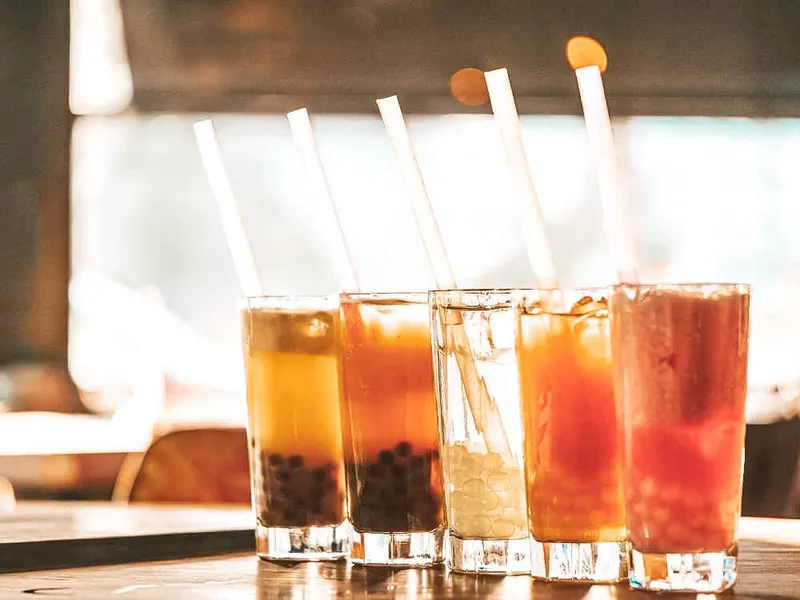
I joined the queue because the queue existed. It was one of those impossibly long lines outside a shop I'd never noticed before — the kind that in London usually indicates either a Supreme drop, a bakery from a viral TikTok, or a new branch of something Asian that everyone under thirty already knows about and everyone over thirty is about to discover. In this case, it was a bubble tea shop, and the queue stretched past a Pret and halfway to the Tube entrance, which by London standards represents genuine cultural significance.
Twenty minutes later I was standing on the pavement holding what looked like a science experiment: a tall, sealed plastic cup of pale lavender liquid with dark spheres — pearls, I would learn — settled at the bottom, accessed through a straw thick enough to qualify as plumbing. The first sip was confusing. Sweet, creamy, vaguely taro-flavoured, and then — pop — a tapioca pearl hit my teeth, chewy and starchy and strangely satisfying in a way I had not anticipated. The second sip was curious. By the third sip I was trying to figure out how quickly I could come back and try a different flavour.
That was three years ago, and bubble tea has since become a genuine fixture in my weekly routine — which makes me part of a global trend that shows no signs of slowing down. The worldwide bubble tea market was valued at over $4 billion in 2023 and is projected to keep growing. What started as a Taiwanese night market drink in the 1980s has become one of the most successful food-and-drink exports in modern history. Here's the full story.
The origins: how a Taiwanese tea shop changed everything
The origin story of bubble tea is, like many great food inventions, slightly disputed. Two Taiwanese tea shops both claim to have created it in the 1980s, and the matter was actually litigated in Taiwanese courts — which ultimately ruled that bubble tea couldn't be patented because it was too simple a concept. Both origin stories are charming, and both may contain elements of truth.
The most widely cited version credits Chun Shui Tang tea house in Taichung, Taiwan. In 1988, the story goes, product development manager Lin Hsiu Hui was sitting in a staff meeting, bored, and dropped her tapioca pudding into her iced tea to see what would happen. What happened was delicious, and the shop added it to the menu. The other claimant, Hanlin Tea Room in Tainan, says its founder Tu Tsong-he was inspired by white tapioca balls he saw at a local market in 1986 and created a tea drink around them.
What's undisputed is that Taiwan is the birthplace, that the 1980s is the origin decade, and that what started as a local curiosity spread first across East Asia, then to Asian diaspora communities worldwide, and eventually to mainstream global popularity. The UK bubble tea market, which was essentially non-existent before 2010, now includes hundreds of dedicated shops in London alone, plus chains like Gong Cha, Tiger Sugar, and CoCo that have brought it to high streets across the country.
The name "bubble tea" itself causes confusion. The "bubbles" don't refer to the tapioca pearls — they refer to the frothy bubbles that form on top when the tea is shaken. "Boba" — the other common name — refers to the tapioca pearls specifically and is derived from a Taiwanese slang term. In practice, "bubble tea" and "boba" are used interchangeably in English-speaking countries, and nobody will correct you either way.
What exactly is bubble tea?
At its most basic, bubble tea is a tea-based drink served cold (or sometimes warm), usually with milk or a creamy element, sweetened, and — the defining feature — served with chewy tapioca pearls or other toppings at the bottom. It's drunk through a wide straw that allows the pearls to pass through, creating a drink-and-snack hybrid that's unlike anything else in the beverage world.
The components:
- Tea base: Black tea is the classic, but green tea, oolong, jasmine, and fruit teas are all common. Some shops offer non-tea bases: fresh fruit blends, yoghurt drinks, or coffee. The tea is usually strongly brewed to stand up to the milk and sweetener.
- Milk or cream: Traditional milk tea uses fresh milk or condensed milk. Many shops use non-dairy creamers for a specific texture. Oat milk and almond milk are increasingly available as alternatives. "Cheese tea" — topped with a savoury whipped cream cheese foam — is a variation that sounds awful and tastes inexplicably good.
- Sweetener: Sugar syrup, in varying amounts. Most shops allow you to customise sweetness on a scale (0%, 25%, 50%, 75%, 100%). This is genuinely useful because default bubble tea sweetness can be intense.
- Ice: Also customisable (no ice, less ice, regular ice). Ice level affects both temperature and dilution — less ice means a stronger, sweeter drink.
- Toppings: This is where bubble tea becomes an experience rather than just a drink. Tapioca pearls are the original, but the topping universe has expanded dramatically.
The magic of bubble tea — the reason it inspires the kind of devotion usually reserved for hobbies rather than beverages — is the textural experience. Drinking bubble tea engages your mouth in ways that no other drink does: the liquid is smooth, the pearls are chewy, and the combination of sipping and chewing creates a sensory experience that's oddly compelling and mildly addictive.
Tapioca pearls: the star of the show
Tapioca pearls — boba — are made from tapioca starch, which is extracted from cassava root (a tropical tuber widely grown in Southeast Asia, South America, and Africa). The starch is mixed with water and sometimes brown sugar or caramel colouring, shaped into small spheres, and cooked by boiling. The result is a translucent, chewy ball with a texture somewhere between gummy bear and mochi — springy, slightly sticky, and deeply satisfying to bite into.
The cooking process matters enormously. Properly cooked tapioca pearls are soft throughout with a gentle chew — QQ, as the Taiwanese describe it, meaning bouncy and resilient. Undercooked pearls have a hard, starchy centre that's unpleasant. Overcooked pearls become mushy and lose their satisfying texture. The best bubble tea shops cook their pearls in small batches throughout the day because the texture deteriorates within a few hours. If your pearls are hard in the centre, you're at the wrong shop.
Types of pearls and toppings:
- Classic black tapioca pearls: The standard. Dark brown or black (coloured with brown sugar or caramel), about 1cm in diameter, chewy and slightly sweet. These are what most people picture when they think of bubble tea.
- White tapioca pearls: Made from plain tapioca starch without colouring. More neutral in flavour, sometimes used in fruit teas where the dark colour would look incongruous.
- Popping boba: Not tapioca at all — these are small spheres made from fruit juice encapsulated in a thin alginate skin (the same technique used in molecular gastronomy). They burst when you bite them, releasing a shot of flavour. Available in mango, lychee, strawberry, passion fruit, and dozens of other flavours. They're a completely different experience from tapioca pearls — more pop than chew.
- Crystal boba (agar jelly): Translucent, slightly firm jelly cubes made from agar or konjac. Lower in calories than tapioca pearls and with a lighter, crunchier texture. Popular with people who want the topping experience without the starch load.
- Pudding: Egg pudding or custard, scooped into the bottom of the cup. Adds a creamy, dessert-like element. Particularly good in milk teas.
- Coconut jelly: Cubes of nata de coco — a chewy, translucent jelly made from fermented coconut water. Lighter and crisper than tapioca pearls.
- Red bean: Sweet azuki bean paste. Traditional in East Asian desserts and a natural fit for milk tea.
- Grass jelly: A slightly bitter, dark jelly made from a plant in the mint family. Traditional in Chinese desserts. Adds a herbal, slightly medicinal note that balances sweet teas.
The flavour universe: from classic to chaotic
The variety of bubble tea flavours available today is, frankly, absurd. A typical bubble tea menu in a dedicated shop runs to 40–60 options, which is more than most people can process without experiencing mild decision paralysis. Here's a navigable breakdown by category.
Milk teas (the classics):
- Classic milk tea: Black tea with milk and sugar. Simple, comforting, the equivalent of a standard order.
- Brown sugar milk tea: Milk tea with a dark, caramelised brown sugar syrup that creates dramatic tiger-stripe patterns on the cup. Sweeter and richer than classic. This is the Instagram-famous variant.
- Taro milk tea: Made with taro root (a purple-fleshed tuber), giving a naturally purple colour and a sweet, nutty, slightly vanilla-like flavour. Unique and very popular.
- Matcha milk tea: Green tea powder with milk. The earthy bitterness of matcha balanced by milk sweetness. Beautiful green colour.
- Thai milk tea: Made with Thai-style strongly brewed black tea (often with star anise and tamarind), condensed milk, and distinctive orange colouring. Sweet, spiced, unmistakable.
Fruit teas (lighter, no milk):
- Mango green tea: Green tea base with mango purée. Fresh, tropical, works beautifully with popping boba.
- Passion fruit tea: Intensely tart and fruity. Often served with actual passion fruit seeds floating in it.
- Peach oolong: Oolong tea with peach flavouring. Floral, delicate, and refreshing.
- Lychee tea: Fragrant and sweet. Lychee's natural perfume-like quality makes it a natural match for light teas.
- Strawberry tea: Sweet and fruity. Often made with real strawberry purée in better shops.
The adventurous options:
- Cheese tea: Any tea topped with a whipped salted cream cheese foam. You drink the tea through the foam, getting both simultaneously. It sounds wrong. It's magnificent.
- Yakult teas: Made with the probiotic yoghurt drink Yakult as a base. Sweet, tangy, oddly moreish.
- Coffee boba: Espresso or cold brew with milk and tapioca pearls. For people who want their coffee to be more fun.
- Ube (purple yam): Similar to taro but distinctly different — more intensely purple and with a sweeter, more cake-like flavour.
How to order bubble tea (without panicking)
Walking into a bubble tea shop for the first time can be overwhelming. The menu is enormous, the terminology is unfamiliar, and there's usually a queue of people who clearly know what they're doing, making your indecision feel conspicuous. Here's the systematic approach.
Step 1: Choose your base. Milk tea or fruit tea? This is the fundamental fork. Milk teas are richer, creamier, more dessert-like. Fruit teas are lighter, more refreshing, lower in calories. If in doubt, milk tea is the classic experience.
Step 2: Choose your flavour. Within your chosen category, pick a flavour. Classic milk tea or brown sugar milk tea are safe bets for beginners. For fruit teas, mango or passion fruit are universally appealing.
Step 3: Choose your sweetness. This is where many shops differentiate from ordinary cafés. You'll typically be offered: 0% (no sugar), 25% (lightly sweet), 50% (moderately sweet), 75% (sweet), 100% (full sweetness). If you're not used to Asian-style sweet drinks, start at 50%. You can always go sweeter next time; you can't unsweeten a drink.
Step 4: Choose your ice level. Regular, less, or no ice. Less ice gives you more drink and less dilution. No ice gives you the strongest flavour but the drink won't be as cold. Regular ice is fine for most situations.
Step 5: Choose your toppings. Tapioca pearls are the default and the experience you should try first. Most shops include one topping in the base price and charge extra for additional toppings (usually £0.50–1.00 each). Popping boba is a fun alternative if you want something lighter.
Step 6: Pay, wait, enjoy. Your drink will be freshly made and typically sealed with a plastic film that you puncture with the straw (part of the ritual). Give it a shake before drinking to distribute the sweetener, then sip. Remember the straw is wide for a reason — the pearls travel through it.
The nutritional reality check
Bubble tea is delicious. Bubble tea is also, in its standard form, a significant source of sugar and calories. This isn't a reason to avoid it — it's a reason to be informed about what you're drinking, particularly if you're having it regularly.
A typical 500ml classic milk tea with tapioca pearls at 100% sweetness contains approximately:
- Calories: 350–450 kcal (comparable to a McDonald's Cheeseburger)
- Sugar: 40–60g (roughly 10–15 teaspoons)
- Fat: 5–15g (depending on the milk/creamer used)
- Tapioca pearls: Add approximately 150–200 kcal per standard serving (they're mostly starch and sugar)
For context: the NHS recommends a maximum of 30g of free sugars per day for adults. A single full-sweetness bubble tea can contain double that.
How to enjoy bubble tea more moderately:
- Reduce sweetness: 25% or 50% sweetness is substantially lower in sugar while still tasting sweet. Many regular drinkers find that 100% sweetness becomes overwhelming once they're accustomed to reduced levels.
- Choose fruit teas: Without milk or creamer, fruit teas are significantly lower in calories. A fruit tea at 25% sweetness with popping boba can be under 200 kcal.
- Smaller size: If available, choose a regular rather than large size. The difference can be 100–150 kcal.
- Crystal boba instead of tapioca: Crystal boba (agar or konjac-based) is substantially lower in calories than tapioca pearls — roughly 50 kcal vs. 150–200 kcal per serving.
- Fresh milk instead of creamer: Non-dairy creamers, while creating a specific texture, often contain more calories and less nutritional value than fresh milk. Ask whether fresh milk is available.
Making bubble tea at home
Making bubble tea at home is surprisingly straightforward once you source the tapioca pearls — which are available from Asian supermarkets, Amazon, and increasingly from regular supermarkets in the "world foods" section.
Classic milk tea — basic recipe:
- Cook the tapioca pearls: Bring a large pot of water to a rolling boil (use lots of water — the pearls need room). Add the dry tapioca pearls (roughly 50g per serving) and stir immediately to prevent sticking. Boil for 20–30 minutes (check the packet — times vary by brand and size). The pearls are done when they're translucent throughout with no opaque centre. Drain, rinse briefly with cold water, and toss in brown sugar syrup (equal parts brown sugar and water, heated until dissolved).
- Brew the tea: Steep 2 tea bags or 2 tablespoons of loose-leaf black tea (Assam or Ceylon work well) in 250ml of boiling water for 5 minutes. You want it strong — it needs to stand up to milk and ice. Remove the tea and let it cool.
- Assemble: Put the sugar-coated pearls in the bottom of a tall glass. Add ice. Pour in the cooled tea. Add 100–150ml of milk (dairy, oat, or your preference). Add sugar syrup to taste. Stir or shake. Insert a wide straw.
Tips for better homemade boba:
- Cook the pearls fresh each time — they don't store well. Within 2–3 hours they harden and lose their QQ texture.
- The brown sugar soak is essential — it flavours the pearls and keeps them soft. Plain pearls are bland.
- Brew the tea double-strength because ice and milk will dilute it.
- For brown sugar milk tea, drizzle extra brown sugar syrup down the inside of the glass before adding ice — this creates the tiger-stripe pattern.
- Wide straws are available from Asian supermarkets or online. Regular straws don't work — the pearls won't fit.
Homemade bubble tea costs roughly £0.50–1.00 per serving versus £4–6 at a shop. The texture won't quite match a professional shop's (they use industrial-grade pearl cookers that maintain perfect consistency), but it's more than good enough for regular enjoyment, and you control the sweetness precisely.
Frequently asked questions
What does bubble tea taste like?
Classic milk tea bubble tea tastes like a sweetened, creamy iced tea — imagine a cold, milky English breakfast tea but sweeter and richer. The tapioca pearls add a chewy, mildly sweet texture that transforms it from a drink into a drink-and-snack hybrid. Fruit teas taste lighter and more refreshing, closer to a sweetened iced tea with a fruit infusion. The specific flavour varies enormously depending on what you order.
Is bubble tea healthy?
In moderation, bubble tea is a perfectly acceptable treat — comparable to a milkshake or a sweetened coffee drink. However, a standard full-sweetness milk tea with tapioca pearls contains roughly 350–450 calories and up to 60g of sugar, which is significant. Reducing the sweetness level, choosing fruit teas, and opting for lower-calorie toppings like crystal boba can make it a lighter option. Daily consumption at full sweetness is not recommended from a sugar-intake perspective.
What are tapioca pearls made of?
Tapioca starch, derived from cassava root. The starch is mixed with water (and often brown sugar for colour and flavour), formed into small spheres, and cooked by boiling. They're naturally gluten-free and vegan. The resulting pearls are mostly carbohydrate — starch and sugar — with minimal protein or fat.
Can you eat the pearls in bubble tea?
Yes — you're meant to. The wide straw is specifically designed to allow pearls to travel from the bottom of the cup to your mouth. You chew them (they're pleasantly chewy, not hard). Some people swallow them whole, which is fine but misses the textural point. If you don't want to eat them, you can order your bubble tea without toppings — though you'll be missing the defining experience.
Is bubble tea suitable for people with allergies?
Tapioca pearls are naturally gluten-free and dairy-free. However, milk teas obviously contain dairy (unless you request a plant-based alternative), and some shops use non-dairy creamers that may contain soy or other allergens. If you have specific allergies, ask the shop about their ingredients. Cross-contamination is possible in shops that handle multiple toppings. Fruit teas without milk and with tapioca pearls are the safest option for most allergen concerns.
Sources