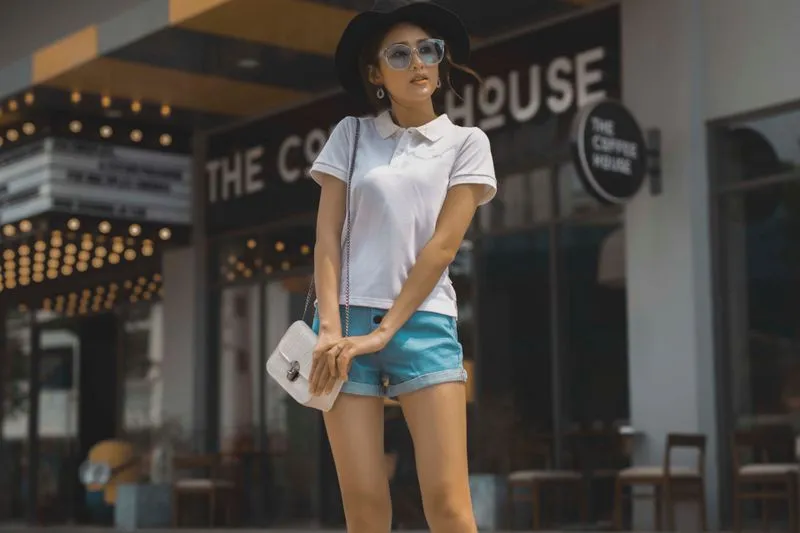
Yesterday morning, 9.12am, in the office lift. A woman from accounts looked me up and down (slowly, very slowly), then smiled: "What time's your match?" I was wearing a white cotton piqué polo, a white pleated skirt that stopped above the knee, white socks pulled up over the ankle and my white leather trainers. Four pieces, one colour, no sporting intent. Roland-Garros had started its main draw two days earlier — I thought the nod was clever. In the lift mirror, I mostly looked like someone waiting for a court to free up.
At lunchtime, I put on the navy blazer that lives on the back of my chair (it exists for surprise meetings and for air con set to "Arctic"). Same skirt, same polo, same socks — and nobody asked about my ranking again. One city piece was enough to defuse the costume. Not to make it a proper outfit: there were still four court pieces under that blazer.
That is the whole idea behind tenniscore, the trend that raids the tennis wardrobe and takes it into town: the polo, the pleated skirt, the cable-knit V-neck jumper, the white socks. Worn together, all in white, those pieces look like club uniform. Just one, slipped in among what's already in your wardrobe, is enough to set the tone. Between the two sit a handful of simple rules — and a century of history that explains why these clothes work so well off court.
Nearly all of these pieces started as a small act of cheek. Wimbledon starts on 30 June, so you have a month to practise.
What exactly is tenniscore?
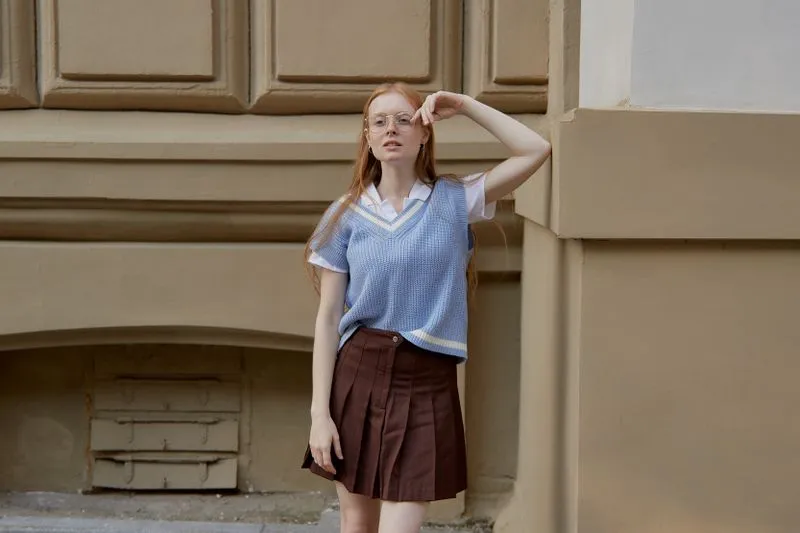
Tenniscore is a way of dressing that borrows the codes of tennis — a fitted polo, a pleated skirt, a cable-knit V-neck jumper, white socks, leather trainers, a cap or headband — and wears them day to day. The "core" suffix comes from social media slang, where it pins an aesthetic to a world (cottagecore and its floral dresses, normcore and its dad trainers). Here, the world is the tennis club, postcard edition — clay, freshly mown grass, lemon barley water in the shade (and nobody sweats).
No, the trend wasn't born with a film. In June 2023, British Vogue was already running a piece headlined "Wimbledon Is Almost Here, But This Tennis-Inspired Trend Is Winning Off The Court", calling tenniscore "the perfect trend for both generations". What Challengers did — Luca Guadagnino's film, released in cinemas in April 2024 — was pour petrol on it. The costumes were by Jonathan Anderson — then creative director of Loewe. On the press tour, Zendaya wore one tennis-inspired look after another, styled by Law Roach, including a silver Loewe dress with a pleated skirt, worn with stilettos whose heels speared tennis balls. "I wanted to be literal, I wanted to have this cultural moment and bring tenniscore back to the masses," Roach told the Los Angeles Times, as quoted by Tennis.com. Literal is the word (tennis balls through the heels: hard to get more literal).
The effect showed up at the tills. Just before the 2024 Championships, City A.M. reported that Wimbledon's merchandise sales were up 54 per cent in volume year on year, a boom it put down to tenniscore and Challengers. "Appetite for our collections has never been stronger," the All England Club's head of retail told the paper. And this week, the trend is back in its natural setting — Roland-Garros runs until 8 June in Paris, then the grass season arrives, with Wimbledon from 30 June to 13 July. Six weeks when polos come out of drawers all over the country.
Why does tennis dress in white?
Tennis still dresses in white largely because one tournament makes it compulsory: Wimbledon's clothing rules require players to wear tennis attire that is "almost entirely white", from the moment they enter the court surround. The rules spell it out: "White does not include off white or cream." A single trim of colour is allowed around the neckline and the cuffs — no wider than one centimetre (yes, the rules really do talk about measuring). Caps, headbands, wristbands and socks must be completely white, apart from that same trim. The one notable relaxation came in 2023: as Time Out London reported, female players may now wear solid, mid or dark-coloured undershorts, as long as they're no longer than the skirt or shorts.
The rule sits on older habits: early women's tennis outfits borrowed from menswear. A V&A blog post on the museum's tennis collections describes a fashion drawing from the turn of the 20th century, and points out that "the high white collar and black necktie, two-tone lace-up shoes with a low heel, and white wide-brimmed hat were all inspired by a smart young man's wardrobe." By the 1920s, the same post notes, tennis dresses had become less formal. By the 1970s, hemlines had "risen considerably" — the proof is a Lacoste dress in the V&A collection.
Why should you care if you don't play? Because those rules describe to the letter what makes an outfit look like match kit — optical white everywhere, from cap to laces. In town, flip the logic. Cream and off-white, banned from the grass at SW19, become your best friends — they keep the freshness of white without the uniform effect. And that navy or burgundy trim, tolerated to the millimetre at Wimbledon, can grow into a proper stripe on you.
The polo shirt: René Lacoste's cropped sleeves and Fred Perry's laurel
The polo shirt started with a simple act — cutting off sleeves. In the early twentieth century, players competed in long-sleeved white button-up shirts with the sleeves rolled up — flannel trousers and ties included. René Lacoste, the French champion nicknamed "the Crocodile", found the kit stiff and uncomfortable. He designed a short-sleeved white shirt in loosely knitted cotton piqué, with an unstarched collar and a tail longer at the back than at the front, so it wouldn't come untucked mid-serve. In 1933, he went into business with André Gillier (a knitwear manufacturer) to sell it — crocodile embroidered on the chest.
Britain had its own answer. Fred Perry — who won Wimbledon three years running, from 1934 to 1936 — launched his tennis shirt at Wimbledon in 1952: white knitted cotton piqué, short sleeves, a buttoned placket. The logo is a laurel wreath based on the original symbol of Wimbledon, stitched into the fabric on the left breast. The crocodile and the laurel stayed; the court is long gone.
Two details still give away a sports polo — that longer back tail (the "tennis tail") and tight ribbed cuffs gripping the arm. Neither is a dealbreaker. Torn between two sizes? Take the one that sits right on the shoulders, not the one that clings. And if you want a real "city" polo, look for a straight hem and slightly roomier sleeves — or go for the long-sleeved version in ribbed knit, which takes you well into October.

The pleated skirt: Suzanne Lenglen's legacy
The pleated tennis skirt owes almost everything to one Frenchwoman — Suzanne Lenglen. In the 1919 Wimbledon final, she played without a corset, in a short-sleeved blouse and a calf-length pleated skirt — against an opponent in long sleeves and a skirt below the calf. Soon after, she had the couturier Jean Patou design her outfits: a sleeveless top, a skirt that stopped at the knee, and a bandeau around her head that became her signature. She wore make-up on court, too.
At the knee. In the early 1920s. On a tennis court. Take a second to appreciate the nerve. If you're watching Roland-Garros this week, you'll see her name everywhere — the stadium's second show court has been called Court Suzanne Lenglen since 1997.
Short skirts kept making waves at SW19. In 1949, the American player Gussie Moran turned up at Wimbledon in a dress designed by Ted Tinling — short enough to show ruffled, lace-trimmed knickers. Photographers fought for low angles, reporters nicknamed her "Gorgeous Gussie", and the affair prompted a debate in Parliament. Tinling — who had been the official Wimbledon host — was then shunned for 33 years. All that for a frill of lace.
In town, the pleated skirt has kept that whiff of cheek, as long as you pick the right version. The white pleated mini is the court version (fun, but loud). It works with a chunky jumper or an oversized men's shirt (charity-shop or borrowed), far less with a polo and trainers. The pleated midi — in satin, fine wool or chiffon — is the real street piece. Worn with a ribbed vest or a crisp poplin shirt, it only hints at tennis through the swing of its pleats as you walk.
The cable-knit V-neck jumper, the cricket jumper's cousin
The white cable-knit V-neck has another name: the cricket jumper. Traditional cricket whites (or "flannels") are trousers, a shirt and a jumper — and the jumpers are traditionally cable-knit. Where it started is less clear: Gentleman's Gazette's history of the tennis sweater weighs three theories — ski slopes, golf courses and cricket grounds. What it does pin down is that "tennis players wore actual tennis sweaters, as we know them today, by the early 1930's" — and they became hugely popular in the mid-thirties.
The detail that makes it is the trim — always. One or two navy, green or burgundy stripes around the V and the cuffs: that's what separates a club jumper from a plain white one. The Prince of Wales (the menswear trendsetter of his day), the same article says, favoured a sleeveless, V-necked cable-stitch sweater for golf that sometimes had a touch of colour along the V. Recognise the tank-top that's been everywhere for a few summers now? Same family.
In town, forget the jumper knotted over the shoulders like a clubhouse poster (unless that's the look you're after — in which case, own it). Actually wear it: on its own over a satin skirt, over a striped shirt with the collar poking out, or a size up with straight-leg jeans and loafers. In cotton, it works from May to September. In wool or cashmere, it carries you through the whole in-between season.
The golden rule of tenniscore: one tennis piece, the rest from the street
One tennis piece per outfit, and everything else comes from your normal life. That's THE rule, the one I forgot yesterday in the lift. A polo with pleated trousers is an office outfit. A polo with a short pleated skirt, white socks and trainers is an entry form for the club tournament (mixed doubles).
You can go up to two tennis pieces — if the third pulls firmly towards the street. A pleated skirt and a cable knit, yes — but with leather loafers and a structured bag, not trainers. Beyond two, costume beats style — except in the stands at a tournament.
| Tennis piece | Pair with (street) | Avoid with (too match-day) |
|---|---|---|
| Knitted polo | Pleated trousers, satin midi skirt, raw denim | Short pleated skirt, high socks, trainers |
| Pleated skirt | Ribbed vest, poplin shirt, fine knit | Technical polo, visor, sweatbands |
| Cable-knit V-neck | Straight jeans, leather skirt, slip dress | White shorts, white socks |
| White socks | Loafers, ballet flats, Mary Janes | Trainers plus pleated skirt plus polo |
| Cap | Trench coat, oversized shirt, jeans | Everything else in white |
The rule works for any trend that comes from a specific world (western, nautical, workwear). I set it out in my method for adapting runway trends to everyday life: the idea is to borrow one code from that world, not its whole costume.
Fabric, colour, shoes: what tips a look towards the street
Three levers take a tennis piece from court to pavement: fabric, colour and shoes. Pull at least one of them — ideally two.
Fabric
Breathable polyester, mesh and shiny fabrics scream "changing room". Cotton piqué, wool knits, cashmere, poplin, linen and satin say "street". A pleated skirt in champagne satin has nothing sporty left about it, whereas the polyester club skort (built-in shorts and all) still looks ready for a match. For the polo, a fine knit moves it into summer-jumper territory.
Colour
Optical white is the colour of the rulebook, not necessarily yours. Shift it with ecru, cream, sand — precisely the shades Wimbledon refuses on its grass. Then add the club-trim colours (navy, bottle green, burgundy, sky blue). One strong colour per outfit is plenty — on a neutral base.
Shoes
Shoes usually settle it (more than you'd think). Leather loafers, ballet flats, Mary Janes, flat sandals or Derbies drag any tennis outfit onto the street side. White leather trainers are still allowed (I'm not going to ban them, I wear mine almost every day), provided everything else is properly urban. The emblem of the genre, the Adidas Stan Smith, is pure court heritage. It launched in 1965 named after the French player Robert Haillet, was renamed in 1978 after the American Stan Smith, and you'll spot it by the three rows of perforations — in place of the three stripes.

Five tenniscore outfits for a real week
Five outfits that work in real life (mine, and my wardrobe's) — from the most restrained to the most full-on.
1. At the office: the tucked-in polo
Busy day and no desire to think at 7am? A navy fine-knit polo, tucked into a cream pleated midi skirt, a thin leather belt, loafers. The blazer stays on the chair (ready for the 4pm meeting). It's the most discreet version — nobody thinks of tennis, everybody thinks you look sharp.
2. Sunday: the cable knit and jeans
An ecru cable-knit V-neck a size up, straight raw jeans, ballet flats or white leather trainers, sunglasses. The outfit that goes from the farmers' market to the pub garden — without you having to think about it.
3. A summer evening out: the polo dress
A knitted polo dress, knee length, with flat sandals and a denim jacket over your shoulders. The collar gives it structure, the knit stays soft — and the dress does all the work (one piece, zero effort).
4. Weekend on the bike: shorts and a striped polo
High-waisted linen or cotton shorts, a striped polo, low white socks and suede loafers. Two tennis pieces (the polo and the socks), and two that pull it towards the street: the linen and the loafers.
5. At Wimbledon (or on Henman Hill with a picnic)
The one place you can go further. White pleated skirt, oversized poplin shirt, cap, sunglasses and trainers. In the crowd, everyone had the same idea as you — and for once, that's perfect.
Headbands, caps, socks: the accessories to ration
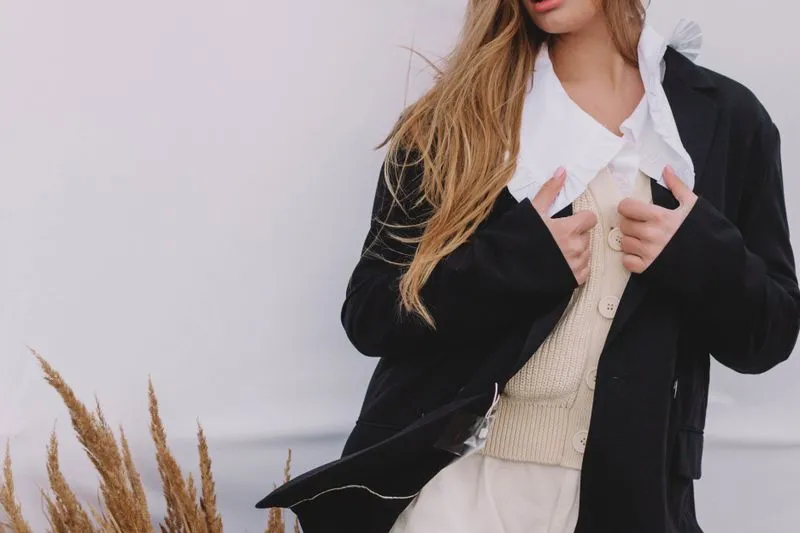
Accessories are the quickest shortcut to tenniscore — and to fancy dress. One per outfit, no more.
- The headband: straight from Suzanne Lenglen. In thick fabric or velvet, it sits happily with a city outfit; in towelling, it stays gym kit.
- The cap: in washed cotton rather than technical fabric — white, cream or a club colour (navy, bottle green). At Wimbledon, it must be completely white, including the underside of the peak. You're allowed colour and an embroidered logo.
- White socks: ribbed, pulled up over the ankle, with loafers or ballet flats. The cleverest accessory in the trend, because it costs next to nothing and changes a whole silhouette.
- The bag: a canvas tote, a bowling bag or a small shoulder bag. Leave the proper racket bag to the people who actually play.
- Jewellery: a fine chain in the open neck of a polo, small hoops, a watch on a leather strap.

The mistakes that turn tenniscore into match kit
When tenniscore goes wrong, it's almost always a pile-up. These are the five traps that come up most often.
- Optical white head to toe. That's word for word Wimbledon's rulebook. Break it with a shade (ecru, cream) or a fabric (linen, chunky knit).
- Technical fabrics. A shiny breathable polo or a polyester skort stays sportswear — however you style it.
- The full kit. Visor, sweatbands, knee-high socks and court trainers all at once: even Zendaya kept the tennis balls for her heels.
- Logos on logos. A crocodile or a laurel wreath on a polo is history. Three sportswear logos on one silhouette is a catalogue.
- The wrong length. A mini designed for chasing a ball isn't made for a day of meetings. Choose the length for your day, not for the product photo.
Where to find tenniscore pieces without overspending
Tenniscore has one huge advantage — its pieces are classics, so they turn up everywhere second-hand. Piqué polos, cricket jumpers and pleated skirts come through charity shops, Depop and Vinted by the dozen (often for far less than new). Search for "cricket jumper", "cable knit V-neck" or "pleated midi skirt" rather than "tenniscore" — in my experience, listings written with the pre-trend words are the cheapest.
If you want the real thing, Wimbledon sells its own collection. According to FashionUnited, last summer's range was the club's largest yet, with prices from £15 to £250, and traffic to its retail website up 69 per cent year on year.
For new pieces, put your money where fabric matters: the jumper (wool, cashmere or thick cotton) and the knitted polo. They're the two pieces that age best when they're well made — I go into more detail in my guide to the fashion pieces worth investing in. The pleated skirt and the cap, on the other hand, can come from the high street without anyone noticing.
Try it tonight, in front of your wardrobe. Take out one single piece that could go on a court — the polo, the pleated skirt, the V-neck jumper or the white socks — and dress it with what you'd wear to work. If you recognise yourself in the mirror, game won. If you catch yourself looking for your racket, take one piece off.
Frequently asked questions
Can you wear a pleated skirt to the office?
Yes, in a midi or knee-length version and a fluid fabric (satin, fine wool, chiffon). Pair it with a fine knit or a shirt, plus loafers or ballet flats. The white pleated mini is trickier at work: check the length once you sit down.
Do you have to wear white to do tenniscore?
No. Head-to-toe white is the very thing that turns an outfit into match kit. Cream and ecru, plus the club-trim colours (navy, bottle green, burgundy), say "tennis" without the uniform.
What shoes go with a tenniscore outfit?
Loafers, ballet flats, Mary Janes, flat sandals or Derbies for town. White leather trainers if the rest of the outfit is clearly urban: a blazer, tailored trousers, a structured bag.
Isn't the polo shirt a bit dated?
Untucked over tracksuit bottoms, maybe. In fine knit, tucked into a midi skirt or high-waisted trousers, it's an office piece that has survived every decade since the 1930s. It all comes down to fabric and how you wear it.
What should I wear to watch Wimbledon?
Wimbledon's all-white rule applies to players, not spectators, so you're free to go as all-out as you like: a pleated skirt or pale shorts, a shirt or polo, a cap and sunglasses. Bring comfortable shoes for the walk around the grounds and a light layer for the evening.
Does tenniscore suit every body shape?
Yes, with the right cuts. A pleated midi adds movement without clinging at the waist; a fine-knit polo should fit at the shoulders, not squeeze. To find the lengths that suit you, the guide to dressing for your body type is the best place to start.
How do you look after a white jumper or polo?
Wash them inside out, at a low temperature, only with other whites. Dry the jumper flat so it doesn't stretch, and the polo on a hanger with the collar set back in shape. A curling ribbed collar can be coaxed back with steam.
Sources
- Wimbledon — Clothing and Equipment
- V&A Blog — Anyone for tennis? (June 2013)
- Time Out London — Wimbledon has relaxed its dress code (July 2023)
- City A.M. — How the tenniscore trend served up a retail sales boost for Wimbledon (July 2024)
- FashionUnited — Wimbledon capitalising on tennis-core trend with largest retail collection (June 2024)
- Gentleman's Gazette — The Cable Knit Tennis Sweater (2011)
- Tennis.com — The year of Tenniscore (December 2024)
- Wikipedia — Fred Perry
- Wikipedia — Polo shirt
- Wikipedia — Suzanne Lenglen
- Wikipedia — Gussie Moran
- Wikipedia — Cricket whites
- Wikipedia — Adidas Stan Smith
- Wikipedia — Challengers (film)
- British Vogue — Wimbledon Is Almost Here, But This Tennis-Inspired Trend Is Winning Off The Court (June 2023)
- Roland-Garros — Roland-Garros 2025: the full schedule
- Wikipedia — 2025 Wimbledon Championships (archived 28 March 2025)