Your partner changed three nappies this week. He's rather proud of himself. You've changed eighteen — and nobody has congratulated you. This Sunday, 15 June, is Father's Day, and plenty of cards made at nursery or school will celebrate brilliant dads — many of whom are. Yet ONS time-use data show women in the UK doing far more of the unpaid work at home, and a father's share is too often applauded as an achievement. This guide isn't here to judge anyone — it brings together the leave, the flexible working rights and the couple arrangements that let both parents share properly.

How unpaid work is split in UK homes: the ONS figures
In autumn 2023, women in the UK spent an average of 3 hours and 37 minutes a day on unpaid work, 54 minutes more than men (2 hours and 43 minutes), according to the ONS "Time use in the UK" bulletin published in November 2023. Unpaid work there covers housework, caring for others and volunteering. The gap has narrowed — it stood at 1 hour and 12 minutes in autumn 2020 (the ONS still labels these statistics experimental).
A more detailed breakdown comes from the ONS analysis "Women shoulder the responsibility of 'unpaid work'" (November 2016), based on 2015 time use data:
- Women carried out an overall average of 60% more unpaid work than men
- Men did 16 hours a week of unpaid work (childcare, adult care, laundry, cleaning and the rest), against 26 hours for women
- Women "put in more than double the proportion of unpaid work when it comes to cooking, childcare and housework"
In short, the day-to-day load of home and family life still leans one way — even as the gap shrinks. It usually settles in without the couple ever choosing it — driven by unequal leave, social norms and pay gaps. A national average also hides huge differences between households (yours may be far from it, in either direction).
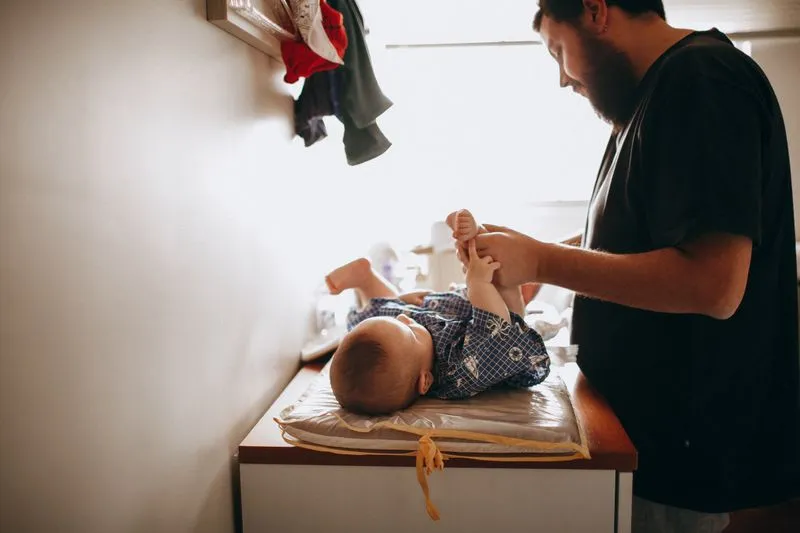
Why the parenting load is still unequal
The parenting load stays unequal because of structures — far more than individual goodwill. Four mechanisms turn up in most households, and you'll probably recognise several.
1. Very unequal leave. In the UK, Statutory Maternity Leave is 52 weeks, and Statutory Maternity Pay runs for up to 39 of them. Statutory Paternity Leave is up to two weeks. During that gap, the mother picks up the skills faster (through sheer time spent), becomes the de facto expert — and the father ends up as the "junior" waiting for instructions.
2. Lopsided expectations. A highly involved father is admired and praised — a mother who does just as much is "doing her job". That double standard quietly reinforces the idea that caring for children is women's work.
3. An economic spiral. The government's Shared Parental Leave evaluation report, published in June 2023, puts it plainly: "Women change their work patterns to accommodate parenting responsibilities to a much greater degree than fathers." Each cut in the mother's hours makes the next one look more "rational" — she earns less, becomes more expert at home, and she's the one who steps back again. To see what that spiral costs over a working life, read the real numbers behind the gender pay gap, and the solutions that work.
4. Default specialisation. Without an explicit agreement, couples specialise: one becomes the "go-to" for care, the other for leisure or finances. It feels efficient in the short term — and it builds a skills gap that makes any later rebalancing harder.
Sweden's parental leave model: what we can learn
In Sweden, 90 days of parental benefit are reserved for each parent and cannot be handed to the other. According to Försäkringskassan, the Swedish Social Insurance Agency, parents share 480 days of parental benefit per child (roughly 16 months) — if the father doesn't take his 90 days, they're lost.
The quota was built up in stages. According to the timeline in Statistics Sweden's "Women and men in Sweden: facts and figures 2022", the third reserved month only applies to children born on or after 1 January 2016. The same report tracks the result: fathers took 30% of all parental benefit days every year from 2018 to 2021, against 5% in 1980, 12% in 2000 and 23% in 2010. Their share has risen sixfold in around forty years — slowly, but without going backwards.

What works in Sweden isn't a "naturally egalitarian culture" — it's a rule that makes leaving the father out costly for the household. As long as parental leave mainly penalises the higher earner (often the father), the split will stay lopsided.
Parental leave in the UK: where things stand
Shared Parental Leave lets eligible parents share up to 50 weeks of leave and up to 37 weeks of pay between them. In practice, it's rarely used — the government's Shared Parental Leave evaluation report (June 2023) found that among eligible couples, only 1% of employee mothers and 5% of employee fathers took it. HMRC figures quoted in the same report show around 13,000 people receiving Shared Parental Pay in 2021-22. Why so few?
- Money. From 6 April 2025, statutory Shared Parental Pay is £187.18 a week, or 90% of average weekly earnings if that's lower, according to the government's rates and thresholds for employers for 2025 to 2026 — for most households, a steep drop from a full salary
- Employers rarely top it up. Less than a tenth (8%) of workplaces where managers were aware of the scheme said they would pay more than the statutory rate
- Affordability. Among parents who took Shared Parental Leave but not their full entitlement, the main reason given was that they could not afford to
- Awareness. A third of mothers who did not take it had not heard of it at all when their baby was born or adopted, and the proportion was closer to half among fathers (45%)
Part-time and flexible working for both parents: your rights in the UK
Since 6 April 2024, employees in Great Britain can ask for flexible working from their first day in a job — they previously needed 26 weeks' service — under the Flexible Working (Amendment) Regulations 2023. GOV.UK's flexible working guide lists what you can ask to change: the number of hours you work, when you start or finish, the days you work and where you work. Your employer must deal with the request in a reasonable manner (the rules differ in Northern Ireland). Both parents can make that request — which opens the door to two adjusted schedules instead of one parent going part time alone.
Shared Parental Leave can be split up too. According to GOV.UK's Shared Parental Leave guide, you can "take leave in blocks separated by periods of work, or take it all in one go", and you can be off together or stagger your leave. The government's Shared Parental Leave evaluation adds that up to three blocks can be booked (more if the employer agrees), with a return to work between them.
In practice, fathers rarely change how they work. In that evaluation, 93% of fathers reported no change in job role, working arrangements or hours. Fathers who took Shared Parental Leave stand out — 14% changed their working hours and 24% their working arrangements, against 3% and 2% of fathers overall. On the mothers' side, among those whose working arrangements changed, three quarters (75%) went part time, against 58% of the mothers who took Shared Parental Leave. Flexible hours are one piece of a wider picture, set out in our guide to gender equality at work and the state of play in 2025.
Three ways couples organise to share the parenting load
How a couple organises the first year shapes what comes next. The government's Shared Parental Leave evaluation found that "Fathers who take SPL are more likely to be involved in childcare and mothers who take SPL are more likely to return to work than mothers generally." A greater proportion of SPL mothers (73%) returned to their pre-birth job than mothers overall (54%), and 62% of SPL fathers, against 23% of fathers in general, said that wanting to share childcare was the main factor in their choice of leave. The report is careful on cause and effect — SPL parents tend to work full time in better-paid, more senior jobs, and it remains difficult to isolate the effect of fathers' involvement on mothers' return to work.
The three arrangements below are practical ways of organising, to try and then adjust — none has been measured on its own in the sources cited here.
The negotiated 50-50. Each parenting task is explicitly allocated to one parent or the other, by agreement. Both parents master every skill (baths, night wakings, GP visits, school), and the list is reviewed every six months. It takes rigour at the start — the regular review is there to catch the tasks that drift to one side without anyone deciding it.
The alternating lead parent. Each parent is the "lead parent" on alternate weeks, even when both are at home. The parent on duty runs the school run, meals, baths and nights; the other is available — but doesn't make the calls. Each of you learns to hold the whole of daily family life alone.

Balanced specialisation. Each parent takes whole domains — health and school for one, leisure and food for the other. Two rules keep it fair: the domains carry a comparable load, and each parent knows enough about the other's domains to cover in a pinch. Splitting by domain also spares you the daily task-by-task negotiations that wear everyone out.
Practical tools to rebalance the parenting load
To correct an imbalance, start by measuring it. For two weeks, each of you notes what you do for the children and how long it takes, without comment or blame: baths, school runs and appointments, but also the lists, the forms and the messages to other parents. A shared spreadsheet is enough, and a deck of cards where each card stands for one task makes the exercise easier to run together. The aim: make the status quo visible — which can surprise both parents.
Then review it together, at a calm moment, figures in hand. Split the tasks using one of the three arrangements (negotiated 50-50, alternating lead parent or balanced specialisation), and set a date for the next check-in, three or six months later.

A shared calendar completes the inventory. When every one of your child's appointments (GP, vaccinations, nursery meetings) carries the name of the parent in charge, the family's memory no longer rests on one person.
The parenting mental load: the invisible share
The mental load — thinking and organising, on top of doing — is the hardest chapter of shared parenting. Because it's invisible, it's hard to measure and even harder to put into words. A time diary can record the half hour spent bathing a child; it struggles to capture the minutes spent remembering that tonight is bath night.
The parental mental load includes:
- Anticipating needs (clothes sizes, upcoming vaccinations, the week's activities)
- Managing appointments (GP, health visitor, speech and language therapy, parents' evenings)
- Keeping track of supplies (nappies, formula, Calpol)
- Coordinating childcare and the inevitable last-minute changes
- Being mentally available for a child's spontaneous questions
In May 2017, the French cartoonist Emma published an English version of her comic "You Should've Asked", which turned the mental load into something couples could finally point at. Its message is simple: when one partner has to ask, the other is still the one doing the thinking.

Sharing the mental load means sharing responsibility as well as execution. It's not "you can do it if I ask you to" — it's "you know it needs doing, you know how, and you do it without me having to think about it."
Frequently asked questions
How do I start the conversation with a resistant partner?
Conversations about dividing tasks often go badly because they feel like accusations. Start from data (the task inventory) rather than feelings: "I've noticed we're doing X and Y — I'd like us to think together about how we could rebalance this." Avoid tired evenings once the children are in bed. Choose a dedicated moment, without the children, perhaps outdoors. These couple communication techniques that actually work help you make a request without it sounding like blame. If the conversation doesn't move forward, a couples therapist or family mediator can create the space you need.
My partner says he doesn't know how — what do I do with that?
"I don't know how" is often true at first — then becomes an avoidance strategy if it lasts. The answer: create situations where he learns, without taking over the moment he stumbles. A father who spends time alone with the children, even short stretches at first, learns by doing. If you consistently solve problems for him, you're keeping him out of practice.
Is shared parenting realistic with very different work schedules?
Yes — as long as you define the split in proportion to the time available rather than in absolute hours. If one parent works 70 hours a week and the other 35, a strict 50-50 won't hold. The parent working fewer hours can take a bigger share of the parenting tasks, while the other makes up for it in other domains (finances, household admin, bigger maintenance jobs). What matters is that the arrangement is explicit and recognised by both of you.
Does everything need to be shared, including things we enjoy?
No. Aim for balance in the total load, not in every task. If one of you loves cooking and the other dreads it, it's logical for the cook to take more meals. What matters is that the total load (enjoyable and demanding) is balanced, with room for each person's preferences and skills.
What do children gain from shared parenting?
A useful reference here is a systematic review of 24 longitudinal studies published in Acta Paediatrica in 2008, 22 of which described positive effects of father involvement. Its authors conclude: "There is evidence to support the positive influence of father engagement on offspring social, behavioural and psychological outcomes." The form that counts is engagement — direct interaction with the child — rather than simply being around. These studies show associations, not a recipe: what matters is time genuinely spent with your child.
What if the imbalance persists despite our best efforts?
First, check whether the problem is organisational (no clear agreement on who does what) or relational (one partner doesn't want to change). In the first case, a more explicit agreement often resolves it. In the second, it's a question of values and commitment — a couples therapist can help clarify whether the difference can be bridged. In some cases, a persistent imbalance also becomes something to weigh in your overall assessment of the relationship.
Can single parents take anything useful from this guide?
Largely, yes — even though the context is very different. For single parents, "sharing" takes other forms: a support network of family or friends, shared care with the other parent where possible, paying for help with specific tasks. The mental load remains a central challenge, and the same principles of making it visible and organising it explicitly still apply.
Sources
- Office for National Statistics — Time use in the UK: 23 September to 1 October 2023
- Office for National Statistics — Women shoulder the responsibility of 'unpaid work' (2016)
- GOV.UK — Maternity pay and leave
- GOV.UK — Shared Parental Leave and Pay
- GOV.UK — Rates and thresholds for employers 2025 to 2026
- GOV.UK — Flexible working
- legislation.gov.uk — The Flexible Working (Amendment) Regulations 2023
- Department for Business and Trade — Shared Parental Leave evaluation report (2023)
- Försäkringskassan — Parental benefit
- Statistics Sweden — Women and men in Sweden: facts and figures 2022
- Sarkadi et al. — Fathers' involvement and children's developmental outcomes (Acta Paediatrica, 2008)