The practice nurse has the screen angled towards her, and she's working through the usual questions in the usual order. Thursday in June, 5.40pm, the last slot before the surgery closes — you can hear the receptionist wishing someone a good evening through the door. Date of your last period. Any unusual bleeding. And then the one that always comes: "And what are you using for contraception at the moment?"
You say "nothing". There's a tiny pause — just long enough for you to decide whether to explain that your girlfriend is called Jess, or to let the misunderstanding float. Sometimes it goes a little further. Someone suggests (or a friend once told you) that between women, a smear test "doesn't really apply". While I was preparing this piece, several readers wrote to me describing that exact moment, almost word for word.
It's hardly a rare scene. According to the Office for National Statistics' Census 2021 analysis of sexual orientation by age and sex, around 830,000 women aged 16 and over in England and Wales (3.32%) identified as lesbian, gay, bisexual or another minority orientation. Among women aged 16 to 24, the figure was 9.38% — close to 1 in 10. And the census only counts the labels people chose to tick, not every woman who has ever slept with a woman.
June — Pride Month — feels like the right moment to take stock. This guide is for women who have sex with women, whether you call yourself lesbian, bisexual, pansexual or queer, or use no label at all. It covers STIs, cervical screening, dental dams and sex toy hygiene, without the scare tactics. Because protection, done well, is there to serve pleasure.
"No risk between women": a stubborn myth
The idea has been around for decades: no penis, no semen, so no sexually transmitted infections (STIs). It's wrong. HPV, herpes, chlamydia and other infections can all pass between women — through oral sex, fingers, shared toys and genital contact. The risk profile is different from sex with men. It isn't zero.
The NHS Cervical Screening Programme considered the myth widespread enough to publish a dedicated guide on cervical screening for lesbian and bisexual women. Its opening is blunt: "Sometimes health workers have advised lesbian women they do not need screening because they do not have sex with men. Or you may have been told by other lesbians that you do not need to be screened." The same guide notes that lesbian and bisexual women are "more likely to have never been screened than heterosexual women".
Why does the myth hold on so well? Part of the answer, I think, lies in how women's health care tends to be organised. For many of us, contraception is the gateway: the pill review, the coil check, the appointment where you finally ask the questions you've been saving up. Without a prescription to renew, that yearly contact loses its most obvious reason to exist — and routine care quietly drifts. (That's my reading of it, not a measured fact.)
The guidance itself fits in one sentence: if you're aged 25 to 64 and you have a cervix, you're eligible for screening, whoever you sleep with. It's not an optional extra. It's the same baseline of prevention everyone gets — adapted to what you actually do in bed.

Which STIs pass between women, and how?
An STI doesn't need penetration to spread. Many travel in body fluids (vaginal fluid, period blood). Some viruses (HPV is the best known) pass through skin-to-skin contact — during any kind of sexual activity. Between women, that means plenty of routes: a mouth on a vulva or anus, fingers moving from one body to another, shared toys, two vulvas rubbing together.
Oral sex deserves particular attention, because it's often central to sex between women. The young people's sexual health charity Brook is clear that "you can get or pass on STIs through oral sex", and that the risk is always there when someone is exposed to genital fluids or blood — during a period, for example, or with bleeding gums. Chlamydia, gonorrhoea, HIV and syphilis can all be passed on when those fluids meet sores, cuts or inflamed skin on the lips, mouth or genitals. Pubic lice, meanwhile, can hop between pubic hair and facial hair.
Herpes shows how easily the trap springs. Brook points out that the herpes simplex virus behind genital herpes is also the cause of cold sores. So oral sex during a cold sore flare can pass the virus to your partner's vulva. While a sore is visible, keep your mouth for other places (her neck, shoulders and breasts have plenty to recommend them).
Hands count too. The NHS screening guide lists "transferring vaginal fluids on hands and fingers" among the ways of being exposed to HPV, alongside oral sex and sharing sex toys. A finger that strokes one vulva and then another carries fluids — and, with them, whatever germs are present.
Periods raise the stakes, since blood makes transmission of some infections easier. Scissoring (tribbing) — where two vulvas rub directly against each other — is the hardest practice to protect, because no barrier really fits it. It's worth skipping during a period, or when either of you has symptoms. If you'd like to get better at spotting where you are in the month, our complete guide to understanding your menstrual cycle walks through each phase.
If you also have sex with men, two more things come into play. HIV prevention — post-exposure prophylaxis (PEP) after a condom accident, or pre-exposure prophylaxis (PrEP) taken in advance — is something a sexual health clinic can talk you through. And pregnancy is back on the table: our complete guide to every contraception method will help you choose.
Cervical screening is for you too
Nearly all cases of cervical cancer are associated with HPV, a virus that is passed on "by skin-to-skin contact through any type of sexual activity", as the NHS guide for lesbian and bisexual women puts it — adding, in so many words, "This includes sexual activity between women." Most HPV infections clear on their own. The ones that linger can cause changes in the cells of the cervix, which may turn into cancer over time if left untreated.
HPV is remarkably common. For every 100 people who have cervical screening, 13 are found to have it (an "HPV positive" result). Studies involving lesbian and bisexual women, cited in the same guide, found that between 3% and 30% of participants tested positive. So this isn't a question of orientation — it's a question of having a cervix.
Screening itself is not a test for cancer. It looks for HPV and for abnormal cell changes on the cervix (the neck of the womb), so they can be treated long before they become dangerous. The results speak for themselves: in England, cervical screening currently prevents 70% of cervical cancer deaths, and the guide estimates that 83% could be prevented if everyone attended regularly.
Everyone aged 25 to 64 with a cervix is eligible. In England, that has meant an invitation every 3 years from 25 to 49 and every 5 years from 50 to 64 — but NHS England announced this month that from 1 July 2025, people aged 25 to 49 whose test finds no HPV will be invited every 5 years instead (Scotland and Wales already work this way). If HPV is found without any cell changes, you're invited back after a year.
The new interval starts with your next test: until then, your invitation follows the interval you were given last time. Northern Ireland runs its own programme. The test is usually done at your GP practice by the practice nurse, and some sexual health clinics offer it too.

The HPV vaccine: where do you stand?
The HPV vaccine is the other half of cervical cancer prevention — it works upstream, before any screening. On the NHS, it's offered to all children aged 12 to 13 (school year 8). According to the NHS page on the HPV vaccine, if you missed it at school, it's available free for "all girls aged 24 and under up until their 25th birthday", usually as a single dose if you're under 25.
If you're past that birthday and were never vaccinated, ask your GP or a sexual health clinic whether anything applies to your situation. Either way, keep going to screening. The NHS is explicit: "It's still important to attend cervical screening appointments if you've been vaccinated against HPV, as there's still a small chance you could get cervical cancer." The vaccine lowers the risk. It doesn't remove it.
Not sure whether you had it? Your GP practice can check your vaccination record. A two-minute phone call beats years of wondering.
Dental dams: what they're for and how to use them
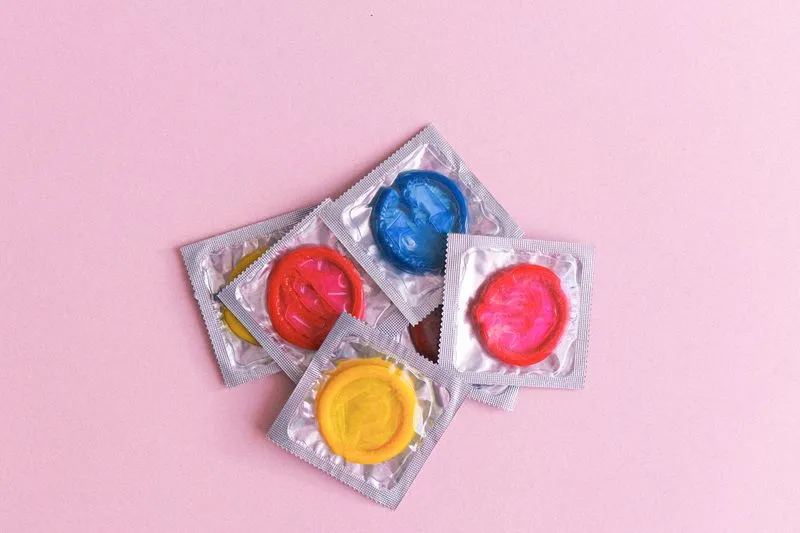
A dental dam is a thin square of latex (or polyurethane, a soft plastic) that you place over the vulva or anus before oral sex. It acts as a barrier between the mouth and the genitals. Brook's practical guide to dental dams sets out how to use one properly:
- check the dam is in date and carries a CE or UKCA mark;
- wet the vulva or anal area with a water-based lube, so the dam doesn't slip;
- place the dam over the vulva or anus before any mouth-to-genital contact, and hold it in place (either of you can do this);
- don't turn it over — the side touching the genitals stays on that side;
- use each dam once, then wrap it in tissue and put it in the bin, not down the toilet.
Lube matters more than people think. With latex dams, use only water-based or silicone-based products: oil-based ones such as Vaseline or baby oil damage the latex. Polyurethane dams are the exception, and they suit anyone with a latex allergy.
Where do you find them? Some GUM (genitourinary medicine) and sexual health clinics, contraception clinics and pharmacies stock them, and you can also order them online. The simplest option is often to make your own. Roll out a condom, cut off the tip and the ring, then cut along its length — and you have a rectangle you can lay flat.
Let's be fair to the dental dam, and to you: the evidence is thin. Brook says so plainly — "Dental dams might offer some protection from STIs, but there is currently very little research to verify this." Nor are they a substitute for regular testing. A dam is a sensible barrier, not a guarantee.
Shared sex toys: hygiene and protection
Toys can carry germs from one body to another, and they're often shared. In an Australian cohort of women who have sex with women, followed for two years, 72% of participants (100 women were analysed) reported using sex toys with a female partner. The 2019 Monash University study published in Scientific Reports notes that sharing toys between women is one of the practices linked to a higher risk of bacterial vaginosis.
Brook's advice is simple: avoid sharing toys, and if you do share them, "clean them thoroughly in between being used by different people". Follow the maker's cleaning instructions, since materials differ. For penetration with a shared toy, a fresh condom for each person adds a barrier — and the condom goes on the toy, never doubled up with an internal condom.
The same care applies when a toy moves from the anus to the vagina. The Australian team lists vaginal sex after anal sex among the practices associated with bacterial vaginosis. Change the condom between the two, or wash the toy before switching. The easiest rule for penetration? Each of you has your own.
Fingers, hands and gloves: the simple habits
Hands often play a big part in sex between women, and they need very little. Wash them before — and between bodies, if you're moving from one person to another. Short, filed nails are a matter of comfort (delicate skin doesn't enjoy scratches or sharp edges).
For deeper penetration (fisting included), latex or vinyl gloves create a simple barrier against STIs. Vinyl contains no latex, so it suits anyone who's allergic. With latex gloves, the lube rule is the same as for dams: water-based or silicone-based, never oil.
Small cuts, spots and chapped lips change the picture as well. Brook explains that sores, cuts or inflamed areas on the lips, mouth, genitals or anus can let infections in. At those times a barrier — a glove or a dam — isn't overkill. It's simply the practical option.
Bacterial vaginosis: what passes between partners
Bacterial vaginosis (BV) is the most common imbalance of the vaginal microbiota. Lactobacilli — the protective bacteria that dominate a healthy vagina — give way to other bacteria, including Gardnerella vaginalis. It isn't usually counted among STIs. Yet it's closely tied to sex between women: the estimates cited by the Australian team put its prevalence at 25% to 52% among women who have sex with women.
The Scientific Reports study goes further. In participants who had a new sexual partner (usually a woman), the vaginal microbiota became more diverse, less stable — and more often dominated by BV-associated bacteria. The researchers describe their findings as microbiological support for "the sexual exchange of bacteria between women".
How would you know? The NHS page on bacterial vaginosis lists the usual signs: an unusual discharge with a strong fishy smell, particularly after sex, that turns greyish-white, thin and watery — although half of women with BV have no symptoms at all. An unusual smell is a reason to get checked at your GP or a sexual health clinic. BV is treatable, usually with antibiotic tablets, gels or creams. The same page notes that a woman can pass it to another woman during sex, and that a same-sex partner may also need treatment: if it keeps coming back, mention your partner to the clinician.
STI testing: when, where and what to ask for
Many STIs have no symptoms, which means you can have one without knowing and pass it on. The NHS overview of sexually transmitted infections is blunt: "The only way to know for sure is to get tested." Brook recommends testing regularly, and each time you have sex with a new partner.
You don't usually need a GP referral or even an appointment for a sexual health clinic (though it's worth contacting the clinic first to check). Visits are confidential. You don't have to give your real name, nothing is shared with your GP unless you ask, and you can request a female doctor or nurse. Some clinics also offer home testing kits for some STIs.
Timing matters. The NHS notes that STIs "can take up to 7 weeks after you have unprotected sex to show up on a test" — so if you have no symptoms, it's best to wait before testing. If you do have symptoms, go sooner. Until you've been checked, the NHS advice is not to have sex, including oral sex, without a condom or dental dam.
Say what you actually do: it decides which swabs you're offered. Tests can include a urine sample, a blood test and swabs from the vagina or anus (taken with a small cotton bud). If oral sex is part of your sex life, mention it, so the clinic can decide whether a throat swab makes sense too. Otherwise, your throat may simply never be tested.
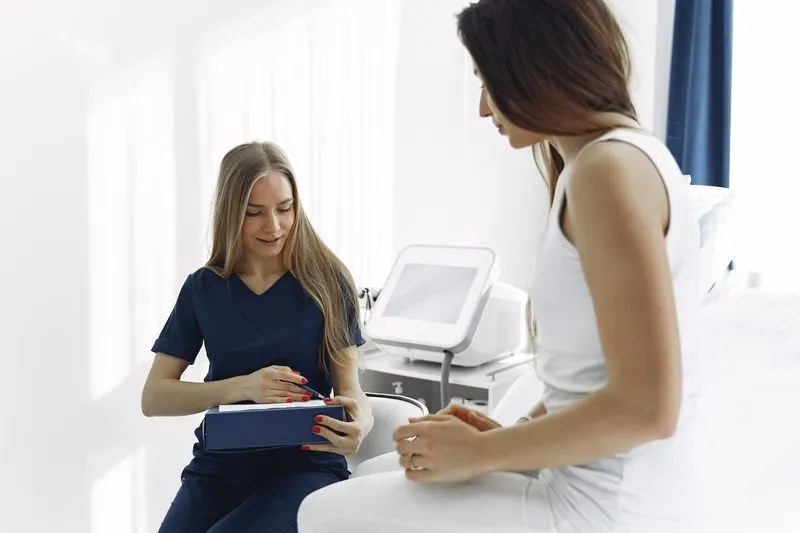
Talking about your sex life at an appointment
You don't have to mention your sexual orientation. But it often helps. The NHS screening guide acknowledges that you're unlikely to be asked, and that "some women may find they get asked sexual health questions more appropriate for heterosexual women". It suggests mentioning your orientation so that the questions — and the information you're given — fit your life.
A few words at the start of the appointment do the job: "I have sex with women, and I'd like to check where I am with screening and STI tests." That sentence steers the rest of the conversation. It also saves you from the contraception questions that don't apply.
If a clinician tells you screening is unnecessary because you don't sleep with men, ask for it anyway. The guide is unambiguous: "As long as you are aged 25 to 64 and you have a cervix, then you are eligible for screening". It adds that even a woman who has never had any sexual activity "should not be refused screening if she is due for an appointment". If your GP practice isn't the right place for you, some sexual health clinics offer screening too.
Pleasure first: protection that doesn't kill the mood
Protection is often talked about as a brake. Between women, it can become one more part of the game. Laying down a dam, rolling a condom onto a toy, easing on a glove with a little lube: each of these can be done slowly, eye to eye, stretching the build-up rather than breaking it.
Pleasure itself doesn't belong to any single practice. It grows out of discovering what feels good to each of you — which is exactly what our shame-free guide to female pleasure and orgasm explores. And if this is your first time with a woman, the principles in our guide to a stress-free first time hold just as true: take your time, talk, and check that the desire is mutual.
Consent sits underneath all of it. As Brook puts it, you should never feel you have to have oral sex, or any other kind of sex, if you don't want to. Saying "not tonight" to a dam, a toy or a particular touch isn't a rejection — it's information. The best protection is the one you agreed on beforehand, calmly, rather than the one you negotiate at the last second.
If you do only one thing after reading this, make it this: find the date of your last screening test. If you're overdue — or you can't remember ever having one — book with your GP practice this week.

Frequently asked questions
Can you get HIV from sex between women?
The risk is very low, but it isn't zero. Brook explains that HIV can be passed on through oral sex when genital fluids or blood meet sores, cuts or inflamed skin — and period blood raises the risk. If you're worried, a sexual health clinic can test you confidentially.
I've never had sex with a man. Do I need cervical screening?
Yes. HPV passes through skin-to-skin contact during any type of sexual activity, including sex between women. Everyone aged 25 to 64 with a cervix is eligible for screening, whatever their sexual orientation.
Are dental dams really necessary?
They're a sensible barrier for oral sex on the vulva or anus, especially with a new partner. Brook notes that there's very little research on how well they work, and that they don't replace regular STI testing. In an exclusive relationship, testing together lets you decide knowing the facts.
How should we clean shared sex toys?
Clean them thoroughly between users, following the maker's instructions for the material. For penetration with a shared toy, use a fresh condom for each person, and another fresh one when moving from the anus to the vagina.
I'm 26 and never had the HPV vaccine. Is it too late?
On the NHS, the free catch-up for girls and young women runs until your 25th birthday. After that, ask your GP or a sexual health clinic whether anything applies to you. Whatever the answer, cervical screening remains your best protection.
My partner has bacterial vaginosis. Does that affect me?
Possibly. A 2019 Australian study found microbiological support for bacteria being exchanged between women during sex. If you notice a thin, greyish discharge or an unusual smell, get checked. If your partner's BV keeps returning, raise it with a clinician.
Sources
- NHS Cervical Screening Programme (GOV.UK), Cervical screening for lesbian and bisexual women
- NHS England (10 June 2025), NHS rolls out more personalised cervical screening for millions
- NHS, Bacterial vaginosis
- Office for National Statistics (2023), Sexual orientation: age and sex, England and Wales: Census 2021
- NHS, HPV vaccine
- NHS, Sexually transmitted infections (STIs)
- Brook, Dental dams
- Brook, Oral sex
- Plummer E. L. et al. (2019), Sexual practices have a significant impact on the vaginal microbiota of women who have sex with women, Scientific Reports