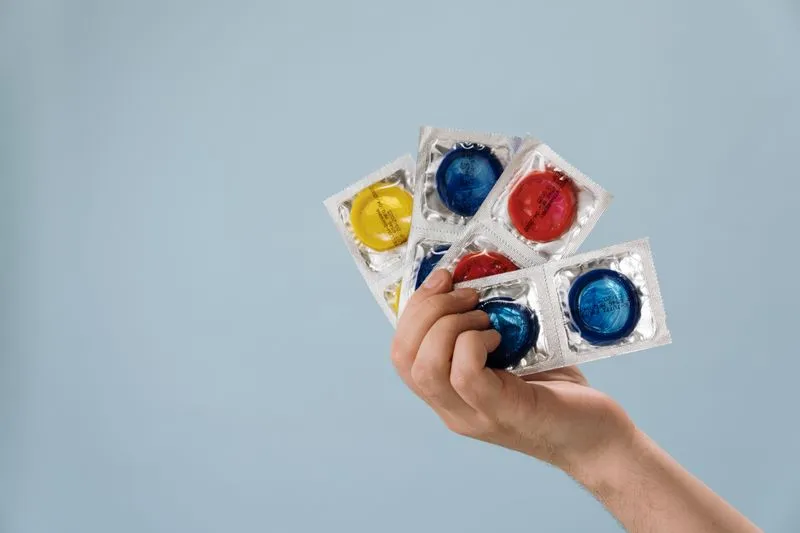
Thursday, 7.10pm, in the Tesco Express downstairs from her student halls. Orla, 22, a second-year speech and language therapy student, has been standing in front of the same shelf for a good five minutes — a bag of penne and a bottle of washing-up liquid in her basket. The strip lights hum. Somewhere near the freezers, a trolley squeaks. In front of her, thirty-odd boxes: "thin feel", "XL", "latex-free", "ribbed" — and on one of them, in tiny print, "53mm". She has no idea what that number means. What she does know is why she's here. Three weeks ago, the condom split. One emergency pill, two bad nights' sleep, and then her boyfriend's kindly meant verdict: "Just bad luck. It happens."
It does happen. But almost never by chance. A condom that tears usually has a reason — a size that's too tight, the wrong lube, a wrapper ripped open with teeth, a condom that spent the winter in a wallet. Those reasons can be fixed before sex, not after. And there's something else Orla doesn't know yet: the sexual health clinic ten minutes away would have given her condoms for free (in many areas, so would the pharmacy next door, through a C-Card scheme).
So here it is, in the order you'll need it — size, material, lube, how to put a condom on, internal condoms, and what to do if the worst happens anyway. If you'd like to weigh condoms against the pill, the coil or the implant, our complete guide to every contraceptive method compares them one by one.
A split condom is rarely just bad luck
Used properly, an external condom is a reliable method; used in a hurry, much less so. The NHS page on condoms puts it plainly: "Condoms are up to 98% effective at preventing pregnancy if you use them correctly every time you have sex." Used incorrectly, the same page says, they're 82% effective — around 1 in 5 women who rely on them for a year will get pregnant. The gap between those two numbers is the margin you control.
Size matters more than most people think. In a study published in 2010, American researchers surveyed 436 men who used condoms (through a questionnaire hosted by the Kinsey Institute), and 44.7% described their condoms as ill-fitting. According to the study by Richard Crosby and colleagues in Sexually Transmitted Infections, those men were far more likely to report breakage (adjusted odds ratio 2.6) and slippage (2.7). They also reported more irritation, less pleasure — for both partners — and were more likely to take the condom off before sex had ended.
A fair caveat: these were volunteers recruited through newspaper adverts and a condom retailer's blog, not a representative sample. The study shows an association, not proof of cause and effect. But it fits the advice every sexual health service gives — a condom has to fit. The right size is part of what makes a condom work.
Finding the right condom size: width before length
Condom size is mostly about width. The number in millimetres printed on some boxes is the nominal width — the width of the condom laid flat. In its technical specifications for male latex condoms, the World Health Organization defines it as the average lay-flat width, measured a few centimetres from the open end. Laid flat, a 53mm condom is therefore about 106mm round before stretching: the number is neither a diameter nor the circumference of the penis. For public-sector supplies, the WHO and the UN Population Fund use two standard widths (49mm and 53mm, give or take 2mm) — while noting that other widths exist and may suit some people better.
Length matters less. Brook, the UK sexual health charity, is blunt about it — it's better for a condom to be a little longer or a little narrower than too wide or too short. Too wide and it can slip off; too tight and it's more likely to split (and quickly becomes uncomfortable). To work out where you stand:
- With the penis erect, measure its length from base to tip with a ruler.
- Measure the circumference around the middle with a tape measure (or a piece of string you then hold against the ruler).
- Compare both with the brand's size guide, on the box or online. Sizes differ between brands — a "regular" in one isn't necessarily a "regular" in another.
- Between two sizes? Try both and keep the more comfortable one.
Condoms are designed to stretch, as Brook points out, but the wrong size still causes problems. Three signs mean something's wrong. A ring that leaves a mark on the skin. A condom that won't roll all the way down. A condom that rides up during sex. In all three cases, change size.

Latex, polyisoprene, polyurethane: which condom material is right for you?
Most condoms are made of latex, a natural rubber that is thin, soft and very stretchy. But there are other options — and what really changes from one material to the next is stretch and lube compatibility. Brook's guide to finding the right condom describes latex, polyisoprene and polyurethane:
| Material | Who it suits | Compatible lubes | Good to know |
|---|---|---|---|
| Latex | No allergy (the most common type) | Water or silicone — never oil | Very stretchy; biodegradable if 100% latex |
| Polyisoprene | Latex allergy, same stretch wanted | Water or silicone — never oil | Synthetic rubber similar to latex; slightly pricier |
| Polyurethane | Latex allergy | Water, silicone or oil | Thinner, transfers heat better; less stretchy, more expensive |
Polyisoprene deserves a closer look: this synthetic rubber keeps the stretch of latex — so a similar fit — but it copes no better with oils. "Latex-free" doesn't mean "compatible with everything". One material to avoid altogether: lambskin condoms, sold in some countries, do not protect against sexually transmitted infections, Brook warns.
And "extra thin", "ribbed" or "dotted"? Those words are mostly about sensation. What you should look for on every packet is the European CE mark or the UKCA mark, which the NHS describes as a sign that the condom has "been tested to high safety standards".
Which lubricants can you use with condoms?
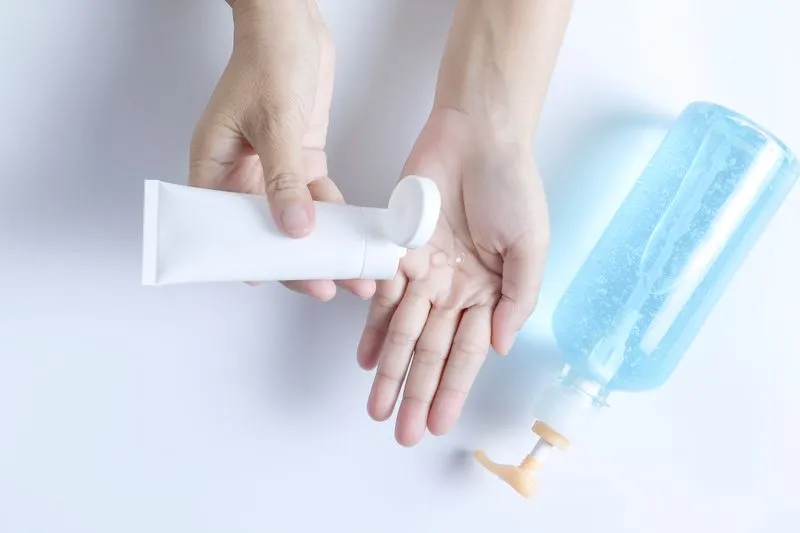
With latex or polyisoprene condoms, only water-based or silicone-based lubricants are safe. The NHS is explicit: "do not use oil-based lubricant with latex condoms – use water-based or silicone-based lubricant instead." Most condoms come pre-lubricated, but that coating isn't always enough — longer sex, anal sex, or simply less natural lubrication that evening.
For anal sex, Brook recommends using additional water-based lube, either on the outside of the condom or directly to the anus. And extra lube is worth having to hand for vaginal sex too — a condom that rubs dry is a condom under strain.
The trap is the oily stuff you already own. Brook lists Vaseline, hand cream and oil-based lube among the products that make latex condoms less effective. In practice, the list is longer than most people think: coconut oil, massage oil, baby oil, body butter, lip balm. In other words — anything within arm's reach of the bed on an unplanned night.
How to put on an external condom, step by step
A condom goes on before any contact between the penis and the vagina, anus or mouth — not "just before the end". The NHS counts putting a condom on after the penis has touched the vagina as incorrect use, and Brook points out that pre-cum alone can carry a risk of pregnancy and STIs. Here are the steps, in order (drawn from the NHS and Brook):
- Check the use-by date and the CE or UKCA mark.
- Push the condom to one side of the wrapper, then tear it open with your fingers — never your teeth.
- Check it's the right way round: it should unroll easily. If it doesn't, it's inside out.
- Pinch the tip between thumb and forefinger to squeeze out the air.
- Put it on the erect penis and roll it all the way down to the base.
- Add a little water-based lube to the outside if needed.
- After ejaculation, pull out before the erection goes, holding the condom at the base.
- Wrap it in a tissue and put it in the bin (never down the toilet).
Two steps tend to get rushed — pinching the tip, which squeezes out the air and leaves room for semen, and pulling out. Holding the base as you withdraw is what stops the condom slipping off; in the NHS's words, "grip the base of the condom as you pull out".
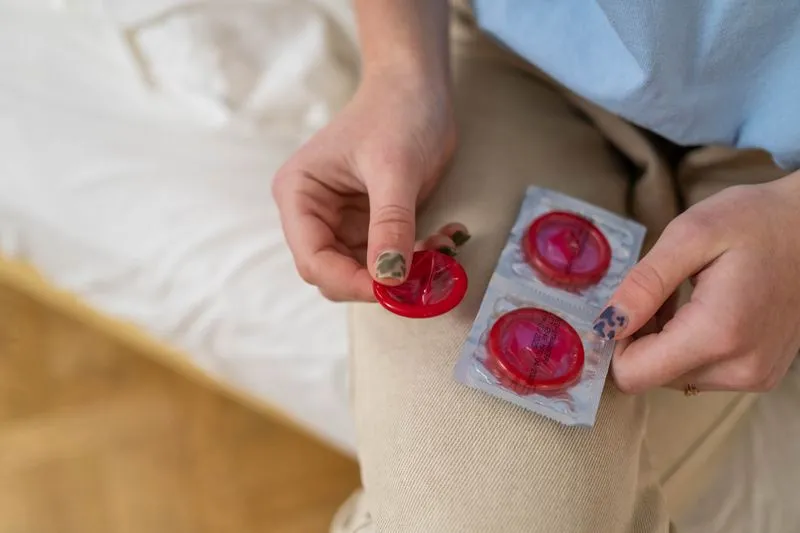
If you start rolling the condom on the wrong way round, don't flip it over. The NHS says to throw it away and use a new one, and Brook explains why — it may already have touched pre-cum, which would then end up on the outside. So always have at least two condoms to hand.
The mistakes that make condoms split or slip
The first mistake is a well-meant one: doubling up. Two condoms rub against each other, and the NHS is clear — "do not use more than one condom – this can make one or both condoms split". The same goes for an external condom combined with an internal one.
Most other mistakes happen before the condom is even used:
- The wallet. Brook advises replacing any condom that has been in a wallet for more than a month (where it's folded, squashed and rubbed all day). A small hard case does a much better job.
- The use-by date. The NHS warns that an expired condom may not be effective. For latex condoms bought by public programmes, the WHO requires a stated shelf life of three to five years — past the date, bin it.
- Nails and jewellery. Brook's advice is to take care not to rip condoms with sharp nails or jewellery — think of rings with claws.
- One condom for everything. A condom is single-use, and you change it when switching from anal to vaginal sex.
Then there's the mark. Both the NHS and Brook say to check the packet for the CE or UKCA mark — and Brook goes further: if it's not there, don't use them. No mark, no sex.
Internal condoms: how to use the lesser-known alternative
An internal condom (often called a female condom) goes inside the vagina rather than on the penis. It's a soft pouch with a flexible ring at each end: the inner ring sits deep inside the vagina, the outer ring stays outside and covers the vulva. It protects against pregnancy and STIs — and it's STI protection you put in place yourself.
Its advantages are practical. According to the NHS page on internal condoms, you can insert one "up to 8 hours before sex" — no pausing, no waiting for an erection. Almost all are made of thin, soft plastic or synthetic rubber rather than latex, so they're an option if you're allergic. Brook also suggests them if you're struggling to find an external condom that fits.
How well they work depends heavily on practice. The NHS gives 95% effectiveness with perfect use and 79% with typical use — "around 1 in 5 women who use internal condoms for a year will get pregnant". The technique takes a little learning:
- Open the packet carefully, without your teeth.
- Get comfortable (squatting, lying down, or one foot up on a chair).
- Squeeze the inner ring and insert it into the vagina, much like a tampon without an applicator.
- With a finger inside the condom, push it as far in as you can; the outer ring stays outside.
- During sex, make sure the penis goes inside the condom — not beside it.
- Afterwards, twist the outer ring a few times, pull the condom out gently and put it in the bin.
With latex internal condoms, the same lube rule applies: water-based or silicone-based only. You can get internal condoms free from some sexual health clinics, some GP surgeries and pharmacies, and some young people's services.
Free condoms in the UK: where to get them
You don't have to pay for condoms in the UK. Contraception services are free and confidential on the NHS, and you can get condoms at no cost from sexual health clinics (also called family planning or contraception clinics), some GP surgeries and pharmacies, and some young people's services. The national sexual health helpline, 0300 123 7123, can tell you what's available near you.
Many areas also run a C-Card scheme for young people. According to Brook, the C-Card lets you pick up free condoms from local outlets such as pharmacies, youth services and shops. Age ranges and registration rules vary from one area to another, so check your local scheme. And if you're under 16, contraception is still free and confidential — the doctor, nurse or pharmacist will not tell your parents unless they think someone is at risk of harm.

One limit to be aware of: if the free condoms on offer don't come in your size, buy your own — it isn't a luxury, it's what lets the condom do its job.
The condom split: what to do, and how quickly
If a condom splits, slips off or gets left inside, there are two risks to deal with side by side — an unplanned pregnancy and a sexually transmitted infection. The tightest window is for HIV (72 hours); emergency contraception gives you 3 to 5 days. Stop, gently remove the condom if it's still inside, and note the time (you'll be asked).
| Risk | What | Time limit | Where |
|---|---|---|---|
| HIV, if your partner's status is unknown | Post-exposure prophylaxis (PEP) | Ideally within 24 hours, at most 72 hours | Sexual health or HIV clinic; A&E out of hours |
| Pregnancy | Emergency pill (levonorgestrel) | Within 3 days (72 hours) | Sexual health clinic, GP, many pharmacies |
| Pregnancy | Emergency pill (ulipristal acetate) | Within 5 days (120 hours) | Sexual health clinic, GP, many pharmacies |
| Pregnancy | Copper IUD (the most effective) | Within 5 days (120 hours) | Sexual health clinic or GP surgery |
| Other STIs | STI test | No symptoms: best tested 7 weeks after sex | Sexual health clinic, some home testing kits |
HIV first, because it has the shortest window. PEP is a combination of HIV drugs that can stop the virus taking hold. Terrence Higgins Trust's guide to PEP says it "must be taken within 72 hours (three days), and should be taken as soon as possible, ideally within 24 hours". It's free on the NHS for people who meet the guidelines. The best place to get it is a sexual health or HIV clinic — out of hours, go to A&E, as PEP isn't normally available from GPs. It won't protect you from other STIs or pregnancy.
Pregnancy next. According to the NHS guide to emergency contraception, levonorgestrel needs to be taken within 3 days and ulipristal acetate within 5 days, while an IUD can be fitted within 5 days — and the IUD is the most effective option. You can get the emergency pill or IUD free from most sexual health clinics and GP surgeries, and you can buy the emergency pill at most pharmacies (some offer it free). For the finer points (weight, interactions, restarting your pill), our guide to the morning-after pill, its time limits and how to get it goes into detail.
Then STI testing. It isn't a next-morning job: the NHS notes that STIs can take up to 7 weeks after unprotected sex to show up on a test, so if you have no symptoms it's best to wait 7 weeks before testing (with symptoms, go to a clinic straight away). You don't usually need a GP referral for a sexual health clinic, visits are confidential, and some clinics offer home testing kits.
In 2023, England recorded over 85,000 gonorrhoea diagnoses — "the highest number since records began in 1918", as the UK Health Security Agency reported. Many STIs have no symptoms at all. A negative result is reassuring; a positive one is far easier to deal with when it's caught early.
Talking about condoms without killing the mood
Talking about condoms before you need one is the easiest way to avoid arguing about them in the moment. Size, material, lube: these are choices you make together, and they're far easier over a cup of tea than by the light of a bedside lamp. People often avoid the subject for fear of offending — but size isn't a judgement. It's a measurement, like shoe size.
A few lines that open the subject without making it a big deal:
- "I read that most splits come down to the wrong size. Shall we try a few different ones?"
- "I got a condom-safe lube — it'll stop things rubbing."
- "Before we stop using condoms, I'd like us both to get tested."
That last one matters. The NHS advises against sex without a condom or dental dam — oral sex included — until you've had a check-up or been tested. If all of this is new to you, our guide to a stress-free first time also covers contraception and protection beforehand.

A condom taken off during sex without the other person knowing is not a "slip-up" — it's a breach of consent, which was given for protected sex. If it has happened to you, the PEP and emergency contraception time limits apply just the same. As for Orla, she left Tesco that Thursday with two small packs in different sizes and a bottle of water-based lube. The conversation happened that same evening.
Frequently asked questions
How do I know if a condom is the right size?
It rolls all the way down without forcing, leaves no red mark and doesn't ride up during sex. If it won't roll down, pinches uncomfortably or moves when you give it a gentle tug, change size. The key measurement is the circumference of the erect penis, compared with the brand's size guide.
Can I use coconut oil as lube with a condom?
Not with latex or polyisoprene condoms: oil-based products weaken them. Use a water-based or silicone-based lube instead. Brook notes that polyurethane condoms, by contrast, can be used with oil-based lube.
Are condoms with spermicide more protective?
Not against STIs. Brook actually advises avoiding spermicide condoms, as there is evidence they don't protect against STIs and may even increase the risk. A lubricated condom in your size is the better choice.
Do I need a condom for oral sex?
Yes, if you want to protect yourself from STIs — they can be passed on through oral sex too. Condoms can be used for oral sex, and some people prefer flavoured ones for it. The NHS advises not having sex, including oral sex, without a condom or dental dam until you've had a check-up or been tested.
The condom came off inside me. What should I do?
Remove it gently with your fingers — squatting can make it easier. Then treat it like a split: emergency contraception if you're not using another method, and ask a sexual health clinic or A&E about PEP within 72 hours if your partner's HIV status is unknown. If you can't reach it, a nurse or doctor can remove it for you.
Condoms and the pill: do I really need both?
The pill protects against pregnancy, not STIs; condoms protect against both when used correctly. Using the two together makes sense with a new partner, at least until you've both been tested.
Sources
- NHS — Condoms
- NHS — Internal (female) condoms
- NHS — Emergency contraception
- NHS — Sexually transmitted infections (STIs)
- Brook — Find the best condom for you
- Brook — Condoms: how effective are they and how do I use them correctly?
- Terrence Higgins Trust — PEP (post-exposure prophylaxis for HIV)
- UK Health Security Agency — Antibiotic resistant gonorrhoea cases are on the rise (August 2024)
- Crosby R. et al. — Does it fit okay? Problems with condom use as a function of self-reported poor fit (Sexually Transmitted Infections, 2010)
- WHO / UNFPA — Technical specifications for male latex condoms (TRS 1025, Annex 10, 2020)