Bordeaux, the Second World War. A six-year-old Jewish boy, born in the city in 1937, escaped deportation by hiding during a round-up of Jews organised by the Nazis. He lost both his parents in the war. That boy was Boris Cyrulnik — the neuropsychiatrist known in France for developing and popularising the concept of resilience, as the International Review of the Red Cross introduces him. Forty years after the war ended, his memories of that day became the starting point for his work on traumatic memory.
His story sounds like an exception. Research says the opposite: after a potentially traumatic event, two in three people on average keep stable psychological functioning (a 2018 review of follow-up studies in Clinical Psychology Review). Resilience is the most common response to this kind of event — which is not the same as the easiest.
When you are living through a bereavement, a separation or an illness, the definition that matters is simpler and harder than the magazine version. Resilience is the capacity to build a liveable life after the unliveable. It takes time, often far longer than a few weeks. It is the way what broke you ends up becoming part of who you are — without denying the wound and without drowning in it.

What Resilience Means in Psychology
The term comes from physics: a "resilient" material returns to its original shape after being deformed. In psychology, the word takes on another meaning. After a bereavement, a break-up, an illness or a trauma, you become someone who has lived through it and carries it with you.
Cyrulnik's own work ties resilience to memory. In his interview with the International Review of the Red Cross, he looks at the relationship between memory, trauma and resilience — for individuals, and for whole societies.
The guide to building resilience from the American Psychological Association (APA) defines it as "the process of adapting well in the face of adversity, trauma, tragedy, threats, or significant sources of stress". The same guide makes a reassuring point: resilience "involves behaviors, thoughts, and actions that anyone can learn and develop".
So resilience leaves room for tears. You can cry, fall apart one evening, take months to get back on your feet and still be resilient. The process comes down to a few things — moving through the pain without making it your identity, finding some meaning in what happened (even without finding a reason), keeping or rebuilding your relationships. And still picturing a future, even a modest one.
What Science Says About Resilience
In their review of 54 studies on trajectories after potential trauma (NYU and Columbia University, 2018), Isaac Galatzer-Levy, Shan Huang and George Bonanno found stable psychological functioning in 65.7 per cent of people on average. Next came recovery after a period of distress (20.8 per cent), chronic distress (10.6 per cent) and delayed onset of symptoms (8.9 per cent). These averages were worked out population by population — which is why they add up to more than 100.
Stable here means that psychological functioning holds, even while it hurts. A harder start still leaves the door open: in that review, around one person in five recovered after a difficult first phase.
What neuroscience adds: the brain is "plastic". Its networks reorganise throughout life in response to experience. Trauma leaves real traces — and those traces can shift. A study published in January 2025, "Plasticity of human resilience mechanisms" in Science Advances, followed people exposed to the 2015 Paris terrorist attacks. In those whose post-traumatic stress disorder (PTSD) went into remission, the brain's memory control processes (the ones that hold back intrusive memories) gradually normalised. This came before the traumatic memories faded.
Researchers are also looking at genetic and epigenetic factors (changes in how genes are expressed, without altering the DNA itself) that may shape individual vulnerability to stress. None of this turns resilience into destiny: biology is the terrain, not the verdict.
The Factors That Support Resilience
Three sets of factors weigh on resilience: what you carry inside you, what surrounds you and what wears you down. All of them shift over time — each can be developed, strengthened or allowed to wither.
What you carry inside you. Emotional regulation is the foundation: being able to identify an emotion, name it and move through it without being overwhelmed. The sociologist Aaron Antonovsky wrote about a "sense of coherence" — the conviction that life remains comprehensible, manageable and meaningful. The psychologist Albert Bandura described self-efficacy, the belief in your own capacity to influence events. Add cognitive flexibility (being able to read a situation in more than one way) and humour — a way of stepping back.
What surrounds you. Social support comes first — having at least one person who is unconditionally there for you. The APA guide puts it at the top of its recommendations: "Connecting with empathetic and understanding people can remind you that you're not alone in the midst of difficulties." A secure environment completes that outer layer. So does access to resources (therapy and support groups, but also work, housing and practical help), along with a cultural or spiritual framework that gives the experience meaning.

What wears you down:
- Earlier traumas that were never processed (a new loss can "reopen" older wounds).
- Social isolation.
- Financial hardship.
- An anxious or disorganised attachment style.
- A tendency to ruminate rather than look for solutions.
What happens after the event matters too: the support you receive, the time you are given, the way people around you respond.
The Body in Resilience: What We Often Forget
Your body is involved at every stage of resilience, and looking after it is part of the work of rebuilding. Resilience is often presented as a purely psychological matter. Yet the first signal of a crisis is often physical — sleep that goes wrong, a tiredness that won't lift.
Trauma inscribes itself in the body. The American psychiatrist Bessel van der Kolk made this the subject of his book The Body Keeps the Score (2014). The NHS page on PTSD symptoms lists sleeping problems and feeling "on edge" among the effects of post-traumatic stress disorder. It also mentions physical symptoms (headaches, dizziness, chest pains and stomach aches).
What your body needs is simple. The APA guide puts it plainly: "proper nutrition, ample sleep, hydration, and regular exercise can strengthen your body to adapt to stress". Nothing spectacular — and that is precisely what goes first when everything falls apart.
Sleep. Broken nights after a shock weigh on everything else, from patience to concentration. If your sleep stays badly disrupted for several weeks, that's a valid reason to speak to your GP.
Movement. Regular, moderate activity — a brisk walk, swimming, yoga, dancing — reconnects you with the sense of living in your body. It comes at a time when you may feel you are merely putting up with it.
Food. In the hard weeks, what matters is to keep eating regularly and with some variety — even if that means letting someone else cook for you. Miracle diets and anti-stress superfoods can wait.
How Long Recovery Takes: What the Research Says
Nobody can give you a date — resilience rarely follows a straight path. Stage-based models — like Elisabeth Kübler-Ross's stages of grief — help name what you're going through. Treat them as landmarks rather than rules: in real life, stages overlap and come back.
The image that feels truest to me is a spiral. You return to emotions you thought you'd dealt with — but each time with a little more distance. That is my own reading; the solid markers of time come from research on post-traumatic stress.

The first few weeks. The NHS says it is normal to have upsetting and confusing thoughts after a traumatic event, and that most people improve naturally within a few weeks. Its page on treatments for PTSD adds that 2 in every 3 people who develop problems after a traumatic experience get better within a few weeks without treatment. That is why active monitoring may be recommended first (for mild symptoms, or symptoms that have lasted less than 4 weeks), with a follow-up appointment within 1 month.
Beyond a month. You're likely to be offered treatment if you've had symptoms of PTSD for more than 4 weeks or if they are severe. Talking therapies are usually recommended first — such as trauma-focused cognitive behavioural therapy (CBT) or eye movement desensitisation and reprocessing (EMDR).
Sometimes, much later. For some people, symptoms appear late: the 2018 review of trajectories puts this delayed onset at 8.9 per cent on average. The NHS notes that PTSD can be successfully treated even when it develops many years after a traumatic event. If that is you, your recovery is simply following a known trajectory — and it can be treated.
After Bereavement, Separation or Illness: What Changes With Each
The foundations stay the same — connection, the body, meaning — but bereavement, a break-up and an illness each call on them in their own way. Here is what changes, and where to turn.
After a bereavement
Grief has its own rhythm. The NHS page on grief after bereavement or loss is clear that "There's no right or wrong way to feel", and that if you do go through stages, they may not happen in a particular order. For most people grief becomes less intense over time. For some it lasts many months or years, which is known as prolonged grief disorder — worth raising with your GP. To talk to someone, Cruse Bereavement Support runs a helpline on 0808 808 1677 (staffed by volunteers trained in all types of bereavement). In Scotland, bereavement support comes from a separate charity, Cruse Scotland, whose free helpline is 0808 802 6161.
After a separation
A separation combines two losses: a relationship, and the life that was organised around it — your home, your money, sometimes your children's routine. The other person is still alive, which makes the grief more ambiguous. The NHS counts the end of a relationship among the losses that can bring on grief. Its Every Mind Matters guide to relationships and mental wellbeing says it plainly: it's OK to leave a relationship that is harming your mental health. Finding someone outside the relationship you trust enough to confide in can really help, and for the practical and financial side of a break-up, the guide points to Citizens Advice. If the separation shakes up your finances, getting back in control of them is part of the rebuild — our guide to women and financial independence starts from exactly that situation.
Facing a serious illness
A serious illness is a different kind of trauma: the threat stays in front of you and goes on, with treatments, scans and uncertainty. With cancer, you can lean on specialist support. Macmillan Cancer Support's emotional help pages cover talking, counselling and support groups, for you and for the people close to you. Its support line is open seven days a week, 8am to 8pm, on 0808 808 00 00. Tell your care team how you are coping emotionally as well as physically.
What Blocks Resilience
Shame, enforced silence, isolation and the pressure to "be fine" often hold resilience back — and so, surprisingly, does one well-meant intervention.
Shame. "I should be over this by now." "I shouldn't have let it happen." Shame isolates and stops people from seeking help. It is particularly present after certain traumas — violence, abuse, postnatal depression.
Enforced silence. "We don't talk about it, it's in the past." Being able to put words to what you've been through — with someone you trust, a therapist, or on paper — is an essential part of integration. The aim is to give the experience a place in your story.
Chosen or imposed isolation. Withdrawing from the world may feel protective in the short term. Yet resilience is built in connection. If this is close to home, our overview of women's mental health and the concrete solutions available maps out where support exists.
Pressure to "be fine". It comes from the people around you, from work, from yourself. "I don't want to complain." "Others have had it much worse." This minimisation is a form of self-abandonment.
Well-meant but unhelpful interventions. Being made to recount everything in detail straight after the event can look like help. The NICE guideline on post-traumatic stress disorder is explicit, though: psychologically-focused debriefing should not be offered to prevent or treat PTSD.
How to Cultivate Resilience Before Crisis Hits
You don't wait for a fracture before thinking about bone strength. Resilience can be cultivated outside a crisis too — in everyday life, in small setbacks, in habits that strengthen your inner resources.
Develop emotional awareness. Learning to name precisely what you feel ("I feel ashamed because I was sure I'd succeed", rather than a vague "I'm stressed") is a muscle you can build. Therapy, journalling and mindfulness are all tools. To train it day by day, these daily exercises for rebuilding self-confidence are a good place to start.
Build meaningful connections. A few deep relationships — where you can be vulnerable without being judged — count for more than a wide network. They are your safety net.
Accept the impermanence of small things. Everyday setbacks — a disappointment, a project that fails, an argument — are chances to practise moving through difficult emotions. Each small hurdle you clear strengthens your trust in your own capacity to get through things.
Get clear on what matters to you. Clear values, commitments, a sense of what matters to you regardless of circumstances. This was the central insight of Viktor Frankl — the Viennese psychiatrist who survived the Nazi camps and built his life's work around the search for meaning.
Practical Steps for Rebuilding After a Crisis
Expressive writing opens this list because it is the best documented of the five practices. The search for meaning closes it, because it is the most personal.
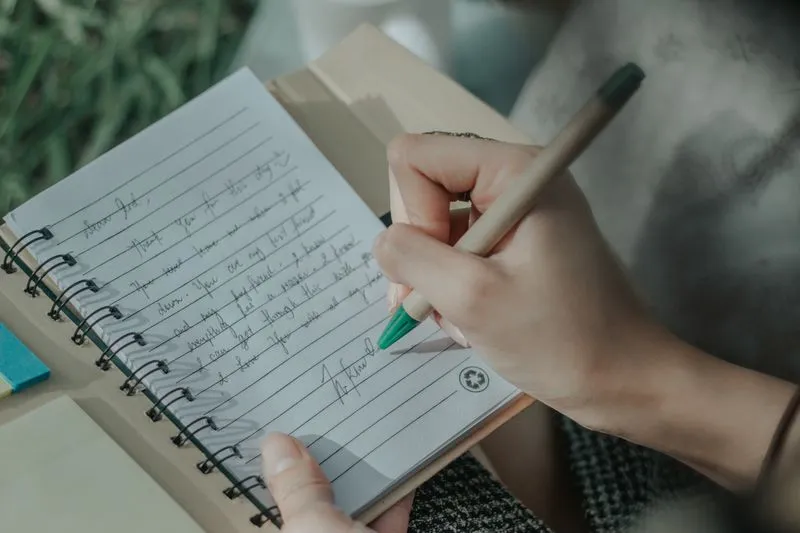
Expressive writing. The protocol has changed little since the first study by James Pennebaker and Sandra Beall in 1986. You write about a difficult event for 15 to 20 minutes, on 3 to 5 occasions (often on consecutive days), without aiming for elegance. According to Karen Baikie and Kay Wilhelm's review of the health benefits of expressive writing, published by the Royal College of Psychiatrists' journal, people who do so generally have better physical and psychological outcomes than those who write about neutral topics. The authors also note a short-term rise in distress straight after writing — you can stop at any time.
Targeted gratitude. Each evening, note one to three specific moments when something or someone supported you, even modestly. The APA guide also suggests recalling "the things you're grateful for, even during personal trials". The pain stays, but the practice widens what you can see.
Transition rituals. Small rituals that mark the passages of the day (morning, bedtime, after a therapy session) help you tell one time from another. A carefully made cup of tea, a ten-minute walk round the block, a few pages of a book: these rituals are anchors.
Limit rumination. Rumination — cycling through the same painful thoughts — is one of the main obstacles to resilience. It differs from healthy emotional processing: it amplifies distress and resolves nothing. For thoughts that keep coming back, the NHS Every Mind Matters guide to tackling your worries, one of its self-help CBT techniques, suggests setting aside "worry time". That means a short period (say 10 or 15 minutes, every day or so before bed) to write things down and try to find solutions. When a worry comes up during the day, you set it aside for your worry time.
Seek meaning — without forcing it. Finding meaning might mean: "This taught me something about my limits, about what truly matters to me, about who I can rely on." Nobody is asking you to decide that "it was good that it happened". Meaning is built gradually, rarely in a hurry.
When and How to Seek Help in the UK
You can build resilience with help — and knowing when to seek professional support is a skill in itself.
Signs that support is needed:
- Symptoms (distress, sleep problems, intense anxiety) persist beyond a month without improvement — the NHS advises seeing a GP if you are still having problems about four weeks after a traumatic experience.
- Daily life is badly disrupted (work, eating, personal care).
- Suicidal thoughts or urges to self-harm appear.
- You are using alcohol or medication to manage distress.
- Social isolation is total and prolonged.
Where to turn:
- Your GP — the first point of contact, who can refer you and prescribe if needed.
- NHS Talking Therapies, which you can refer yourself to, for problems such as anxiety, depression or PTSD. It is free, provided you are registered with a GP and aged 18 or over (16 in some areas).
- Mind — the mental health charity for England and Wales, with information and local support.
- Cruse Bereavement Support — helpline 0808 808 1677 (England, Wales and Northern Ireland; in Scotland, Cruse Scotland runs its own free helpline on 0808 802 6161).
- Samaritans — 116 123, free, 24 hours a day, 365 days a year.
If the difficulty is playing out within your relationship (a crisis, a separation on the horizon), working through it together can help too: here is when and how to seek couples therapy.
Frequently Asked Questions
Can everyone develop resilience?
Research suggests yes, to varying degrees depending on personal history and available resources. The American Psychological Association describes resilience as a set of behaviours, thoughts and actions that anyone can learn and develop. It sits on a continuum, far from all-or-nothing. And the factors that support it (social connection, meaning, emotional regulation) can all be worked on.
Does resilience mean you no longer cry or feel sad?
No. Sadness, grief and nostalgia remain; resilience changes their place in your life. These emotions stay accessible, but they no longer run your days. The image of a scar fits best: it's there, sometimes visible, and it lets you live. A resilient person still cries.
Can someone be resilient after a very serious trauma, such as rape or war?
Yes, even if the road is long. Boris Cyrulnik, who at six escaped a Nazi round-up of Jews in Bordeaux and went on to popularise the concept of resilience in France, is himself an example. Such journeys stay hard and are rarely made alone: they often call for professional support, and sometimes years of work. But rebuilding is possible. In England and Wales, Rape Crisis runs a free 24/7 Rape & Sexual Abuse Support Line on 0808 500 2222, for anyone aged 16 or over.
Is there a difference between men and women in the face of adversity?
In England, the answer is less clear-cut than you might expect. The Adult Psychiatric Morbidity Survey 2014 (NHS Digital) found that 4.4 per cent of adults screened positive for PTSD in the past month, with similar rates for men and women overall. Among women aged 16 to 24, though, the figure reached 12.6 per cent, before falling sharply with age. Being in a higher-risk group is mostly a reason to spot symptoms early and to see your GP if you are still struggling about four weeks on. Cultural expectations ("big boys don't cry") probably also shape how freely men talk about what they are going through.
Can people grow through adversity?
Post-traumatic growth, a concept developed by the psychologists Richard Tedeschi and Lawrence Calhoun in the 1990s, describes this. Some people, after major adversity, report a greater appreciation of life, deeper relationships and a stronger sense of personal strength. This growth varies from one person to another — and it coexists with the suffering.
How can I support someone going through a hard time without trying to "fix it" for them?
Often the best thing is the simplest: be there without trying to repair. Avoid phrases like "you'll get through this", "everything happens for a reason", "at least you have your health" — however well-intentioned, they minimise. Ask instead: "What would help you right now?" Then offer practical support (a meal dropped off without questions, an errand, quiet company). Accept that there are moments when you can do nothing — and that your presence is already enough.
Are children more resilient than adults?
Children are vulnerable in different ways, and helped in different ways. The APA's resilience guide for parents and teachers is blunt: "youth alone offers no shield against the emotional hurts, challenges, and traumas many children face". Children have fewer resources to put into words what they're going through, and they depend on the adults around them. The same guide stresses building a strong family network and keeping a daily routine, which is especially comforting for younger children. The adult who helps can be imperfect — being there is what counts.
Sources
- International Review of the Red Cross — Interview with Boris Cyrulnik
- American Psychological Association — Building your resilience
- American Psychological Association — Resilience guide for parents and teachers
- Galatzer-Levy, Huang and Bonanno (2018) — Trajectories of resilience and dysfunction following potential trauma, Clinical Psychology Review
- Leone et al. (2025) — Plasticity of human resilience mechanisms, Science Advances
- NICE — Post-traumatic stress disorder (NG116), recommendations
- NHS — Post-traumatic stress disorder (PTSD): overview
- NHS — PTSD symptoms
- NHS — Treatments for PTSD
- NHS Talking Therapies — self-referral
- NHS — Grief after bereavement or loss
- NHS Every Mind Matters — Maintaining healthy relationships and mental wellbeing
- NHS Every Mind Matters — Tackling your worries (self-help CBT techniques)
- NHS Digital — Adult Psychiatric Morbidity Survey 2014: Mental Health and Wellbeing in England
- Macmillan Cancer Support — Emotional help
- Baikie and Wilhelm (2005) — Emotional and physical health benefits of expressive writing, Advances in Psychiatric Treatment
- Mind — What is trauma?
- Cruse Bereavement Support
- Cruse Scotland — bereavement support helpline
- Rape Crisis England & Wales — 24/7 Rape & Sexual Abuse Support Line
- Samaritans — 116 123