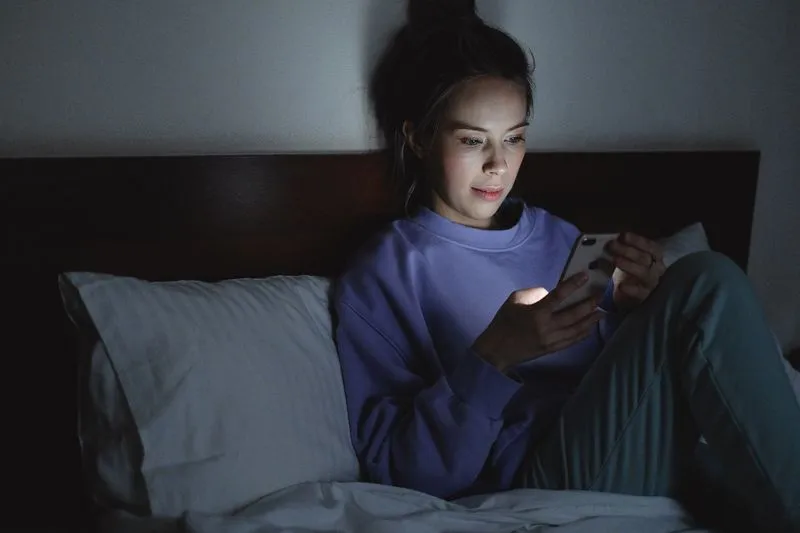
"I went through his phone while he was in the shower. I didn't find anything. And that's almost worse — because now I'm wondering what he deleted."
Imogen, 28, a project manager at an events agency, tells me this on a Saturday morning in March, in a café where the hiss of the milk steamer keeps swallowing half her sentences. She's turning a teaspoon round an empty cup. Then she adds, quickly, almost apologetically: "I'm not normally like this." She and Ollie have lived together for eighteen months. Nothing concrete worries her — a woman's name that has come up twice in conversation, one late Thursday night, a phone left face down on the table. And yet, for three weeks now, the same loop has played out every evening: the anxiety, the checking (when he was last online, whose stories he'd watched), ten minutes of relief, and then the doubt, louder than before.
Imogen's question is one most of us have asked at some point: is it normal to feel this jealous? Romantic jealousy is an ordinary emotion — researchers describe it as a spectrum running from normal to pathological. What makes it a problem is how intense it is, how long it lasts — and what it pushes you to do. Because beyond a certain point (monitoring, snooping, isolating) the feeling turns into controlling behaviour — which, in England and Wales, has been a criminal offence since 2015. Here's how to work out where your jealousy sits, or your partner's, where it comes from and how to ease it, on your own or with support.

Romantic jealousy: what are we talking about, exactly?
Romantic jealousy is the fear of losing a relationship you value to someone else. In their study of attachment and jealousy, Marazziti and colleagues at the University of Pisa's psychiatry department use a precise definition: "a perception of a threat of loss of a valued relationship to a real or imagined rival". One word matters most: imagined. The rival doesn't have to exist for the jealousy — the feeling itself — to be entirely real.
The same team points out that jealousy has three components: affective, cognitive and behavioural. Put simply, there's what you feel (fear, anger, sadness), what you think (the stories that write themselves at 11pm) and what you do (asking questions, checking, sulking, snooping). This distinction lets you separate what belongs to you — the emotion — from what affects the other person — the behaviour.
Jealousy is different from envy. Envy is about something another person has (their job, their body, their relationship as it looks on Instagram); jealousy is about something you have and are afraid to lose. It presupposes a bond — which is precisely why it hits so hard: it touches attachment as much as pride.
Passing jealousy or all-consuming jealousy: where's the line?
The line between passing and all-consuming jealousy can be judged on three criteria. The Pisa team notes wide agreement among researchers that jealousy is a heterogeneous condition, ranging from normality to pathology, with varying degrees of intensity, persistence and insight — the ability to recognise that your reaction is out of proportion. Those three words make a useful checklist.
Passing jealousy flares up after an identifiable trigger (an ex who resurfaces, a party where your partner spent three hours talking to the same person), lasts a few hours or a few days — then fades. You know it's partly excessive, and you can talk about it without accusing anyone. All-consuming jealousy no longer needs a trigger — it settles in, takes over your evenings, is there when you wake up, and no answer is ever enough to calm it.
| Criterion | Passing jealousy | All-consuming jealousy | Control (abuse) |
|---|---|---|---|
| Trigger | A specific event | Sometimes none, or a tiny detail | The other person's freedom itself |
| Duration | A few hours, a few days | Weeks, months | Constant; it shapes the relationship |
| Insight | "I know I'm overreacting a bit" | Doubt grows, perspective shrinks | Jealousy is used as a justification |
| What it makes you do | Talk about it, ask for reassurance | Question, check, ruminate | Monitor, forbid, isolate |
| What the other person lives with | An occasionally awkward conversation | Fatigue, endless explaining | Fear, a life that keeps shrinking |
The third column marks a change in kind. You move from what you feel to what you impose. Someone can be intensely jealous without ever controlling their partner, and someone else can control a partner while invoking a jealousy they only half feel. What counts is the behaviour, however intense the emotion used to justify it.

What attachment theory says about jealousy
Attachment theory links adult jealousy to our earliest bonds. It was developed by Bowlby in the late 1960s: attachment forms in the first years of life, through the emotional ties between an infant and the people who care for them, and stays relatively stable across a lifetime. Researchers then extended it to adult romantic relationships, with one big difference, as the Pisa team explains. For an adult, the attachment figure is most often a partner, and the need for that person to be available often comes with a need for exclusivity. Hence, according to some authors, jealousy: the fear of being abandoned and of losing that exclusivity.
Researchers now describe romantic attachment along two dimensions — anxiety (fear of being abandoned) and avoidance (discomfort with intimacy). Combined, they produce four styles:
- Secure (low anxiety, low avoidance): comfortable seeking help and closeness, and expecting support from others.
- Preoccupied (high anxiety, low avoidance): an anxious, on-alert way of relating, with an excessive fear of loss.
- Fearful-avoidant (high anxiety, high avoidance): a deep need for closeness — and, at the same time, a flight from intimacy.
- Dismissing (low anxiety, high avoidance): independence, distance, distrust of others.
So what does this mean for jealousy? In the Italian study of 100 healthy adults, the attachment anxiety score was linked to every dimension of jealousy measured. People with a preoccupied style scored higher than secure people on obsessionality, interpersonal sensitivity and fear of loss; fearful-avoidant people differed only on fear of loss. The authors' conclusion: romantic attachment and jealousy are intertwined.
A team at the University of Minnesota (Huelsnitz and colleagues, 2018) looked at jealousy in motion. Across three studies, participants read a five-stage scenario in which the threat to their relationship gradually escalated. Highly anxious people were hypervigilant, stepped in earlier, felt more jealousy, sadness and worry — and wanted to respond with more vigilant, sometimes destructive, behaviour towards their partner. Highly avoidant people — a different profile, a different reaction — mostly felt more anger.
Two caveats before you file yourself in a box. First, insecure attachment isn't pathological in itself: the Pisa team says so explicitly. Second, an attachment style describes a tendency: you don't choose it, but you can learn to spot what it sets off, and stop letting it drive.

Where does jealousy come from? Trust, history and self-esteem
Jealousy rarely has a single cause: it feeds on a mix of fragile trust, personal history and context. The role of trust was examined closely by a University of Houston team (Rodriguez and colleagues, 2015), who surveyed 261 people in committed relationships. The result — attachment anxiety changes how distrust plays out. Anxiously attached people who reported low trust in their partner experienced much higher levels of jealousy, both in their thoughts and in their actions.
The authors go further. Among those anxious participants, distrust was also associated with more non-physical abuse of their partner. In their words, anxiously attached individuals who experience distrust "are more likely to become jealous, snoop through a partner's belongings, and become psychologically abusive." One methodological point matters here: this was a cross-sectional study (a snapshot in time), so it shows associations without proving a chain of cause and effect.
Personal history weighs in too. Imogen makes the link herself, with a previous relationship in which she discovered her boyfriend was cheating by chance, on a screen left unlocked. "Since then, a phone turned face down means something to me." A memory like that proves nothing about her current relationship, but it does explain why a harmless detail can set off a disproportionate reaction.
Context, finally, supplies endless raw material. A like, a new follow, a story viewed at 2am: social media makes visible a mass of micro-interactions that, twenty years ago, would have gone unnoticed. If that sounds familiar, what the research says about social media's impact on self-esteem sheds light on the comparison mechanism that often sits underneath jealousy. And when the real question is "am I enough for someone to stay?", working on self-confidence with a few daily exercises tackles the root.
Checking their phone: why it doesn't ease jealousy
Going through a partner's phone doesn't ease jealousy, because checking can never prove an absence. Imogen said it herself: she found nothing, and it was "almost worse". An empty history becomes a deleted history — a mundane conversation, a coded one. The relief lasts ten minutes, then the mind invents the next question, and the next check.
You can think of it as a loop: anxiety rises, the checking brings it down for a moment, and the urge to do it again comes back faster next time. Found nothing? You must not have looked properly. Either way, jealousy is likely to come out stronger — and trust takes another step back.
The line with abuse is also closer than most people think. Among the questions the NHS guide to getting help for domestic violence and abuse asks, several read like ordinary jealousy: does your partner ever "accuse you of flirting or having affairs?", "make unreasonable demands for your attention?", or "read your emails, texts or letters?" The NHS also lists partners who "monitor your social media profiles" or "use GPS locators to know where you are?". One panicked look at a phone, one evening, is not a system of control. Regular checks, demanded passcodes, enforced location sharing — those are.
When jealousy becomes control: coercive control and the law
Jealousy becomes abuse when it turns into control of the other person. Women's Aid, in its explanation of coercive control, describes the mechanism in one sentence: "This controlling behaviour is designed to make a person dependent by isolating them from support, exploiting them, depriving them of independence and regulating their everyday behaviour."
The charity's list of common examples could almost be a list of what jealousy asks for, pushed a step too far: isolating you from friends and family, monitoring your time, monitoring you via online communication tools or spyware, taking control over where you can go, who you can see and what you can wear. The NHS sums it up in one line: "There are different kinds of abuse, but it's always about having power and control over you."
In England and Wales, this is a crime. Section 76 of the Serious Crime Act 2015, in force since 29 December 2015, makes it an offence to repeatedly or continuously engage in controlling or coercive behaviour towards a partner when that behaviour has a "serious effect" — causing them to fear, on at least two occasions, that violence will be used, or causing serious alarm or distress that has a substantial adverse effect on their day-to-day activities. The current text covers people who "are, or have been, in an intimate personal relationship with each other", and the maximum sentence on indictment is five years' imprisonment.
Scotland and Northern Ireland have their own laws — the Domestic Abuse (Scotland) Act 2018 and the Domestic Abuse and Civil Proceedings Act (Northern Ireland) 2021 — and their own helplines. Scotland's Domestic Abuse and Forced Marriage Helpline is on 0800 027 1234, and Northern Ireland's Domestic and Sexual Abuse Helpline is on 0808 802 1414; both answer 24 hours a day.
The figures show how widespread abuse is. According to the Office for National Statistics' domestic abuse overview published in November 2024, the Crime Survey for England and Wales estimated that 2.3 million people aged 16 and over experienced domestic abuse in the year ending March 2024 — 1.6 million women and 712,000 men. Abuse by a partner or ex-partner (3.2% of adults) was more common than abuse by a family member (1.9%). Among victims of domestic abuse-related crimes recorded by the police, 72.5% were female.

Easing jealousy on your own: five concrete steps
Easing jealousy starts with a change of target: stop looking for proof in the other person, and look at what's going on inside you. The steps below are simple tools to try for a few weeks.
- Name what's happening. "I'm feeling jealous" is already a calmer sentence than "he's lying to me". The first describes your state — the second asserts a fact you don't know.
- Separate facts from stories. Take a sheet of paper and draw two columns: on the left, what actually happened ("he smiled while replying to a message"); on the right, what you concluded ("he's talking to another woman, he's getting bored of me"). The right-hand column is often the longer one — by some distance.
- Delay the action. A question, a reproach, a check: anything that can wait twenty minutes is better for waiting twenty minutes. The emotion doesn't have to disappear for the action to be postponed.
- Know your danger hours. Your jealousy may keep its own timetable — late evening, Sunday night, after a hard day or one glass too many. Knowing that 11pm is your fragile hour means you don't make decisions at 11pm.
- Widen your life. When the relationship becomes your only source of security, every threat to it becomes a threat to everything. Friends, a project, a sport or a commitment that belongs to you alone give weight back to the rest of your life.
None of these steps depends on your partner — deliberately so. Calm that relies on what the other person does (replying quickly, explaining themselves, showing you their screen) is at the mercy of the first unanswered message.

Talking to your partner about jealousy without a cross-examination
Talking to your partner about your jealousy helps, provided it's a confidence rather than an interrogation. You can hear the difference in the first sentence. "Who's that girl who likes all your photos?" opens a trial; "I've noticed I've been feeling jealous lately, and I'd like to talk to you about it" opens a conversation. In the first case, the other person defends themselves. In the second, they can listen.
A few pointers to keep the conversation useful:
- Pick your moment. Not in the heat of it, not at midnight, not by text. A calm moment, face to face, when neither of you is in a rush.
- Talk about yourself. What you feel, what sets it off, what you're doing to manage it. That keeps you on ground nobody can dispute.
- Ask for a specific gesture. "Let me know if you're going to be much later than planned" is a reasonable request. Passcodes, permanent location sharing or a list of their female friends are not.
- Accept a no. Your partner may turn down a request that feels intrusive. That refusal proves nothing: each of you keeps a space of your own.
If your conversations always get stuck in the same place, couple communication techniques that work in practice sets out concrete tools, with example phrases.
If your partner is the jealous one
Living with a jealous partner means distinguishing what you can offer from what you don't have to give up. You can reassure — say that the relationship matters to you, let them know if you're running late, introduce your friends, answer a calmly expressed worry with patience.
You don't have to give up your friendships, your phone, your clothes or your evenings to prove you're faithful. One question is worth asking yourself: is my life shrinking? If you see the people close to you less than before, if you choose your clothes according to their reaction, if you rehearse your explanations on the way home, your partner's jealousy has stopped being their problem — it has become a rule you live under.
If that's the case, talk to someone outside the relationship — a friend, your GP, a specialist service. An outsider's perspective helps you see what habit has made invisible. And if you're the partner who worries about your own behaviour, the NHS points to the free Respect Phoneline, on 0808 802 4040.
Individual therapy or couple therapy: which one to choose?
Choosing between individual and couple therapy depends on where the jealousy comes from. Individual therapy makes more sense when the jealousy predates the relationship: it was there with previous partners, it follows the same script from one to the next, and it comes with anxiety or low self-esteem. What needs exploring is your own history — and that belongs to you. The NHS overview of the different types of talking therapy includes interpersonal therapy (IPT), which helps people with depression identify and address problems in their relationships with family, partners and friends. In England, NHS talking therapies are free, and you can refer yourself without going through a GP.
Couple therapy makes sense when both partners want to rebuild damaged trust — after an affair, a lie, a period of crisis — and both can speak freely. The NHS offers a couple therapy for depression that may be linked to problems in the relationship, sometimes called behavioural couple therapy (BCT) or couple therapy for depression (CTfD); according to the same NHS page, it usually runs to 15 to 20 sessions over five to six months. Outside the NHS, charities and private therapists offer relationship counselling, with fees that vary. To understand how couples therapy works and how to choose a practitioner, our guide to couples therapy: when, how and why to seek help answers the practical questions.
One important limit: when jealousy has tipped into control, couple therapy isn't the right starting point. It assumes two voices that carry equal weight — precisely what coercive control removes. The priority then becomes the safety and support of the person being controlled (the National Domestic Abuse Helpline, a specialist service), and individual help for the person doing the controlling.

Some signals mean it's time to ask for help without waiting: jealousy that takes up hours of your day, checking you can't stop despite your resolutions, fear of how your partner will react, dark thoughts. In that last case, Samaritans are on 116 123, and NHS 111 can direct you to urgent mental health support. For Imogen, the first step turned out simpler than she feared: she told Ollie about the shower, the phone and the shame afterwards. "He didn't get angry. He asked me how long I'd been this frightened." Start there: tell your partner what you're afraid of.
Frequently asked questions
Is a little jealousy a sign of love?
No. Jealousy mostly shows that the relationship matters to you and that you're afraid of losing it. Research links it chiefly to attachment anxiety (Marazziti, 2010; Huelsnitz, 2018).
What's the difference between jealousy and possessiveness?
Jealousy is an emotion: the fear of losing someone. Possessiveness is an attitude: treating the other person as property whose friendships, clothes or timetable you get to manage. You can be jealous without being possessive. Possessiveness, on the other hand, slides quickly into control — the mechanism Women's Aid describes as coercive control.
Is looking at my partner's phone a big deal?
A one-off, on a panicked evening, damages trust above all. But reading someone's emails, texts or letters, or monitoring their social media, appears among the warning signs the NHS lists for domestic abuse. Repeated and combined with other controlling behaviour, it can form part of the criminal offence of coercive control.
My attachment style is anxious: am I doomed to be jealous?
No. Studies such as the University of Pisa's show that attachment anxiety and jealousy tend to go together, and insecure attachment isn't pathological in itself. Knowing your pattern helps you spot your automatic reactions so you can respond differently.
Can I get couple therapy on the NHS?
The NHS offers couple therapy for depression that may be linked to relationship problems, usually over 15 to 20 sessions. It's aimed at depression rather than at relationship difficulties in general. For jealousy on its own, NHS talking therapies (which you can self-refer to, free of charge) or relationship counselling outside the NHS are the usual routes.
My partner is jealous but has never hit me: can it still be abuse?
Yes. Domestic abuse isn't only physical: the NHS lists emotional abuse, threats and intimidation, and the Serious Crime Act 2015 makes controlling or coercive behaviour a criminal offence. The National Domestic Abuse Helpline (0808 2000 247) can help you make sense of what's happening, with no obligation to report anything.
Sources
- Women's Aid: What is coercive control?
- NHS: Getting help for domestic violence and abuse
- legislation.gov.uk: Serious Crime Act 2015, section 76
- Office for National Statistics: Domestic abuse in England and Wales overview, November 2024
- NHS: Types of talking therapies
- NHS: NHS talking therapies for anxiety and depression
- legislation.gov.uk: Domestic Abuse (Scotland) Act 2018
- legislation.gov.uk: Domestic Abuse and Civil Proceedings Act (Northern Ireland) 2021
- mygov.scot: Support for female victims of domestic abuse
- nidirect: Domestic and sexual abuse helpline
- NHS: Where to get urgent help for mental health
- Marazziti et al. (2010), Romantic attachment and subtypes/dimensions of jealousy
- Rodriguez et al. (2015), The Price of Distrust
- Huelsnitz et al. (2018), Attachment and Jealousy