
Sneezing, laughing, lifting the car seat: after a birth, ordinary moments can come with a flicker of worry. The reason is your pelvic floor — a group of muscles you'd probably never thought about before pregnancy. NHS England's service specification for perinatal pelvic health services puts a number on it: research estimates that about one in three women experience urinary incontinence three months after pregnancy. The same document notes that pelvic health problems are "commonly under-reported due to embarrassment, shame, or a belief that problems are ‘normal’". They aren't something to put up with. And they can be treated.
Pelvic floor physiotherapy is available on the NHS, and NICE guidance encourages women who have recently given birth to do pelvic floor muscle training. To improve access, NHS England has set out a specification for perinatal pelvic health services (PPHS). These should accept self-referrals during pregnancy and for at least 12 months after birth.
What exactly is the pelvic floor?
The pelvic floor is a group of muscles and connective tissue forming a hammock-like structure at the base of the pelvis. These muscles surround and support:
- the bladder and urethra;
- the womb and vagina;
- the bowel and back passage.
During pregnancy, the pelvic floor carries a load that grows month by month. During a vaginal birth, it is stretched — and sometimes torn or cut (episiotomy). NICE lists several birth-related risk factors for later pelvic floor problems. Among them: an assisted vaginal birth (forceps or ventouse), a baby lying face up, a second stage of labour lasting more than an hour — and an injury to the anal sphincter.
A caesarean doesn't take pregnancy out of the equation: the pelvic floor has still carried the baby for nine months. The question of pelvic floor recovery applies after every birth — the right answer simply depends on your symptoms and your birth.
Why your pelvic floor deserves attention after birth
The consequences of a weakened pelvic floor can appear straight away — or months, even years, after the birth. NICE recommends that women who have recently given birth are asked about symptoms of pelvic floor dysfunction during routine postnatal care, in hospital and in the community. Here is what those symptoms usually look like.
Stress urinary incontinence
The most familiar one: leaking urine when you cough, sneeze, laugh, jump or run. NHS England's figure — about one in three women three months after pregnancy — shows how common it is. The treatment is well established. NICE (the National Institute for Health and Care Excellence) recommends supervised pelvic floor muscle training for women with stress or mixed urinary incontinence (pregnant women included). The programme should last at least three months.
If your leaks started before the birth, our guide to urinary leakage during pregnancy and how to manage it explains why they happen in the first place.
Pelvic organ prolapse
When the pelvic floor offers less support, the womb, bladder or bowel can slip down into the vagina. This is pelvic organ prolapse. How common is it? According to NHS England's specification, one in 12 women report symptoms of prolapse. Mild prolapse may cause few symptoms. The NHS page on your post-pregnancy body mentions a heavy feeling between your vagina and anus among the problems that pelvic floor exercises can help with.
Painful sex
Pain during sex after birth deserves a mention at your postnatal check — even if it feels awkward to bring up. The NHS guidance on sex after having a baby is refreshingly frank. There are no rules about when to start again. Hormonal changes after birth can make your vagina feel drier than usual (a lubricant can help). If you're still experiencing pain when you have your postnatal check, talk to your GP.
When to start pelvic floor rehabilitation — and when not to rush
You don't need a referral to begin gentle pelvic floor exercises — you can start on your own. NICE's guideline on pelvic floor dysfunction (known as NG210) recommends encouraging women who are pregnant or who have recently given birth to do pelvic floor muscle training. It then recommends encouraging it again — before discharge from maternity care, and during routine postnatal care.
For some women, NICE goes further. It recommends considering a three-month programme of supervised training during postnatal care after an assisted vaginal birth (forceps or ventouse), a birth with the baby lying face up (the occipito-posterior position), or an injury to the anal sphincter. If any of these applies to you, ask about it before you leave hospital.
Your 6-week postnatal check is the next natural checkpoint. The NHS says it should take place 6 to 8 weeks after the birth, and that your GP surgery should offer it. You can also request an appointment yourself — especially if you have concerns.

Who provides pelvic floor rehabilitation in the UK?
In the UK, the specialists to ask for are pelvic health physiotherapists. NICE recommends that pelvic floor muscle training programmes are supervised by a physiotherapist or another healthcare professional with the appropriate expertise.
On the NHS
You can be seen through your local perinatal pelvic health service or through an NHS continence service. The NHS describes continence services as centres staffed by specialist nurses (sometimes called continence advisers) and specialist physiotherapists. A GP can refer you. In some cases, you may be able to refer yourself.
Private pelvic health physiotherapy
Some women choose to see a private pelvic health physiotherapist — for quicker access, or more flexible appointment times. Whoever you see, look them up on the Health and Care Professions Council (HCPC) register, which lists registered physiotherapists.

What happens during pelvic floor physiotherapy sessions
The first pelvic floor physiotherapy session is an assessment — not a workout.
The initial assessment
The physiotherapist will ask about:
- your symptoms (leaks, heaviness, pain, discomfort during sex);
- your birth history, including any tears or episiotomy;
- how your scar is healing (if relevant);
- your current level of physical activity.
NICE describes what supervision should involve: assessing your ability to perform a pelvic floor contraction and relaxation, then tailoring the programme to that ability, to any discomfort you feel and to your own goals. The assessment may include an internal examination. It is always your choice. On consent, the NHS is unambiguous: "Consent from a patient is needed regardless of the procedure, whether it's a physical examination or something else." You can decline the internal part and ask for an external assessment only.
Treatment approaches
Supervised pelvic floor muscle training: the core of treatment. Guided contraction and release exercises, adjusted as your muscles strengthen, with at least one review during the programme and one at the end, as NICE recommends.
Biofeedback: a small probe or skin electrodes send information to a screen when your muscles squeeze. The NHS is honest about it. There is not much good evidence that biofeedback adds significant benefit to pelvic floor training for incontinence — but the feedback may help motivate some people.
Electrical stimulation: a small probe delivers a current that helps the muscles contract. The NHS says it may be recommended if you're unable to contract your pelvic floor muscles, and warns you may find it difficult or unpleasant. NICE, similarly, suggests considering biofeedback or electrical stimulation for women who cannot yet perform an effective contraction.

Pelvic floor exercises to do at home
Between sessions, your physiotherapist will give you a home programme. It matters. The NHS says a pelvic floor training programme for incontinence should include a minimum of 8 contractions at least 3 times a day (for at least 3 months).
Pelvic floor contractions (Kegel exercises)
The foundation, and subtler than it looks. You're aiming to contract only the pelvic floor muscles — not your buttocks or thighs — and not to pull your tummy in. The NHS guide to stopping leaks describes the basic routine:
- Breathe normally throughout — don't hold your breath.
- Squeeze your pelvic floor muscles, as if stopping yourself peeing and farting (without pulling your tummy in).
- Hold the squeeze for 2 seconds to begin with, then relax the muscles.
- Repeat 10 times.
- Gradually increase the hold towards 10 seconds with each squeeze, and include short squeezes as well as long ones.
The same page is realistic about timing. You may have to do pelvic floor exercises for a few months before you see any benefits. Your physiotherapist will adjust the numbers to you.

The "knack": squeezing before you lift
The NHS advises tightening your pelvic floor muscles before and during a lift (your baby, the car seat, the shopping bags). With practice, it becomes a reflex rather than something you have to think about.
Straining on the toilet matters too. The NHS says straining to poo weakens your pelvic floor muscles and makes urinary incontinence worse. If constipation has followed you since pregnancy, our guide to what helps with constipation in pregnancy is a good place to start.
Returning to exercise after birth
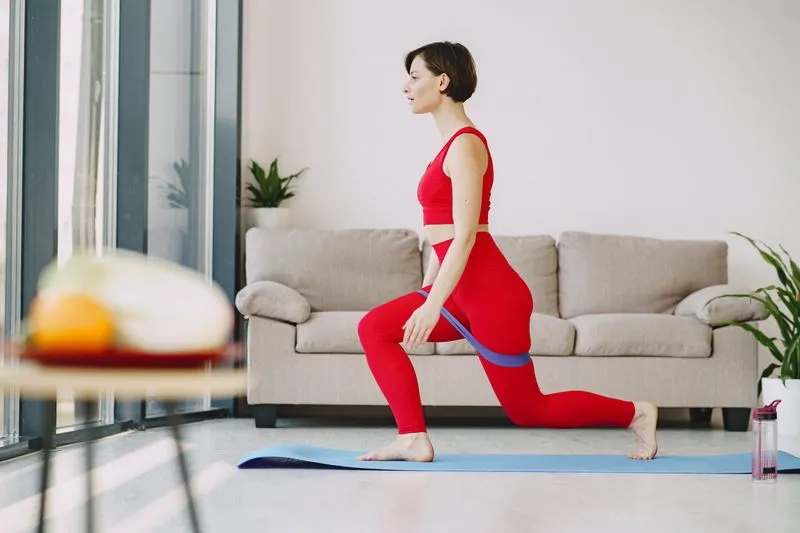
Returning to exercise after birth works in stages: gentle activity first, high-impact exercise later — once you've had your postnatal check.
What the NHS and NICE say
The NHS guidance on keeping fit after a baby is gradual and led by how you feel:
- After a straightforward birth, you can start gentle exercise — walking, gentle stretches, pelvic floor and tummy exercises — as soon as you feel up to it.
- It's usually a good idea to wait until after your 6-week postnatal check before starting high-impact exercise, such as aerobics or running.
- After a more complicated birth or a caesarean, recovery takes longer. Talk to your midwife, health visitor or GP before starting anything strenuous.
NICE adds a useful nuance. There is no evidence that unsupervised physical activity such as walking or swimming will improve or worsen pelvic floor symptoms. In other words, don't count on your daily walk to do the pelvic floor work for you.
Pelvic floor recovery after a caesarean, a tear or prolapse
After a caesarean
A caesarean doesn't rule out pelvic floor work. NICE encourages women who have recently given birth to do pelvic floor muscle training — and a caesarean is a birth too. Your recovery will take longer, though: the NHS advises talking to your midwife, health visitor or GP before starting anything strenuous. At your postnatal check, you may be offered an examination to see whether your stitches have healed. For the operation itself, our complete guide to planned and emergency caesareans covers physical recovery and scar care in detail.
Following an episiotomy or tear
At your 6-week check, you may be offered an examination to see whether your stitches have healed. Is the scar still painful, tight, or making sex uncomfortable? Say so. It's useful information, not a complaint.
If the tear involved the anal sphincter (the ring of muscle that keeps the back passage closed), ask specifically about physiotherapy. NICE recommends considering a three-month supervised pelvic floor training programme during postnatal care for women who have had this injury.
If prolapse has been diagnosed
For symptomatic prolapse that does not extend more than 1 cm beyond the hymen on straining, NICE recommends considering supervised pelvic floor muscle training (for at least four months). NICE also recommends considering pessaries — a device inserted into the vagina to support the pelvic organs — for women with symptomatic prolapse. Surgery is not the starting point. NHS England's specification says women with pelvic health problems should be offered all conservative treatment options before surgery is considered.

Accessing pelvic floor physiotherapy on the NHS
There are three routes in, and you can use more than one.
- Your 6-week postnatal check: the NHS lists trouble holding in wee or wind, soiling, and painful sex among the things to tell your doctor about.
- Your perinatal pelvic health service: NHS England's specification says the single point of access should accept self-referrals alongside clinical referrals, antenatally and for at least 12 months after birth.
- Your local NHS continence service: through your GP, or directly where self-referral is possible.
If you've had an assisted birth, a baby lying face up or a tear involving the anal sphincter, mention it explicitly when you ask for a referral. Those are the situations in which NICE recommends considering supervised training.
Pelvic floor symptoms after birth that mean you should see someone
Some signs are worth raising with your GP, midwife or health visitor — at your 6-week check or at any point afterwards:
- Leaking urine, or trouble holding in wind: both are on the NHS list of things to mention at your postnatal check. For stress or mixed urinary incontinence, NICE recommends supervised pelvic floor muscle training for at least three months.
- Soiling, or difficulty controlling your bowels: also on that list. NHS England's specification estimates that around one in seven women have anal incontinence six months after birth.
- A heavy feeling between your vagina and anus: the NHS suggests pelvic floor exercises may help. If it persists, ask to be assessed — NICE recommends considering supervised training for symptomatic prolapse.
- Painful sex: if you're still experiencing pain at your postnatal check, the NHS advises talking to your GP.
- Symptoms that appear months or years later: it's never too late to ask. NICE encourages women to keep up pelvic floor training throughout their life, and the NHS says you can ask a GP or health visitor for help at any time.
Frequently asked questions
Is pelvic floor physiotherapy painful?
It shouldn't be. Some techniques may feel uncomfortable, particularly if your scar is still sensitive, and the NHS acknowledges that some people find electrical stimulation unpleasant. Tell your physiotherapist about any pain or discomfort straight away — the programme should be tailored to what you feel, and you're entitled to change your mind about an examination.
How many sessions will I need?
It varies. For stress or mixed urinary incontinence, NICE recommends a supervised programme lasting at least three months. It should include at least one review during the programme and one at the end. You should be offered the choice of group or individual sessions, and the home exercises between sessions are part of the programme.
I don't have any leaking — do I still need physiotherapy?
Not necessarily a formal programme, but pelvic floor training, yes. NICE recommends encouraging women of all ages to do pelvic floor muscle training because it helps prevent symptoms, and considering a supervised programme after an assisted birth, a baby lying face up or an anal sphincter injury. Heaviness, discomfort during sex or reduced sensation count as symptoms too, even without leaks — mention them at your postnatal check.
Can I do pelvic floor exercises while breastfeeding?
Yes. Nothing in the NHS or NICE advice reserves these exercises for women who aren't breastfeeding: NICE encourages women who have recently given birth to do pelvic floor muscle training, with no exception for breastfeeding. The NHS also notes that hormonal changes after birth can make the vagina feel drier than usual, so let your physiotherapist know if an internal examination or probe feels uncomfortable.
Will Kegel exercises alone be enough without seeing a physiotherapist?
Sometimes. But it's worth checking your technique. The NHS stresses that it's important to do the exercises properly (short and long squeezes). NICE recommends supervision that assesses both contraction and relaxation. A physiotherapist can confirm you're squeezing the right muscles — and that you can let them go again.
Is it too late if I didn't have rehabilitation after my first birth?
No. NICE recommends encouraging women of all ages to do pelvic floor muscle training. And the NHS says research has shown that pelvic floor muscle training can benefit everyone with urinary incontinence. Whether your symptoms started six months or several years after the birth, ask your GP for a referral — or refer yourself if your local service allows it.
Sources
- NICE NG210 — Pelvic floor dysfunction: prevention and non-surgical management (recommendations)
- NHS England — Service specification: Perinatal Pelvic Health Services (October 2023)
- NHS — Your 6-week postnatal check
- NHS — Keeping fit and healthy with a baby
- NHS — Your post-pregnancy body
- NHS — Urinary incontinence: non-surgical treatment
- NHS — 10 ways to stop leaks
- NHS — Sex and contraception after birth
- NHS — Consent to treatment
- Health and Care Professions Council — Check the Register