
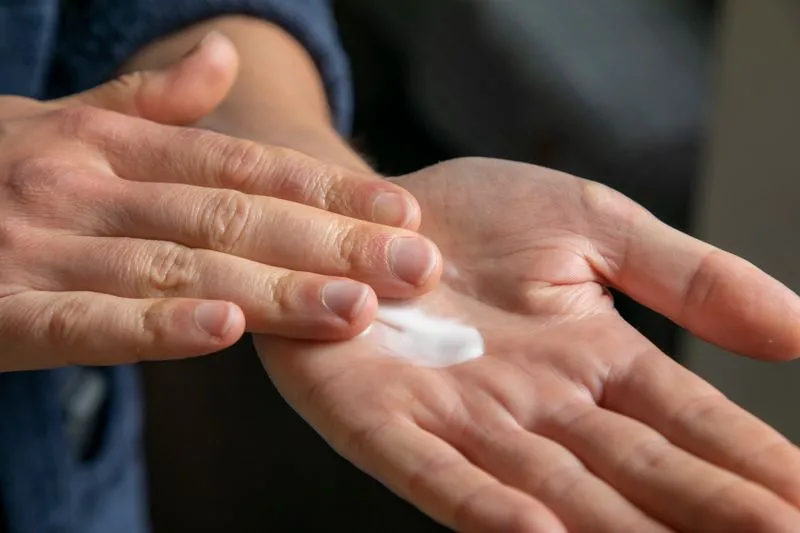
Saturday 31 May, 4.40pm, on the grass at London Fields. The first long, lazy afternoon of the summer with bare arms in proper sunshine — that dry warmth that prickles just enough to remind you your skin hasn't seen daylight since October. I pulled out the tube I'd bought at Boots the week before (a "100% mineral filters" cream) and squeezed out a blob. Thick. Almost chalky. It squeaked under my fingers like modelling clay left out on a windowsill — it took a good minute to spread.
The result: forearms of a faintly lilac white, a plaster-cast film on the backs of my hands and five perfectly crisp fingerprints on my black linen trousers. A woman walking her dog gave me the look you give someone who has just finished painting a ceiling. Meanwhile, at the bottom of my bag, sat my usual fluid — the one that vanishes in ten seconds and smells vaguely of holidays. I'd shelved it after a link did the rounds on a WhatsApp group: "chemical sunscreen is poison".
That's when the real question landed. What exactly is in these two tubes? Does one protect better than the other? Is mineral really gentler? Does chemical get through your skin? And what about the coral reefs?
That evening I put both tubes on the kitchen table. I read their ingredients lists line by line — then the regulations behind every filter. This guide isn't about SPF numbers — our complete guide to choosing and applying sun protection covers those. It's about what makes the number: the filters themselves, how they work, how your skin tolerates them, the marks they leave, where they end up in the water and what the regulators say.

Mineral and chemical sunscreen filters: two families, one job
A sunscreen filter is the ingredient that stops UV before it reaches your skin cells. No brand gets to pick them freely. In Great Britain, every filter has to appear on a closed list — Annex VI of the UK Cosmetic Products Regulation — with a maximum concentration. The EU works the same way with its own version of the list. No listed filter, no sunscreen.
These filters fall into two families:
- organic filters, often called "chemical": synthetic molecules that absorb UV energy and release it as heat too faint to feel;
- inorganic filters, known as "mineral": there are only two, titanium dioxide and zinc oxide.
First thing to clear up: "organic" does not mean organic as in the veg box. The British Association of Dermatologists spells it out in its fact sheet — organic "simply refers to the fact that the active UV ingredients contain carbon atoms." Avobenzone is organic — and entirely lab-made.
Plenty of sunscreens also mix the two families to cover the whole spectrum. So a big "mineral" on the front of the bottle tells you nothing until you've read the back.
Do mineral filters really reflect UV?
It's the claim on every other bottle: mineral filters "reflect" UV like a mirror, chemical ones "absorb" it like a sponge. No. Or rather — it's true for visible light, much less so for UV.
In 2016, three researchers (Cole, Shyr and Ou-Yang, in Photodermatology, Photoimmunology & Photomedicine) measured each mechanism with an integrating sphere. Their conclusion is blunt. Across the UV range, zinc oxide and titanium dioxide reflect only 4–5% of the radiation on average — less than SPF 2's worth. The rest? Absorption, just like chemical filters.
The nuance is useful. Beyond UV — in long UVA and visible light — those same particles become proper reflectors, up to 60% according to the same study. That's exactly what creates white cast. Your skin bounces visible light back, and everyone sees a mime's mask. The film is an optical effect, not extra UV protection.
So the real difference between the families is size. An organic molecule dissolves into the formula and disappears. A mineral particle stays a particle — it has to be dispersed, coated and sized. The finer it is, the less it whitens (and the closer it gets to nanomaterial territory). Everything else in this guide flows from that trade-off.
Reading the ingredients list: the filter names to look for
The INCI list is the ingredients list on the back of the tube, written in an international naming system. It's the only reliable information about the filters in your sunscreen. If you've learned to decode a serum with our guide to active ingredients like niacinamide, vitamin C and BHA, you already have the reflex. The hard part here is the names — long, technical, and not designed to be read standing up in a chemist.
These are the filters you'll meet most often, with their current legal ceiling in the EU. Great Britain has kept its own list since Brexit. For most of these filters the numbers are identical — the exceptions are benzophenone-3, octocrylene, homosalate and 4-MBC, the four filters the EU has just tightened.
| INCI name | Common name | Family | EU ceiling and notes |
|---|---|---|---|
| TITANIUM DIOXIDE | Titanium dioxide | Mineral | 25%; also comes as [nano]. |
| ZINC OXIDE | Zinc oxide | Mineral | 25%; also comes as [nano]. |
| BUTYL METHOXYDIBENZOYLMETHANE | Avobenzone | Organic | 5%. |
| OCTOCRYLENE | Octocrylene | Organic | 10% (9% in propellant sprays). |
| HOMOSALATE | Homosalate | Organic | 7.34%, face products only. |
| BENZOPHENONE-3 | Oxybenzone | Organic | 2.2% body; 6% face, hands, lips. |
| ETHYLHEXYL METHOXYCINNAMATE | Octinoxate | Organic | 10%. |
| ETHYLHEXYL SALICYLATE | Octisalate | Organic | 5%. |
| BIS-ETHYLHEXYLOXYPHENOL METHOXYPHENYL TRIAZINE | Bemotrizinol | Organic | 10%. |
| METHYLENE BIS-BENZOTRIAZOLYL TETRAMETHYLBUTYLPHENOL | Bisoctrizole | Organic | 10%; also comes as [nano]. |
| DIETHYLAMINO HYDROXYBENZOYL HEXYL BENZOATE | — | Organic | 10%. |
| TEREPHTHALYLIDENE DICAMPHOR SULFONIC ACID | Ecamsule | Organic | 10% (as acid). |
| 4-METHYLBENZYLIDENE CAMPHOR | Enzacamene (4-MBC) | Organic | Banned in the EU. |
A filter on the list has been assessed and approved (the figure is a ceiling, not a typical dose). The four with recent restrictions — octocrylene, homosalate, benzophenone-3 and 4-MBC — share one backstory: endocrine disruption.
What [nano] means on a sunscreen label
You may have spotted it in brackets: TITANIUM DIOXIDE [NANO]. The law requires it — Article 19 of the UK Cosmetic Products Regulation says any ingredient present as a nanomaterial must be clearly flagged in the list, with the word nano in brackets after its name. For mineral sunscreens this is no detail — it's what makes zinc and titanium more or less invisible on skin.
Only a handful of filters are approved in nano form: titanium dioxide, zinc oxide, bisoctrizole, TRIS-BIPHENYL TRIAZINE and BIS-(DIETHYLAMINOHYDROXYBENZOYL BENZOYL) PIPERAZINE. Small surprise — three of those five are organic. Nano isn't a mineral speciality.
Nano zinc oxide and nano titanium dioxide come with strict conditions on purity, particle size and coatings. They also carry a flat rule in the annex: "Not to be used in applications that may lead to exposure of the end-user's lungs by inhalation." In practice, those nano forms are kept out of sprays you might breathe in.
What does that mean for you, without an electron microscope in the bathroom? A mineral cream that goes on almost clear almost certainly relies on very fine particles. Want to avoid nano? Accept a whiter finish (that's just physics).
Endocrine disruptors: the filters regulators have cut back
The fear that sends people running to mineral has a name: endocrine disruption. Could a molecule you spread over your whole body, several times a day, all summer long, interfere with your hormones? That question didn't start on WhatsApp. It led the EU to tighten — or scrap — four organic filters in three years, and it led Britain's own advisers to review two of them.
Benzophenone-3 and octocrylene. EU regulation 2022/1176 on certain UV filters records that the EU's Scientific Committee on Consumer Safety found benzophenone-3 "not safe for the consumer" at 6% in body creams and sprays. The body limit dropped to 2.2%. Octocrylene was judged safe up to 10% (9% in propellant sprays), as long as benzophenone — which can form from it — stays at trace levels. Since 28 July 2023, every product on EU shelves has had to comply.
Britain's own advisers reached the same conclusion on benzophenone-3 — but the UK rules themselves haven't changed yet. In December 2023, the government's Scientific Advisory Group on Chemical Safety (SAG-CS) opinion on benzophenone-3 concluded that it does not meet acceptable safety margins at 6% when applied to the full body, while 2.2% does. Its separate opinion on octocrylene found it acceptable up to 10%. On endocrine effects, both opinions say the same thing — the data were "inconclusive".
Homosalate and 4-MBC. In the EU, homosalate has been capped at 7.34% and limited to face products (no aerosols) for anything placed on the market since 1 January 2025; old stock can be sold until 1 July 2025. 4-MBC (enzacamene) went further: the EU banned it outright in 2024, citing "sufficient evidence" that it may act as an endocrine disruptor. No new products since 1 May 2025, with existing stock allowed until 1 May 2026.
| Filter | New EU rule | Whole shelf compliant by |
|---|---|---|
| Benzophenone-3 | 2.2% body; 6% face, hands, lips. | 28 July 2023. |
| Octocrylene | 10%; 9% in propellant sprays. | 28 July 2023. |
| Homosalate | 7.34%, face only, no aerosols. | 1 July 2025. |
| 4-MBC | Banned. | 1 May 2026. |
In Great Britain, the old limits still apply: benzophenone-3 up to 6% in any product, octocrylene up to 10% (sprays included), homosalate up to 10% in body products too, and 4-MBC is still permitted at up to 4%. A bottle on a UK shelf can legally contain what an EU shelf can no longer sell — one more reason to read the list yourself.
What these rules say — and what they don't. Some filters were dosed too high, or too uncertain, so they were cut. They don't condemn "chemical sunscreen" as a whole: avobenzone or bemotrizinol aren't touched by any of these texts. The British Association of Dermatologists puts it plainly: "Expert reviews of sunscreen safety have concluded that the current list of active ingredients used in sunscreens do not pose a concern for human health." After the clear-out, the list doesn't worry the specialists.
Do chemical sunscreen filters get into your bloodstream?
Some of them, yes. And this is probably the study that did the most to fuel the mistrust. In early 2019, researchers at the US Food and Drug Administration (FDA) applied four sunscreens to 48 volunteers at maximal-use doses: 2mg per square centimetre over three-quarters of the body — once on day one, then four times a day on days two to four.
The results appeared in 2020 in the randomised trial by Matta and colleagues in JAMA. All six filters tested (avobenzone, oxybenzone, octocrylene, homosalate, octisalate and octinoxate) reached the bloodstream. Every one crossed the FDA's 0.5ng/mL threshold after a single application — the level above which manufacturers can no longer skip some extra safety studies. Oxybenzone reached the highest concentrations.
Now for the sentence the scary posts always leave out. It's in the study's own conclusion: "These findings do not indicate that individuals should refrain from the use of sunscreen." The 0.5ng/mL line triggers more testing; it isn't a toxicity limit. Getting into the blood and being harmful are two different claims.
The study says nothing about mineral filters — zinc and titanium weren't part of the trial. So you can't use it to claim "mineral doesn't get through". It simply didn't measure it.

Sensitive skin and allergies: who should read the label closely
Tolerance is mineral's strongest argument — as long as it doesn't turn into dogma. The British Association of Dermatologists keeps it simple: allergies to sunscreen are uncommon, but sunscreens "can occasionally cause skin irritation, or a skin allergy." When a reaction happens, a formula packed with organic filters and fragrance simply offers more suspects than a fragrance-free mineral cream (that's arithmetic, not a guarantee).
One case deserves a closer look: ketoprofen gel, a prescription anti-inflammatory you rub into the skin. The patient leaflet for ketoprofen 2.5% gel on the Electronic Medicines Compendium warns that sunlight on treated areas — even hazy sunlight — can cause serious skin reactions. It also says to "Stop using Ketoprofen Gel immediately if you experience any skin reactions including skin reactions after co-application of octocrylene-containing products". And the SAG-CS opinion on benzophenone-3 ends with a line few people read: "Members noted potential interactions between ketoprofen and benzophenone-3."
For everyone else, here's how I'd think about it. Skin that reacts easily (redness, stinging, contact eczema already diagnosed)? A fragrance-free mineral formula is a logical starting point. Never reacted to anything? Nothing obliges you to ditch a sunscreen you like and actually reapply. And if you've started retinol, our complete retinol guide explains why morning SPF becomes non-negotiable — whatever the filter.
White cast and texture: the real cost of mineral filters
White cast from a mineral sunscreen isn't a manufacturing fault: zinc and titanium particles bounce visible light back. My linen trousers can confirm. And it doesn't hit everyone equally. On very fair skin, the film fades within minutes. On olive, brown or Black skin, it can leave a grey or purplish sheen you can see from across the room. Let's be honest: that doesn't make anyone keen to reapply every two hours.
Brands have three ways to fight the plaster-cast effect:
- shrinking the particles — the move to [nano], with its size and labelling rules;
- adding pigment — tinted versions cancel out the white, if you find your shade;
- blending mineral and organic — less powder, less white, but no longer "100% mineral".
On texture, organic filters still lead — fluids, lotions, mists and gels that vanish under make-up. Mineral creams tend to be thicker and more matte (that squeak under your fingers is them). A plus on skin that gets shiny by 4pm. A minus on dry skin that already feels tight.
Sunscreen and the environment: what happens to UV filters in water
This is mineral's other big selling point: it's supposedly "reef safe". The science is messier than the label — and it isn't only about beaches.
In 2022, the US National Academies of Sciences, Engineering, and Medicine published a review of the fate and effects of sunscreens in aquatic environments. UV filters reach water directly from swimmers and indirectly through wastewater. The highest concentrations of most filters turn up in shallow water near swimming beaches, during the day — and filters such as octocrylene also settle into sediments. The committee's main recommendation was that the US Environmental Protection Agency "should conduct an ecological risk assessment (ERA) for all currently marketed UV filters". It also warned that making preferred sunscreens harder to get could lead people to use less sunscreen — with consequences for skin health.
So your shower counts too, not just the sea. The filter you rinse off at night heads down the drain and on to the river. Thinking the problem stops at tropical lagoons means forgetting half the journey.
Octocrylene is one filter under scrutiny closer to home: the SAG-CS notes that the European Chemicals Agency is assessing whether it is persistent, bio-accumulative and toxic. A mineral formula avoids it. That's something. But "mineral" doesn't mean "no impact" — cosmetics rules assess safety for the people wearing the product, not for rivers or reefs.
The most useful move for the water isn't in the bottle. A UV swim top, a hat, shade at midday — every inch of covered skin is less sunscreen in the sea and down the plughole. And if you followed the cracked heels and dry feet routine before sandal season, remember the tops of your feet: first to burn, last to get sunscreen.

Mineral or chemical: which protects better in independent tests?
No filter family protects better by nature: what counts is whether the sunscreen delivers the SPF on the label. A sunscreen that doesn't is useless, whatever its filters. And the independent test that pits the two families against each other points one way.
In June 2022, Which?'s sunscreen tests on mineral and chemical SPF30s put 13 products through the British Standard lab methods. The eight chemical sunscreens — cheap supermarket own brands included — all passed both SPF and UVA tests. All five mineral sunscreens (one of them blending mineral and chemical filters) failed at least one; three failed both. One of the least effective, a £26 bottle, barely provided a third of its claimed SPF. The mineral products cost up to ten times more than the chemical ones.
Five mineral products, one season — a small sample, so read it as a warning sign rather than a verdict. Several brands disputed the results, and Which? re-tests any failure on a second sample before publishing.
Why are minerals trickier? Part of the answer is formulation: a powder has to be spread evenly through the cream to form a continuous screen. Poorly dispersed, it leaves gaps. It's a formulation challenge, not a death sentence — but the margin for error is narrower, and "mineral" on the label proves nothing about protection.
Mineral or chemical sunscreen: my pick for your situation
I'll be straight with you: there's no outright winner. There's the sunscreen you'll reapply every two hours without grumbling, and the one that ends up at the bottom of your bag. The first one wins. Whatever you pick, the NHS baseline still applies — the NHS advice on sunscreen and sun safety asks for at least SPF30 and at least 4-star UVA protection.
| Your situation | My pick | Why |
|---|---|---|
| Reactive skin, contact eczema, a past reaction to sunscreen. | Fragrance-free mineral. | Fewer ingredients to suspect. |
| Using a ketoprofen gel. | Octocrylene-free, plus clothing over the area. | Octocrylene reactions flagged in the leaflet. |
| Olive to dark skin. | Organic, hybrid or tinted mineral. | No grey sheen to put you off. |
| Under make-up. | Organic fluid or tinted mineral. | No white film under foundation. |
| Swimming in the sea or a lake. | UV swim top first, then mineral or octocrylene-free. | Less filter in the water. |
| Sport and sweat. | The texture you'll really reapply. | Reapplying matters more than the family. |
| Want to avoid nano. | Mineral without [nano] on the list. | At the price of a whiter finish. |
As for me, I made up my mind that Saturday. The mineral cream became my "swimming and beer gardens" sunscreen, for my body. For my face, under foundation, I'm keeping a fluid whose list I've checked (no 4-MBC, and no homosalate beyond the EU's new face-only limit). The linen trousers got a stain remover.
The takeaway fits in one line. Read the ingredients list once, choose with your eyes open — then drop the debate and reapply. Sunscreen that's properly applied and topped up beats a perfect formula forgotten in your bag.
Frequently asked questions
Does mineral sunscreen protect less well than chemical sunscreen?
Not by nature. But mineral powders are harder to spread evenly, and in Which?'s 2022 tests, which compared the two families, all five mineral SPF30s failed at least one SPF or UVA test, while all eight chemical ones passed. Trust test results over the word "mineral".
Are chemical sunscreen filters dangerous?
Approved filters have been assessed. The ones that raised questions (benzophenone-3, homosalate, 4-MBC) have been restricted or banned in the EU, and Britain's advisers reached a similar view on benzophenone-3. Some organic filters do reach the blood, according to an FDA trial published in 2020 — but its authors stress that this is no reason to stop using sunscreen.
How can I tell if my sunscreen contains nanoparticles?
Look for [nano] after an ingredient name in the list: it's a legal requirement. Only five filters are approved in nano form, including titanium dioxide and zinc oxide. A mineral cream that goes on almost clear very likely uses fine particles.
Which sunscreen filter is best for sensitive skin?
A fragrance-free mineral formula is a sensible place to start, because it contains fewer ingredients likely to react. If your skin is happy with an organic sunscreen, there's no need to switch. If you do react, keep the ingredients list and show it to your GP or a dermatologist.
Do "reef safe" sunscreens really protect coral?
The phrase is marketing, not a guarantee. Skipping octocrylene avoids a filter under European assessment for its environmental profile, but no sunscreen has had to prove it's harmless to aquatic life. For swimming, a UV swim top is the lowest-impact protection.
Can I wear mineral sunscreen under make-up?
Yes — let it set for a few minutes before foundation. A tinted version avoids the white or grey cast (and on dry skin, moisturise first).
My sunscreen contains 4-MBC: should I throw it away?
4-MBC (4-METHYLBENZYLIDENE CAMPHOR on the label) can't go into new products sold in the EU since 1 May 2025, and existing stock can be sold until 1 May 2026. In Great Britain it is still permitted at up to 4%. You don't have to bin an opened bottle. Next time you buy, choose a formula without it.
Sources
- UK Cosmetic Products Regulation, Annex VI: UV filters (legislation.gov.uk)
- UK Cosmetic Products Regulation, Article 19: labelling and [nano] (legislation.gov.uk)
- EU Regulation 2022/1176: benzophenone-3 and octocrylene (EUR-Lex)
- EU Regulation 2022/2195: homosalate (EUR-Lex)
- EU Regulation 2024/996: 4-MBC ban (EUR-Lex)
- SAG-CS: final opinion on benzophenone-3 in cosmetic products (GOV.UK)
- SAG-CS: final opinion on octocrylene in cosmetic products (GOV.UK)
- British Association of Dermatologists: Sun Protection Fact Sheet
- NHS: sunscreen and sun safety
- Ketoprofen 2.5% w/w Gel: patient information leaflet (emc, PDF)
- Matta et al., JAMA 2020: sunscreen active ingredients in plasma
- Cole, Shyr, Ou-Yang, 2016: metal oxide sunscreens protect by absorption
- National Academies (2022): sunscreens in aquatic environments
- Which? (2022): sunscreens costing up to £28 fail sun safety tests