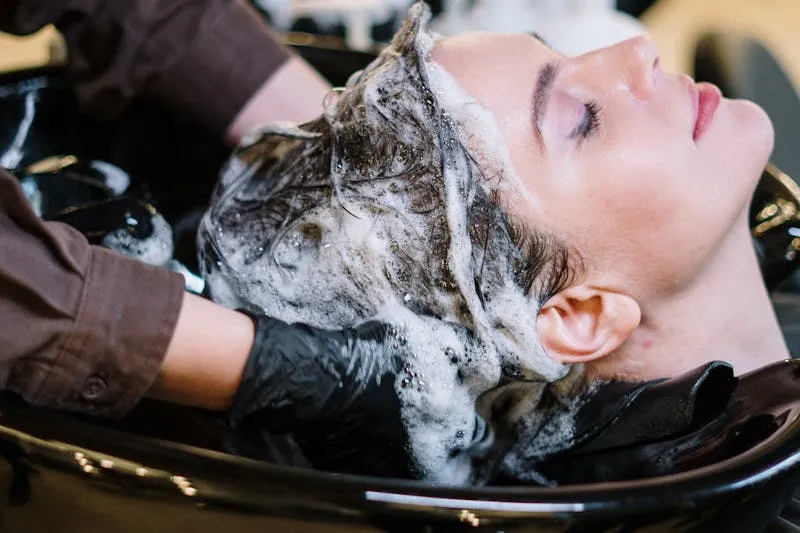
I spent ten years buying the wrong shampoo. Not for lack of budget or motivation — out of ignorance. I followed magazine advice telling me to use products "for normal hair" because my hair wasn't particularly oily, dry, curly, or straight. Result: hair that was perpetually "fine" but never shiny, never supple, never beautiful like the women in adverts. The day a hairdresser explained that I had fine hair with high porosity — and that this changed everything about which products to use — my hair life transformed in three weeks.
The problem with "universal" hair routines is that they don't exist. Fine, porous hair doesn't react remotely like thick, resistant hair — just as dry skin and oily skin can't tolerate the same skincare. This guide starts with diagnosis (5 minutes, 3 simple tests) and then builds the routine tailored to your exact profile. No magic recipes — just hair logic.
The porosity test: the key that changes everything
Porosity is your hair's ability to absorb and retain moisture. It's the single most important parameter for choosing products — and the most ignored. Think of your hair like a pine cone: when the scales (cuticles) are open, water enters easily but escapes just as fast. When they're sealed shut, water struggles to penetrate but stays trapped once inside.
The water glass test (2 minutes):
- Take a strand of clean hair (product-free) that's fallen naturally — from your brush or pillow
- Place it on the surface of a glass of room-temperature water
- Wait 2–4 minutes and observe:
- Hair floats → low porosity (very sealed cuticles)
- Hair sinks slowly, stays in the middle → medium porosity (normal cuticles)
- Hair sinks straight to the bottom → high porosity (open cuticles)
What porosity means for your routine:
Low porosity — your hair repels treatments. Masks sit on the surface without penetrating. Colours take poorly. But once hydrated, your hair holds moisture well. Your routine needs to force penetration: heat (warm towel over mask), lightweight liquid products (no heavy butters), humectants (glycerin, aloe vera).
Medium porosity — the hair jackpot. Your hair absorbs and retains properly. Most products work for you. The simplest routine: gentle shampoo, classic conditioner, weekly mask.
High porosity — your hair absorbs everything but retains nothing. Dries quickly, frizzes, breaks easily. Often caused by chemical treatments, excessive heat, or UV damage. Your routine needs to seal moisture in: proteins (keratin, silk, rice) to fill cuticle gaps, heavy oils to seal (castor oil, shea butter), no pure humectants (glycerin alone attracts ambient humidity and makes hair puff).
Thickness vs density: the confusion that ruins routines

It's the most common confusion in hair care: mixing up "fine hair" and "thin hair." These are completely different things:
Thickness = the diameter of each individual hair strand. Fine (< 60 microns), medium (60–80 microns), or coarse (> 80 microns). To test: hold a single hair between your fingers. If you can barely feel it, it's fine. If you feel it clearly, it's medium. If it feels almost rigid, it's coarse.
Density = the number of hairs per cm² of scalp. Low, medium, or high. To test: part your hair down the middle and look. If you see lots of scalp between the hairs, your density is low. If the scalp is barely visible, your density is high.
Why this matters:
- Fine + high density — you have lots of hair but each strand is fragile. Heavy products (butters, thick oils) will weigh everything down. You need lightweight, volumising products
- Fine + low density — the most delicate profile. Minimal volume, easy breakage. Every gesture counts: gentle drying, finger-detangling, ultra-light products, no heat
- Coarse + high density — the "lion's mane." Lots of volume, resistant strands but hard to control. You can use rich products, butters, and heavy oils without weighing anything down
- Coarse + low density — less common. Each hair is strong but the overall effect lacks volume. Nourishing products but applied to roots only to avoid weighing down lengths
The scalp: the soil your garden depends on
We always talk about hair — but rarely about the scalp. It's a fundamental error. The scalp is a living ecosystem: hair follicles, sebaceous glands, bacterial and fungal microbiome, blood circulation. If the soil is unhealthy, no plant will grow properly — and the same goes for your hair.
The 4 scalp types:
Normal — neither oily nor dry, no itching, no flaking. You can space washes 2–3 days easily. Easiest to maintain: gentle shampoo, that's it.
Oily — roots shine by the day after washing. Counter-intuitively, the solution is NOT washing more often (this stimulates sebum production). The solution: gentle sulphate-free shampoo, gradually spacing washes (your scalp self-regulates within 3–4 weeks), and a scalp scrub every 2 weeks.
Dry — tightness, dry flakes (fine and white), itching. Often aggravated by sulphates and hard water. The solution: sulphate-free shampoo, jojoba or coconut oil as pre-wash treatment, and a final rinse with diluted apple cider vinegar to rebalance pH.
Sensitive/reactive — redness, tingling, product reactions. Often linked to a compromised skin barrier. Eliminate fragrances, essential oils, and dyes from your products. See a dermatologist if symptoms persist — chronic scalp conditions need medical diagnosis, not cosmetic products.
Routine for fine and/or porous hair

Fine hair is the most demanding in terms of formulation. Too rich = flat and lifeless. Not nourishing enough = dry and brittle. The balance is narrow, but once found, the results are spectacular.
The routine:
- Gentle sulphate-free shampoo — apply to scalp only, never lengths. The rinse water is enough to cleanse the ends
- Lightweight conditioner — lengths and tips ONLY, never roots. Rinse thoroughly — any residue weighs fine hair down
- Light protein mask (weekly) — hydrolysed keratin, silk or rice proteins strengthen without weighing down. Apply under a warm towel for 10–15 minutes
- Leave-in serum — a few drops on damp tips. Jojoba oil or volatile silicone-based. No coconut or castor oil on fine hair — too heavy
- Heat protectant (if using heat tools) — MANDATORY. Fine hair burns faster than coarse. Maximum straightener temperature for fine hair: 150°C (not the 200°C default)
Routine for thick and/or resistant hair
Thick hair is more robust, more tolerant of rich products, but also harder to deeply hydrate — the thick cuticles form a natural barrier. The strategy: penetrating treatments, not just surface care.
The routine:
- Pre-wash oil treatment (1–2 times weekly) — virgin coconut or olive oil on dry lengths, 1 hour before washing (or overnight under a shower cap)
- Clarifying shampoo (every 2 weeks) — thick hair accumulates more residue. A clarifying wash resets everything. Other days: regular gentle shampoo
- Rich conditioner (every wash) — shea butter, argan oil, avocado oil. Leave 3–5 minutes for penetration
- Intensive mask (weekly) — 20–30 minutes under heat. Mango butter, baobab oil, or wheat protein-based masks
- Finishing oil (after every wash) — argan or macadamia oil on tips and mid-lengths. Thick hair absorbs oil like a sponge
Routine for curly to coily hair: a world of its own
Curly to coily hair is structurally different from straight hair: the oval cross-section creates the curl, but also structural fragility at twist points. Sebum struggles to travel down the spiral — resulting in a potentially oily scalp and chronically dry ends.
The adapted Curly Girl method:
- Co-wash or sulphate-free shampoo — co-washing (cleansing with conditioner) suffices for regular washes (1–2 per week). A gentle sulphate-free shampoo every 10–15 days to clarify. NEVER sulphates — they open already fragile cuticles
- Generous conditioner — apply liberally, detangle with fingers or a wide-tooth comb in the shower (hair saturated with conditioner). Don't rinse completely — leave a veil of product
- Leave-in conditioner — on squeezed (not dried) hair. The key product of the Curly Girl method
- Gel or styling cream — for curl definition and frizz control. Apply by "scrunching" (pressing sections upward)
- Drying — air-dry ideally. If blow-drying: diffuser MANDATORY, medium heat, head upside down for volume. NEVER a round brush on curls
The 8 hair mistakes (almost) everyone makes

- Washing every day — stimulates sebum production and dehydrates lengths. Ideal for most profiles: every 2–3 days
- Applying conditioner to roots — it belongs on lengths and tips only. On roots, it weighs down, greases, and kills volume
- Brushing wet hair with a regular brush — wet hair is elastic and fragile. Use a wide-tooth comb or flexible detangling brush. Always tips to roots, section by section
- Using scalding water — hot water opens cuticles and dehydrates. Wash with lukewarm, final rinse with cool (cold seals cuticles and adds shine)
- Rubbing hair dry with a towel — friction causes breakage and tangles. Press hair into the towel with squeezing motions. Or use a cotton t-shirt
- Skipping heat protection — a straightener at 200°C without protection is like sunbathing without sunscreen. Damage is cumulative and irreversible on existing hair
- Layering products without clarifying — silicones, waxes, and polymers build up wash after wash. A clarifying shampoo once a month resets everything
- Only trimming when ends look damaged — by then, splits have already travelled 2–3 cm up the shaft. Trim every 8–10 weeks, even if ends look healthy. Prevention costs less than repair
Frequently asked questions about hair routines
How often should I wash my hair?
It depends on your scalp type, not your hair. Oily scalp: every 2 days. Normal: every 2–3 days. Dry: every 3–4 days. Curly to coily: 1–2 times per week maximum. Dry shampoo between washes is an ally — it absorbs excess sebum without disrupting production rhythm. But it's a complement, not a substitute for actual washing.
Are silicones really bad for hair?
It's nuanced. Heavy non-water-soluble silicones (dimethicone, amodimethicone) create a film that smooths and shines — but build up and eventually suffocate the fibre. Water-soluble silicones (cyclomethicone, PEG-modified) rinse out easily and don't accumulate. For fine hair: avoid non-water-soluble ones. For thick hair: they can be beneficial as finishing sealants. The essential: clarify regularly if you use silicones.
Is coconut oil suitable for all hair types?
No. Coconut oil is the only oil that genuinely penetrates the hair shaft (thanks to lauric acid) — making it excellent for thick, porous hair. But on fine, low-porosity hair, it's too heavy and can create an impermeable film that blocks moisture. For fine hair: jojoba oil (lightweight, mimics sebum) or argan oil (nourishing without weighing down).
How long should hair masks be left on?
Minimum 10 minutes for actives to penetrate. Ideal: 20–30 minutes under heat (heated cap, warm towel, or shower cap). Heat opens cuticles and facilitates penetration — the difference between a mask that "sits on the surface" and one that deeply nourishes. Overnight? Possible with natural oil-based masks, but unnecessary with formulated ones — actives finish working after 30 minutes.
Is my hair damaged or just dehydrated?
Simple test: take a wet hair and gently stretch it. If it stretches and springs back: dehydrated but structurally sound — hydration will fix it. If it stretches without returning (like a dead elastic) or snaps: structurally damaged — you need proteins to rebuild, not just hydration. Both can coexist on the same head (healthy roots, damaged ends), hence the importance of adapting care by zone.
Sources and references
- International Journal of Trichology — Hair type classification and porosity studies
- The Trichological Society — Professional hair diagnostic and treatment guide
- Journal of Cosmetic Dermatology — Comparative efficacy of hair conditioning agents, 2022
- British Journal of Dermatology — Effects of hair care practices on hair fibre integrity