
On Easter Sunday, most large shops in England and Wales — those with more than 280 square metres of selling space — are barred by law from opening their doors. That includes the big supermarket where you were planning to grab cream, bread and a forgotten bag of potatoes on Sunday morning. Closed. All day.
It's not a staff tradition — it's written into Schedule 1 of the Sunday Trading Act 1994. A "large shop" is one with a floor area over 280 square metres. On an ordinary Sunday it can trade for six hours, between 10am and 6pm. The exemption that allows those six hours "does not apply where the Sunday is Easter Day". Christmas Day has its own ban. Most of us simply never notice until the car park is empty.
I found out the hard way — well, almost. Last Thursday, at 11.05pm, I was writing my shopping list for the lunch I'm hosting on Sunday 20 April at my parents'. Eight of us: my parents, my boyfriend, two of their friends and their daughter, five months pregnant, with her partner. Next to "double cream" I'd written "Sunday morning, big Tesco". I crossed it out. Then I looked at the guest list again — a pregnant guest and a pink roast leg don't mix — and crossed out half the plan. The result: a slow-roast lamb shoulder that everyone can eat, a starter and a pudding made the day before, and a Sunday on which I handle one oven and two pans.
Here is that full menu, with quantities per person and a countdown from Thursday to the day itself. It borrows the logic of my complete Christmas menu and timing plan (anything that can wait a night in the fridge does), but none of the recipes — this one tastes of spring.

The Easter lunch menu for eight, at a glance
This Easter lunch menu comes in four parts — and three of them are ready before Sunday. Here it is, scaled for eight:
- Nibbles: devilled eggs with chives, radishes with salted butter. Filling made the day before, assembled in ten minutes.
- Starter: pea and mint soup, topped with pan-fried asparagus tips. Soup made the day before, reheated in ten minutes.
- Main: slow-roast lamb shoulder, new potatoes roasted in its juices, glazed carrots and homemade mint sauce.
- Pudding: dark chocolate tart topped with mini chocolate eggs. Made the day before, out of the fridge 45 minutes ahead.
The menu rests on three rules. I learnt them by watching hosts (my mother first among them) spend their own celebration standing at the hob — year after year.
One oven, and never more than two rings at once. The shoulder takes the oven from 8.15am to 12.45pm — the potatoes cook in the same tin. Everything else happens on the hob or comes out of the fridge. No queue of dishes waiting their turn in front of a small oven (my parents' is a perfectly ordinary built-in one).
Anything that can spend a night in the fridge spends it there. Soup is often better the next day. A ganache needs a night to set, and a devilled-egg filling is perfectly happy to wait overnight. What can't spend a night in the fridge (the asparagus, the carrots) cooks on the day, in twenty minutes flat.
One main that everyone can eat, no exceptions. A pregnant guest, a three-year-old, a grandad who struggles to chew — a shoulder you can pull apart with a spoon covers all three at once. It's the one rule I no longer bend.
A pregnant guest: what the NHS says about meat and eggs
If a pregnant woman is coming to lunch, her lamb needs to be thoroughly cooked. The NHS guide to foods to avoid in pregnancy is plain about it: raw or undercooked meat carries a small risk of toxoplasmosis, and meat should be well cooked, with "no trace of pink or blood". A classic pink roast leg is therefore off her plate — or at least, her slice is.
You don't need to play detective. Just ask her when you invite her, menu in hand. It's a cook's question, not a nurse's — and she'll appreciate being asked before Sunday rather than at the table.
Eggs are easier than you might think. The same NHS page says British Lion hen eggs — the ones with the lion stamp — are fine raw or partially cooked. Mayonnaise and mousse made with British Lion eggs are fine too. So check the stamp on the box, and your devilled eggs — or a chocolate mousse, if you'd rather — are safe for her.
Thinking of starting with smoked salmon or oysters instead? Before you decide, read what's safe and what's not when it comes to seafood in pregnancy. It goes through it product by product (and saves you serving a plate she'll have to push away politely).
How much to buy per person, for 4 to 8 guests
For eight people, buy a lamb shoulder of about 1.8 to 2kg on the bone, 1kg of frozen peas, 1.6kg of new potatoes and enough for one 26cm tart. The full breakdown is in the table below.
For the lamb, I start from Simply Beef & Lamb, the consumer site of the Agriculture and Horticulture Development Board (AHDB). Its spiced pulled shoulder recipe uses a 1.8kg whole shoulder to serve eight — about 225g per person. For a long, slow roast, I go up to 250g: a slow-cooked shoulder shrinks as it renders, and nobody has ever turned down a second helping of lamb that melts. Everything else in the table is my own rule of thumb (tested on several family lunches).
| Menu item | Per person | For 4 | For 8 |
|---|---|---|---|
| Devilled eggs | 1 egg (2 halves) | 5 eggs | 10 eggs |
| Radishes | a quarter of a bunch | 1 bunch | 2 bunches |
| Pea and mint soup | 250ml | 500g frozen peas | 1kg frozen peas |
| Asparagus | 3 spears | 1 bunch | 2 bunches |
| Lamb shoulder, bone in | 225 to 250g | 1kg | 1.8 to 2kg |
| Leg of lamb (if you prefer) | about 300g | 1.2 to 1.5kg | 2 to 2.5kg |
| New potatoes | 200g | 800g | 1.6kg |
| Carrots | 125g | 1 bunch | 2 bunches |
| Chocolate tart | 1 slice | 20cm tart | 26cm tart |
| Bread | 1 roll | 1 small loaf | 2 small loaves |
Watching what you eat at the moment? Shoulder is a fattier cut than leg — which is exactly why it turns so tender. For the wider picture, this guide ranks everyday meats by protein, fat and calories. One Easter lunch won't undo anything. Still, it's good to know what's on your plate.
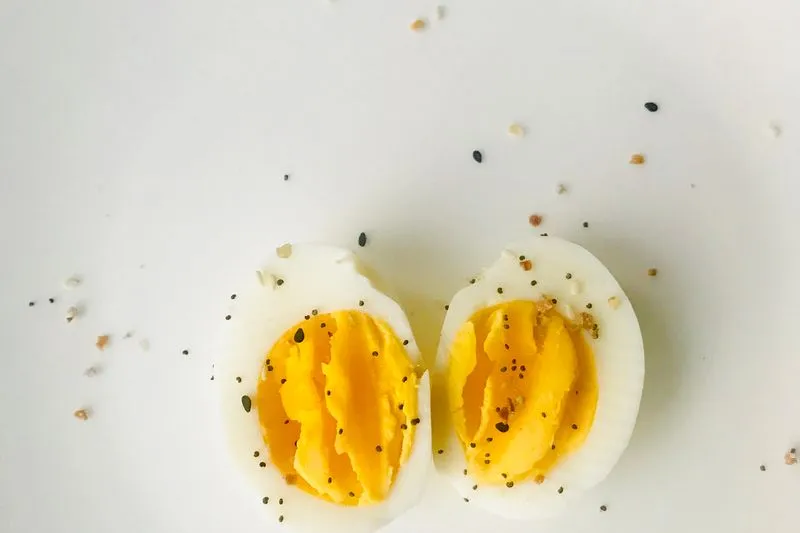
Easter nibbles: devilled eggs and radishes with butter
Devilled eggs are made the day before and eaten without cutlery, which is all you need from Easter nibbles. And an egg on Easter Sunday is the least you can do.
For 8 (20 halves): 10 British Lion eggs, 3 tbsp crème fraîche, 1 tsp English mustard, half a bunch of chives, salt, pepper, a pinch of smoked paprika.
- Lower the eggs into boiling water and time 10 minutes. Cool them straight away in iced water (they peel far more easily).
- Peel, halve lengthways and scoop out the yolks.
- Mash the yolks with the crème fraîche, mustard, salt and pepper. Keep two yolks aside — they're the crumbly topping.
- The day before — whites in an airtight box, filling in a piping bag (or a freezer bag), both in the fridge.
- On the day — pipe the filling, grate the reserved yolks over the top, finish with rinsed, snipped chives and a dusting of paprika.
Yes, I swapped the mayonnaise for crème fraîche. The filling holds better in the fridge, it's lighter before a meal with three courses still to come — and nobody has ever noticed. Radishes get washed the day before (they often come caked in soil). Trim them, leaving a centimetre of leaves, and serve with cubes of salted butter and a little dish of sea salt flakes.
The spring starter: pea and mint soup with asparagus
Pea and mint soup cooks in fifteen minutes and is all the better for a night in the fridge. On the day, it reheats while your guests finish their drinks. Pan-fried asparagus tips, added at the last minute, bring the crunch — and the sense of season.
For 8: 1kg frozen peas, 2 shallots, 1.2 litres vegetable stock, 200ml single cream, 1 bunch of mint, 2 bunches of thin asparagus, a splash of olive oil, salt, pepper.
- Soften the sliced shallots in a little oil for five minutes, without colouring.
- Add the peas straight from the freezer and the hot stock. Simmer for 12 minutes.
- Off the heat, add the cream and about fifteen rinsed mint leaves. Blitz for a good while (two full minutes with a stick blender) until it's completely smooth.
- Taste, season, cool. Into a lidded box and into the fridge.
- On the day — reheat gently for ten minutes, stirring. Fry the asparagus tips in olive oil for four to five minutes, add sea salt, and lay them on each bowl.
Frozen peas on a special occasion? Yes. In mid-April, podding fresh peas for eight takes an hour — and once they're blitzed with mint and cream, I've never been able to tell the difference blind. Asparagus is another story: I want it fresh, and at this time of year that's the whole point of a spring menu.

You can also serve it chilled, in small glasses, if Easter Sunday turns out warm. In that case, loosen it with 100ml of cold stock — soup thickens as it cools.
The Easter main: slow-roast lamb shoulder and new potatoes
A slow-roast lamb shoulder forgives almost anything: four and a half hours at 150°C under its foil, nothing to watch, and meat that comes apart with a spoon. It's cooked through by definition (your pregnant guest eats exactly what everyone else does), and it doesn't mind if drinks run on.
For 8: 1 lamb shoulder, 1.8 to 2kg on the bone (or two smaller ones of about 1kg), 1 bulb of garlic, 4 sprigs of rosemary, 6 sprigs of thyme, 2 onions, 250ml dry white wine or stock, 3 tbsp olive oil, 1.6kg new potatoes, salt, pepper.
For the carrots and mint sauce: 2 bunches of carrots, 40g butter, 1 tbsp honey, a large bunch of mint, 1 tbsp caster sugar, 3 tbsp white wine vinegar.
- Saturday evening. In a large roasting tin, lay the quartered onions, the unpeeled garlic cloves, the thyme and rosemary. Sit the shoulder on top, drizzle with oil, add pepper. Cover, into the fridge.
- Sunday, 7.15am. Take the tin out of the fridge. Simply Beef & Lamb's guide to roasting lamb recommends taking a joint out an hour before cooking, so it cooks evenly.
- 8.15am. Oven at 150°C (130°C fan, Gas Mark 2). Pour the wine into the tin, cover the lamb with baking parchment, then foil, sealed tightly at the edges, and slide it in.
- 11.15am. Tip the washed potatoes around the shoulder, turn them in the juices, cover again.
- 12.15pm. Remove the foil and parchment. Baste the lamb and let it brown, still at 150°C.
- 12.45pm. Out it comes. Cover with foil and a clean tea towel — the shoulder rests, and stays hot, through the starter.
- 1.30pm. Season with salt just before serving.
The carrots go on the hob at 12.15pm, while the lamb browns: into a sauté pan with the butter, honey, a pinch of salt and water halfway up. Lid on for 15 minutes, then lid off until they're glossy. Around 12.40pm, take them off the heat and keep the lid on; a minute back on the hob just before serving brings them up to temperature. For the mint sauce, chop the mint leaves finely with the sugar (the grains help the knife), add 3 tbsp of boiling water, stir, then the vinegar. Make it the day before — it only gets better.
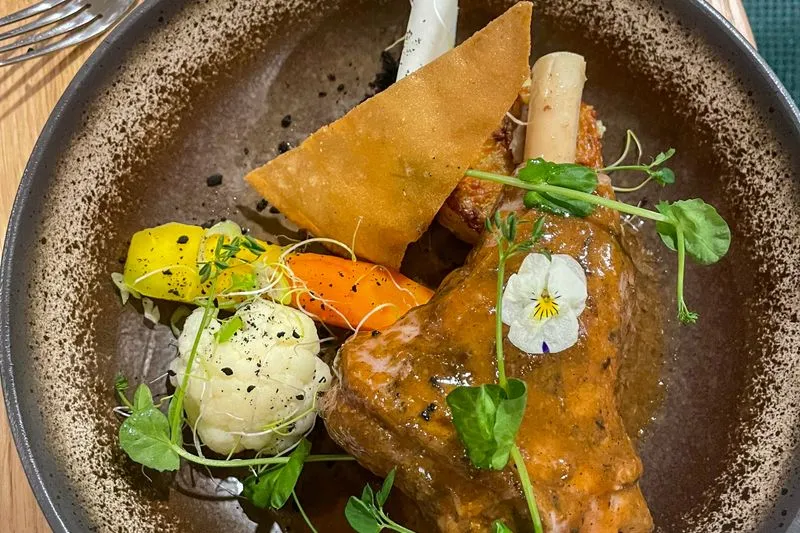
How do you know it's ready? The meat gives way under a spoon — and the shoulder blade bone moves almost on its own. With a probe thermometer, push it into the thickest part, away from the bone. To serve, forget the carving knife: two forks, and pull the meat apart right there in the tin.
Roast leg of lamb: timings if you'd rather
Set on a classic roast leg? It needs you near the oven while your guests are arriving. Simply Beef & Lamb gives an oven of 180-190°C (160-170°C fan, Gas Mark 4-5) and, for medium, 25 minutes per 450g plus 25 minutes — 70-75°C in the centre. For a 2.25kg leg (five times 450g), that's 150 minutes: two and a half hours. Then rest it for 15 to 20 minutes before carving. The guide gives no timing for anything pinker than medium: if that's what you're after, take the leg out earlier and trust a probe thermometer rather than the clock.
And the pink? For most of the table, it's fine. The Food Standards Agency's advice on cooking your food explains that whole cuts such as steaks and joints (except poultry and pork) only carry bacteria on the outside, so they can be served pink in the middle once the outside is properly seared. Anything minced or skewered all the way through is another matter — cook it through.
- Rolled joints. A boned and rolled leg has its outer surface tied up inside. The Food Standards Agency lists rolled joints with mince and sausages as meat that must be cooked all the way through — for everyone at the table, not just your pregnant guest.
- Resting. Those 15 to 20 minutes let the juices settle, so the first slices don't sit in a pink puddle.
- Timing. For a main served at 1.30pm, a 2.25kg leg goes in at about 10.30am. The potatoes can roast around it, but then everything hangs on the minute.
And for your pregnant guest? Carve her slice first, put it back in a hot pan with a couple of spoonfuls of gravy, and cook until no pink remains. That was my plan at first. Then I pictured her eating a grey, dry slice on her own while everyone else passed the platter. That's why I changed the menu.
The Easter pudding: a dark chocolate tart made the day before
A dark chocolate tart is finished on Saturday and asks nothing of you on Sunday except a handful of mini eggs. It holds in the fridge, and no cake shows off a scattering of chocolate eggs better. No oven on Sunday — no nerve-racking unmoulding in front of your guests.
For a 26cm tart (8 slices). Pastry: 200g plain flour, 30g cocoa powder, 80g icing sugar, a pinch of salt, 110g cold butter, 1 egg. Ganache: 250g dark chocolate (60-70% cocoa), 250ml double cream, 40g butter. To finish: a handful of mini chocolate eggs and a few flakes of sea salt.
- Thursday. Rub the flour, cocoa, sugar, salt and butter together with your fingertips. Add the egg, bring it into a ball without overworking, wrap in cling film, fridge.
- Friday. Roll out, line the tin, prick the base and chill for 30 minutes. Blind bake at 180°C (160°C fan): 20 minutes under parchment and baking beans, then 5 minutes without. Leave to cool in the tin.
- Saturday morning. Bring the cream just to a simmer, pour it over the chopped chocolate, wait a minute, then stir gently from the centre outwards. Stir in the butter. Pour into the case and leave to set in the fridge overnight.
- Sunday, 1.45pm. Take the tart out of the fridge (ganache served too cold loses all its flavour). Top with mini eggs and sea salt just before serving.

Why not a chocolate mousse — the great classic? With British Lion eggs, it's fine for a pregnant guest. The problem is space: eight ramekins in the fridge on Saturday night, just when the fridge is already bursting. The tart fits on a single shelf. And it travels without complaint if you're cooking at home and eating somewhere else (like me, this year).
The Easter timeline, from Thursday to Saturday
This Easter timeline takes three days of prep (Thursday, Friday, Saturday) for a Sunday 20 April with no racing against the clock. But it starts today — with a call to the butcher.
Now (a week ahead): order your lamb. Ask to collect it on Saturday 19 April. Good Friday, 18 April, and Easter Monday, 21 April, are both bank holidays in England and Wales, according to the GOV.UK list of UK bank holidays (in Scotland, only Good Friday is). Butchers don't all keep the same hours over a long weekend, so check yours before you plan around it.
Thursday 17 April: the big shop.
- Store-cupboard shop: chocolate, flour, cocoa, icing sugar, butter and an egg for the pastry, cream, stock, frozen peas, wine, soft drinks, mini eggs — and anything you'd have bought on Sunday morning.
- Count chairs, plates, glasses, pudding spoons. Thursday is when you find out you're three forks short — not Sunday at 12.50pm.
- Clear one entire fridge shelf (yes, entire).
- Make the pastry and chill it.
Friday 18 April (Good Friday): the tart case.
- Roll out and blind bake the tart case.
- Hot cross buns for breakfast — you've earned them.
Saturday 19 April: the big day.
- Morning: collect the lamb and buy the fresh veg (radishes, asparagus, carrots, new potatoes, herbs, eggs, bread for Sunday). Pour the ganache into the case, into the fridge. Soup cooked, blitzed, boxed.
- Lunchtime: boiled eggs, filling, whites boxed. Mint sauce made.
- Afternoon: rinse and dry the herbs, wash the radishes and potatoes. Lay the whole table — cloth, plates, glasses, napkins.
- Evening: shoulder ready in its tin (onions, garlic, herbs, oil), covered, in the fridge. Sunday's timings taped to the fridge door.
This year I'm cooking at home, so on Saturday evening I head over to my parents' with the tart, the soup, the devilled eggs in kit form and the shoulder in its tin.
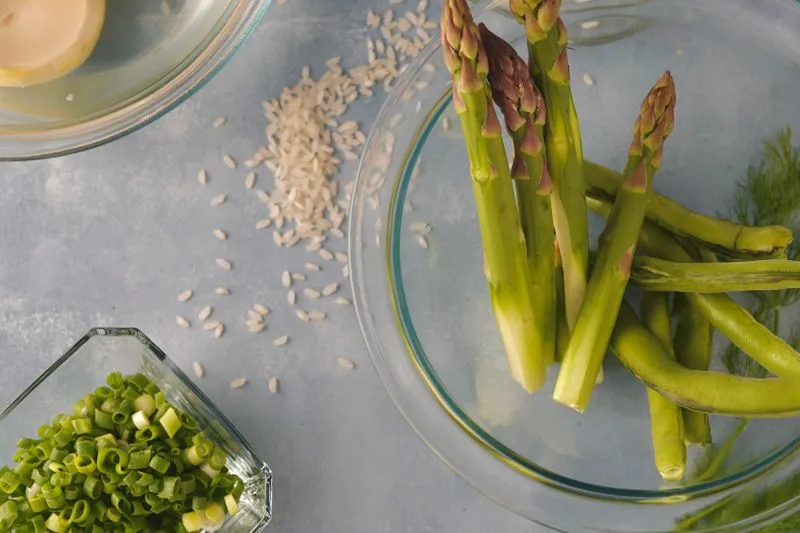
Easter Sunday, hour by hour
On Easter Sunday, for lunch served at 1pm, you only have a handful of cooking jobs: oven on, potatoes in, eggs piped, foil off, carrots and asparagus, soup reheated. Everything else is service. Here's the plan going up on my parents' fridge:
| Time | What you do |
|---|---|
| 7.15am | Shoulder out of the fridge, in its tin. |
| 8.15am | Oven at 150°C, wine in, parchment and foil on, lamb in. |
| 8.30 to 11am | Nothing. Shower, coffee, flowers in a vase (the oven is working for you). |
| 11.15am | Potatoes around the lamb, turned in the juices, covered again. |
| 11.45am | Devilled eggs piped, radishes and butter out, kept cool. |
| Noon | Guests arrive, drinks. |
| 12.15pm | Foil off the lamb, basted. Carrots on the hob. |
| 12.40pm | Carrots off the heat, lid on. |
| 12.45pm | Lamb out, covered. Soup reheating gently. |
| 12.55pm | Asparagus in the pan, five minutes. |
| 1pm | Starter served. |
| 1.30pm | Carrots back on the hob for a minute. Main served: pulled lamb, potatoes, carrots, mint sauce, juices. |
| 1.45pm | Tart out of the fridge. |
| 2.30pm | Pudding, coffee, then the egg hunt. |
Spot the gap between 8.30 and 11am? It's there on purpose. It's what separates the host who opens the door made-up and relaxed from the one who answers in an apron, wooden spoon in hand. I've been both. I prefer the first.

Easter Monday leftovers
Easter lunch leftovers belong in the fridge as soon as the meal is over — and Easter Monday, a bank holiday in England and Wales, is made for finishing them. Pulled lamb goes with everything: sandwiches with the last of the carrots and a little gravy, a quick shepherd's-pie-style bake with the crushed potatoes, or flatbreads with yoghurt and mint.
Don't let them hang around, though. The FSA's chilling guide says to cool cooked food and get it into the fridge within one to two hours, and to eat leftovers within 48 hours (or freeze them). When you reheat, the FSA's cooking advice says to do it once only, until the food is steaming hot all the way through. The soup keeps the same way — and so does the tart, if it lasts that long.
And on Monday, there's no need to "detox" after one lunch. If the idea is nagging at you, read what actually works in a detox, what's marketing, and a realistic plan before you buy a single juice cleanse. A day of simple meals, vegetables and water — that's usually all anyone fancies after a big celebration.
Frequently asked questions
Are supermarkets open on Easter Sunday?
Not the big ones in England and Wales. Under the Sunday Trading Act 1994, most shops with more than 280 square metres of selling space can't open on Easter Day (shops in railway stations and petrol stations are among the exceptions). Smaller convenience stores can, so a corner shop may save you — but don't build your menu around it. Do your big shop on Thursday.
How much lamb do I need per person?
For a slow-roast shoulder, about 225 to 250g per person: Simply Beef & Lamb serves eight from a 1.8kg whole shoulder, and I buy mine on the bone. For a roast leg, I allow about 300g per person on the bone, so 2 to 2.5kg for eight.
Can a pregnant woman eat roast lamb?
Yes, if it's thoroughly cooked. The NHS says meat should be well cooked, with no trace of pink or blood. A pink leg isn't suitable for her; a slow-roast shoulder cooked for hours is. The simplest thing is to ask her ahead.
Can I cook the lamb shoulder the day before?
Yes. Roast it on Saturday, let it cool, then get it into the fridge within one to two hours, covered, with its juices. On Sunday, reheat it covered at 150°C until it's steaming hot all the way through (allow a good hour for 2kg) — and reheat it only once. You free up your Sunday morning, but you lose a little of the crisp, golden edges of a shoulder straight from the oven.
What starter can I make ahead for Easter?
Pea and mint soup — it cooks in fifteen minutes, keeps overnight and reheats in ten. Devilled eggs can also be made the day before, with the filling and whites kept apart until you assemble them. Only the asparagus needs cooking at the last minute.
How do I keep lunch warm if guests are late?
A slow-roast shoulder copes brilliantly. Out of the oven, covered with foil and a tea towel, it stays hot right through the starter (45 minutes in my plan). Longer than that? Put it back in the switched-off but still warm oven, door closed — that's the beauty of a slow roast over a pink leg.
How long do Easter leftovers keep?
Eat them within 48 hours, or freeze them, says the Food Standards Agency. Get them into a fridge at 0 to 5°C within one to two hours of cooking, and reheat only once, until steaming hot. Pulled lamb makes excellent Easter Monday sandwiches.
Sources
- legislation.gov.uk — Sunday Trading Act 1994, Schedule 1: Restrictions on Sunday opening of large shops
- GOV.UK — UK bank holidays
- NHS — Foods to avoid in pregnancy
- Food Standards Agency — Cooking your food
- Food Standards Agency — How to chill, freeze and defrost food safely
- Simply Beef & Lamb (AHDB) — How to roast lamb
- Simply Beef & Lamb (AHDB) — Spiced pulled shoulder of lamb