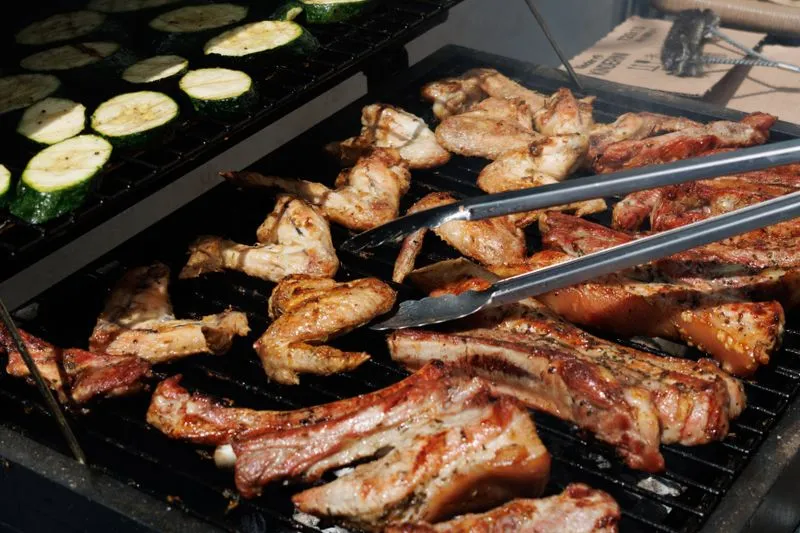
Saturday 22 June 2024, 12.50pm, my parents' garden. Dad handed me the barbecue tongs the way you'd hand someone the keys to a new car — with a smile slightly too wide to be reassuring. For as long as I can remember, that grill has been his territory. That day he'd decided to step back and sit down, for once, with a glass of rosé. I had eight chicken thighs marinated the night before, a bag of charcoal and a completely unjustified level of confidence.
The flames were still hand-high when I laid the chicken on. Twelve minutes later the skin was black, crackly, gorgeous. I stuck my probe thermometer (bought a month earlier for my first fraisier) into the thickest part of a thigh. 52°C. Around the table, everyone was hungry — and everyone was pretending not to watch.
Dad said nothing. He got up, pushed all the coals to one side, slid the thighs to the other side, away from the fire, and put the lid down. "Indirect heat," he said, sitting back down. Thirty-five minutes later the chicken was perfect — golden, juicy, the meat pulling away from the bone. The black skin never went away, though.
That scene sums up everything I didn't know about barbecuing. Flames are not coals. "Black outside" doesn't mean "cooked inside". And a barbecue with a lid is an oven, not just a grill. If you're the one being handed the tongs for the first time this summer, here's what I should have known that Saturday: which barbecue, which heat, how long, which marinade — plus the hygiene and safety rules the food and fire safety authorities publish (and nobody reads).
Charcoal, gas or electric: which barbecue should you choose?
The right barbecue is first and foremost the one you're allowed to light where you live. Taste comes second. All three types cook well — they just ask different things of you.
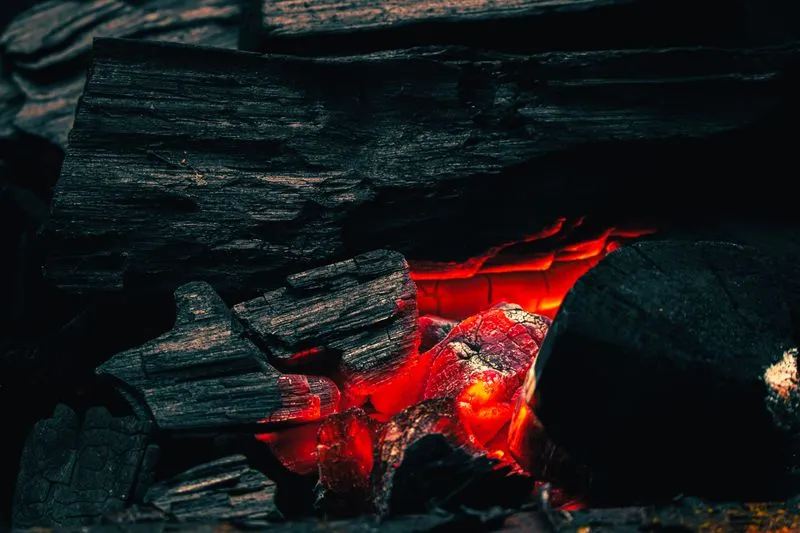
Charcoal is still the king of smoky flavour. It's also the slowest to get going, and that delay is the first trap. You light it too late, you start cooking too early — over flames (see my chicken). The Food Standards Agency's test for when charcoal is ready is simple: the coals "should be glowing red with a grey, powdery surface". Gas is quicker: Weber's UK guide to cooking methods says to light all the burners on full and preheat for 5 to 10 minutes. You lose the smoky flavour, but you set the heat with a turn of a knob.
| Charcoal | Gas | Electric | |
|---|---|---|---|
| Flavour | Smoky | Grilled | Grilled |
| Getting going | Slowest: wait for grey, glowing coals | 5-10 min preheat (Weber) | Quick |
| Heat control | Moving the coals, lid vents | Burner knobs | Thermostat |
One detail matters more than it looks: the lid. Without it, there's no indirect cooking — no whole chicken, no rescue when everything is burnt outside and raw inside. Weber's UK guide says to cook with the lid on, charcoal or gas: the temperature stays under control and you don't risk scorching your food with flare-ups.
How to light charcoal without lighter fluid
You light a charcoal barbecue with newspaper, kindling, a chimney starter or solid firelighters — and then you wait. Weber's UK guide lights its chimney starters with firelighters and says to wear gloves or mitts when handling them. The London Fire Brigade's barbecue safety page goes further: never light a barbecue in an enclosed space, and "don't use accelerants to get it going".
Why so much insistence? Because coals that look dead often aren't. A liquid poured onto them can flare up in an instant — and the hand holding the bottle is the closest thing to the flame. A fire that's dying gets relit with kindling and patience. Nothing else.
So how do you know the coals are ready? No flames at all. Coals glowing red under a grey, powdery surface — the FSA's own description. If it's still flaming, it isn't ready, however hungry your guests are (especially if they're hungry: that's when mistakes happen).
Direct or indirect heat: the technique that changes everything
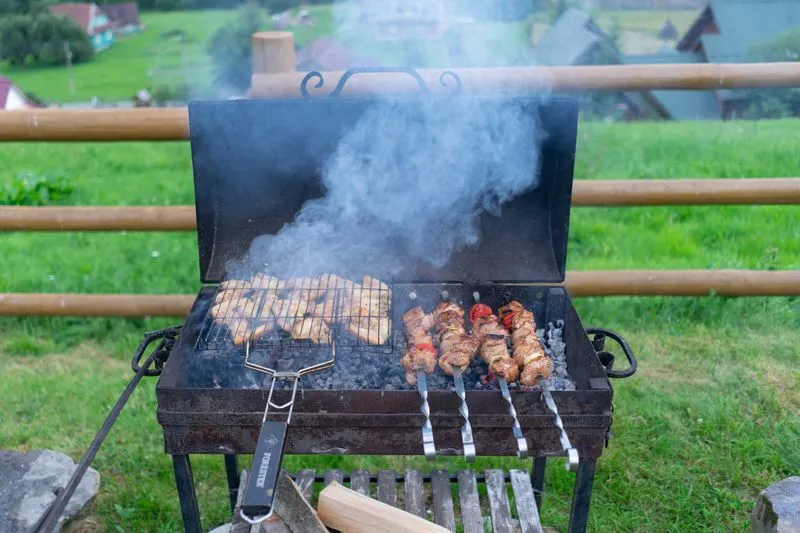
Direct heat puts the food right above the heat source; indirect heat puts it to the side, lid down, like an oven. The whole technique of barbecuing comes down to that choice. Weber's UK guide to barbecue cooking methods draws the line clearly — direct heat for "small cuts and food that takes less than 20 mins to cook", indirect heat for food that takes longer: roasts, and even bread and cakes.
On a charcoal barbecue, indirect heat can be set up two ways. Either the coals go on each side of the charcoal grate with a drip tray between them and the food in the middle. Or — Weber calls it the 50/50 method, Dad just calls it common sense — all the coals go to one side: you sear over the fire, then slide the meat across to finish. I now set up that two-zone barbecue every single time. It's my escape route: a sausage flaring up, a chicken breast colouring too fast, a guest running late — it all goes over to the cool side, and the lid goes down.
Then there's temperature. Weber's chart suggests 200-220°C for a 2.5cm steak. The US National Cancer Institute, in its fact sheet on meat cooked at high temperatures, notes that meat cooked above 300°F (about 150°C) or for a long time tends to form more heterocyclic amines — and that fat dripping onto an open fire creates the smoke that deposits PAHs on the meat.
My take: sear briefly over glowing coals (never flames), then finish on the indirect side. You keep the crust without the black. And if a piece is thick, it belongs on the cooler side for most of its time on the grill.
Barbecue cooking times: the chart by meat
A barbecue cooking time is only a rough guide; the only thing that tells you food is cooked is the temperature in the middle. Weber says so itself at the top of its UK cooking-time chart: the exact time depends on the size of the food, the outside temperature and more. Here are its figures for the June classics.
| Cut | Size | Method | Time | Core temperature |
|---|---|---|---|---|
| Rump or fillet steak | approx. 2.5cm | Direct / indirect, 200-220°C | 10-12 min | To taste |
| Hamburger | approx. 2cm | Direct / indirect, 180-200°C | 10-12 min | 68-70°C (well done) |
| Raw sausages | 100-120g | Direct / indirect, 180°C | 15-20 min | 70-72°C |
| Pork chop | approx. 3cm | Direct / indirect | 10-12 min | 65-68°C (see below) |
| Lamb chop | 2.5-3cm | Direct / indirect, 180°C | 10-12 min | 55-58°C (pink) |
| Chicken breast, boneless | 180g | Direct, 160°C | 15-20 min | 75°C |
| Chicken leg | 180g | Direct / indirect, 180°C | 25-35 min | 75°C |
| Whole chicken | approx. 1.2kg | Indirect, 180°C | 50-60 min | 75°C |
The safety rules don't move, whatever the chart says. The Food Standards Agency's BBQ food safety guidance splits meat into two camps. Steaks "can be served pink, rare or bloody" as long as the surface has been properly seared. Chicken and pork — plus minced meat products such as burgers, kebabs and sausages — "should not be served pink or rare". Before serving, check the meat is steaming hot throughout, with no pink in the thickest part and juices running clear. And the line I should have had tattooed on my wrist in 2024: "charred on the outside doesn't always mean cooked on the inside".
Notice the pork chop in Weber's chart, at 65-68°C. The FSA's cooking guidance says food is fully cooked when the middle reaches 70°C for 2 minutes (or 75°C for 30 seconds), and pork shouldn't be pink. When the manufacturer and the regulator disagree, I go with the regulator. The FSA also suggests cooking chicken and pork in the oven first, then finishing them on the barbecue — exactly what my first chicken needed.
Burgers deserve their own paragraph. The FSA says to serve them well done at home, because mincing spreads bacteria from the surface right through the meat. Restaurants can serve rare burgers thanks to extra controls that are hard to replicate at home — and the quality of the meat you buy doesn't change that risk.
Fish, vegetables and fruit on the barbecue
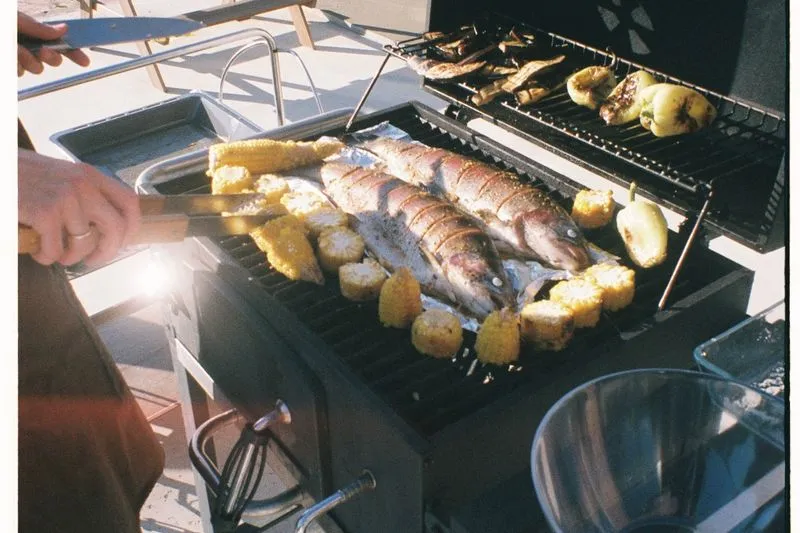
Fish, vegetables and fruit cook faster than meat and need a gentler touch. Most go over direct heat for a few minutes; only whole fish and halved onions need the indirect side. Weber's UK chart gives these benchmarks:
| Food | Preparation | Method | Time (Weber) |
|---|---|---|---|
| Fish fillet with skin | 150-180g | Direct, skin side down | 6-8 min (65°C) |
| Whole fish | approx. 400g | Indirect, 180°C | 20 min (60-65°C) |
| Peeled prawns | medium | Direct | 4-5 min |
| Courgettes | 1cm slices | Direct | 3-5 min |
| Peppers | 0.5cm slices | Direct | 4-5 min |
| Corn on the cob | whole | Direct | 15-20 min |
| Onions | halved | Indirect | 35-40 min |
| Peaches | halved, cut side down | Direct | 8-10 min |
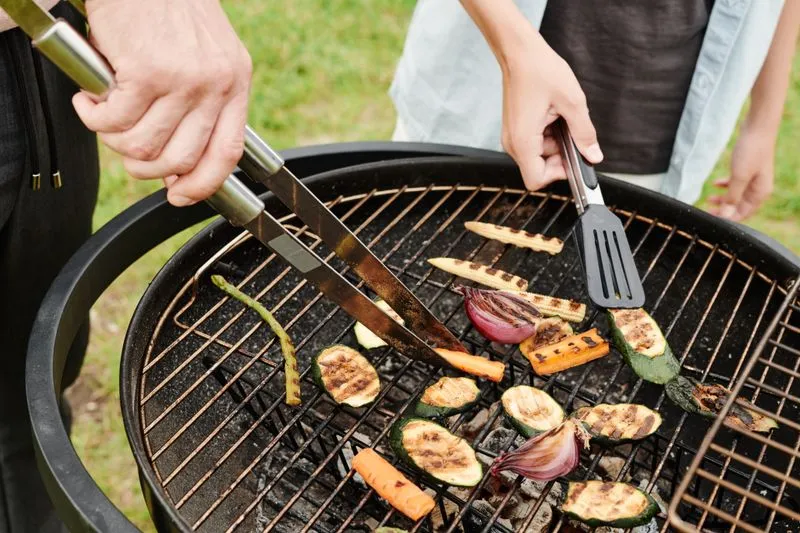
Fish sticks, tears and falls through the bars? Three habits fix most of it: a hot, oiled grill, the fish laid skin side down and left alone, and a fish basket for anything whole. For vegetables there's one rule — even slices. Weber's 3 to 5 minutes are for 1cm courgette rounds, not chunks twice as thick.
If a guest is pregnant, prawns and shellfish need extra care — here's which seafood is safe during pregnancy, and what to avoid.
Marinades: how long, what goes in, and what never gets reused
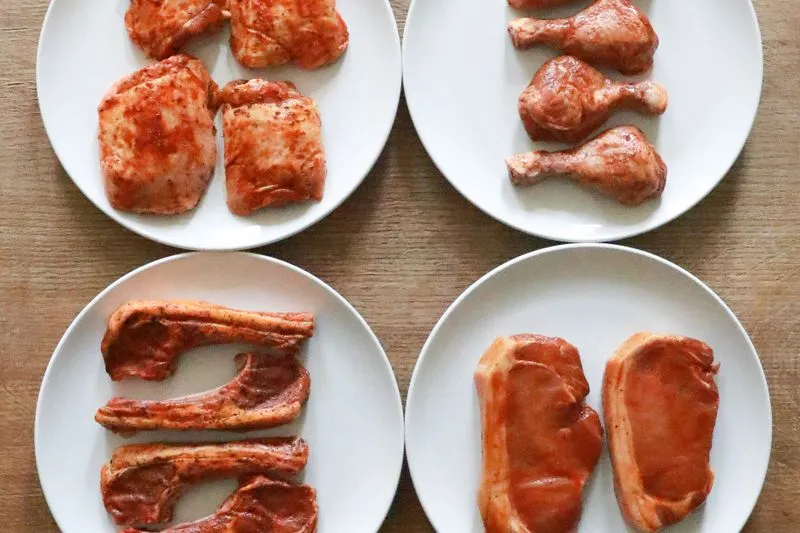
A marinade adds flavour and can help tenderise meat — but it won't rescue poor meat or bad cooking. Weber's American guide, Marinating 101, builds every marinade on three things: an acid (vinegar, wine, citrus juice, soy sauce), a fat (usually oil) and flavourings (herbs, spices, garlic, salt and pepper).
Its timings are simple. Most meats need more than two hours, or even overnight. Large cuts can marinate for up to 24 hours before grilling. The exception is vinegar: don't leave meat in it for more than 30 minutes, because it can make the meat tougher rather than more tender. The same guide warns against too much salt, which hides the flavours you're trying to bring out.
My three summer marinades (they fit on a Post-it):
- Chicken: a pot of plain yoghurt, the juice of half a lemon, two grated garlic cloves, a teaspoon each of smoked paprika and cumin, salt. Two hours to overnight, in the fridge.
- Lamb: olive oil, rosemary, crushed garlic, lemon zest (not the juice). A quick brush just before cooking, or an hour or two for chops.
- Pork (ribs, shoulder steaks): soy sauce, honey, fresh ginger, garlic. Honey caramelises fast, so finish on the indirect side.
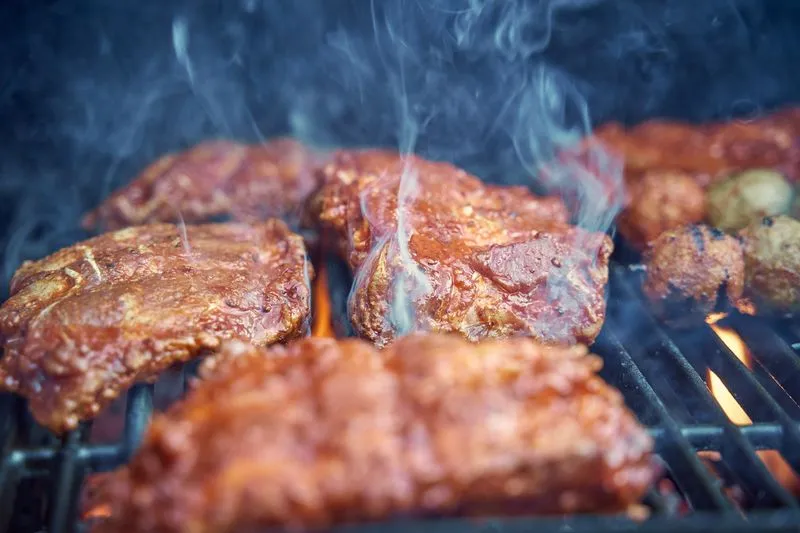
Before the meat goes on, let the excess drip off. Oil and juices running onto the coals means flames and smoke — the very smoke the NCI links to PAH formation. A thick glaze, on the other hand, can be brushed on towards the end to build a sticky crust.
Barbecue hygiene: cold, chopping boards and tongs
Barbecue hygiene comes down to three ideas: raw meat stays cold until the last moment, it never touches anything cooked or ready to eat, and leftovers don't hang around outside. The FSA's reasoning is blunt — warm weather and outdoor cooking can be "the perfect conditions for bacteria to grow".
Here's the FSA's checklist, in short:
- Keep food covered and chilled until you're ready to cook it on the barbecue.
- Wash your hands with soap and warm water before preparing food and after handling raw meat — and firelighters and charcoal.
- Never wash raw chicken or any other meat: it splashes germs onto hands, utensils and worktops.
- Defrost frozen meat overnight in the fridge, then cook and eat it within 24 hours.
- Use different utensils, plates and chopping boards for raw and cooked food.
- Keep raw meat away from cooked meat on the grill — dedicate a section to cooked food.
- Get leftovers into the fridge or a cool bag with ice packs within one to two hours, and eat them within 48 hours.
The first point surprises people. You read everywhere that meat should come out of the fridge an hour early to "come up to temperature"; the FSA says keep it chilled until you're ready to cook. My fix — a cool bag with ice packs, in the shade, two steps from the barbecue. The meat comes out when the grill is ready. Not before.
That leaves the tongs. I prefer them to a fork because you don't pierce the meat to turn it (and lose its juices on the coals). One pair for raw, one for cooked — the two-chopping-boards rule, barefoot-on-the-lawn edition.

Charred meat, PAHs and sausages: what the science says
Yes, cooking meat at very high heat forms compounds that can damage DNA. No, a well-run barbecue isn't a health hazard in itself. The NCI puts it plainly: heterocyclic amines (HCAs) and polycyclic aromatic hydrocarbons (PAHs) form when muscle meat is cooked at high temperatures, such as grilling directly over an open flame — but population studies "have not established a definitive link" between these compounds from cooked meat and cancer in humans.
The NCI's practical advice is the same as a good barbecue technique. Avoid direct exposure to an open flame and long cooking times at high heat. Turn meat often. Cut off charred bits. Pre-cooking in a microwave also shortens the time on high heat — which is the FSA's oven-first advice, reached from a different angle.
What you put on the grill counts for more than how you cook it. In October 2015, the International Agency for Research on Cancer (IARC) classified processed meat as carcinogenic to humans (Group 1) and red meat as probably carcinogenic (Group 2A). Its press release states that "each 50 gram portion of processed meat eaten daily increases the risk of colorectal cancer by 18%". And among its examples of processed meat? Sausages.
None of that means banning bangers from the barbecue — just not making them the base of every summer meal. The NHS advice on meat in your diet says that if you eat more than 90g of red or processed meat a day (cooked weight), you should cut down to 70g — and on the NHS's own list of portion weights, a quarter-pound beefburger already counts for 78g. To choose well, I've compared the leanest meats, ranked by protein and fat.
Burns and fire safety around the barbecue
A barbecue gets watched from the first match to the last ember — outside, on level ground, away from anything that burns. The London Fire Brigade's safety page lists the basics: level ground (not decking), well away from sheds, fences and trees, never left unattended, children, pets and garden games kept at a safe distance, a bucket of water or sand nearby. It even advises the person in charge of the barbecue to avoid drinking alcohol (which, in hindsight, is why Dad had the rosé and I had the tongs).
And once it's over? Let it cool and make sure it's properly out. The Brigade warns that smouldering ashes can give off carbon monoxide — so a barbecue never goes into a shed, a garage or a tent to "finish cooling".
If someone does get burnt, the British Red Cross first aid advice for burns is to cool the burn under cold running water for at least 20 minutes, then cover it loosely with cling film or a clean plastic bag. No butter, cream or toothpaste. No cold tap nearby? The Red Cross says you can pour other cold liquids — milk, soft drinks or beer — over the burn to cool it. (Finally, a use for the lager chilling in the cool bag.) Call 999 if the burn looks serious, and always get medical advice for a baby or child.
Balconies, parks and leases: where can you barbecue?
In a city, the question isn't how to barbecue — it's where. The London Fire Brigade's answer on balconies is short: "Don't use a BBQ on a balcony". Flames, sparks and hot embers can spread quickly to the rest of the building. In June 2023, the Brigade's pre-heatwave warning described a block of flats in Croydon where around 60 firefighters were called, and investigators believed the most probable cause was a barbecue on a balcony.
Parks are no easier. The Brigade asks people not to barbecue in parks and public spaces — including with disposables — and points out that many of London's parks have banned disposable barbecues under public space protection orders, which your local council publishes on its website. That's the check I slipped into my hen party picnic ideas: park rules, barbecues, alcohol, closing times.
If you rent or own a leasehold flat, your tenancy agreement or lease may also have its own rules on barbecues. Read them before you buy anything with a plug or a gas bottle.
Me? In my 300 sq ft flat on the second floor in Hackney, with no lift, the question answers itself — no balcony, no barbecue. My barbecues happen at my parents' (where the grill remains, whatever happens, morally Dad's).
A barbecue timeline, hour by hour
A good barbecue is won the day before, not at the grill. It's the same idea as my Easter lunch menu and its timeline: everything that can be done ahead is done ahead, and on the day you only cook and serve. Here's the plan for a 1.30pm lunch.
| When | What you do |
|---|---|
| The evening before | Marinate the chicken and any large cuts (up to 24 hours, according to Weber), covered, in the fridge. Frozen meat defrosting in the fridge overnight. |
| 10am | Cool bag and ice packs in the shade. Skewers threaded; smaller cuts into their marinade (a couple of hours). |
| 11am | Light the charcoal. Bucket of water or sand, gloves and tongs next to the barbecue. |
| 12.15pm | Coals glowing and grey, pushed to one side. Whole chicken on the indirect side, lid down (50 to 60 minutes). |
| 1pm | Sausages, then skewers and chops, over direct heat. Thermometer for poultry, pork and anything minced. |
| 1.30pm | Serve from the "back" tray. Then vegetables, fish and peaches as the heat drops. |
| 3.30pm at the latest | Leftovers into the fridge or cool bag (within one to two hours, says the FSA), to be eaten within 48 hours. |
The last job is the one everyone forgets: putting it out. Let the ashes cool completely in the closed barbecue before they go in the bin — never "nearly cold" against a hedge.
This year, for lunch tomorrow, Dad has handed me the tongs again. I've got the cool bag, the two-zone set-up and the thermometer. He's got his glass of rosé. We'll see who gets up first.
Frequently asked questions
Should you take meat out of the fridge an hour before barbecuing?
No. The Food Standards Agency advises keeping food covered and chilled until you're ready to cook it on the barbecue. A cool bag with ice packs, in the shade and close to the grill, bridges the gap between the kitchen and the coals.
How can you tell barbecued chicken is cooked without a thermometer?
Cut into the thickest part — for a whole bird, the FSA says that's the leg between the drumstick and the breast. The meat should be steaming hot, with no pink and juices running clear. With a thermometer, the FSA's benchmark is 70°C in the middle for 2 minutes; Weber's chart gives 75°C for chicken.
Are pink burgers safe from the barbecue?
Not at home. The FSA says burgers should be served well done at home, because mincing spreads any bacteria from the surface right through the meat. Restaurants that serve rare burgers rely on extra controls that are hard to replicate in a back garden.
Can you reuse a marinade as a sauce?
Not if raw meat has been in it. The FSA says not to reuse a sauce or marinade that has been on raw meat with cooked or ready-to-eat food. Set some clean marinade aside before adding the meat, and use that as your sauce.
Can I barbecue on my balcony?
The London Fire Brigade's advice is not to use a barbecue on a balcony at all: flames, sparks and hot embers can spread to the rest of the building. Your lease or tenancy agreement may also ban it — check before you buy.
What should you do for a barbecue burn?
Cool it under cold running water for at least 20 minutes, as the British Red Cross advises, then cover it loosely with cling film or a clean plastic bag. No butter, cream or toothpaste. Call 999 if the burn looks serious, and get medical advice for any baby or child who has been burnt.
Sources
- Food Standards Agency — BBQ food safety (updated 8 May 2025)
- Food Standards Agency — Cooking your food (updated 12 June 2024)
- NHS — Meat in your diet (reviewed 1 May 2024)
- British Red Cross — First aid for burns
- London Fire Brigade — BBQ safety
- London Fire Brigade — BBQ plea ahead of a weekend of hot weather (9 June 2023)
- IARC — Press release no. 240: IARC Monographs evaluate consumption of red meat and processed meat (26 October 2015)
- National Cancer Institute — Chemicals in Meat Cooked at High Temperatures and Cancer Risk (2017)
- Weber UK — Perfectly cooked food: cooking times
- Weber UK — Barbecue cooking methods
- Weber (US) — Marinating 101