Tuesday, 3.20pm, five days before Easter. In the little chocolate shop at the end of her road, the air smells of roasted cocoa and warm butter. Behind the counter, the shop assistant snaps a slab of dark chocolate — the crack carries all the way to the door. Isla — 27, a chef de rang at a brasserie, on her break between lunch and dinner service — is queuing for her nephews' Easter eggs. On a shelf at eye level, a red box stops her: "aphrodisiac" truffles (dark chocolate, crystallised ginger, a pinch of maca) with a hand-lettered label promising to "awaken desire". She tries the tasting square. Bitter, then melting. Then that prickle of ginger at the back of the throat. "It works, you'll see," says the assistant with a smile. Isla buys the box, half as a joke, half out of curiosity — and spends the walk home wondering how much of it is true.
The question deserves better than a shrug. On chocolate, the most-quoted research is an Italian study of 163 women published in 2006: those who ate chocolate every day had better sexual function scores… until the researchers took their age into account. Then the gap disappeared. The whole story of natural aphrodisiacs looks a lot like that result — a tempting lead, tiny trials, and an effect that melts away on closer inspection. Here is what the studies measure for chocolate, maca, ginseng and ginger. And why "libido" supplements sold online are a genuine safety problem.

What counts as an aphrodisiac, and how is it measured?
An aphrodisiac is, first and foremost, a label claim. The US Food and Drug Administration (FDA) defines it as any product that claims to arouse or increase sexual desire, or to improve sexual performance. That definition is quoted in a 2015 review of natural aphrodisiacs (West and Krychman, Sexual Medicine Reviews). It describes what a product says — not what it does. An aphrodisiac doesn't have to prove anything to earn the name.
To find out whether a plant keeps its promise, researchers don't rely on impressions. They use standardised questionnaires. Several of the trials in this guide use the FSFI (Female Sexual Function Index), which splits sexual life into domains — desire, arousal, orgasm, satisfaction, among others — and produces a score. A good trial then compares two randomly allocated groups. One gets the product, the other a placebo, and nobody knows who is taking what (that's what "double-blind" means).
The distinction matters, because desire and arousal are not the same thing. A plant can shift an arousal score — the body's response, lubrication — without touching the wanting itself. When you read "boosts libido" on a packet, ask three questions. Which domain? Measured how? Compared with what?
The placebo effect: the best-measured aphrodisiac
In trials on female sexual dysfunction, placebo alone accounts for about two-thirds of the effect of treatment. That is what a meta-analysis published in Obstetrics & Gynecology calculated in 2018, after pooling eight controlled trials on female sexual dysfunction, all measured with the FSFI. In total, 1,723 women had received a placebo and 2,236 an active treatment (flibanserin, bupropion or nasal oxytocin, for example). On placebo, scores rose by 3.62 points. On treatment, by 5.35 points. The authors' conclusion: 67.7% of the treatment effect was accounted for by placebo.
In other words, simply taking part in a trial — thinking about your sex life, talking about it, expecting a change — already improves the scores. That isn't "all in your head" in the dismissive sense. It's a real effect, and it can be measured. But it changes how you should read every study that follows: a plant that "improves sexual function" without a placebo group proves nothing.
A red ginseng trial shows this almost too neatly. In 2015, researchers gave red ginseng or a placebo to 41 premenopausal women for eight weeks, then swapped the groups. The 23 women who finished saw their scores climb… in both arms. From 20.13 to 23.98 on ginseng, from 20.06 to 23.78 on placebo. No difference at all. The authors themselves describe a substantial placebo effect.
Does chocolate boost women's desire?
Chocolate has no proven effect on women's desire. The study everyone quotes was published in 2006 in the Journal of Sexual Medicine. Its authors surveyed 163 women in northern Italy, recruited through advertising (average age 35); complete data were available for 153 of them. Of these, 120 ate chocolate daily and 33 didn't eat it at all. The daily eaters had a better overall score — and a better desire score. There was no difference, however, for arousal, satisfaction or sexual distress.
The result says more about age than about cocoa. The daily chocolate eaters were 33.9 years old on average, against 40.4 for the others. Once that difference was adjusted for, the scores were similar. It's an observational study: it describes habits, it doesn't give anyone chocolate. So it can't establish cause and effect.
What about the molecules in chocolate? A 2019 review of cocoa (International Journal of Environmental Research and Public Health) notes that it contains caffeine, theobromine and three compounds that mimic cannabinoids. These might activate cannabinoid receptors or raise levels of anandamide (a cannabinoid the brain makes naturally). Together, they produce a passing sense of well-being. But on sex, the data the review cites for anandamide comes from male rats. Nothing allows that result to be carried over to women.
The same review makes a point that applies to every "health" aisle. Many studies look at cocoa, not chocolate — and turning cocoa into a bar strips out some of its polyphenols. What's measured in the lab doesn't necessarily survive the journey into an Easter egg.
Does maca improve libido? A modest signal, mostly after the menopause
In women, maca has shown only a modest effect, clearest after the menopause, in a handful of small trials. The root of an Andean plant from the mustard family, it is sold as a powder or in capsules — and its reputation runs well ahead of its evidence. A 2010 systematic review of maca searched 17 databases. It found only four placebo-controlled trials. Two suggested a positive effect — one in menopausal women, the other on desire in adult men. The third showed nothing in cyclists; the fourth, in men with erectile dysfunction, reported a significant effect.
The authors' verdict: limited evidence. The trials were too few, and their size and methodological quality too limited, to draw firm conclusions.
The trial in menopausal women, published in 2008, is worth a closer look: 14 postmenopausal women took 3.5g of powdered maca a day for six weeks, then a placebo (or the other way round). On maca, their anxiety, low mood and sexual dysfunction scores fell — compared with both baseline and placebo. Their hormones (oestradiol, FSH, LH) didn't change. The researchers found no oestrogen-like or androgen-like activity in the powder: whatever the effect was, it wasn't hormonal.
A trial published after that review, in 2015, was run at Massachusetts General Hospital in Boston. It tested maca in 45 women (average age 41.5). Their depression was in remission — but their antidepressant had damaged their sex life. They took 3g a day, or a placebo, for twelve weeks. On the average change in scores, maca did no better than placebo. Remission was a little more common on maca (30% against 20% on one measure), but the difference was not statistically significant, and it came from the postmenopausal women. Of the 42 women analysed, only 12 were postmenopausal. Hence the authors' caution: maca may ease these problems after the menopause.
On safety, maca was well tolerated — in these trials, at least. A 2024 review of maca (Frontiers in Pharmacology) describes it as generally safe, with rare side effects. That applies to the root that was studied, at the doses studied — not to an online blend whose real contents you can't check.
Red ginseng: an effect on arousal after the menopause, and nothing clearer
Red ginseng has beaten placebo in only one trial, in menopausal women: their overall assessment was better than on placebo, and their arousal score rose while taking ginseng. It is the root of Panax ginseng, steamed and then dried. Among the trials reviewed here, two crossover trials tested it in women, at the same dose: three 1g capsules a day. The first (Journal of Sexual Medicine, 2010) involved 32 menopausal women, average age 51; 28 completed the study. The arousal score rose from 3.10 to 3.50 on ginseng.
The second trial, in 2015, involved premenopausal women. For them, ginseng did no better than placebo. So: two trials, a few dozen women, and a modest benefit in only one of them. A 2010 review of natural aphrodisiacs (Shamloul, Journal of Sexual Medicine) already saw a positive trend for ginseng — but studies that were too small, and limited data in women. Its overall conclusion is blunt: the evidence does not support using any natural aphrodisiac as an effective treatment for sexual dysfunction, in women or in men.

Ginseng isn't harmless, either. In the 2010 trial, no serious side effects were reported — but two women had vaginal bleeding while taking it. The US National Institutes of Health's complementary medicine body (NCCIH) says, in its factsheet updated in February 2025, that insomnia is the most common side effect. Asian ginseng may also interfere with blood clotting, lower blood sugar and interact with some medicines. And it may be unsafe during pregnancy.
Is ginger an aphrodisiac? None of the trials reviewed tested it alone
Nothing shows that ginger is an aphrodisiac: none of the trials on female sexuality gathered for this guide test it on its own. Despite its reputation as a "warming" spice, it only appears in blends. In 2023, a small trial published in Medicina followed 41 women with depression who were taking sertraline (an antidepressant) and had sexual side effects. For eight weeks, they took either a blend called Aphrodite — ginger, saffron, cinnamon, thistle and tribulus — or a placebo. Sexual problems, low mood and anxiety improved more on Aphrodite.
There's no way of knowing what the ginger contributed, though. Saffron, in the same blend, has its own positive trials in exactly this situation. Crediting a cocktail's effect to one of its five ingredients is precisely the reasoning a packet would like you to follow.
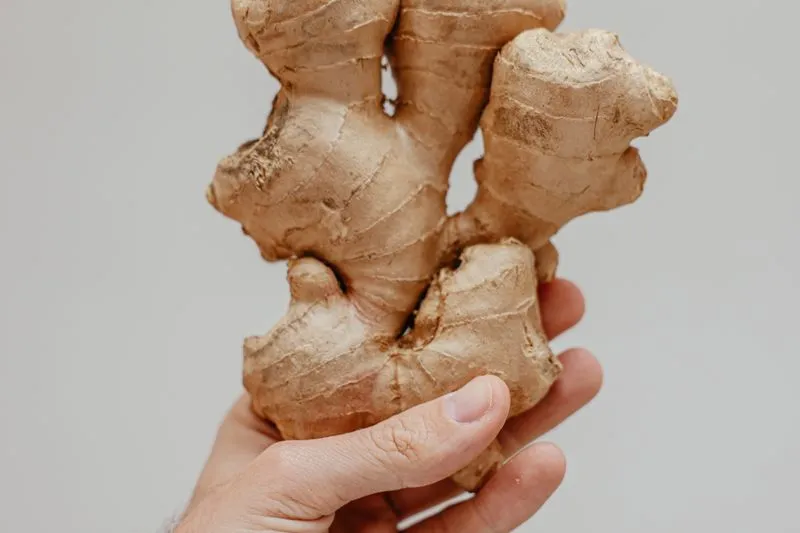
On ginger, research centres on digestion. According to the NCCIH factsheet on ginger (February 2025), it has been studied for several types of nausea and vomiting, and may help with pregnancy sickness. As a supplement, it can cause tummy discomfort, heartburn, diarrhoea or irritation of the mouth and throat. In the kitchen, keep it for what it brings without argument: heat, fragrance — and a dish you want to share.
Saffron, tribulus, yohimbe: the other label promises
Among the other ingredients in "libido" supplements, only saffron rests on consistent trials, and only for sexual problems caused by antidepressants; tribulus remains very uncertain and yohimbe is one to avoid. These supplements rarely contain just one ingredient, and these three names come up often, with very different levels of evidence (and of risk).
Saffron has been studied for a narrow use. A 2022 systematic review (Current Issues in Molecular Biology) gathered ten controlled trials on sexual problems caused by antidepressants. A high dose of maca, SAMe and saffron may improve them; no effect emerged for ginkgo or yohimbine. None of these trials shows that saffron increases desire in a woman who isn't taking an antidepressant.
Tribulus (Tribulus terrestris) had its own systematic review in 2020: five trials, 279 participants, sexual function scores up after one to three months. No serious side effects were reported. But the certainty of the evidence was rated very low — meaning future studies are likely to change these estimates.
Yohimbe, taken from the bark of a tree (Pausinystalia johimbe), is one to avoid. Over seven years (2000-2006), California's poison control system recorded 238 cases of side effects from yohimbine products. In 27.7% of cases, the product had been taken for sexual enhancement. Stomach upset (46%), racing heart (43%), anxiety or agitation (33%), high blood pressure (25%) were among the effects recorded. The dosing is a lottery, too. Of 49 brands of yohimbe supplements analysed in the US (study published in 2016), only 11 stated an amount of yohimbine — mostly wrong, at 23% to 147% of the labelled dose.
| Ingredient | What trials in women show | Strength of evidence | Points to watch |
|---|---|---|---|
| Chocolate | No effect of its own: the gap disappears once age is accounted for | One observational study (153 women) | No particular signal |
| Maca | Lower dysfunction scores after the menopause (one 14-woman trial); no proven benefit for antidepressant-related problems | A few small trials, limited evidence | Well tolerated; ask your GP if on medication |
| Red ginseng | Slightly better arousal after the menopause; no better than placebo before | Two small crossover trials | Insomnia, clotting, blood sugar, pregnancy |
| Ginger | Never tested alone, only in blends | No stand-alone trial among those reviewed | Heartburn, digestive upset |
| Saffron | Possible improvement in antidepressant-related problems | A few controlled trials | Narrow use |
| Tribulus | Scores up after one to three months | Very low certainty | Limited safety data (no serious side effects reported) |
| Yohimbe | No proven effect on antidepressant-related problems | No benefit shown in the trials reviewed | Racing heart, anxiety, high blood pressure; risks may outweigh any benefit |
"Libido" supplements bought online: the risk the label doesn't mention
The main danger of a desire supplement isn't the plant on the front of the box. It's what's inside that the box doesn't mention. An analysis published in 2018 in JAMA Network Open went through ten years of FDA warnings: between 2007 and 2016, 776 supplements contained undeclared pharmaceutical ingredients. Almost half (353, or 45.5%) were marketed for sexual enhancement. In 47% of those, the hidden ingredient was sildenafil — the active ingredient in Viagra.
Those figures are American, and part of the trade ran online: between 2014 and 2016, 38.6% of the adulterated samples were found through online purchases. One product in five (20.2%) contained more than one unapproved ingredient. The authors spell out the risks: accidental misuse, overuse, interactions with other medicines or with an existing health condition. As early as 2010, Shamloul's review warned about sildenafil-like compounds being secretly added to "natural" aphrodisiacs.
The UK regulator has seen the same pattern. In a 2009 Drug Safety Update on how the public sees herbal medicines, the MHRA reported that it "continues to find evidence of TCMs and other unlicensed herbal products illegally containing potent and toxic undeclared ingredients" (TCMs being traditional Chinese medicines). The Ipsos MORI survey behind that update — carried out in 2008 among 2,305 people across Great Britain — found that 36% were unaware of any possible problems or risks to look out for with herbal medicines. Only 6% mentioned interactions with conventional medicines. And 29% believed herbal medicines were regulated, 31% believed they weren't — while 30% didn't know.
The MHRA's #FakeMeds campaign makes the same point about sexual health products bought online. Its March 2020 warning on erectile dysfunction pills sold online puts it plainly: "Fake medicines may not contain any active ingredients, or worse, may contain toxic ingredients which could lead to serious health consequences."
Before you buy: five questions to ask a label
Reading a supplement label takes two minutes.
- Where is it sold? The MHRA's advice on medicines is to buy from legitimate sources, and it warns that anything bought from an unregistered website may be fake. The same caution makes sense for a pill sold as "natural" but promising a drug-like effect.
- Is the dose of each ingredient listed? A "proprietary blend" with no quantities doesn't tell you what you're swallowing — and for yohimbe, even the amounts on the label are often wrong.
- Is it a registered herbal medicine? In the UK, herbal medicines under the traditional herbal registration scheme meet assured standards of safety, quality and patient information, according to the MHRA. You can spot them by the THR number on the pack.
- Are you on any medication? Blood thinners, diabetes medicines, antidepressants, heart medicines: speak to your GP or pharmacist before adding anything.
- Are you pregnant or breastfeeding? Ginseng may be unsafe during pregnancy. And little is known about the safety of ginseng or ginger supplements while breastfeeding.
What actually feeds desire: causes before plants
Low desire has reasons, and they're rarely found in the spice cupboard. The NHS page on low sex drive lists the main ones. Relationship problems. Stress, anxiety or depression. Vaginal dryness. Pregnancy and having a baby. Lower hormone levels with age, particularly during the menopause. Certain medicines (for high blood pressure, or antidepressants), hormonal contraception like the pill, patch or implant, drinking too much alcohol — and long-term conditions such as diabetes or an underactive thyroid. Its logic fits in one line: treating the cause should help your sex drive recover.
Contraception shows how a cause can be discussed rather than endured. The NHS suggests seeing a GP if "you're taking a medicine or using hormonal contraception and you think it may be affecting your sex drive". Changing to a different medicine or type of contraception is one of the options it lists. For vaginal dryness, it mentions vaginal lubricants; for the menopause, HRT; for relationship problems, relationship counselling.
Each cause has its own solutions, set out in our guide to low libido in women, its causes and when to seek help. If desire has faded over the years rather than after a specific event, our ideas for reigniting desire in a long-term relationship will do more for you than a capsule. And if the wanting is there but routine has taken over, foreplay ideas to try together often change more than a box of truffles.
None of this rules out chocolate, maca in a smoothie or ginger in a stir-fry. They just don't replace a conversation — or an appointment. Are you hoping a plant will fix something that has lasted for months? That's often the sign it's time to talk to someone.
Frequently asked questions
Is there a scientifically proven natural aphrodisiac?
No. A 2010 review (Journal of Sexual Medicine) concluded that the evidence does not support any natural aphrodisiac as an effective treatment for sexual dysfunction. Maca, red ginseng and tribulus have a few small, encouraging trials — too few, and too fragile, to count as proof.
Is dark chocolate more of an aphrodisiac than milk chocolate?
Neither has shown any effect on desire. The 2006 Italian study found a difference that vanished once the women's ages were taken into account. Choose your chocolate for its taste: it's the only criterion the research doesn't contradict.
How long do you need to take maca to notice anything?
In the trials, women took 3 to 3.5g of maca a day for six to twelve weeks. The effects were modest, and seen after the menopause. No immediate effect has been described. If you're on any medication, check with your GP first.
Can I take ginseng alongside medication?
Not without medical advice. According to the NCCIH, Asian ginseng may interfere with blood clotting, lower blood sugar and interact with some medicines. Some experts advise against it during pregnancy and breastfeeding.
Why do some "natural" supplements work so fast?
Because some contain a hidden drug. Of 353 "sexual" supplements flagged by the FDA between 2007 and 2016, 47% contained undeclared sildenafil (the active ingredient in Viagra). A dramatic, instant effect is a warning sign — not a mark of quality.
Does a glass of wine help desire?
A drink can relax you in the moment. But the NHS lists drinking too much alcohol among the causes of a low sex drive. If desire only turns up after a glass or two, that's worth exploring — on your own or with a professional.
When should I see someone about low desire?
As soon as it worries you, or if you think a medicine or hormonal contraception may be behind it. Those are two of the situations in which the NHS advises seeing a GP — the third being a sex drive that doesn't return to normal after pregnancy.
Sources
- Salonia A. et al. — Chocolate and women's sexual health: an intriguing correlation, Journal of Sexual Medicine (2006)
- Montagna M. T. et al. — Chocolate, "Food of the Gods": History, Science, and Human Health, IJERPH (2019)
- Weinberger J. M. et al. — Female Sexual Dysfunction and the Placebo Effect: a Meta-analysis, Obstetrics & Gynecology (2018)
- Shin B. C. et al. — Maca (L. meyenii) for improving sexual function: a systematic review, BMC Complementary and Alternative Medicine (2010)
- Brooks N. A. et al. — Beneficial effects of Lepidium meyenii (Maca) on psychological symptoms and measures of sexual dysfunction in postmenopausal women are not related to estrogen or androgen content, Menopause (2008)
- Dording C. M. et al. — A double-blind placebo-controlled trial of maca root as treatment for antidepressant-induced sexual dysfunction in women (2015)
- Ulloa del Carpio et al. — Exploring the chemical and pharmacological variability of Lepidium meyenii: a comprehensive review of the effects of maca, Frontiers in Pharmacology (2024)
- Oh K. J. et al. — Effects of Korean red ginseng on sexual arousal in menopausal women, Journal of Sexual Medicine (2010)
- Chung H. S. et al. — The Effect of Korean Red Ginseng on Sexual Function in Premenopausal Women (2015)
- Shamloul R. — Natural aphrodisiacs, Journal of Sexual Medicine (2010)
- West E., Krychman M. — Natural Aphrodisiacs: A Review of Selected Sexual Enhancers, Sexual Medicine Reviews (2015)
- Shahmoradi N. et al. — Effects of Aphrodite (an Herbal Compound) on SSRI-Induced Sexual Dysfunctions and Depression in Females with Major Depressive Disorder, Medicina (2023)
- Concerto C. et al. — A Systematic Review on the Effect of Nutraceuticals on Antidepressant-Induced Sexual Dysfunctions, Current Issues in Molecular Biology (2022)
- Martimbianco A. L. C. et al. — Tribulus terrestris for Female Sexual Dysfunction: A Systematic Review, Revista Brasileira de Ginecologia e Obstetrícia (2020)
- Kearney T. et al. — Adverse drug events associated with yohimbine-containing products: California Poison Control System reported cases, Annals of Pharmacotherapy (2010)
- Cohen P. A. et al. — Pharmaceutical quantities of yohimbine found in dietary supplements in the USA, Drug Testing and Analysis (2016)
- Tucker J. et al. — Unapproved Pharmaceutical Ingredients Included in Dietary Supplements Associated With US FDA Warnings, JAMA Network Open (2018)
- MHRA Drug Safety Update — Public perception of herbal medicines
- MHRA — New figures show 3.5 million unlicensed erection pills seized in 2019 (#FakeMeds, March 2020)
- NCCIH — Asian Ginseng: Usefulness and Safety (February 2025)
- NCCIH — Ginger: Usefulness and Safety (February 2025)
- NHS — Low sex drive (loss of libido)