
One Sunday evening in January, just before seven, in the steam of bath time, my daughter — who's at nursery — dropped her plastic duck, pointed between her legs and asked: "And what's that called?" I opened my mouth to say "your front bottom", the phrase I grew up with, and closed it again. "That's your vulva," I said, trying to use exactly the tone I'd have used for "your elbow". She repeated the word twice, looking pleased with herself, and went back to her duck. I stayed perched on the edge of the bath, towel on my knees. With a much less comfortable question. In my forties, with two children, could I actually draw the thing I'd just named? No. Not the whole clitoris, not the vestibule, not the exact spot where the urethra opens.
I'm far from the only one — and doctors say it matters. In 2023, BBC Wales reported that doctors were warning embarrassment about naming parts of the female anatomy is putting women's health at risk. The same article raised a concern that children taught euphemisms could be taken less seriously if they are abused. NHS GP Dr Aziza Sesay (who makes social media content to educate women about their bodies) put it simply: "It's just part of your normal anatomy, just like your head, shoulders, knees, and toes." This guide is the annotated tour I was missing that evening — the vulva from the outside in, the whole clitoris, the vagina, and the wide range of shapes that are perfectly normal.

Vulva or vagina: what's the difference?
The vulva is on the outside — the vagina is on the inside. In a BBC World Service piece on five things everyone with a vagina should know, gynaecologist Dr Jen Gunter (author of The Vagina Bible) explains it like this: the vagina is the muscular canal that connects the uterus to the outside world, while the vulva is what you can see — the part that touches your clothes. Calling the whole area "the vagina" is a bit like calling your face "your throat".
This is more than a question of vocabulary. Gunter puts it this way: "When you can't say the word vagina or vulva, there is an implication that there's something dirty or shameful about that." She also notes that the medical term "pudenda", used for the outside of the vulva, comes from the Latin "pudet" — "it shames". Worse, patients who lack the words may struggle to describe what's wrong, and so to get the right treatment. An itch on the outer lip, a sting at the entrance of the vagina, a deep ache: three complaints, three places.
| Question | The vulva | The vagina |
|---|---|---|
| Where is it? | On the outside, between your legs | Inside the body, between the vulva and the cervix |
| What's it made of? | Mons pubis, labia, clitoral hood and glans, vestibule, urethral opening, vaginal opening | A muscular canal lined with mucous membrane, home to the vaginal microbiome |
| What comes out? | Urine (through the urethra, not the vagina) | Periods and vaginal discharge |
| How to look after it | Warm water and a mild, non-perfumed soap | Nothing: it cleans itself |
The vulva from top to bottom: an annotated tour
The vulva reads from top to bottom, from the pubic bone down to the anus. Here are its parts in the order a mirror shows them.
- The mons pubis (or mons veneris) — the rounded area above the pubic bone, covered in hair from puberty onwards.
- The labia majora (outer labia) — two folds of skin that frame the vulva and protect the more sensitive parts inside.
- The labia minora (inner labia) — "the flaps of skin either side of the vaginal opening", as the NHS describes them. They often extend beyond the outer labia.
- The clitoral hood (prepuce) — the fold of skin covering the glans of the clitoris, where the inner labia meet at the top.
- The glans of the clitoris — the only visible part of the clitoris, packed with nerves. Its size varies from one woman to the next.
- The urethral opening (urethral meatus) — the small opening where pee leaves your body, just above the entrance to the vagina.
- The vestibule — the area between the inner labia, where the urethra and the vagina open.
- The vaginal opening (introitus) — the entrance to the vagina, where periods and discharge come out. The hymen sits here.
- The vestibular glands — small glands that open into the vestibule, including Bartholin's glands.
- The fourchette — the point at the back of the vulva where the inner labia meet.
- The perineum — the area between the vulva and the anus.
A textbook diagram is reassuring. It's also misleading — symmetrical lips, a neat hood, clean outlines — because real bodies aren't drawn with a ruler. Real vulvas rarely look like their textbook drawing (and that's not a flaw). This list helps you locate things. It shouldn't be used to judge yours.
The whole clitoris: you only see the tip
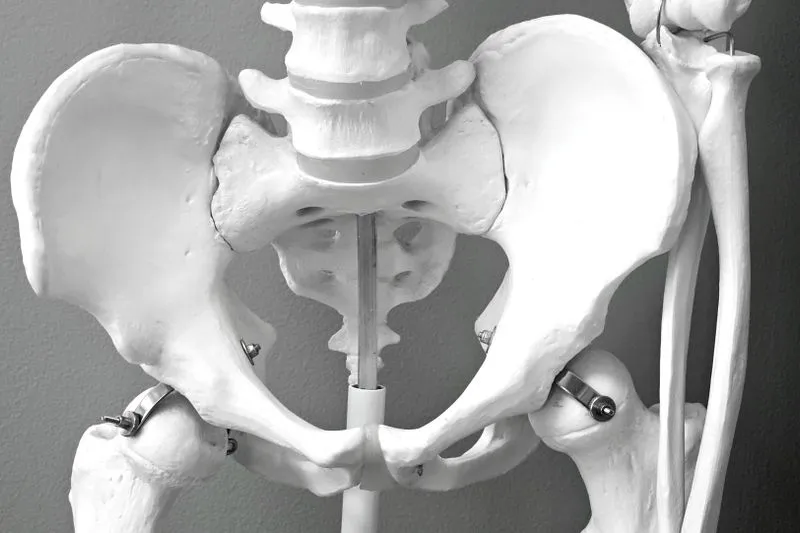
The clitoris is not just the little button under the hood. That glans is only the tip — the rest of the organ extends inside the body, under the skin of the vulva and around the vagina. The most widely cited anatomical account comes from Australian urologist Helen O'Connell. In her 2005 review of clitoral anatomy in the Journal of Urology, she describes a three-dimensional organ with a broad attachment to the pubic arch, joined in the middle to the urethra and the vagina.
Her review is blunt about textbooks. "It is impossible to convey clitoral anatomy in a single diagram showing only 1 plane, as is typically provided in textbooks, which reveal it as a flat structure." The glans, she writes, "is a midline, densely neural, non-erectile structure that is the only external manifestation of the clitoris". Everything else is erectile tissue.
| Part of the clitoris | Where it is | What to know |
|---|---|---|
| The glans | Under the hood, at the top of the vulva | The only external part; densely supplied with nerves, not erectile |
| The body (corpora) | Under the skin, continuing on from the glans | Erectile tissue, joined to the crura |
| The two crura (roots) | Along the pubic arch, one on each side | Erectile tissue, continuous with the body |
| The two bulbs | Either side of the vestibule, around the vaginal opening | Spongy erectile tissue, part of the clitoris |
O'Connell's conclusion goes further. The distal urethra and the vagina, she writes, form a tissue cluster with the clitoris. "This cluster appears to be the locus of female sexual function and orgasm." This is why pleasure isn't only about the glans. For desire and orgasm themselves, our shame-free guide to female pleasure and orgasm takes over; here, we stick to the map.
Outer and inner labia: why they often stick out
Inner labia that extend beyond the outer labia are entirely ordinary. The NHS says it plainly on its labiaplasty page: "it's completely normal to have noticeable skin folds around the opening of your vagina". The smooth, closed vulva of anatomical drawings (two outer lips meeting in a neat line) is not the adult standard.
Measurements back this up. At the Cantonal Hospital in Lucerne (Switzerland), a team measured the vulvas of 657 women aged 15 to 84 between August 2015 and April 2017. The results — published in 2018 in BJOG, the journal of the Royal College of Obstetricians and Gynaecologists — point to two modest trends. Inner labia tend to get shorter with age, and outer labia tend to be slightly longer as body mass index rises. One caveat: every woman in the sample was white.

Vestibule, urethra and glands: the forgotten zone
The vestibule is the area framed by the inner labia, and it holds two separate openings. The urethra sits at the front; the entrance to the vagina sits just behind it. Urine doesn't come out of the vagina — a detail that matters, for instance, when you're trying to understand cystitis or put in a tampon without worrying.
These openings are close together, which explains one piece of NHS advice. On its page on cystitis, the NHS explains that the infection is usually caused by bacteria from poo getting into the urethra. Women also have a shorter urethra than men, so bacteria reach the bladder more easily. Hence the simple habit it recommends: wipe from front to back when you go to the toilet.
The same page also advises against scented soap, bubble bath and talcum powder — and the NHS page on vaginal discharge says the same about perfumed soaps and gels.
The vagina, a muscular canal that cleans itself
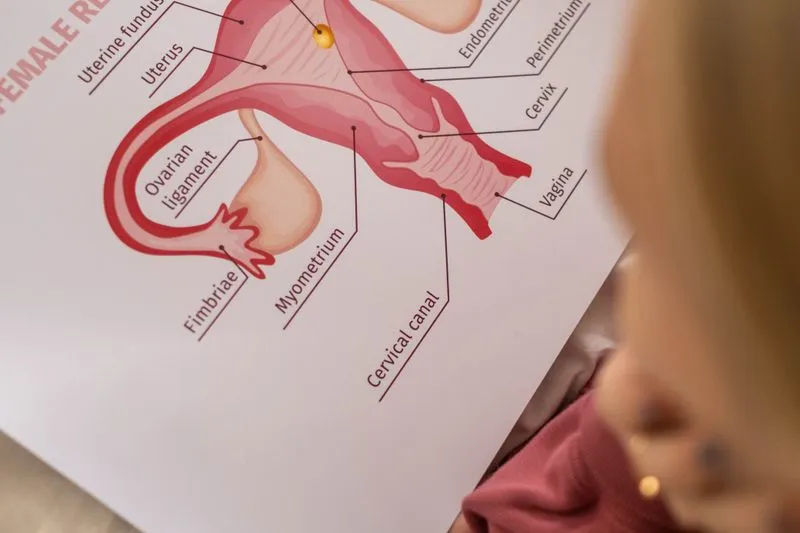
The vagina is a flexible canal that links the vulva to the cervix — the cervix you'll meet at a smear test, and in our complete guide to contraception methods when it comes to coils or diaphragms. Its size varies. A 2006 American study in Human Reproduction (77 MRI scans of 28 women of reproductive age) measured an average length of 62.7 mm at rest, from cervix to entrance. Its width ranged from 26.2 mm at the entrance to 32.5 mm at the top.
The authors concluded that no single description characterises the shape of the vagina. Variation is the rule here too — parity, age and height were all associated with some of the measurements.
Above all, the vagina looks after itself. The NHS page on vaginal discharge opens with this: "Vaginal discharge is normal – most women and girls get it." It's a fluid that keeps the vagina clean and moist, and protects it from infection. Gunter describes the vaginal microbiome as a garden. Its "good" bacteria keep the environment slightly acidic, which stops "bad" bacteria taking hold. Her own summary: "It is a self-cleaning oven."
Discharge changes, and that's expected. According to the NHS, it isn't usually anything to worry about if it doesn't have a strong or unpleasant smell and is clear or white, thick and sticky, or slippery and wet. It tends to be clearer and wetter around ovulation. It's usually heavier in pregnancy, if you're sexually active, or if you use contraception.
The hymen: what it is, and what it doesn't prove
The hymen is a fold of tissue at the entrance to the vagina, and it looks different from one woman to the next. Around it, a stubborn myth has grown — the idea that it offers "proof" of virginity that an examination could read. That myth has no medical basis.
In 2018, an interagency statement published by the World Health Organization on eliminating virginity testing spelled it out. The examination "has no scientific merit or clinical indication – the appearance of a hymen is not a reliable indication of intercourse and there is no known examination that can prove a history of vaginal intercourse". The statement also describes "virginity" as a social, cultural and religious construct (with no medical or scientific basis).
UK law has followed. According to the government's multi-agency guidance on virginity testing and hymenoplasty, the Health and Care Act 2022 makes carrying out, offering, and aiding and abetting virginity testing and hymenoplasty illegal.
If this is on your mind before having sex for the first time, our stress-free guide to your first time also covers the worries many people bring with them.
What does a "normal" vulva look like?
A normal vulva looks like… yours, as long as it doesn't hurt and hasn't changed suddenly. That may sound like a dodge — but what the research shows is how widely vulvas differ. In 2005, a team at the Elizabeth Garrett Anderson Hospital in London (part of University College London Hospitals) photographed and measured the vulvas of 50 premenopausal women. All were having gynaecological procedures under general anaesthetic, for other reasons. Their study, published in BJOG as "Female genital appearance: 'normality' unfolds", noted a wide range of values for every measurement — clitoral size, labial length and width, colour, texture, vaginal length.
More striking still, none of these differences was significantly associated with age, number of births, ethnicity, hormone use or sexual history. The authors' conclusion is short: "Women vary widely in genital dimensions." They add that this information should be made available to women considering surgery on their genitals.
| What varies | What's common | What's worth a GP appointment |
|---|---|---|
| Length of the inner labia | They often stick out beyond the outer labia | Rubbing or pain that affects daily life |
| Size of the clitoral glans | It varies widely | A recent change in size or appearance |
| Shape, colour and texture | Wide variation from one woman to the next | A new lump, sore or patch that doesn't go away |
| Discharge | It changes through your cycle | A strong smell, itching, soreness |
Vulva and vagina: what changes with your cycle and age
The vulva doesn't keep one look for life. Discharge shifts through each cycle — clearer and wetter around ovulation, heavier during pregnancy. The Lucerne study of 657 women also found that the inner labia tend to get shorter with age.
After the menopause, the drop in hormones changes things again. In the BBC piece, Gunter explains that low levels of oestrogen in particular affect the vagina and vulva. Tissues once kept moist can atrophy, and the resulting dryness can make sex painful. Her message is reassuring, though. Most women can get help from their doctor, some manage well with over-the-counter lubricants — and, in her words, "You don't have to suffer."
If dryness comes with a dip in desire, our article on low libido in women, its causes and when to seek help goes through the possible reasons.

Intimate care: what the vulva needs, what the vagina refuses
The vulva needs very little, and the vagina needs nothing at all. The NHS advice fits in a few lines:
- Wash the skin around your vagina gently, using warm water and a mild, non-perfumed soap.
- Don't use perfumed soaps or gels.
- Don't use deodorants or scented hygiene wipes.
- Don't wash inside your vagina (douche).
Gunter adds a few details. The vulva can be cleaned with water or a gentle cleanser when needed; soap can strip the skin's acid mantle, its protective layer — so if even a mild soap stings or leaves you dry, warm water alone is enough. Skip the hairdryer (the skin there is meant to stay moist). And pubic hair has a function: it is probably a mechanical barrier that protects the skin. If you remove it, she warns that waxing, shaving or sugaring cause microscopic trauma to the skin — cuts, abrasions and infections are seen after hair removal.
Pain, itching, unusual discharge: when to see a GP
Pain in the vulva is not something to put up with. The NHS page on vulvodynia defines it as pain in the vulva that lasts at least 3 months and doesn't have a specific cause. The vulva usually looks unchanged. The pain can feel like burning, throbbing, stabbing or soreness — constant or on and off, sometimes set off by touch, a tampon or sex.
The NHS advises seeing a GP if vulval pain doesn't go away or keeps coming back, or if pain makes inserting a tampon or having sex difficult. A useful detail: you can ask to see a female GP, and for someone else to be with you in the room. Treatment often involves several specialists (a gynaecologist, a physiotherapist, a psychologist, a pain specialist). No single treatment works for everyone.
Changes in discharge are the other big signal. The NHS lists the usual suspects. Fishy-smelling discharge suggests bacterial vaginosis; thick and white, like cottage cheese, suggests thrush (a yeast infection); green, yellow or frothy, trichomoniasis. With pelvic pain or bleeding, it may be chlamydia or gonorrhoea; with blisters or sores, genital herpes. But do not self-diagnose. NHS 111 can help (by phone or online), and many sexual health clinics offer walk-in services — often with quicker results than a GP surgery.
Finally, some women live with female genital mutilation (FGM). The NHS describes four main types, from removal of part or all of the clitoris to narrowing of the vaginal opening. FGM is illegal in the UK. If you have had FGM, you can get help from a specialist NHS gynaecologist or FGM service — ask a GP or midwife about the National FGM Support Clinics near you.

Frequently asked questions
What is the difference between the vulva and the vagina?
The vulva is all the external genitals you can see: the mons pubis, outer and inner labia, clitoral hood and glans, vestibule, urethral opening and vaginal opening. The vagina is an internal muscular canal linking the vulva to the cervix. When something itches or stings "down there", it is very often the vulva.
Is it normal for the inner labia to stick out?
Yes. The NHS says it is completely normal to have noticeable skin folds around the opening of the vagina. A London study published in BJOG in 2005 found a wide range of labial length and width among 50 women. Only a real physical problem (rubbing, pain) is a reason to talk to a GP.
Is the clitoris just the part you can see?
No — the whole organ is much bigger than the part you can see. The glans is the only external part; according to urologist Helen O'Connell's 2005 review, the organ also includes a body, two crura running along the pubic arch and two bulbs around the vaginal opening. Most of it sits under the skin, around the vagina.
Is vaginal discharge normal?
Yes. The NHS describes vaginal discharge as normal: a fluid that keeps the vagina clean and moist and protects it from infection. It is usually nothing to worry about if it has no strong or unpleasant smell and is clear or white. A change in colour, smell or texture, itching or soreness is a reason to get help.
Do I need a special intimate wash?
No. The NHS recommends washing the skin around the vagina gently with warm water and a mild, non-perfumed soap, and not using perfumed gels, deodorants or scented wipes. Never wash inside the vagina: it cleans itself, and douching upsets its balance.
Can the hymen show whether someone has had sex?
No. The World Health Organization stated in 2018 that the appearance of a hymen is not a reliable indication of intercourse and that no known examination can prove it. In the UK, the Health and Care Act 2022 made virginity testing and hymenoplasty illegal.
Can I get a labiaplasty on the NHS?
Rarely. The NHS says labiaplasty is not usually available on the NHS, except in some circumstances such as repairing tears after childbirth or treating vulval cancer. Privately it costs about £4,000, and it should not be done on girls under 18. Your GP is the right first step.
Sources
- BBC News — Women's health: Body part names taboo a risk to health (2023)
- BBC News — Five things everyone with a vagina should know (2019)
- NHS — Labiaplasty (vulval surgery)
- NHS — Vaginal discharge
- NHS — Vulvodynia (vulval pain)
- NHS — Cystitis
- NHS — Female genital mutilation (FGM)
- GOV.UK (Department of Health and Social Care) — Virginity testing and hymenoplasty multi-agency guidance (2022)
- World Health Organization — Eliminating virginity testing: an interagency statement (2018)
- O'Connell H. E. et al., Anatomy of the clitoris, Journal of Urology (2005)
- Lloyd J. et al., Female genital appearance: "normality" unfolds, BJOG (2005)
- Kreklau A. et al., Measurements of a 'normal vulva' in women aged 15-84, BJOG (2018)
- Barnhart K. T. et al., Baseline dimensions of the human vagina, Human Reproduction (2006)