
A few years ago, one April evening, I had to stop after barely 500 metres. Hands on my knees, beside a park bench. Lungs on fire, legs like lead. The smell of freshly mown grass, breathed in doubled over — and that little voice saying "you're just not built for this." All around me, people were running as if it cost them nothing.
Plenty of beginners start exactly there. In my case, the reason was simple: a pace that was too fast from the very first minute. Spring is a good moment to start differently. The clocks went forward on 30 March, the evenings are light and the mornings are no longer pitch black. You can finally head out without three layers on. It's the right time for an eight-week run-walk programme. It takes you from zero to 30 minutes of non-stop running, then on to 5K in a few more weeks.
Why running is brilliant (and why it's so tough at the start)
Running is one of the most accessible forms of exercise there is: no membership, no complicated equipment, no fixed class times. You open the door and go. It works your heart and lungs, your legs and — for many women — your state of mind.
The benefits of regular activity are well documented:
- Heart and lungs: the NHS Couch to 5K page says running can "improve your heart and lung health". The NHS physical activity guidelines for adults aged 19 to 64 recommend at least 150 minutes of moderate activity or 75 minutes of vigorous activity a week, plus strengthening exercises on two days. At the conversational pace this plan uses, your run-walk sessions count as moderate activity (by the NHS's own talk test): three sessions of around 30 minutes cover more than half of the weekly target.
- Mood: the same NHS page says running can "boost your mood, ease stress, and give you more confidence" — something many new runners notice long before any change in fitness shows up on a watch.
- Bone strength: contrary to popular myth, running doesn't wear your bones out. The NHS advice on preventing osteoporosis lists running among high-impact weight-bearing exercises and states that weight-bearing and resistance exercise are particularly important for improving bone density.
Here's why it's hard at the start: your breathing catches up fairly quickly, which is the whole bet behind run-walk plans. Your tendons respond to load — not to breath. That's the whole reasoning behind gradual plans. A 2015 meta-analysis of 27 studies (Bohm, Mersmann and Arampatzis) only included programmes of at least eight weeks, targeting the Achilles or patellar tendon in adults aged 18 to 50. Loading made tendons stiffer, with a slightly larger but non-significant effect in programmes of twelve weeks or more. The classic beginner trap is speeding up the plan because your breathing feels ready.

Before you start running outdoors: April kit, pace, walk breaks and how often to run
Starting outdoors in April means dressing for weather that changes fast: mornings can still be chilly, and a light layer you can peel off after ten minutes beats a heavy hoodie. Towpaths, park paths and firm trails are kinder than tarmac alone — and a short loop close to home keeps the first weeks simple. Now that the evenings are light, an after-work run happens in daylight — an easy slot to keep three times a week.
The golden rule: start slowly
Start at a pace where you can hold a complete conversation. The NHS describes moderate intensity with a simple test: you can still talk, but not sing. At vigorous intensity, you can only manage a few words before pausing for breath. If you're gasping after two minutes, you're going too fast: slow down until you can talk again.
Most beginners go too fast. Much too fast. The pace that feels embarrassingly slow? That's the right starting pace.
Walking is not the enemy
Alternating running and walking is how beginner plans work, and runners of all levels use it to progress. The free NHS Couch to 5K plan, designed for absolute beginners, opens with one-minute runs followed by 90 seconds of walking, three times a week with rest days in between, and takes nine weeks or longer to complete. Run-walk intervals let your breathing develop without overloading tendons and ligaments before they're ready. It's the foundation of the programme below too.
Consistency beats intensity
Three sessions of around half an hour a week are worth far more than one exhausting weekly session — the kind you come back from wrecked and then put off the following week. The body gets stronger on rest days — provided the effort comes back regularly enough to give it a reason to adapt.
Running kit for beginners: shoes, sports bra and clothing
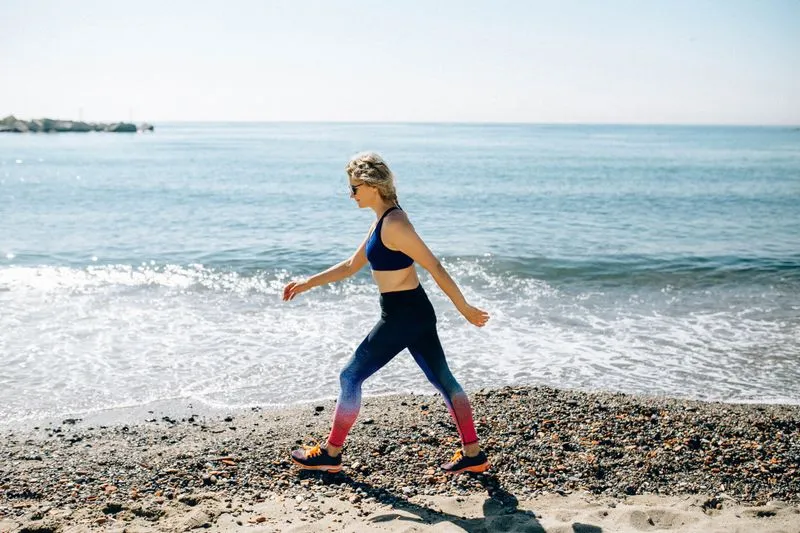
Two purchases matter when you start running: trainers that feel comfortable on your feet and a high-impact sports bra. Everything else — technical tops, a watch — can wait until you know running is for you.
Running shoes: comfort first
Running shoes were long sold as injury prevention — correct your pronation, cushion every impact. The research has since softened that message. A 2015 review in the British Journal of Sports Medicine by Benno Nigg's team at the University of Calgary found no conclusive evidence that impact forces or pronation predict injury. It proposed a simpler guide instead: the "comfort filter". A runner instinctively picks the shoe that feels comfortable, and that choice may by itself keep injury risk down.
How to choose well:
- Go to a specialist running shop: staff will let you try several pairs, sometimes with a few minutes on a treadmill. A gait analysis can help you compare — but the deciding factor is how the shoe feels on your foot.
- Try them on later in the day: feet are slightly more swollen by the afternoon — closer to how they'll be during a run.
- Room at the front for your toes: that may mean half a size up from your everyday size — check when you try them on.
- Budget: price guarantees nothing — an entry-level or mid-range pair that fits you well beats a racing shoe that pinches.
Sports bra: high-impact support for running
Breasts move a great deal when you run, and a poorly chosen bra shows up as chafing and discomfort. In a survey of 1,285 women running the 2012 London Marathon, 75 per cent reported bra fit issues — chafing and straps digging in were the most common. Use of professional bra fitting was low.
For running, you need a high-impact sports bra; a light yoga bra (designed for slower movement) usually won't do. Test it by jogging on the spot in the changing room (nobody is judging). Still a lot of movement, or a seam that rubs? Move on to the next one. If you can, ask for a proper fitting before a big purchase.
Clothing: function first
Go for technical fabrics (polyester, nylon blends) that wick moisture and dry quickly. Avoid cotton — it holds on to sweat and can irritate the skin on longer runs. Flat or seamless construction in high-friction areas (inner thighs, underarms) makes a real difference as your distances increase, and a light waterproof is a sensible buy given a British spring.

The 8-week programme: from 0 to 5K
This run-walk programme is designed for true beginners — those who don't run at all or very rarely. It has three sessions a week — with at least one rest day between sessions — and takes the running from 1-minute blocks to 30 minutes non-stop. Every session starts and ends with 5 minutes of brisk walking (your warm-up and cool-down), which isn't counted in the table. It reaches 30 minutes of continuous running a week sooner than the nine-week Couch to 5K. If you prefer a gentler slope, follow the NHS app or simply repeat weeks.
Core rule: if any week feels too difficult, repeat it before moving on. The programme takes eight weeks or longer, at your own pace.
| Weeks | Intervals | Repeats | Duration (plus 5 min brisk walking before and after) |
|---|---|---|---|
| 1 and 2 | 1 min running, 2 min walking | 6 to 8 | 18 to 24 min |
| 3 and 4 | 2 min running, 2 min walking | 6 | 24 min |
| 5 and 6 | 5 min running, 2 min walking | 4 | 28 min |
| 7, session 1 | 8 min running, 2 min walking | 3 | 30 min |
| 7, session 2 | 12 min running, 3 min walking | 2 | 30 min |
| 7, session 3 | 20 min continuous running | 1 | 20 min |
| 8 | 20, 25 then 30 min continuous running | 1 per session | 20 to 30 min |
Weeks 1 and 2: 1 minute running, 2 minutes walking
The first two weeks get your body used to the run-walk rhythm without strain. Speed doesn't matter at all. Consistency is everything: three sessions, a rest day between each.
Weeks 3 and 4: 2 minutes running, 2 minutes walking
By the end of week 4, running should start to feel more natural. If not, repeat week 3 — that's where the foundation for the rest of the programme is built.
Weeks 5 and 6: 5 minutes running, 2 minutes walking
The running share grows and the walking breaks shrink. For many beginners, these are the hardest weeks mentally — the body is adapting, but progress feels less visible. If a 5-minute block won't go, walk the rest of the session and repeat the week.
Weeks 7 and 8: 8 and 12-minute blocks, then continuous running
Jumping straight from 5-minute blocks to 20 minutes non-stop would be the steepest step in the plan, so week 7 goes through 8-minute and then 12-minute blocks before your first continuous 20 minutes. Week 8 stretches the running to 20, 25 and then 30 minutes — one step per session. By the end, you should be able to run for 30 minutes without stopping — roughly 3.5 to 5K depending on your pace.
After week 8: from 30 minutes to 5K
At 7 or 8 km/h (about 4.3 to 5 mph), 30 minutes of running covers 3.5 to 4km. To reach 5K, keep three sessions a week and lengthen just one of them by 5 minutes each week (35, then 40 minutes), the other two staying at 30 minutes, until you cover the distance. You can also finish your first 5K with a brisk walk — parkrun has no time limit. What counts is the distance, not the clock.

Running technique: the basics that prevent injury
A few simple adjustments from your first runs improve comfort and reduce the strain on your joints: an upright posture, a short stride and relaxed breathing.
Posture
- Slight forward lean from the ankles (a few degrees, without bending at the waist).
- Eyes level: look well ahead, not down at your feet. This relaxes the shoulders and opens the chest.
- Shoulders low and relaxed: tension in the shoulders and neck tires you out for no benefit.
- Arms bent, swinging forward and back rather than across the body. Hands loosely cupped, not clenched.
Stride
The heel-strike versus midfoot debate matters less than cadence — the number of steps you take per minute. A University of Wisconsin study of 45 recreational runners (Heiderscheit and colleagues, 2011) tested small increases in cadence. Raising it by 5 to 10% above a runner's natural rate reduced the energy absorbed at the knee, and at the hip at +10%. In practice: a slightly shorter, quicker stride rather than long, bounding steps (which brake you with every footfall). Most running apps can show your cadence.
Breathing
Breathe through both nose and mouth. There's no prescribed pattern — your body will find its rhythm. Your breathing is the best pace indicator available to a beginner: if you can no longer talk, slow down or walk.
Common beginner injuries (and how to prevent them)
Injuries are part of the landscape for beginners. In the GRONORUN trial, roughly one participant in five had to cut back or stop running for at least a week during their training. Knowing three common running aches lets you spot them early and ease off before they settle in.
IT band syndrome
Symptom: pain on the outer side of the knee. The iliotibial band is a broad strip of fibrous tissue running down the outside of the thigh. What we know: a 2012 systematic review in Sports Medicine (van der Worp and colleagues) describes it as the most common injury on the outer side of the knee in runners. Its estimated incidence is 5 to 14%. The review rates the evidence on its causes as limited or conflicting — including the role of weak hip muscles. What can help: the same review points to hip-strengthening exercises and advice on shoes and running surface. To lower the risk in the first place, the NHS knee exercises for runners (wall squats, lunges, a hamstring stretch) strengthen the muscles around the knee and stretch out the ITB, but the NHS says they are not suitable if you already have a knee injury. If the outer-knee pain comes back on every run, see a physio or your GP before trying them.
Shin splints
Symptom: pain and tenderness along the front of the lower leg, usually brought on by exercise such as running. Context: the NHS page on shin splints says you're more likely to get them if you've started exercising after a period of inactivity, run on hard surfaces or don't have a good running technique. They usually get better within a few weeks. Prevention: comfortable shoes, varied surfaces (towpaths, park grass, not just tarmac), a slow build-up.
Plantar fasciitis
Symptom: pain on the bottom of the foot, around the heel and arch, typically much worse when you start walking after sleeping or resting. Context: the NHS page on plantar fasciitis lists recently starting to exercise on hard surfaces, recently doing a lot more walking, running or standing, exercising with a tight calf and wearing shoes with poor cushioning or support among the things that make it more likely. Prevention: gradual increases, shoes with cushioned heels and good arch support, regular gentle stretching, and a GP appointment if the pain doesn't settle.
Nutrition and hydration for beginner runners
For the sessions in this programme, you don't need a complex nutritional strategy — a few straightforward guidelines are enough.
Before the run
Running on an empty stomach doesn't suit everyone. As a beginner, a small snack can make the effort feel more comfortable. Ideally, have a light meal a few hours before (fruit and yoghurt, toast and a cup of tea). If you run early in the morning, a banana or a few dates will do. If you're wondering how meal timing fits into your day, the science behind chrononutrition is a useful read.
During the run
Throughout the eight weeks of the programme (40 minutes at most per session, walking included), water is all you need. You can even skip drinking altogether. Energy gels and sports drinks serve no purpose over these durations; save them for the day you start training for much longer runs.
After the run
Eat normally in the hours that follow — no need to rush for a protein shake. A meal that includes protein (Greek yoghurt, eggs, pulses, fish or meat) supports recovery. For help choosing your protein sources, our ranking of meats by protein, fat and calories gives simple benchmarks.
Staying motivated to keep running: goals, partners and milestones
Three things help you see a running plan through: a date to aim for, someone to run with and a written record of your sessions. Enthusiasm often dips halfway through a programme — once the novelty has worn off but the results aren't yet obvious.
Set a concrete, dated goal
Signing up for an event — even a small local 5K — transforms the training dynamic. You're no longer running "to see how it goes": you're preparing for something specific on a specific date. parkrun is an obvious first target in the UK: a free, weekly 5K every Saturday morning. You can walk, jog or run, with no time limit and nobody finishing last.
Find a training partner
Running with someone — even occasionally — helps many beginners stick to their three sessions: you arrange to meet, you don't cancel at the last minute, and you chat — which guarantees conversational pace. Local running clubs and parkrun are good places to find people at a similar level to run with, and the Couch to 5K Facebook and HealthUnlocked groups connect beginners from across the UK online for support between runs.
Log your sessions, and repeat a week when you need to
Note every session in a notebook or on your phone: the date, the intervals you did, what felt easy or hard. Your first five minutes of continuous running, your first kilometre without stopping: seeing them written down helps on the day a week goes badly. If pain appears, repeat the week instead of moving on — the same goes for a session that leaves you exhausted.
Frequently asked questions
Is it normal to be very breathless in the first few minutes?
Entirely normal at the start — and a clear signal you're going too fast. Slow down until you can hold a conversation. If you're still breathless at that pace, alternate with walking. Early breathlessness fades over the weeks as you keep training regularly.
How many times per week should I run to make progress?
For beginners, three sessions a week is a good rhythm — frequent enough for the body to adapt, with a rest day in between, which is also the pattern Couch to 5K follows. With only one session a week, progress is very slow. Before adding a fourth run, wait until you've finished the programme without pain.
Is running bad for your knees?
This widely held belief isn't supported by the research. In a Stanford University study published in 2008, which followed 45 long-distance runners and 53 non-runners aged 50 to 72 from 1984 to 2002, the runners did not have more knee osteoarthritis on X-ray by the end: 20% against 32%. The difference was not statistically significant. New knee pain is still a signal: slow your progression and get it checked if it persists.
Should I stretch before or after running?
A systematic review in the BMJ (Herbert and Gabriel, 2002) concluded that stretching before or after exercise does not protect against muscle soreness. Stretching beforehand doesn't reduce injury risk in any useful way either. The simplest warm-up is 5 minutes of brisk walking. Gentle stretches after a run can feel good, but they aren't essential.
Is treadmill running equivalent to running outside?
A treadmill is a good alternative in bad weather or when getting out is difficult (sideways rain, awkward shift patterns). Without air resistance, the effort is slightly easier. A University of Brighton study (Jones and Doust, 1996) measured it in nine trained male runners. A 1% incline reproduced the energy cost of road running at speeds of roughly 6.5 to 11 mph (10.5 to 18 km/h). At the two slowest speeds tested, road running wasn't even significantly different from a flat treadmill — so at a beginner's pace, often slower still, the setting matters little. Outdoors, on the other hand, you work on balance and vary the terrain.
When can I return to running after having a baby?
If you had a straightforward birth, the NHS guidance on keeping fit after having a baby suggests starting with gentle exercise such as walking, stretches and pelvic floor exercises, and waiting until after your 6-week postnatal check before any high-impact exercise such as running. After a caesarean or a more complicated delivery, recovery takes longer: agree the timing with your midwife, health visitor or GP.
Which app should I use to track my progress?
The free NHS Couch to 5K app guides you through each run, with a choice of trainers to keep you going — which saves you staring at your watch. To follow the intervals in this programme instead, any interval timer that lets you set your own durations will do: it beeps at each change. GPS watches give more precise data but aren't necessary to start: a basic stopwatch is entirely sufficient for the first few weeks.
Can running help with weight loss?
Running burns energy, but it's easy to overestimate its effect on the scales. What you burn depends mostly on your weight and your pace, and a beginner's run-walk session uses less than people imagine. The NHS Couch to 5K page does note that running can help you manage your weight when paired with a healthy diet. If weight loss is your main goal, food matters at least as much: how long it really takes to lose 5 kilos will give you a realistic timeline.
Sources
- NHS — Physical activity guidelines for adults aged 19 to 64
- NHS — Osteoporosis: prevention
- NHS Better Health — Get running with Couch to 5K
- Bohm, Mersmann and Arampatzis (2015) — Tendon adaptation to mechanical loading, meta-analysis (Sports Medicine Open)
- Nigg et al. (2015) — Running shoes and running injuries (British Journal of Sports Medicine)
- Brown et al. (2014) — Breast support and sports bra use in 2012 London Marathon runners (Journal of Sports Sciences)
- Buist et al. (2008) — GRONORUN trial of a graded training programme for novice runners (American Journal of Sports Medicine)
- Heiderscheit et al. (2011) — Step rate and joint mechanics during running (Medicine & Science in Sports & Exercise)
- van der Worp et al. (2012) — Iliotibial band syndrome in runners: a systematic review (Sports Medicine)
- NHS — Knee exercises for runners
- NHS — Shin splints
- NHS — Plantar fasciitis
- Morton and Callister (2015) — Exercise-related transient abdominal pain (Sports Medicine)
- parkrun UK — Free weekly 5K events
- Chakravarty et al. (2008) — Long distance running and knee osteoarthritis, Stanford study (American Journal of Preventive Medicine)
- Herbert and Gabriel (2002) — Stretching, muscle soreness and injury risk (BMJ)
- Jones and Doust (1996) — A 1% treadmill grade and outdoor running (Journal of Sports Sciences)
- NHS — Keeping fit and healthy with a baby