
Thursday 5 June, 7.30pm, in the beer garden of a pub in Hackney. It's the third leaving do of the spring, and Beth — six years at the same agency — taps her glass to announce she has no idea yet what she'll do in September ("and that's completely fine"). On your left, a friend from your master's is explaining she's leaving London for Leeds, "maybe, well, probably". On your right, another one holds out her phone: an astrology post, "Born between April 1996 and early March 1999? Your Saturn return began on 25 May." Everyone laughs. Then everyone checks their birth year (just to see).
We've all been at those leaving drinks, or we will be. Somewhere between 28 and 30, the announcements come in waves — resignations, house moves, break-ups, engagements — and astrology has a ready-made name for it: the Saturn return. Psychology has a less poetic one: the quarter-life crisis. I'm 33 and mine is behind me. So here's how to date yours, what it tends to stir up, and why Saturn isn't the only suspect.
What exactly is a Saturn return?
A Saturn return is the moment Saturn comes back to the exact spot in the sky it occupied on the day you were born. The mechanics are not mystical at all — it's pure astronomy. As NASA's Saturn fact page puts it, "Saturn makes a complete orbit around the Sun (a year in Saturnian time) in about 29.4 Earth years (10,756 Earth days)." Seen from Earth, it therefore moves through all twelve zodiac signs in just under thirty years — and crosses your starting point again around your 29th birthday.
So you get more than one. The first lands around 29, the second around 58 or 59, the third (for the truly hardy) around 88. It's the first one that made the phenomenon famous — it coincides with the run-up to thirty, which is bad timing.
For astrologers, Saturn is the planet of structure: work, commitments, rules, limits, the passing of time. Its return reads like an MOT — whatever was built properly passes, whatever was bodged starts to rattle. Cafe Astrology describes Saturn's transits as cycles of achievement and maturity.
A Saturn return isn't a date, it's a period. Saturn spends about two and a half years in each sign, and every year it appears to move backwards for several months. The result: it can cross your birth degree once… or three times.

Saturn in Aries since 25 May 2025: why everyone's talking about the Saturn return
Everyone is talking about the Saturn return because the planet has just moved into Aries, the Saturn sign of nearly everyone born between April 1996 and early March 1999. According to Cafe Astrology's dates for the Saturn in Aries transit, the ingress happened overnight on 24-25 May 2025 (4.35am UK time). Saturn stays there until 1 September, slips back into Pisces during its retrograde phase, returns to Aries on 14 February 2026 and doesn't leave until 13 April 2028.
Last time round, Saturn was in Aries from 7 April 1996 to 9 June 1998, then from 25 October 1998 until the early hours of 1 March 1999 (UK time). If you were born in either window — so if you're between 26 and 29 now — your first Saturn return has just begun. The post in the beer garden was right, for once (give or take a four-month gap: between 9 June and 25 October 1998, Saturn had already moved on into Taurus before backing into Aries again).
Born just before or just after? You don't escape it, you just shift. Here are the last three waves, with dates converted to UK time:
| You were born between… | Your natal Saturn is in… | Saturn passes back through that sign… |
|---|---|---|
| 6 February 1991 and 21 May 1993, or 30 June 1993 and 28 January 1994 | Aquarius | 22 March to 2 July 2020, then 17 December 2020 to 7 March 2023 |
| 21 May and 30 June 1993, or 28 January 1994 and 7 April 1996 | Pisces | 7 March 2023 to 25 May 2025, then 1 September 2025 to 14 February 2026 |
| 7 April 1996 and 9 June 1998, or 25 October 1998 and 1 March 1999 | Aries | 25 May to 1 September 2025, then 14 February 2026 to 13 April 2028 |
If you were born on a day when Saturn changed sign — 7 April 1996, say — your time of birth settles it. For every other day, your date of birth is enough.

How do you date your own Saturn return?
To date your Saturn return you need two things: the sign of your natal Saturn, then its exact degree. The rest is reading a calendar — no harder than booking annual leave. The method, in order:
- Find your Saturn sign. Cafe Astrology's Saturn sign tables list every time Saturn entered a sign from 1920 to 2045. You're looking for the last entry before your date of birth. One catch: the times are given in US Eastern Time (five hours behind the UK for most of the year).
- Find its degree. Any free birth chart calculator will give it to you from your date, time and place of birth. Something like "Saturn at 12° Aries".
- Spot when Saturn crosses that degree. This is where retrograde comes in. Saturn stations on 13 July 2025 at 1°56' Aries, drifts backwards until late November (25°09' Pisces), then moves forward again.
- Widen the window. Astrologers don't stop at the exact day. They look at the whole journey through the sign, and often the year before it.
In practice, if your natal Saturn sits at 1° Aries (true for some people born in spring 1996), Saturn crosses it this month, crosses it again going backwards this summer, then a third time in late February 2026. Three appointments for the same exam — resits included. If your Saturn is at 20° Aries, though, the real crossing won't come until 2027: according to Cafe Astrology's retrograde calendar, Saturn won't get past 14°45' Aries in 2026. Your whole year group doesn't start on the same day.
My own case, to make it concrete. My natal Saturn is in Aquarius, like everyone born between February 1991 and May 1993. Saturn moved back into Aquarius on 22 March 2020 — the day before the first lockdown was announced — and stayed there until March 2023, with a break from July to December 2020. That's the window in which Sophie and I started the book club: a WhatsApp group, five friends, one book a month. And it was at 30 that I reread A Room of One's Own in tears, having dismissed it as "dated" at 22. Coincidence? Almost certainly. But it's exactly the kind of re-reading of your own life that astrologers file under Saturn.
My friend Margaux, a graphic designer, is 29: she was born while Saturn was crossing Pisces. Her return ran from March 2023 to this 25 May, with one last pass between September 2025 and February 2026. When I showed her the table, she said "ah, that explains 2024" — and refused to elaborate (fair enough).
One last point of method: in astrological tradition, the house of your chart that Saturn occupies narrows down the area in question, exactly like reading an eclipse by the house it lands in. Saturn in the 10th house points to career; in the 7th, relationships; in the 4th, home. But in Saturn-return stories, the same three areas come up again and again.
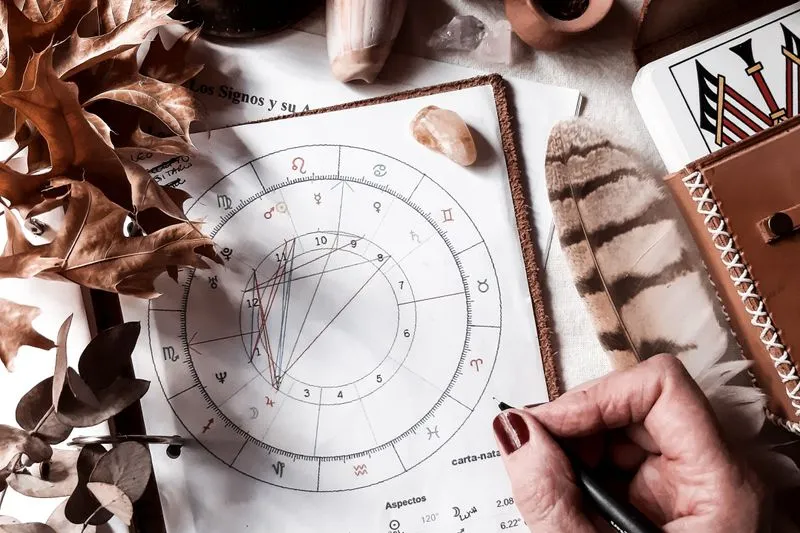
Saturn return and career: the choices you made by default get tested
At work, the Saturn return puts your default choices on trial — the first permanent contract you signed because you had to, the degree you picked because it "opens doors", the company you stayed at because leaving felt scary. Cafe Astrology frames Saturn in Aries around initiative, independence, authentic self-expression and asserting yourself, and adds that "Saturn demands simplicity, definition, realism, and truth wherever it touches our charts." Which sounds a lot like a first resignation letter.
On the numbers side, there's one big survey on the subject, commissioned by LinkedIn — and it included the UK. According to LinkedIn's 2017 research on the quarter-life crisis, 61% of respondents named finding a job or career they're passionate about as the number one cause. More than a third (36%) said they'd entirely changed careers, and 23% had taken a career break to work out what they wanted. A caveat worth keeping — it's an online poll run for a professional network, across the US, the UK, India and Australia.
I know the "by default" version well. At twenty-three, I was stuck in a permanent contract I didn't want. Nobody forced me into it — it was just easier than saying no. That's the kind of decision a Saturn return drags back onto the table six or seven years later, when you finally have the means (and the nerve) to look at it squarely.

Relationships: why commitments and break-ups pile up around 29
In love, the Saturn return asks one simple question: did you choose this relationship, or did you let it settle in? Astrologers see it as the season of big decisions — you commit for good, or you part. And to be honest, the social calendar — babies, weddings, first mortgages — gives them a serious helping hand.
Take the baby timetable. The ONS bulletin on births in England and Wales in 2023 puts the average age of mothers at 30.9, and of fathers at 33.8. The same release notes that the total fertility rate "dropped to 1.44 children per woman, its lowest value since records began in 1938". In other words, the "so when are you two…?" question arrives right as Saturn does — and astrology didn't invent it.
The researchers who studied early-adult crisis make the same point. In the full text of their 2013 paper, Oliver Robinson and his colleagues note that "the average age for marriage is between 26 and 30 in most developed countries and the average age for first-time parenthood is between 27 to 31". And among the most common locked-in situations they describe, the first is a relationship that is no longer wanted (the second, a career path that is highly pressured or dissatisfying).

Saturn return and identity: when "what I'm supposed to want" starts to crack
The quietest area of the Saturn return is identity. Not "who am I" in the philosophical sense — more the gap between the version of you that ticks the boxes and the one that wants something else. Robinson and his colleagues describe it well: in the first phase of a crisis, people build an outward identity adapted to the role they're in, which hides a more authentic self. Hiding that self takes effort, and the effort is stressful: it deepens the feeling of being hemmed in and trapped.
Comparison doesn't help. In the LinkedIn survey, 48% said comparing themselves to more successful friends had caused them anxiety — 51% of women against 41% of men. A ten-point gap, in a survey of 6,014 people. Add an Instagram feed full of engagement rings and new-build keys, and you've got quite the cocktail for a Sunday night.
What changes with age is how you read your own story. A Room of One's Own hadn't changed a word between my 22nd and my 30th birthday. I had. Maybe that's the real Saturn return: reading the same pages and no longer finding the same thing in them.
The quarter-life crisis: what psychology has actually studied
The quarter-life crisis isn't an Instagram invention: it has been studied, though far less than the midlife crisis. The most detailed model I've found comes from psychologist Oliver Robinson (University of Greenwich) and his colleagues at Birkbeck, University of London. Their holistic phase model of early adult crisis, published in the Journal of Adult Development in 2013, is built on 50 interviews in London with 25 men and 25 women who had been through a crisis between the ages of 25 and 35.
The bar to take part was high. The episode had to have lasted at least a year, disrupted work or home life substantially, and been resolved for at least a year. Not a three-week slump, then — a proper turning point. As the authors put it: "A crisis starts out with a commitment at work or home that has been made but is no longer desired."
The unsettling bit for anyone who reads their horoscope is the age range. The authors link their findings to a period that Levinson, one of the big theorists of adult development, called the Age 30 Transition, which runs from 28 to 33. It's when you move from the life structure of your twenties to the more settled one of the next decade. Saturn comes back around 29, and its trip through your sign spreads over two or three years. The two calendars overlap almost perfectly.
The LinkedIn survey points the same way, with a much lighter method: 75% of the 25 to 33-year-olds questioned said they'd had a quarter-life crisis, at 27 on average (6,014 people, online poll run by Censuswide in late 2017). Treat it as an order of magnitude, not scientific truth — but it says one thing clearly: if you're going through it, you're far from alone.

The four phases of the quarter-life crisis according to Robinson, and their astrological echo
Robinson splits early-adult crisis into four phases, one of them in two parts. The right-hand column is my own parallel with Saturn's journey — a reading, not data.
| Phase (Robinson et al., 2013) | What happens | The Saturn parallel (my take) |
|---|---|---|
| 1. Locked-in | A commitment you no longer want but can't yet see how to change. A sense of powerlessness, of being trapped. | Saturn approaches your degree: something is jamming, and you don't know what to do. |
| 2a. Separation | You distance yourself from the job, the relationship or the group. The most emotionally intense phase: guilt, sadness, anxiety, excitement, relief, shame. | The first exact crossing: the decision is made, or it's made for you. |
| 2b. Time-out | A deliberate step back, often with travel or a change of place. No appetite for new commitments. | The retrograde: Saturn backs off, and so do you. |
| 3. Exploration | You try out new directions (training, careers, relationships) that fit your values. The self becomes a question rather than an answer. | The second crossing: you test, you adjust. |
| 4. Rebuilding | New commitments, chosen this time. More intrinsic motivation, a more coherent identity. | The final crossing, then Saturn leaves your sign. |
Two important caveats. Robinson also describes loops. Some people skip the time-out or the exploration and go straight to rebuilding (6 people out of 50) — which can be a good solution when you know exactly what you want, but is sometimes forced by circumstances. Others relapse: the new direction recreates the same locked-in feeling, and it all starts again (8 out of 50). And not everyone reaches phase 4 — the authors say so plainly. The positive path exists; it isn't automatic.
Does Saturn really cause your crisis? What the science says
No — or at least, there's no evidence for it, and someone looked seriously. In 1985, researcher Shawn Carlson published a double-blind test of astrology in the journal Nature, designed with the help of astrologers. They had to match 116 birth charts to the right personality profile, picked out of three. Chance predicted 38.5 correct matches; the astrologers had predicted at least half (58.5). They got 40 — barely better than chance. The verdict under the results table: "The data are consistent with chance, inconsistent with astrological hypothesis."
Physically, Saturn sits an average of 1.4 billion kilometres from the Sun — again according to NASA. Nothing we know of links its position to your resignation letter.
So why does it "work" so well? Because Saturn's timetable lands right on a transition that psychology and demography describe without it: the end of your twenties, the average age of first-time parents, Levinson's Age 30 Transition. Astrology puts a name and a date on a moment that exists anyway. That's how I take it — a mirror, not a cause. Openly superstitious, diary up to date.
How to get through your Saturn return without blowing everything up
Getting through your Saturn return is mostly about sorting things out without smashing what works. What helps, from what I've lived and seen around me:
- Take stock before you act. The "chosen / drifted into" list on one side, Saturn's three crossing dates on the other.
- Separate reversible decisions from the rest. A new haircut, an evening class, two weeks away on your own — reversible. Quitting with no safety net, breaking a tenancy, selling, getting married — take your time.
- Test before you leap. That's Robinson's exploration phase: you try things, you don't swear by them.
- Talk to someone who's 33 or 35. A friend, a colleague, a cousin. Someone who's come out the other side and can tell you what really mattered, with hindsight.
- Keep a financial cushion. Even a small one. Calm exploration costs a lot less than panic in your overdraft.

The Saturn return always passes — the one prediction that never fails, since the planet changes sign every two and a half years. What counts is what you'll have built by the time it leaves. Tonight, open the Saturn sign table, find your sign and write down your three dates. Everything else can wait until tomorrow morning.
Saturn return: frequently asked questions
At what age does the first Saturn return happen?
The first Saturn return happens around 29, because Saturn takes 29.4 years to orbit the Sun. Depending on your degree and the retrograde phases, the period can open as early as 26 and close around 30. For people born between April 1996 and the start of March 1999 (except June to October 1998), it began on 25 May 2025.
Do you need your time of birth to date your Saturn return?
Not for the sign — unless you were born on a day when Saturn changed sign. Saturn spends about two and a half years in each sign, so it moves very slowly, and your date of birth is enough to estimate its degree. Your time of birth matters if you want to know which house of your chart it sits in.
Is a Saturn return always a hard time?
No. In Robinson's model, the positive path through a crisis leads to rebuilding: chosen commitments, more personal motivation. Plenty of people go through it without much drama. And when it is hard, the difficulty comes from a commitment that no longer suits you — not from the planet.
How long does a Saturn return last?
Saturn stays in a sign for close to two and a half years on average. The exact crossings of your birth degree (one or three, depending on retrograde) usually fall within less than a year. Astrologers often count the whole trip through the sign, sometimes the year before too.
I was born in 1997: has my Saturn return started?
Yes. The whole of 1997 falls within the period when Saturn was in Aries (7 April 1996 to 9 June 1998). Saturn moved back into Aries on 25 May 2025, leaves on 1 September, then returns from 14 February 2026 to 13 April 2028. Depending on your degree, the heart of your return falls between summer 2025 and 2027.
Is there a second Saturn return?
Yes, around 58 or 59, then a third around 88. Same mechanism, with thirty more years of hindsight. On the psychology side, research on the midlife crisis is far more plentiful than on the quarter-life crisis.
Does the quarter-life crisis hit women harder?
There isn't enough data to say so. Robinson's study, qualitative and evenly split (25 men, 25 women), wasn't designed to measure a gap between the sexes. In LinkedIn's 2017 survey, women were more likely than men to say comparing themselves to friends caused them anxiety (51% against 41%), but that's an online poll, not a clinical study.
Should you see an astrologer for your Saturn return?
You don't need to. The Saturn sign table and a free chart calculator are enough to find your dates. If you do book a reading, steer clear of anyone selling fear ("if you don't act, everything will collapse"): Carlson's test is a reminder that, in an experiment designed with their input, astrologers did no better than chance.
Sources
- NASA Science — Saturn Facts
- Cafe Astrology — Saturn in Aries Transit 2025-2028
- Cafe Astrology — Saturn sign tables 1920-2045
- Cafe Astrology — Retrograde cycles and stations 2024-2026
- Cafe Astrology — Saturn turns retrograde in Aries (13 July 2025)
- Robinson, Wright and Smith — The holistic phase model of early adult crisis, Journal of Adult Development (2013)
- LinkedIn — New research shows 75 percent of 25-33 year olds have experienced quarter-life crises (2017)
- Office for National Statistics — Births in England and Wales: 2023
- Shawn Carlson — A double-blind test of astrology, Nature, vol. 318 (1985)
- NHS — NHS talking therapies for anxiety and depression
- Samaritans — Contact us