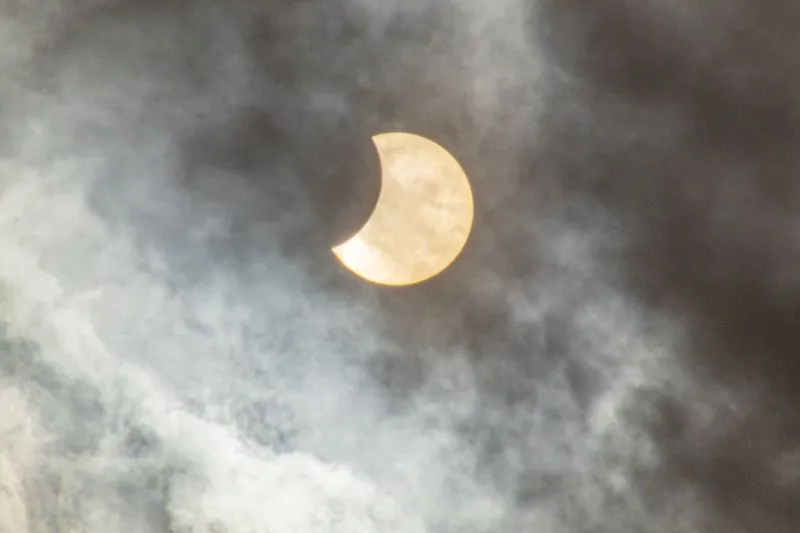
Saturday 29 March, 11.03am. I'm holding the pasta colander at arm's length in front of the living-room window. On the wall I painted sage green this month, dozens of tiny crescents of light are trembling. Not circles — crescents. Every hole in the colander projects a miniature image of the Sun — and this particular Sun has a bite taken out of its side. Outside, the light hasn't really dimmed — it has changed texture: more metallic, slightly colder, as if someone had swapped the Hackney sky for the strip light in a chemist's. A cloud drifts over, the crescents fade, then come back, while my tea goes cold on the windowsill and the street carries on with its Saturday as if nothing were happening. My boyfriend, who sniggered at 10am when he saw me take the colander out of the cupboard, has been filming the wall for ten minutes (he denies this).
Seen from London, this partial eclipse was hardly a disaster film. The Moon covered a little over two-fifths of the Sun's diameter, for just under two hours. And yet, for a week, my Instagram feed had talked about nothing else — "portal", "karmic reset", "whatever you do, don't sign anything this weekend". What the sky did on Saturday fits into three timestamps. What astrology makes of it fits into one word, the nodes, and that word explains why eclipses come back every six months.
What is an eclipse, according to astronomy?
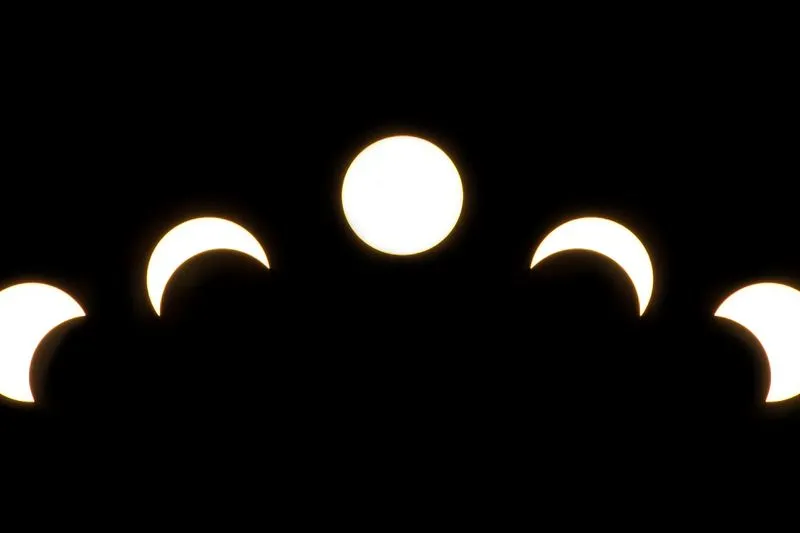
An eclipse is an almost perfect line-up of the Sun, the Earth and the Moon — and a story about shadows. When the Moon passes between the Sun and the Earth, it hides all or part of the Sun's disc. That's a solar eclipse, and it can only happen at new moon. When the Earth gets in the way instead, its shadow falls on the Moon. That's a lunar eclipse — always on the night of a full moon.
The real question is: why not every month? The Royal Observatory Greenwich answers it in its guide to lunar eclipses: "the Moon’s orbit is inclined by 5˚ relative to the Earth’s orbit". So most months, the Moon's shadow simply passes above or below us. Missed.
The two orbital planes cross at two points — the nodes. Fred Espenak's NASA page on eclipses and the Moon's orbit puts the mean tilt at 5.145° and explains how those nodes work. An eclipse needs the right phase (new or full moon) and a Moon sitting close to one of the nodes. Remember that word, node. In astrology, it explains almost everything.
Solar or lunar eclipse: what's the difference in astrology?
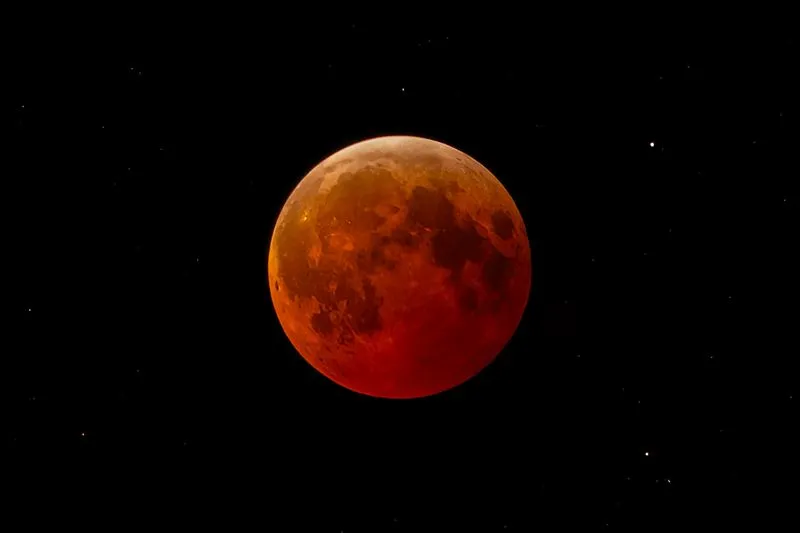
In astrology, a solar eclipse (new moon) reads as a beginning, a lunar eclipse (full moon) as an ending or a revelation. In the sky, too, the two have little in common. A solar eclipse can only be seen from part of the Earth, where the Moon's shadow falls. Every city gets its own version — total here, partial there, invisible elsewhere. A lunar eclipse can be watched from wherever the Moon is up at the time. No travel needed — a clear night will do (and, often, an alarm clock). During totality the Moon stays in view — it turns coppery, sometimes properly red. The Royal Observatory's explanation: dust in the atmosphere blocks the blue light, while the longer red wavelengths still get through.
That reading comes from where the two bodies sit. A solar eclipse is a new moon turned up to eleven: Sun and Moon in the same sign, at the same degree. Tradition reads it as a beginning — a door opening, sometimes before you've knocked. A lunar eclipse is a supersized full moon. Sun and Moon face each other from opposite signs, and it's read as an ending, a revelation, something spilling over. Astrologers sum it up — the solar eclipse sows, the lunar eclipse reaps. The image has nothing to do with physics. It just helps you sort out what you're living through.
| Criterion | Solar eclipse | Lunar eclipse |
|---|---|---|
| Moon phase | New moon | Full moon |
| Who shades whom | The Moon hides the Sun | The Earth shades the Moon |
| Where to see it | From part of the globe only | Wherever the Moon is up |
| How to watch | Certified eclipse glasses or projection | Just look up, binoculars if you have them |
| In the zodiac | Sun and Moon in the same sign | Sun and Moon in opposite signs |
| Astrological reading | A start, a new direction | An ending, a realisation |
My opinion, for what it's worth — you feel a lunar eclipse faster. A full moon that lays emotions bare, everyone recognises. The solar one is subtler (apart from crescents on a wall, you barely notice anything). Whatever it "opens" often only shows with hindsight — weeks, sometimes months later.
Why do eclipses keep landing in the same signs?
Because of the lunar nodes. In astrology, they're called the North Node and the South Node. Tradition also calls them the head and tail of the dragon (a monster swallowing the Sun is never far away when eclipses come up). Astronomers kept a trace of it: the time the Moon takes to return to the same node is the draconic month. According to NASA, it lasts 27.21222 days on average.
The nodes don't stay put. They slide backwards along the ecliptic — about 0.053° a day, according to the same NASA page — and complete a full circuit in 18.6 years. Do the maths — 18.6 years divided by twelve signs gives you just over a year and a half per pair of signs. During that time, nearly all the eclipses fall on the same axis — two opposite signs batting the ball back and forth, season after season.
The dates come from NASA's catalogue of 21st-century solar eclipses; the signs, from the Sun's position on those days. The solar eclipses of 20 April 2023, 8 April 2024 and 29 March 2025 all happened while the Sun was in Aries. Those of 14 October 2023 and 2 October 2024, while it was in Libra. On the lunar side, the switch has already happened: the eclipses of 18 September 2024 and 14 March 2025 played out on the Virgo-Pisces axis. So 29 March closed the Aries-Libra series that opened two years earlier.
In astrological terms, the North Node points to the direction you're invited to grow in. The South Node is what you can do with your eyes shut — your comfort zone, your old reflexes. On the Virgo-Pisces axis, that means a pull between the practical (sorting, organising, looking after your daily life) and letting go (intuition, daydreams, the need to switch off). Astrologers say every eclipse on this axis shakes up both ends, in whichever houses of your chart they fall.
Why do eclipses come in pairs (sometimes threes)?
Eclipses come in pairs because an eclipse is only possible when the Sun passes close to one of the nodes, which happens twice a year; within that window, both the new moon and the full moon can cast a shadow. The Sun travels from one node to the other in 173.3 days on average (NASA again). That window has a name — an eclipse season.
Fifteen days separated the lunar eclipse of 14 March and the solar eclipse of 29 March. Not a coincidence: that's how long the Moon takes to go from full to new. Six months later, same again. And sometimes a season squeezes in three — on 5 June, 21 June and 5 July 2020, two penumbral lunar eclipses bracketed an annular solar eclipse, according to NASA's catalogues.
Astrologers talk about the "eclipse corridor" for the stretch between the two: a period described as restless, when everything seems to move at once. I'm passing that on as it is — it comes from practitioners, and nobody has measured it.
Eclipses also follow a longer cycle — the saros. NASA's eclipse glossary defines it as 223 synodic months, the equivalent of 18 years and about 11 days. After that interval, the Sun, Earth and Moon return to almost the same geometry, and a very similar eclipse comes round again. NASA's catalogue files the 29 March eclipse under saros 149.
A little exercise I like (take it lightly): think back to what you were living through eighteen years earlier — in the same season. Most of the time nothing much happened; when an echo turns up, write it in an eclipse notebook rather than turning it into a rule.
What do the 14 and 29 March 2025 eclipses mean?
In astrology, the 14 March 2025 eclipse (Moon in Virgo) reads as an ending around daily life, and the 29 March one (Sun in Aries) as the full stop of the Aries-Libra series. Both belong to the same eclipse season, spring 2025.
The season opened with a total lunar eclipse on 14 March. According to NASA's catalogue of lunar eclipses, it peaked at 6.59am Universal Time, with totality lasting just over an hour (65.4 minutes). From London, the Royal Observatory's eclipse timings for London had warned that the eclipse would peak locally at 6.19am, because the Moon would already have set by the actual maximum — early risers got a heavily bitten Moon sinking in the west.
Astrologically, that eclipsed full moon sat on the Virgo-Pisces axis: Sun in Pisces, Moon opposite in Virgo. The classic reading? An ending, or a realisation, around your daily routine and the way you organise yourself (Virgo). Opposite, the need to dream, slow down and rest (Pisces). Did you get a sudden urge to sort out everything in mid-March — or to chuck it all in? An astrologer would call that the eclipse. I'd also call it the end of winter.
Then, on 29 March, the new moon — and the solar eclipse. Seen from London, it began at 10.07am and ended at 12.00pm GMT. Maximum at 11.03am, with a magnitude of 0.417 (the fraction of the Sun's diameter covered by the Moon). Those times come from Time and Date's local circumstances for London. The further north-west you went, the bigger the bite. NASA's catalogue puts the point of greatest eclipse in far northern Canada, with a magnitude of 0.9376. Almost total — but not quite. (And that night the clocks went forward, which felt a bit like the universe rubbing it in.)
Astrologically, this eclipse fell in the first decan of Aries (around 9°), just over a week after the spring equinox. Aries is the sign of drive — of "me first", of the nerve to begin. In the traditional reading, a solar eclipse in Aries pushes you to take the initiative you've been putting off. Or it shows you that you're done waiting for permission. It was also the last of a series that began in April 2023, so many astrologers read it as a full stop. Whatever was launched (or shaken up) on the Aries-Libra front over the past two years is coming to maturity.

Which house of your chart does an eclipse activate?
An eclipse activates the house of your chart that contains its sign and degree: that house tells you which area of your life astrology places the movement in. The sign of an eclipse is the same for everyone; the house it lands in, in your chart, isn't. Relationships, work, money, family, friends: it all plays out there.
- Draw up your birth chart. You need your date, place and time of birth, as precise as possible (ask your parents, or look in your red book, if it's still in a drawer somewhere). Any chart calculator does the rest.
- Find the eclipse's sign. For 29 March 2025: the first decan of Aries (around 9°). For 14 March: Virgo for the Moon, Pisces for the Sun.
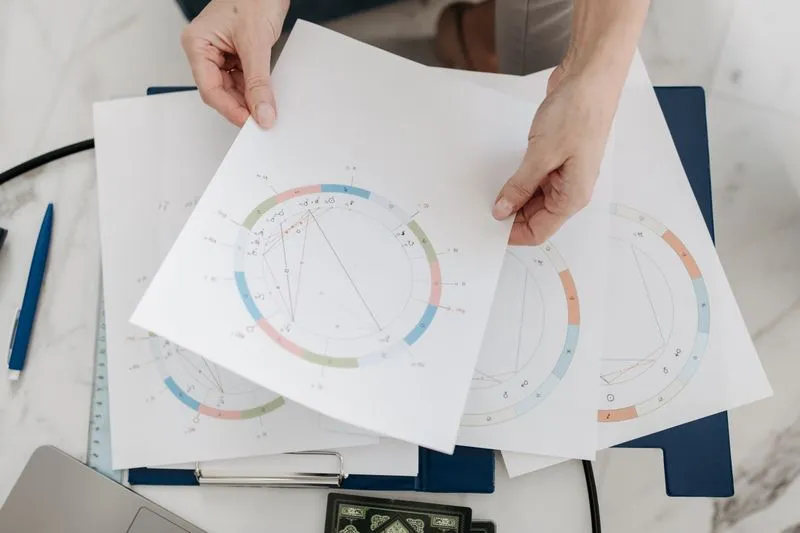
- Find the house that contains that sign. On your chart wheel, the twelve houses are the twelve slices of the cake. They're counted anticlockwise, starting from the ascendant.
- Check whether it hits a planet. An eclipse within a few degrees of one of your natal planets (Sun, Moon and ascendant, also called the rising sign, above all) concerns you more directly, according to astrologers.
A personal example, to make it concrete. My Moon is in Scorpio. None of this spring's eclipses fell anywhere near that sign — astrologically, I had no reason to expect an emotional earthquake. I was still wiped out on Friday 14 March. I put that down to a busy week (and an alarm set far too early to catch a Moon that was setting anyway).
The 12 houses: what an eclipse stirs up, area by area
Here's the grid I use. It follows the classic meanings of the houses. The "solar eclipse" column covers what starts; the "lunar eclipse" column, what ends or comes to light. Treat it as a starting point for thinking.
| House | Area of life | Solar eclipse (what begins) | Lunar eclipse (what wraps up) |
|---|---|---|---|
| 1 | You, your image | An urge to present yourself differently | A role you no longer want to play |
| 2 | Money, self-worth | A new relationship with money | A spending habit that stops |
| 3 | Communication, siblings, learning | A writing project, a short course | A conversation that clears up a misunderstanding |
| 4 | Home, family, roots | Renovations, a housing plan | An old family story resurfacing |
| 5 | Romance, creativity, pleasure | A meeting, a creative project | A passion running out of steam |
| 6 | Daily life, routines, day-to-day work | A new routine | A system that no longer holds |
| 7 | Relationships, partnerships, contracts | A commitment, a partnership | A relationship coming into focus |
| 8 | Intimacy, shared money | A joint project (mortgage, joint account) | A bond transforming deeply |
| 9 | Travel, study, beliefs | A departure, a long course | A certainty you let go of |
| 10 | Career, reputation | A new professional direction | The end of a work chapter |
| 11 | Friends, networks, group projects | A new circle | A friendship drifting apart |
| 12 | Rest, retreat, inner life | A need for solitude | A fear you finally look in the eye |
In astrologers' readings, two houses come up most often after an eclipse: the 7th and the 10th. In the 7th, the eclipse doesn't decide anything for you. It mostly shines a light on what goes unsaid in your relationship — and there, the couple communication techniques that actually work will serve you better than any transit. In the 10th, reread our guide to astrology and the job that suits your sign. And if the urge to change everything lasts for weeks, well beyond the evening of the eclipse, the complete step-by-step guide to changing career will help you turn it into a plan.

What does science say about eclipse astrology?
No study I know of has shown that an eclipse acts on people's lives; a test of astrology published in Nature in 1985 came out at chance level. What isn't up for debate is the mechanics — astronomy predicts eclipses to within seconds, decades ahead. NASA's catalogue lists every solar eclipse from 2001 to 2100, with its time, its magnitude and the point on the globe where it peaks. Nothing mysterious about it — it's the geometry of shadows, worked out from the movements of the Earth and the Moon.
In 1985, Shawn Carlson, then at the physics department of the University of California, Berkeley, published a double-blind test of astrology in Nature. He designed it with astrologers well respected in their field, who approved the protocol.
How did it work? The astrologers received a person's birth chart and three personality profiles from a standard questionnaire (the CPI). Only one was the right match. They had predicted they'd find it at least half the time. The result: across 116 charts, they picked the right profile as their first choice 34% of the time — chance level, roughly one in three. The paper's conclusion doesn't mince words: "The experiment clearly refutes the astrological hypothesis."
Does that settle it? On that specific point, yes: in this test, birth charts didn't help anyone recognise a personality better than chance. For me, it puts astrology in its place. A symbolic language, a tool for thinking. Prediction just isn't something it can do. I still look at which house the eclipses land in. I just don't ask them to make my decisions.
How to watch a solar eclipse without damaging your eyes
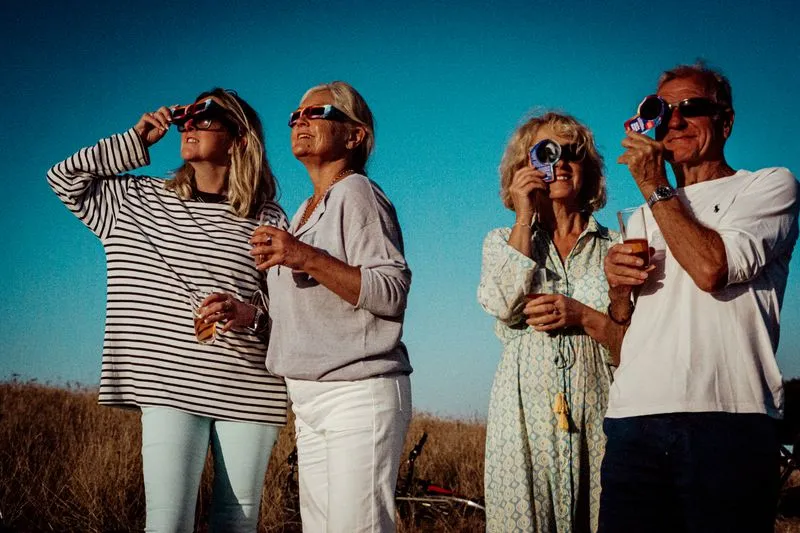
A partial solar eclipse is never something you look at with the naked eye, however small the bite. For 29 March, the Royal Observatory's guide to solar eclipses expected "Around 30-40% of the Sun" to be obscured from London at maximum, and its rule doesn't change with the percentage: "you should never look directly at the Sun without the appropriate filters". NASA's eclipse safety guidance says the same: during a partial or annular eclipse, looking directly at the Sun without proper eye protection is never safe. And ordinary sunglasses — however dark — are not safe for viewing the Sun.
What works, according to the Royal Observatory and NASA:
- Your local astronomical society. The Royal Observatory suggests checking whether yours is hosting an eclipse event, with instruments fitted with proper solar filters.
- An indirect method. A pinhole in a piece of card, projecting the Sun's image onto paper, a cardboard-box projector, or the trusty colander. The Royal Observatory puts it plainly: "The safest, cheapest and arguably the most convenient way to view the event is by pinhole projection."
- Eclipse glasses that meet the ISO 12312-2 standard. Inspect them before every use: if the filter is scratched, torn or damaged, bin them.
- Supervised children. Always, whenever they use eclipse glasses or solar viewers.
These precautions are about the Sun. A lunar eclipse happens at night, with the Sun below the horizon: just look up, and grab binoculars for a better view of that coppery totality.
The next eclipses for your diary (September 2025 to August 2026)
The next eclipse season arrives in September 2025, and it stays on the Virgo-Pisces axis. In 2026, the solar eclipses already slide towards the next axis, Aquarius-Leo. The lunar eclipses stay in Virgo-Pisces — for now. The dates and times below come from NASA's catalogues, converted to Universal Time and rounded to the minute; the signs follow the Sun's position on each day.
| Date | Type of eclipse | Peak (Universal Time) | Astrological reading |
|---|---|---|---|
| 7 September 2025 | Total lunar | 6.12pm | Sun in Virgo, Moon in Pisces |
| 21 September 2025 | Partial solar, southern hemisphere | 7.42pm | Sun and Moon in Virgo |
| 17 February 2026 | Annular solar, southern hemisphere | 12.12pm | Sun and Moon in Aquarius |
| 3 March 2026 | Total lunar | 11.34am | Sun in Pisces, Moon in Virgo |
| 12 August 2026 | Total solar | 5.46pm | Sun and Moon in Leo |
| 28 August 2026 | Partial lunar | 4.13am | Sun in Virgo, Moon in Pisces |
The date to circle is 12 August 2026. The Royal Observatory's table of UK solar eclipses describes it as a partial eclipse that "will almost be total", with around 90% of the Sun obscured by the Moon at maximum. From London, it should begin at around 6.17pm BST, with maximum at around 7.13pm. A solar eclipse in Leo, in high summer, in the early evening — hard to get more theatrical for the most solar sign of the zodiac. And if you're holding out for totality on home soil, the Royal Observatory has bad news: the next total solar eclipse in the UK won't happen until 2090.
Frequently asked questions about eclipses in astrology
Is an eclipse always a bad omen in astrology?
No. For a long time eclipses were read as worrying omens, because they disrupted the order of the sky. Modern astrology describes them more as accelerators: they get stuck things moving again. An ending can even be exactly what you were waiting for without daring to cause it.
I'm not Aries, Virgo or Pisces: does it affect me?
Yes, like everyone. In astrology, an eclipse always lands somewhere in your chart, in one of the twelve houses. What changes from one person to the next is the area of life involved. And the intensity, which is considered stronger when the eclipse falls close to your Sun, Moon or ascendant.
How long does an eclipse's effect last?
Many astrologers consider that an eclipse "works" for about six months, until the next eclipse season. Some talk about longer. It's an interpretive convention, not a measurement. Your eclipse notebook is still the best way to see whether it holds true for you.
Can you do a new moon ritual on the day of a solar eclipse?
Opinions differ. Some astrologers advise against setting intentions on the day itself, because the eclipse is considered too unpredictable. Others see it as a powerful moment. My approach: on the day, I watch and I write, without asking for anything. I save intentions for the following new moon, which is calmer.
Why do people call eclipses "karmic"?
Because of the lunar nodes. An eclipse always happens near one of them. And astrology links the South Node to the past and to habits, the North Node to the direction ahead. Hence "karma", which is a shortcut: the idea of letting go of an old pattern to try a new one.
Why does my horoscope mention the eclipse when I don't feel anything?
Because a Sun-sign horoscope is general by definition: it knows nothing about your ascendant, your houses or what you're going through right now, and it's written for every reader of your sign at once. An eclipse landing in a quiet house of your chart can go unnoticed. And that's fine — nobody needs an upheaval every six months.
When is the next solar eclipse visible from the UK?
After 29 March 2025, the next one is 12 August 2026. It will be partial from the UK but very deep, with around 90% of the Sun covered at maximum, according to the Royal Observatory Greenwich. In between there are two lunar eclipses: 7 September 2025, when the Moon rises already eclipsed in the UK, and 3 March 2026, which can't be seen from the UK. For the September one, find a clear eastern horizon: the Royal Observatory expects the Moon to rise just in time to catch the total eclipse.
Sources
- Royal Observatory Greenwich — Lunar eclipse guide
- Royal Observatory Greenwich — Solar eclipses explained (archived, 2 March 2025)
- NASA, Fred Espenak — Eclipses and the Moon's Orbit
- NASA — Catalogue of solar eclipses, 2001 to 2100
- NASA — Catalogue of lunar eclipses, 2001 to 2100
- NASA Science — Eclipse glossary
- Time and Date — Partial solar eclipse of 29 March 2025 in London
- ScotlandsPeople — Statutory register of births
- GOV.UK — Guide to birth certificates
- NASA Science — Eclipse Viewing Safety
- Shawn Carlson — A double-blind test of astrology, Nature, vol. 318 (1985)
- Royal Observatory Greenwich — Lunar eclipse guide (archived, 15 March 2025)
- NASA — Lunar eclipses of the decade 2021 to 2030