
Saturday 8 July 2017, 6.40am, outside a leisure centre in east London. I'm 25. Over my shoulder, a suit carrier holding three outfits in "neutral colours — no white, no stripes, no logos". In my bag, a flask of coffee (and a packet of biscuits, just in case). In my head, the secret conviction that someone — that day, surely — was going to notice me. Nobody noticed me. I spent five hours on a folding chair finishing an entire novel. Then forty minutes at a café table, stirring the same cold flat white — twenty-three takes, I counted — while two actors had a row at the next table. The following winter, the TV drama went out — I'm not telling you the title (you'd only go and check). My mum paused it to show my dad my elbow. My elbow. Two seconds, out of focus, at the edge of the frame.
And yet I remember that day like a school trip. Coffee in paper cups at dawn, lunch from the catering truck where the supporting artists queue after the crew, the grips joking with each other between takes. The woman on the folding chair next to mine — a law student, thirtieth job as an extra — who taught me everything in one morning. And the payslip that turned up three weeks later, with a proper line for the day's work on it. Not fame (no, really). But a paid day watching a film set from the inside, with its rituals, its jargon and its endless waiting — and it remains one of the funniest things I've ever done.
Summer is when filming spills onto the streets. Cafés, parks and beaches turn into sets — and productions need passers-by, customers and holidaymakers to fill them. There's no shortage of productions, either. The BFI's official statistics for 2024 put film and high-end television production spend in the UK at £5.6 billion — up 31% on 2023. Of that, £3.4 billion went on high-end TV and £2.1 billion on feature films. Here's how to get yourself onto one of those call sheets without getting ripped off on the way — where to find the work, which agencies to avoid, what a day rate really pays and how a shoot day unfolds.

Supporting artist, featured, stand-in: who does what on a film set?
In the UK, a film extra is usually called a supporting artist (SA) or background artist. She fills the frame without playing a part — the customer at the bar, the commuter crossing the road, the fan in the stands. She has no name in the script, she doesn't speak (or she mouths words silently) and she crosses the frame without ever glancing at the lens. And above all, nobody should notice her. That's the whole craft — and it takes more concentration than you'd think.
On set, the work splits into a few levels:
- Background: being in the shot, usually as part of a group, with no lines.
- Featured or "action" background: a more visible moment with a specific action (bringing the lead her coffee, handing over a ticket), still without dialogue.
- Minimal dialogue: a line or two, along the lines of "Your change, madam". A few words — but words, and paid as such.
- Stand-in: she takes an actor's place during the long lighting and camera set-ups, with the same height, the same skin tone and sometimes the same haircut.
Each level carries a different fee, and the level is sometimes decided on the day, in the middle of a scene, when the director suddenly needs one more line. Say a supporting artist is asked at 3pm to deliver a line. In principle, she's now doing a different job from the one she was booked for. If that happens to you, check that your pay reflects it — politely, but check.
Where to find supporting artist work
In the UK, most supporting artist work goes through agencies. You register with one or several, and they put your profile in front of productions. When a casting brief matches you, they offer you the job (fingers crossed). Alongside the agencies, some productions post open calls on social media — usually for big crowd scenes or very specific looks.
In practice, you have three ways in:
- Supporting artist agencies. You create a profile with photos, measurements and availability. The agency sends you "availability checks", then confirms the booking, the call time and the address once the production has made its final choice. Some work mostly in London and the studios around it, others cover the regions.
- Open casting calls. Search social media for "supporting artists" or "extras wanted" plus your city. That's where the urgent requests land — "we're short of fifteen people for tomorrow morning" — and where a beginner can grab a first day.
- Word of mouth. Once you're on a set, you meet regulars who know every agency worth joining. The woman on the next chair had a whole notebook of contacts (and showed it to me with the pride of a stamp collector).
Availability checks come in all year round, often only a few days ahead, sometimes the evening before when someone has dropped out and needs replacing before dawn. The law student summed it up in one sentence. The supporting artist who works the most isn't the most photogenic one — she's the most available. The one who replies within ten minutes, turns up on time and never cancels the night before.

Extras agencies: what they can legally charge you
A good agency makes its money from commission on the work it finds you, not from your sign-up. GOV.UK's guidance on the fees agencies can charge performers, which names background artists and extras explicitly, says that fees or commission for finding work "normally come out of the worker or performer's earnings from the employment that you found". An agency can only charge upfront fees for listing your details in promotional publications or on websites. For performers, that fee can only be charged 30 days after the contract starts. Within those 30 days, you can cancel without penalty. If your details aren't made available to potential hirers within 60 days, you're entitled to a refund.
In plain English: a registration or listing fee can be legal — but it comes with a cooling-off period and strings attached. A "compulsory photoshoot" at the agency's own studio? A "premium membership" to be seen first? Pressure to pay on the spot? None of that fits the picture. Here's a quick way to sort the normal from the fishy.
| Situation | Normal? |
|---|---|
| Commission taken from your pay for work the agency found you | Yes, that's how agencies are normally paid, so ask what percentage they take before you register |
| Sending photos, measurements and availability | Yes, that's the basis of every application |
| A fee for listing you on the agency's website or book | Allowed, with 30 days to cancel and a refund if you're not listed within 60 days |
| Being told to pay on the day you sign up | No, a performer's listing fee can't be charged in the first 30 days |
| A paid photoshoot as a condition of joining | No, sharp photos taken at home are enough |
| A day paid cash in hand, no payslip or invoice | No, and you'll have no record of your work |
The application that gets you booked
An application for supporting artist work gets read in ten seconds. The person casting is looking for someone who fits the scene — not a future star. Your job: make the sorting easy. You don't need an acting CV (or any experience, for that matter).
Photos first. Two or three are enough: a headshot (face and shoulders) and a full-length shot, recent, in daylight, no filter, with your hair as you wear it every day and plain clothes. Light make-up. Skip the low-angle selfie, the sunglasses and the cropped group photo (your mate's arm is always poking into one corner of the frame, however carefully you crop). For the top, pick a colour that properly suits you. Not sure which? The at-home colour analysis test gives you your palette in an evening. Since I took it, my mustard jumper has stayed in the wardrobe (rest in peace).
Then your details — in the body of the message, not an unreadable attachment.
- Name, age, town, phone number.
- Height, measurements, dress size, shoe size.
- Hair colour and length, eye colour.
- Visible tattoos and piercings (a period drama will ask you to cover them).
- Driving licence, car, useful skills.
- Your real availability — not the one you hope to have.
What if your look changes? Tell your agency. A fringe cut between the photo and the booking, hair dyed red the night before — on a set, that's a continuity problem. And a surprise like that can cost you the day (no hard feelings, but no fee either).

How much does a film extra earn? The day rate explained
A supporting artist is paid by the day. In and around London, the benchmark is an agreement between two organisations. On one side, Pact (the producers' trade body); on the other, the Film Artistes' Association — the supporting artists' branch of the Bectu union. The Pact/FAA rate card for 2025 sets the Basic Daily Rate for a standard day at £107.19 — plus £11.54 of holiday pay. Overtime is paid at £11.14 per 30 minutes including holiday pay, a standard night pays £160.79, and a non-performance call of up to four hours pays £53.60.
That rate comes out of a three-year deal. In 2023, Bectu announced a pay deal for background artistes with increases of 5% for 2023, 3.5% for 2024 and 2% for 2025. On top of the day rate, the same rate card lists supplementary fees for extra tasks.
| What you're paid for | Pact/FAA 2025 rate |
|---|---|
| Basic Daily Rate, standard day | £107.19 (plus £11.54 holiday pay) |
| Standard night | £160.79 |
| Non-performance call, up to four hours | £53.60 |
| Change of clothing and haircuts | £22.17 |
| Minimal dialogue, swimming, driving and other Category C tasks | £29.41 |
| Uniforms, provision of a car and other Category D tasks | £35.87 |
| Stand-in, dialogue, lookalike doubling | £59.40 |
To put that in context: the National Living Wage is £12.21 an hour for workers aged 21 and over from April 2025. The Basic Daily Rate is worth roughly eight and three-quarter hours at that rate — decent for a one-day job, no more. Outside London and away from Pact productions, rates are set by each production or agency — so ask what you'll earn before you say yes.
Let's be honest: nobody (nobody) becomes a supporting artist to get rich. You do it to top up a summer month (enough for a chunk of a ticket to one of the must-attend music festivals this summer). To watch a set up close. And to tell people for the next ten years that you queued behind a famous actress at the catering truck (from behind, admittedly). Which is a perfectly good reason.
A day on set, from call time to "that's a wrap"
A supporting artist's day starts the night before, with the booking confirmation. It's a text or email — call time, address of the unit base (a car park full of trailers, a marquee in a field, a church hall), costume to bring. The call time is often early (very). It's not up for discussion.
When you arrive, you sign in with the crowd team, who tick your name off and collect your details. Then comes what the crew call HMU and costume — hair, make-up and wardrobe. The costume department picks from the outfits you've brought, or hands you a costume. In 2017, the costume assistant grabbed my navy dress without even looking at the other two (offended? me? barely). In make-up, skin gets evened out, shine gets taken down and whatever the morning wind did to your hair gets tidied, in a few minutes flat for supporting artists. Even a "natural" face on screen has had work done — that's the whole paradox of the celebrity "no-make-up" look.
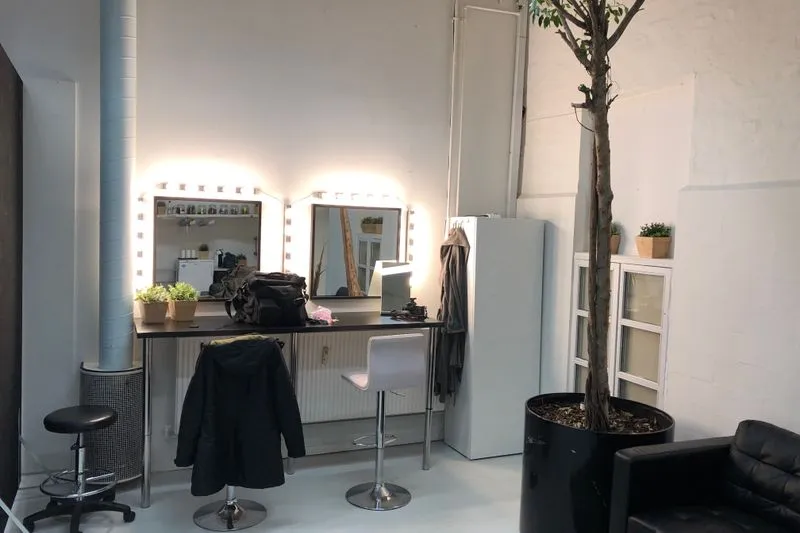
After make-up, you wait (a lot). The real job of a supporting artist is waiting. Scenes are shot in an order that has nothing to do with the script. A lighting set-up can take an hour, a location can fall through — and your scene slides from 10am to 4pm. I read a whole novel (a 400-page thriller, finished before lunch). Other people sleep, knit, play cards or revise for exams on a corner of a table (my neighbour was highlighting her contract law textbook in three colours of marker).
When your turn comes, an assistant director places everyone and gives out actions. "You cross left to right when she opens the door. You look in the shop window." There are one or two rehearsals, then the sequence you know from behind-the-scenes clips: "Quiet, please!", "Turning over", "Action!"… and "Cut". Then again. And again, with the camera at a new angle. Twenty-three times, in my case.
Lunch is from the catering truck or a packed lunch depending on the production, and it's often the best moment to chat with the other supporting artists. At the end of the day you're "wrapped" — you hand back your costume and sign out with your times. Then you head home with aching feet, feeling like you've been backstage at a show. Which is exactly what happened.

What to bring to wear (and what stays in the bag)
The booking almost always spells out the outfits wanted. Mine fitted on one line — neutral colours, no white, no stripes, no logos. Each rule has a reason. Pure white catches the light and draws the eye. Fine stripes can "strobe" on camera. A visible brand logo raises a rights question the production would rather avoid. And a supporting artist in bright red at the back of a scene steals it from everyone (precisely what she's not there for).
Bring two or three options that match the brief: "office wear", "evening wear", "student look", packed so you can show them to the costume department in thirty seconds. Think about the season in the story, not the one on the calendar. A July shoot can be a November evening on screen — and you'll spend the afternoon in a wool coat in the heat. Clean, quiet shoes too (yes, quiet): soles that clack on the pavement ruin a take while the sound recordist is recording dialogue.

If you're asked to bring something specific (evening wear, a uniform, swimwear), ask your agency when the booking comes in. On Pact/FAA productions, a change of clothing, uniforms and special clothing all appear among the supplementary fees. Better to know before than after.
The set rules nobody tells you
A film set runs on unwritten rules that the regulars know by heart and that nobody takes the time to explain to newcomers, somewhere between two takes and three changes of set-up. Here they are, as they were passed on to me that Saturday — and as I checked the hard way.
- Never look at the camera. Never (even when it glides past a foot from your nose). One glance down the lens means another take for the whole crew.
- Talk without sound. When you're "chatting" at a café table, you move your lips without making a noise: the background chatter is added in the edit.
- Repeat the exact same gesture. Same hand, same cup, same moment. That's continuity, and it will drive you mad (my spoon went round twenty-three times in the same direction).
- Change nothing between takes. No hair clip added, no glasses taken off, no jacket removed because it's hot.
- Phone on flight mode. A vibration during a take can be heard — from quite a distance.
- Don't vanish. If you leave the holding area, tell someone: the crowd team needs to find you in thirty seconds.
- Let the actors work. No selfies, no autograph requests between takes.

After the shoot: payslips, tax and getting paid
Depending on the agency, you'll be paid through PAYE (tax taken off at source) or as self-employed. Payment times vary by production and agency: my money arrived three weeks after the shoot. Ask your agency which system it uses when you register, because it changes what you need to do next.
If you're paid as self-employed, keep an eye on the total. GOV.UK says you must send a Self Assessment tax return if you were self-employed as a sole trader and earned more than £1,000 in the tax year. That's before taking off anything you can claim tax relief on. A handful of summer days won't get you there. A regular Saturday habit might.
And if you enjoy it without wanting to make it a career? Keep it as a one-off day out. For a Saturday that isn't dinner and a film, it sits nicely alongside our original weekend activity ideas. With one big difference — here, someone pays you to turn up.
Children on set: the performance licence
A child can't just turn up on a film set. GOV.UK's page on performance licences for children explains that a child under school leaving age may need a licence to take part in films, plays, concerts or other public performances. The person in charge of the production applies for it to the child's local council, and GOV.UK's advice is to ask the council if you're not sure one is needed. If the child won't be with their parent, school teacher or home tutor, they must be supervised by a chaperone approved by the council.
If your little sister, your niece or the child you babysit gets a casting call, ask the production two simple questions — who is applying for the licence, and who will be chaperoning? A serious production brings it up in the very first message.
Your first booking won't make you a star. It'll give you something better: a day on the other side of the screen and stories for the next ten years. And, who knows, a blurry elbow in a TV drama. Put your application kit together tonight. Register with one agency whose fees follow the GOV.UK rules — and say yes to the first booking that fits your diary.
Frequently asked questions
Do you need experience to become a film extra?
No. Supporting artist work is the most open door on a film set: no training, no acting CV and no experience are required. What counts is a look that fits the scene, recent photos and genuine availability on the day.
Do you need a particular look to be a supporting artist?
No. A believable street, café or market needs people of every age, height, body shape and style, because a crowd of identical faces looks fake on screen. Some bookings look for specific profiles (a period, a job, a style), but most simply want passers-by who look real.
How long is a day as a supporting artist?
A full day, so plan it as one. Call times are often early, waits are long and overtime happens. On Pact/FAA productions, overtime is paid by the half-hour. Don't book anything important for that evening.
How much does a film extra get paid in 2025?
On Pact productions under the FAA agreement, the Basic Daily Rate for a standard day is £107.19 in 2025 (plus £11.54 of holiday pay). Supplementary fees are added for tasks such as minimal dialogue, uniforms or standing in. Elsewhere, rates depend on the production and the agency.
Can an extras agency charge me a registration fee?
Under GOV.UK's rules, an agency can charge performers an upfront fee only for listing their details in promotional publications or on websites. For performers, that fee can only be charged 30 days after the contract starts — and you can cancel within that period without penalty. You're also entitled to a refund if your details aren't made available to hirers within 60 days. Commission on the work they find you normally comes out of your earnings.
Can students work as film extras?
Yes, and it's one of the easiest jobs to fit around lectures and exams, since you only accept the days you can do, which makes it far easier to plan than a weekly shift. If you're paid as self-employed, keep track of your earnings. Above £1,000 in a tax year, you need to file a Self Assessment return.
Can being an extra lead to an acting role?
Rarely, and it's better not to go in expecting it. Sometimes a supporting artist gets a line on the day because she's there, reliable, available and able to say three words without looking at the camera. For real acting work, the route is still drama classes, auditions and an agent.
Do children need a licence to be film extras?
Usually, yes. A child under school leaving age may need a performance licence for film work: the production applies to the child's local council, and the council can confirm whether one is needed. If a parent, teacher or tutor isn't with the child, a council-approved chaperone is required.
Sources
- BFI — Official BFI statistics for 2024 reveal £5.6 billion film and high-end television production spend in the UK
- GOV.UK — Charge fees as an entertainment and modelling agency: performers and entertainment workers
- Pact / FAA Rate Card, 1 January – 31 December 2025 (as published by Extra People)
- Bectu — Bectu negotiates pay increase for background artistes (March 2023)
- GOV.UK — National Minimum Wage and National Living Wage rates
- GOV.UK — Self Assessment tax returns: who must send a tax return
- GOV.UK — Child employment: performance licences and supervision for children