The first time I went to the cinema alone I was 24. It was a Sunday, 4pm, in a little neighbourhood cinema with the screen three-quarters empty. I'd suggested a film to three different people — one I really wanted to see, not a compromise — and none of them were free. I could have waited. Instead, I bought a ticket, a ridiculously large bag of popcorn (the "sharing" size, shared with nobody), and watched the film. Alone. And it was... good. Very good, in fact. I was watching exactly what I wanted to watch, reacting exactly as I wanted to react, without checking whether the person next to me was enjoying it too. Coming out into the late-afternoon light, I realised I'd spent two hours entirely in my own company. It was the first time I understood what "enjoying your own company" meant in practice.
Early April: the clocks have gone forward, the pub gardens are filling up again, and the urge to go out arrives well before your friends' diaries catch up. It's the perfect moment to try. This guide works in steps. A café comes first, then the cinema and museums, then lunch on your own. After that, a drink at the bar or a gig early in the evening, and the four safety habits worth keeping when you go out alone at night.
Why going out alone is more enjoyable than you expect
Going out alone is more enjoyable than you expect because we get two things wrong in advance: what other people will think, and how much company adds to the fun. Being alone in a public space is not the same as feeling lonely (even if the little voice in your head happily confuses the two on a Friday night).
Social psychology has looked at this hesitation closely. In Rebecca Ratner and Rebecca Hamilton's 2015 study in the Journal of Consumer Research, people considering going to the cinema alone anticipated what others would infer — that they had no one to go with — and that put them off. They also overestimated how much their enjoyment depended on having a companion beside them.
The field test is even more telling. In an experiment at an art gallery at the University of Maryland, reported by Georgetown University, participants visiting alone predicted a less enjoyable experience — and ended up enjoying it just as much as those who went with someone. Simply put: we expect it to be more awkward and less fun than it turns out to be.
On your own, the agenda is entirely yours. You choose where you go, what you do there and how long you stay, with no negotiating and no clock-watching on someone else's behalf. Your attention stays on what you came for, too: with no conversation running alongside, you notice more and take in more detail.
The other effect is room for the unexpected. With no conversation already going, you notice the bartender who wants to talk wine, or the woman at the counter reading the same novel as you. And what you choose when nobody else's preferences are in play tells you something about yourself (sometimes something surprising).
Going out alone for the first time: a step-by-step progression
To go out alone for the first time, start at the lowest step and move up one at a time. Dinner alone at a smart restaurant on a Saturday night, as a baptism of fire, is probably not the best idea. Here's a progression that works:
Level 0 — The warm-up
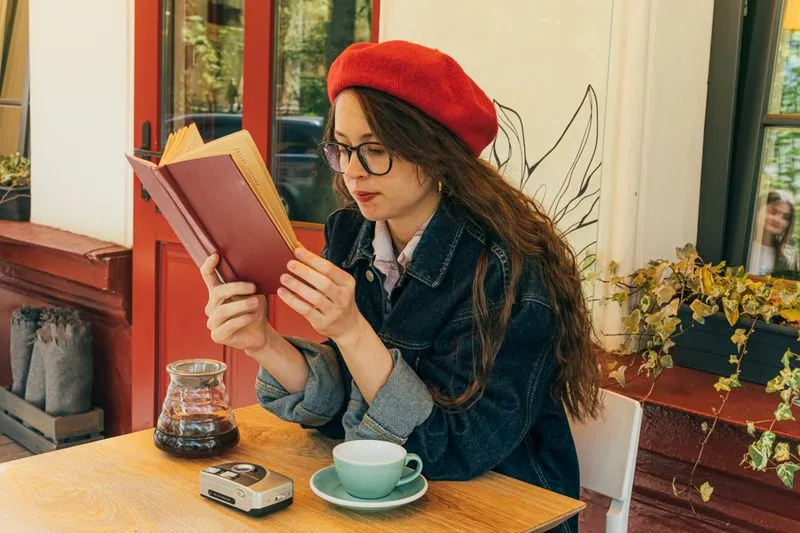
A café with a book or laptop. The point isn't "going out alone" — you're there for something (working, reading), and being alone is just part of the logistics. There's a reason this works: the same Ratner and Hamilton research found that making an activity seem more useful, or having fewer people watching, makes people more willing to do it unaccompanied.
Level 1 — Something to watch or look at
Cinema, museum, exhibition — the activity itself makes being alone unremarkable. Everyone is there to look at something, not to socialise. And if you want something beyond the usual dinner-and-a-film, our original weekend activity ideas work brilliantly solo.
Level 2 — Lunch for one
Lunch before dinner (daylight helps more than you'd think). A bar seat or counter rather than a table. A restaurant lively enough that you don't feel on display (no library silence), but not so packed you can't hear yourself think.
Level 3 — An evening out
A bar, a gig, an event where the main activity is social. The hardest level for self-consciousness — and the most rewarding once you dare it.
Eating at a restaurant alone without awkwardness
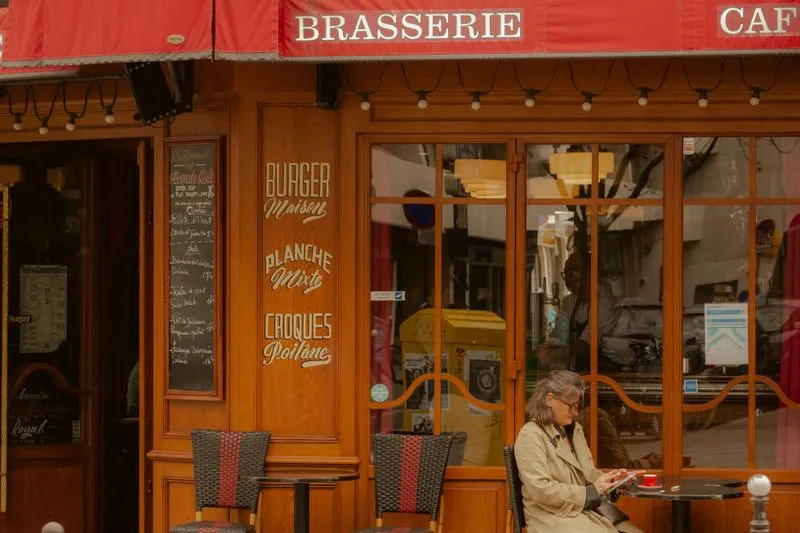
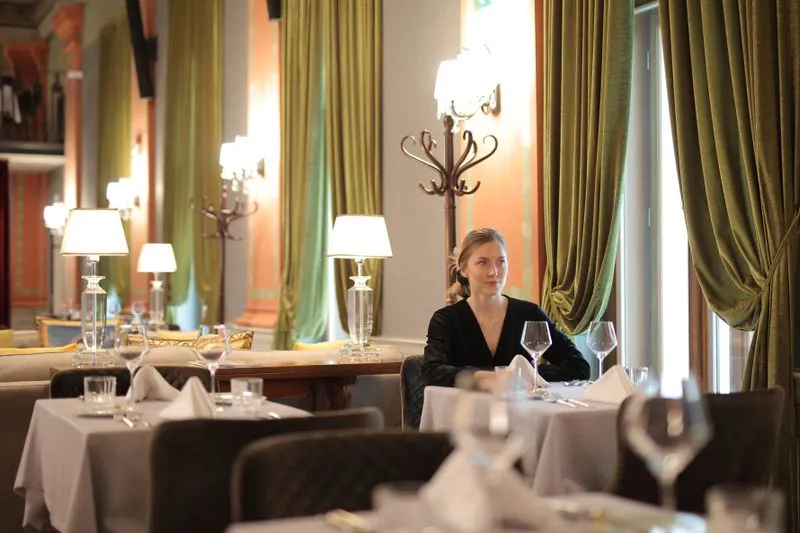
For a first meal alone, go for lunch, at the counter, somewhere lively. Meals are the moment most tied to sharing, which is why eating alone feels intimidating. Yet look around any neighbourhood café or dim sum spot at lunchtime: the tables for one are there, and nobody notices them.
A few things that help:
Choose your seat strategically. A counter stool, a terrace seat with your back to the wall, a spot facing the open kitchen — positions where being alone feels natural and where you have something to look at.
Have something to do. A book, a notebook, or one of the podcasts for women we recommend in one ear. It gives you a parallel activity and shortens the moment when your brain starts worrying about how you look.
Order exactly what you want. This is the absolute luxury of solo dining. The starter AND the pudding, not the middle-ground dish because your friend wanted the same thing. The wine that goes with the food (yes, even at a weekday lunch), not the cheapest glass because you were sharing a bottle. This is where solo dining becomes properly pleasurable.
Talk to the staff. A server or bartender makes a good conversation partner for someone on their own — not necessarily for the whole meal, but for a brief exchange. Two lines with the server about the specials, and the exposed moment has passed.
Cinema, museum, gig alone
Cinemas and museums are the easiest outings to do alone, because everyone there has come to look at the same thing; a gig takes a little more nerve.
Cinema. The ideal solo set-up: you're in the dark, everyone is watching the same thing, no one is looking at you. And you can react exactly as you want — cry, laugh loudly, nip to the loo at a crucial moment — without worrying about anyone else. My take: the cinema is better solo for films that demand real emotional presence (the kind that leaves you silent in the foyer afterwards).
Museum. In a group, you follow others' pace, you stop when they stop, you walk past the works that don't interest them. Solo: you spend 45 minutes in front of the painting that moves you and skip the entire wing that bores you. It's your museum, your pace, your visit (I plan my weekends around exhibitions, so trust me, you feel the difference).
And in the UK, the entry ticket is rarely the obstacle: free entry to all the national museums sponsored by the Department for Culture, Media and Sport began on 1 December 2001, which is why you can wander into the V&A or the Natural History Museum on a whim. For where to start, our pick of exhibitions and museums makes a good list.

Gigs. Trickier, because there's a stronger social dimension. But there's an art to the solo gig: find a strategic spot (side of the stage, near a pillar, up in the balcony if there is one) and be entirely in the music without worrying about what your companion thinks. Some gigs are better alone — electronic music or jazz in particular, where everyone dances or listens in their own bubble. And come summer, the must-attend music festivals of the season are perfect territory: everyone wanders about, and nobody keeps track of who came with whom.
Bars, pubs and evenings out solo
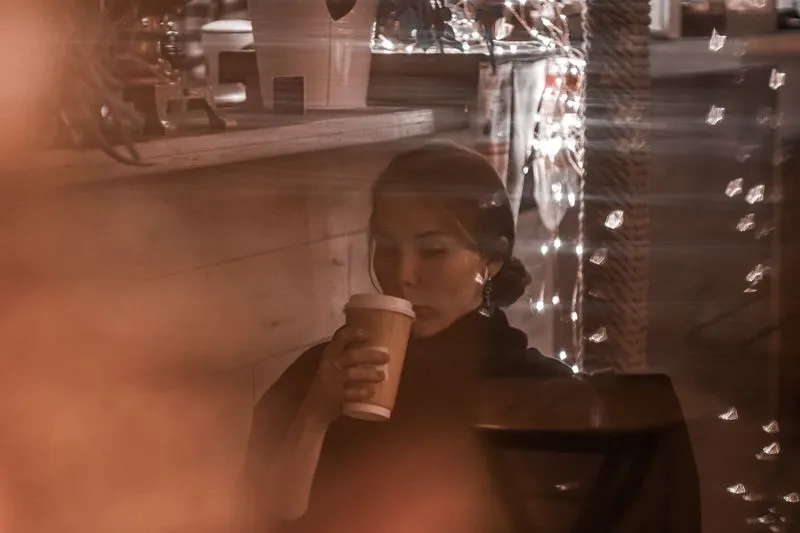
For a first night out alone, pick a wine bar, a cocktail bar or a decent pub early in the evening, and sit at the bar. Drinking alone has a bad reputation — some of it earned, most of it not.
The pub makes this easier than anywhere, because in a traditional British pub you order at the bar anyway. Nobody shows you to a table or asks how many you are. You walk up, order a half or a pint, and the stool is right there. A woman at the bar with a drink and a book is an ordinary pub sight. A quiet local on a weekday evening is the gentlest possible first step.
What's hard: walking into a heaving bar on a Friday night where everyone already seems locked into tight groups. That arrival moment is the shortest and most intense in terms of anticipated awkwardness (about thirty seconds, usually, the time it takes to find a stool).
What happens in reality: in most bars, a woman on her own quickly becomes part of the furniture if she seems at ease (or simply neutral). The bar itself — getting a drink, settling in, looking around — offers enough to carry you through the first few minutes.
- Choose the right type of bar. An intimate cocktail bar, a wine bar or a quiet local — far better for solo than a sports bar showing the match or a club. At the counter, the bartender becomes a natural person to chat to.
- Sit at the bar, not at a table. The bar is the social space of the venue. At the counter, you're part of the room's energy. At an isolated table, you're a spectator.
- Go earlier in the evening. A bar at 6-8pm is far more welcoming for solo than one at 11pm when groups are well established. In April, it's also when the beer garden still gets the sun.

How to stop feeling self-conscious going out alone
Feeling self-conscious about going out alone fades once you treat the outing as a choice rather than an admission. Three shifts help.
Stop seeing solitude as a lack. The "why is she alone?" you imagine in other people's heads is mostly a projection. The people around you are busy with their own lives, their own thoughts, their own problems (and their own phones). You're not on their radar in the way you imagine.
Reframe solitude as a choice. "I'm here because I decided to be here" rather than "I'm here because I had no one to come with." The first version keeps you in charge; the second makes the evening something that happens to you. Same situation — completely different feeling.
Treat solo outings as practice. The first time is the hardest. By about the tenth, you no longer look up every time the door opens, and you forget to get your phone out to look busy. After a while, you can't quite remember what seemed so complicated.

Going out alone at night: the safety habits that matter
Four habits cover most of what matters when you go out alone at night: telling someone, keeping your phone charged, watching your drink and knowing how you're getting home.
Let someone know. A text to a friend with "I'm at X this evening" (and another when you're home) takes ten seconds.
Keep your phone charged. Obvious, but a battery at 8% at 11pm leaves you with no cab app, no map and no way to text a friend. A small portable charger at the bottom of your bag solves it (the one lurking in a drawer since Christmas will do).
Trust your instincts. If a situation, a place, or a person makes you uncomfortable for no apparent reason, that information deserves to be taken seriously. Leaving, moving seats, asking bar staff for help — none of these need a justification. There's even a code word. Under the Ask for Angela scheme, which the Met has rolled out to bars, clubs and other licensed venues across London, anyone who feels unsafe, vulnerable or threatened can discreetly approach venue staff and ask for "Angela". A trained member of staff will then help, whether that means reuniting you with a friend, seeing you to a taxi, or calling venue security or the police.
Plan your way home. A cab app with your home address saved, knowing which night bus or Tube line gets you back. Deciding this before you go out avoids making choices when you're tired or a couple of drinks in.
Frequently asked questions
Do people really stare when you go out alone?
Much less than you think. In Thomas Gilovich (Cornell), Victoria Medvec and Kenneth Savitsky's study of the "spotlight effect" (2000), participants asked to wear a potentially embarrassing T-shirt overestimated how many observers would remember what was on it. We overestimate how much space we take up in other people's attention. And even when someone notices a person is alone — it's a neutral observation, not a judgement.
Is it weird to eat at a restaurant alone?
No. Business travellers, people grabbing lunch near the office, people who simply wanted a nice meal: tables for one are part of the scenery in any restaurant, and staff are entirely used to them. The discomfort you anticipate comes mostly from how you see yourself, not from how others see you.
Should you book a table for one?
Yes, whenever the restaurant takes bookings. A table for one books like a table for four, and it saves you the wait at the door, when you feel most on show. Ask for what you want when you book — "at the counter if possible", "by the window". For places that don't take bookings, arrive as service opens, while the counter seats are still free.
How do you handle unwanted approaches in a bar alone?
The direct, neutral response works better than excuses or half-answers: "I'd rather be on my own tonight, thanks." No need to add "I'm waiting for someone" (you don't have to lie to protect your peace), no need to smile to soften it. If someone persists after a clear answer, tell the bar staff — that's their job.
Does going out alone mean you don't have friends?
No. That's exactly the fear Ratner and Hamilton describe: we worry others will conclude we have no one. Going out alone says you wanted to go, not that your contacts list is empty. Very sociable people go out alone because they enjoy it; others never go out because they're always waiting for someone to be free. Going out alone is something you learn, like anything else.
Where can you find group outings when you don't know anyone?
Meetup groups in your city run themed outings (walks, tastings, language exchanges), and book clubs at independent bookshops or local libraries are a great way in. They make a useful stepping stone if you want to build confidence at your own pace before going out entirely on your own.
Are women who go out alone at greater risk?
I haven't found UK figures comparing solo nights out with nights out in a group. What the Home Affairs Committee did find is that spiking is poorly measured and underreported — which is why habits like telling someone where you are and watching your drink apply whether you're alone or with friends. Staying in out of fear has a cost too. The part worth planning, alone or not, is the journey home. Know how you're getting back before you go out, keep enough battery for the cab app, and text someone when you're in.
What should you do with your phone when you're out alone?
Use it for the useful things, not as a shield. Checking the last train, texting a friend, taking a photo of your plate: fine. Scrolling without reading so you look busy cuts you off from what you came out for. It doesn't protect you from anything either, since nobody is watching you as closely as you think. A book or a notebook on the table gives you the same sense of cover without shutting you in.
Sources
- Ratner & Hamilton, "Inhibited from Bowling Alone", Journal of Consumer Research (2015)
- Georgetown University, McDonough School of Business — The Value of Going Alone
- Gilovich, Medvec & Savitsky, "The spotlight effect in social judgment", Journal of Personality and Social Psychology (2000)
- GOV.UK — Ten years of free museums
- Metropolitan Police — Ask for Angela
- House of Commons Home Affairs Committee — Spiking (2022)