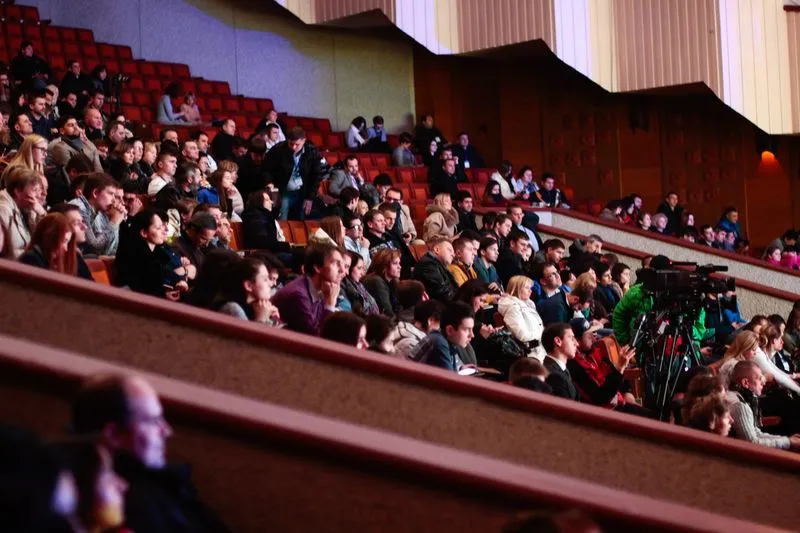
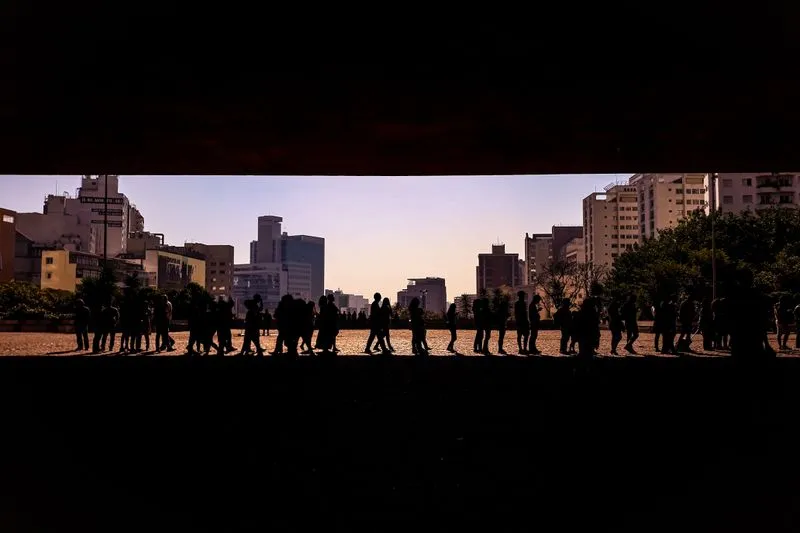
Thursday 14 April 2016, 12.50pm. I'm standing in a queue that runs along a grey warehouse of a building (the kind you drive past a hundred times without wondering what goes on inside), wedged between a railway line and the North Circular. Around me: a hundred-odd strangers. In my back pocket: an e-ticket folded into quarters. I'm 24, I have a week of annual leave to use up before the end of April and precisely zero pounds in the holiday fund. Three weeks earlier, a colleague had said over the office kettle: "Apply — it's free, and you'll finally see what's behind the screen." I was expecting two hours of glitter. I walked out at 7.35pm with red palms from clapping, a stiff back — and one thought: I want to do that again.
In between, there was an airport-style bag check, a phone handed in, a coat taken off me (in April, yes), a warm-up man who made us rehearse our applause "in three gears", a floor steward who moved me twice — my striped jumper was clearly not to her taste — and forty-seven minutes of game show recorded in over four hours. I hadn't paid a penny. I didn't regret a minute.
That's the real price of a free ticket: not a penny, but a whole afternoon and a list of rules nobody explains beforehand. So here's everything I wish I'd known that Thursday — where to apply, age limits and ID, what to wear, what you can keep on you, how long a recording really takes and the scams to avoid. If the Easter holidays have just started and your going-out budget fits in one hand, add it to our 20 original weekend ideas beyond dinner and a film.
Why are TV studio audience tickets free?
TV studio audience tickets are free because you're doing the show a favour — not the other way round. An empty studio sounds empty: no laughs, no gasps, no applause at the right moment. You are, quite literally, the soundtrack. And nobody charges the soundtrack.
Filling those seats is a job in itself, and the UK has a whole little industry built around it. Alongside the BBC's own ticket unit, independent companies recruit audiences for broadcasters and production companies. SRO Audiences — short for "Standing Room Only", although it points out that at most of its shows the audience are seated — describes itself on its About Us page as a TV and radio audience company with more than 25 years' experience. The same page is clear about money: there is "no charge to join the mailing list or to apply for tickets".
These companies don't just fill rows; they try to build the right crowd for each programme. SRO says it carefully builds "each audience profile to meet the requirements of a production". Translation: a late-night comedy panel and a Saturday teatime quiz won't want exactly the same room. Your job is simply to turn up, react — and enjoy a free look behind the scenes.
Where can you apply for free TV audience tickets?
You apply for free TV audience tickets through the broadcaster's own ticket unit or the audience company the show uses — never through a reseller. For BBC programmes, that's the BBC's Shows and Tours service. For many other shows, it's one of the specialist companies: SRO Audiences, ApplauseStore and Lost in TV all list upcoming recordings on their sites. Not sure who runs a show's audience? Check its website, its social accounts or the end credits (the production company is usually named there).
The process is simple. You create an account in your own name, join a mailing list (general or show-specific) and apply for the recordings you fancy. SRO explains that its tickets are allocated by random draw among everyone who applies through the site, so being first isn't everything — and the mailing list simply means you hear about a show sooner. If you're going as a group, apply for everyone in one go — and use the same names as on your IDs.
In 2016, I did exactly that: name, age, mobile number and my annual leave dates. A few days later, an e-ticket arrived with my name on it and a call time. No money changed hands at any point. And that's the rule of thumb for the rest of this guide — if someone asks you to pay, something's wrong.

What are the age limits and ID rules for a studio audience?
Every show sets its own minimum age, and it's shown before you apply. The BBC says so in its answer on minimum age limits, adding that, unless stated otherwise, under-18s must come with an adult. The ApplauseStore FAQs give a useful range: most shows ask for audience members aged at least 16 or 18, while some admit children as young as 8, 10 or 12 — and anyone aged 12 to 17 must be accompanied by an adult.
ID is the other half of the story. The BBC's guide to what ID to bring on the day asks every adult in the audience for original, in-date photo ID — no photocopies, nothing expired — and the name on your ticket has to match it. Its list includes a passport, a driving licence and a Citizen Card. ApplauseStore asks every ticket holder and every guest for photo ID too, unless your ticket says otherwise.
So if you're 18 but look 15 (lucky you, in ten years), don't leave home without it. And if you're planning to bring your younger cousin along, check the age limit first — then check who's going to be the accompanying adult.
Why doesn't a free ticket guarantee a seat?
A free ticket doesn't guarantee a seat because the BBC and several of the big audience companies deliberately give out more tickets than there are seats. The reason is simple — when something is free, a chunk of people don't turn up. The BBC spells it out in its answer to "Does my ticket guarantee me a seat?": it issues "more tickets than there are seats available". ApplauseStore says the same thing (tickets are distributed in excess of studio capacity to cover the no-shows), and Lost in TV's FAQs put it bluntly: "we overbook to ensure a full studio".
The result: entry is first come, first served. That Thursday in 2016, around ten people who arrived after 1.30pm went home without seeing the set. Nobody refunded their Overground fare — and ApplauseStore, for one, states that it can't cover travel or accommodation costs for anyone who isn't admitted.
Does that mean camping outside the studio at dawn? It depends on who issued your ticket. The BBC validates tickets at a set time, and its page on what happens when you arrive asks you not to turn up too far ahead of it, because queueing early won't get you a particular seat (until validation, entry is still first come, first served). At ApplauseStore and Lost in TV, where entry is simply first come, first served, the advice goes further. ApplauseStore advises arriving as early as you can before the 'arrive by' time on your ticket, and Lost in TV recommends getting there before the doors open.
The safe bet: read the time on your ticket and be there before it — well before it if the organiser warns that it issues more tickets than seats. Turning up bang on time for an overbooked recording is how you end up walking home.
How long does a TV recording really take?
A TV recording takes far longer than the programme it produces: allow at least two to three hours for one episode, before you even count the queue. That's the range ApplauseStore gives for most half-hour and hour-long programmes, blaming retakes (the mistakes you never see at home) and technical problems. Lost in TV gives the same order of magnitude — around two to three hours for most shows. Live shows are more predictable: ApplauseStore says they usually last the length of the broadcast plus an hour for getting the audience in and out.
What stretches the day is everything around the recording — the queue, the security check, the cloakroom, being seated row by row, the warm-up. Here's my 2016 afternoon, from queue to exit:
| Time | What was happening |
|---|---|
| 12.50pm | Queue outside, ticket and ID check. |
| 1.40pm | Bag search, phone and coat to the cloakroom. |
| 2.20pm | Seated in the audience, row by row. |
| 2.35pm | Warm-up with the comedian running the room. |
| 3.05pm | Recording starts, with stops to redo sections. |
| 5.10pm | Twenty-minute break, without leaving the building. |
| 7.20pm | Recording ends, back to the cloakroom. |
| 7.35pm | Out. About six hours and forty-five minutes in total. |
Six hours forty-five for forty-seven minutes of television. I'm not telling you this to put you off — I'm telling you so you keep the whole afternoon free and don't promise anyone drinks at 6pm. Even the recording alone ran long that day: over four hours for a single episode, thanks to retakes and one very uncooperative microphone.
What should you wear in a TV studio audience?
In a TV studio audience, wear something simple, comfortable and easy to layer — and read your ticket, because its instructions trump everything else. Every show has its own rules. Lost in TV says smart casual is usually fine, but tells ticket holders to check their ticket for any specific instructions. The BBC, meanwhile, reminds you that you'll often queue outside until your ticket is validated, so dress for the weather.
I never found out what the floor steward had against my striped jumper (the stripes? the colour? my face?). The next time, I kept it simple: plain colours, no big logos, nothing sparkly. That's my opinion, not a written rule — but a neutral outfit will never earn you a comment, and it leaves you free to be seated wherever they need you.
Think comfort, too. You'll stand outside, then sit for hours on tiered seating (mine had no back). Studio lights can make the room warm — or not, depending on the studio. Hence the layers: a T-shirt, then a shirt or a light cardigan over the top, and you adjust as you go.

Phone, bag, snacks: what can you bring into a TV studio?
Bring the bare minimum: your photo ID, your ticket, any medication you need and a small bag. At BBC venues, the rules on what you can take into the studio allow one bag per person, no bigger than A4 or a standard handbag. Backpacks, travel cases, laptop bags and large totes are not allowed — and every bag is checked on the way in. There's often no cloakroom at all, so travel light.
And your phone? It depends on the show. The BBC says some programmes (Strictly Come Dancing is its example) make you hand your phone to security for the whole recording; where you can keep it, you're asked not to use it in the studio. Cameras and recording equipment are banned outright. ApplauseStore's terms go further: no photos, no videos, no footage of any kind — and no food or drink taken into the venue.
The logic is always the same: nothing that can film, flash, ring or rustle during a take. Leave the family-size crisps at home (sorry).
During the recording: the warm-up act and laughter on cue
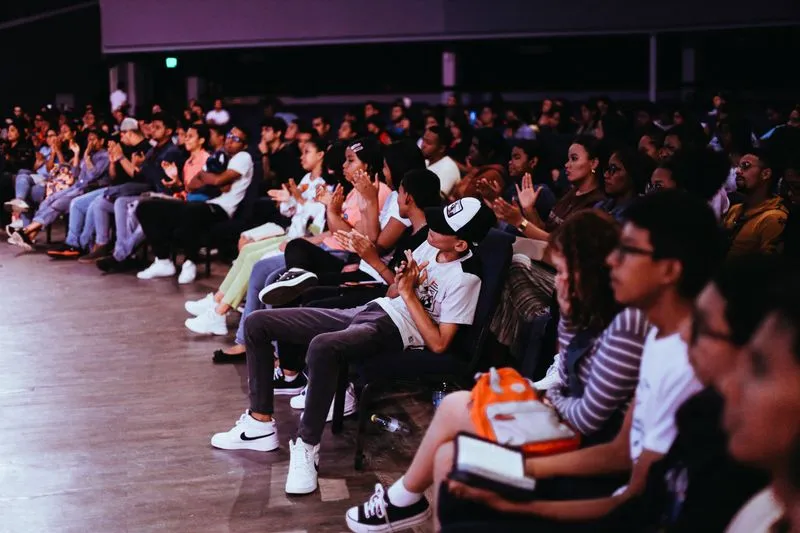
During the recording, your job is simple — react when you're asked to, and stay quiet the rest of the time. The person running the room isn't the host. It's the warm-up act (ours, in 2016, was a comedian in a very loud shirt), who gets you going before the first take, teaches you the signals and lifts the energy whenever it dips.
That day, he had a system with three gears. First gear: polite applause. Second gear: applause plus whooping. Third gear — the big finish — on your feet, arms in the air (as if your team had just won the World Cup). We rehearsed each gear three times before the first take. Then we applauded the host's entrance… five times. The first was too limp, the second too early, the third ruined by a camera — and I never did find out what was wrong with the fourth.
Around you, a small army is at work. Floor stewards fill the rows, squeeze people together and plug the gaps. Producers sometimes need a particular type of person for a segment. You might end up on screen. You might not appear at all. You don't get a say.
Being filmed: what do you agree to when you walk in?
When you walk into a studio audience, you agree to be filmed and broadcast — that's the whole point of you being there. The detail is in the small print. ApplauseStore's terms and conditions say that by taking part in a recording, you allow any broadcaster the right to use the footage and give them clearance "throughout the world". Worldwide — and with no time limit mentioned in that clause.
In practice, that means your face can pop up again in a repeat, a blooper reel or a clip on social media, years later. In 2016, I signed a release form at the front desk, between the ticket check and the cloakroom — without reading a word of it (don't copy me). Other audience companies have their own wording, so read yours before the day — it takes five minutes.
Paid tickets and fake sites: which scams should you watch for?
Studio audience tickets are never for sale, so anyone selling you one is either scamming you or selling a ticket that won't get you in. The genuine companies say it loud and clear. SRO Audiences warns that anyone selling or buying tickets will not be admitted. ApplauseStore calls its tickets complimentary, never for sale and non-transferable — and says it takes action against people advertising them on sites such as eBay.
The warning signs are all alike (and none of them is subtle). An "admin fee" to confirm your place. A "VIP seat" offered by direct message. A site that looks like a broadcaster's and asks for your card details to "hold" your seat. A real audience company doesn't need your bank card to send you a free ticket — full stop.
And if an offer looks convincing? Go back to the source. The show's website, its official social accounts or the end credits will tell you who handles its audience. If the names don't match, walk away. Let's be honest: a free ticket that suddenly costs money at the last minute is never a bargain.
How do you plan a studio day out on a budget?
A day at a TV recording costs you your travel and your lunch — as long as you plan it properly. Look up the studio address as soon as your ticket arrives (not the night before), check your route and add a buffer. Arriving late means staying outside.
Go with a friend or two (it's more fun). Many tickets let you add guests under your name — check how many — and six hours fly by with someone whispering commentary in the breaks. One catch: ApplauseStore won't let you join the queue until your whole party is there, so no saving places for a friend running late.
As budget days out go, it's hard to beat. The same afternoon at a gig or a festival would cost you a small fortune — and after more than thirty festivals, I know exactly what a day on your feet in front of a stage costs (for planning those, our guide to the must-attend summer music festivals). Here, you pay your fare and your sandwich — that's it. And if live telly is more your thing than an edited recording, May has the biggest night of the year: our complete Eurovision guide will get you ready.
Tonight, sign up to one or two audience mailing lists for shows you actually watch. Pick a weekday date with nothing planned after 6pm. And on the morning itself, put on a plain top, eat a proper meal and slip your photo ID into your bag. Leave the striped jumper at home. Trust me.
Frequently asked questions
Are TV studio audience tickets really free?
Yes. The BBC and the main audience companies give tickets away free, and SRO Audiences states there is no charge to join its mailing list or apply. Your only costs are travel and food. Anyone asking for money or card details for an audience ticket should set alarm bells ringing.
How old do you have to be to be in a TV audience?
It depends on the show, and the minimum age is shown before you apply. ApplauseStore says most shows require audience members to be at least 16 or 18, with some admitting children as young as 8, 10 or 12. At the BBC, under-18s must be accompanied by an adult unless a show says otherwise.
How long should you allow for a recording?
Allow at least two to three hours of recording for one episode, plus the queue, security and seating. Block out a whole afternoon or evening. My first recording took six hours and forty-five minutes from queue to exit, for a forty-seven-minute show.
Can you go to a TV recording on your own?
Yes, and it can be easier: a single person is simple to seat. You'll end up chatting to your neighbours during the breaks. If you'd rather go with friends, check how many guests your ticket allows and arrive together.
Will I be on TV?
Maybe. Stewards seat the audience to suit the production, and you don't choose your place or the reaction shots. By taking part, you agree to the footage being used, including in repeats and clips.
Can you keep your phone during the recording?
Sometimes, but never to use it. Some shows make you hand it in for the whole recording; others let you keep it on you, as long as you don't use it in the studio. Photos, videos and social media posts from the studio are always off-limits.
What should you do if you can no longer go?
Let the organiser know as soon as possible, using the cancellation link on your e-ticket if there is one. Your seat can then go to someone else. Don't pass it to a friend: tickets are usually in your name, and she could be turned away at the door.
Sources
- BBC Shows and Tours — Does my ticket guarantee me a seat?
- BBC Shows and Tours — What is the minimum age limit for shows or events?
- BBC Shows and Tours — What can I take into the studio with me?
- BBC Shows and Tours — What happens when I arrive at the venue?
- BBC Shows and Tours — What ID should I bring with me on the day?
- ApplauseStore — Frequently Asked Questions
- ApplauseStore — Terms and Conditions
- SRO Audiences — About us
- Lost in TV — Frequently Asked Questions