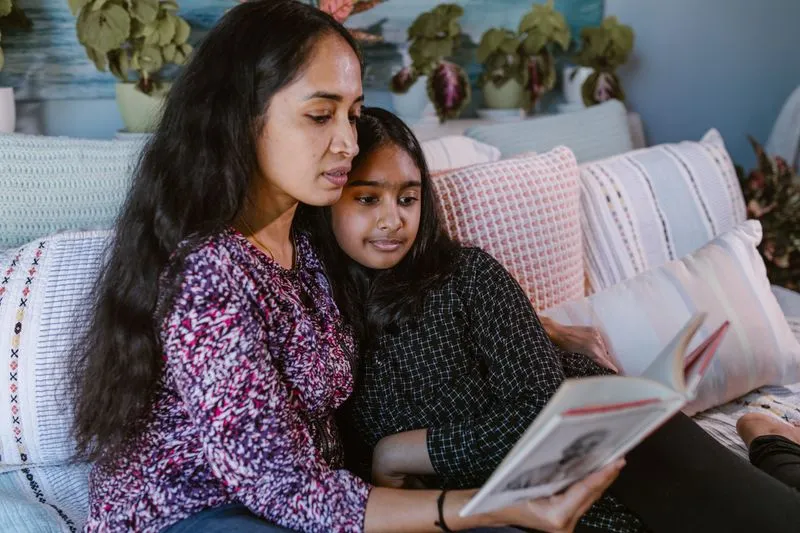
Wednesday, 9.05pm. On the fridge door, between the swimming timetable and a drawing from Reception, the kit list for the Year 5 residential — five days at an outdoor activity centre, coach leaves Monday. Sleeping bag, torch, waterproof, "wash bag clearly labelled with your child's name". You've ticked almost everything. Except your daughter is ten and a half. Her chest started changing last summer. And for a few weeks now, sorting the washing, you've noticed a whitish mark in her knickers. The pen stops: what if her period starts there, in a dormitory of twelve, three hours up the motorway?
She knows what periods are — in theory. A lesson at school, perhaps, and plenty of playground talk. But where to find a pad, how to put one on, who to tell when you're away from home? Nobody has actually shown her. And for many girls, that first time is unsettling. In a 2019 Plan International UK poll of 1,000 girls aged 14 to 21, nearly half (49 per cent) said they felt anxious when their periods first started — a third felt embarrassed, and three in ten felt frightened. This guide covers what to have in place before that first period: the age and the early signs, when to see a GP, the kit to pack, the products that suit a beginner. And a way of talking about it that doesn't turn it into an ordeal for either of you.
What age do periods usually start?
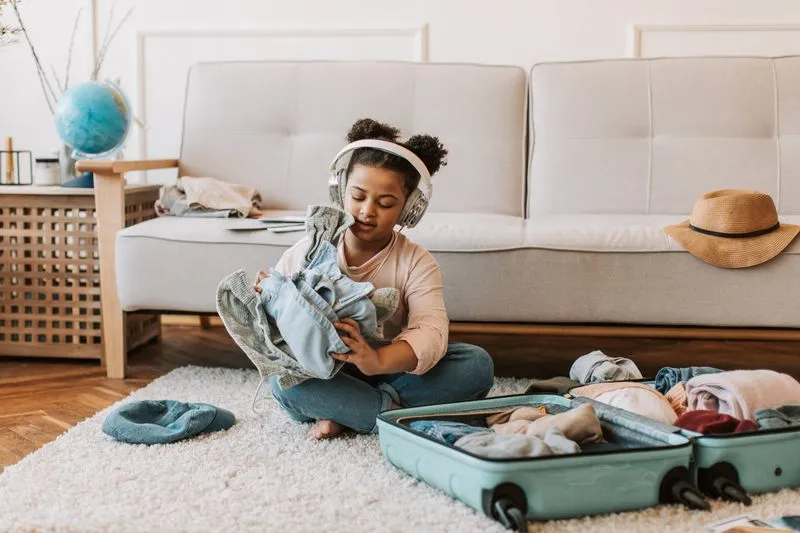
Most girls start their periods at around 12. The NHS guide to starting periods adds straight away that they can start as early as 8 — which is exactly why it recommends talking to girls from an early age. The usual window runs from 8 to 17, or roughly two years after the first signs of puberty.
A first period doesn't start puberty; it arrives partway through. For girls, the average age for puberty to begin is 11, and anywhere between 8 and 13 is perfectly normal. By the time her period comes, your daughter's body will usually have been changing for a couple of years.
Why can two girls in the same class be so far apart? Family patterns play a part — the NHS notes that early or late puberty can simply run in families. Weight, heavy training and stress can also delay periods. So a girl of 10 with her first period isn't "too early", and a girl of 14 without one isn't "behind". It's the overall picture — and the order things happen in — that tells you most.
The signs that a first period is on its way
The first visible sign of puberty in girls is nearly always the same — breast development. Underarm and pubic hair come next (the NHS lists them among the signals that a period is on its way). It also gives parents a handy rule of thumb: a first period typically arrives about two years after breasts start growing. If your daughter's chest began developing eighteen months ago, the moment is getting close.
The second clue tends to turn up in the laundry basket — vaginal discharge. Brook, the young people's sexual health charity, explains that in puberty it's normal for the vagina to produce a small amount of clear or milky fluid, which keeps it healthy. It isn't a hygiene problem. But it is exactly the kind of detail that worries a ten-year-old if nobody has mentioned it.
Other changes come along at the same time: a growth spurt (the school trousers bought in September that are too short by March), more sweat, sometimes spots, and moods that swing more than they used to. None of these signs gives you a date. Together, though, they tell you the question is no longer theoretical.

First period too early or too late: when to see a GP
Most girls go through puberty without needing any medical input. Two situations do call for a GP appointment, though — and the thresholds are precise.
Puberty is considered early (precocious) when a girl shows signs of it before the age of 8. The NHS page on early or delayed puberty points out that some girls develop one sign without the others — periods before 8 with no breast development, for example — and that this also needs a GP. Early puberty mostly affects girls and often has no obvious cause.
Puberty is considered delayed if a girl hasn't started developing breasts by 13, or has breasts but no period by 15. For periods specifically, the NHS advice is to see a GP if they haven't started by 15 (or by 13 if there are no other signs of puberty). The GP may suggest a blood test to check hormone levels. They may also refer your daughter to a specialist (usually a gynaecologist), who might arrange a hand X-ray or a scan.
One situation deserves particular attention: the very sporty girl. The NHS lists being underweight and doing lots of exercise — including dance, gymnastics and athletics — among the possible reasons for delayed periods, alongside stress and hormone imbalance. If your daughter trains hard and her periods haven't come, mention it to the GP rather than waiting.
How to talk to your daughter about periods without awkwardness
The period conversation works better as lots of small chats than one big one. The closed bedroom door, the serious voice, the "we need to talk" — that's usually what makes everyone tense. The NHS puts it simply: "Try to talk about periods as an ongoing process rather than a formal sit-down talk." A TV advert, a trip down the supermarket aisle, a question about the box on the bathroom shelf — each one is an opening.
Start by listening. Ask what she already knows, what her friends say, what she's heard at school. You may uncover a few myths — that you lose "loads of blood", that you can't go swimming, that a tampon can get lost inside you. Correcting one myth is much easier than delivering an entire lecture.
Use the proper words: womb, vagina, vulva, period. Not "down there". Clear language makes the subject ordinary — and she'll need those words with the GP, the school nurse or the leaflet in a box of tampons. If that vocabulary feels tricky to introduce, our age-by-age guide to talking with children about their bodies and consent has pointers that carry straight over to periods.
Tone matters as much as content. Periods aren't an illness or a drama; they're something bodies do, like digestion. Watch the big symbolic lines, too. "You're becoming a woman" loads the moment with a meaning a ten-year-old didn't ask for. Something practical is far more reassuring — one day she'll see a bit of blood in her knickers, it's normal, and here's what she'll do. "What do I do?" calms nerves better than "What does it mean?"
Don't leave the conversation to mum alone. A dad, a stepdad, an aunt or a godmother can take it on — which matters a great deal if your daughter spends part of her time in another household. Boys need to learn about periods too (the NHS says so explicitly): what's explained calmly at home is less likely to become a joke at school. For keeping the tone open over the years, the principles of positive parenting applied to everyday conversations offer practical tools.
What your daughter needs to know before her first period
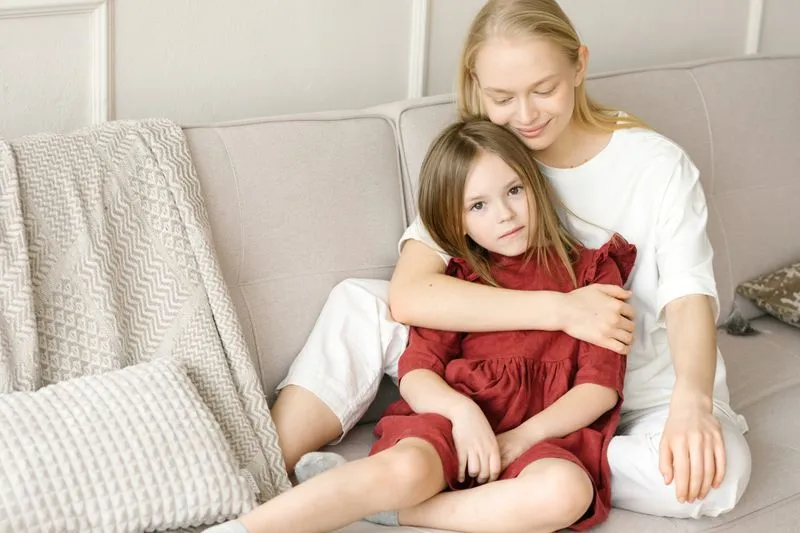
Before the day comes, your daughter needs five pieces of information. They fit into ten minutes — and bear repeating as often as she likes.
What a period is. Each month, the lining of the womb thickens, ready for a possible fertilised egg. If there's no pregnancy, the lining breaks down and leaves the body through the vagina. That's the period.
What the first one looks like. Not a flood. The NHS describes it plainly: "It's not a sudden gush" — more often a reddish-brown stain on her pants, or on the sheets in the morning. The total blood lost over a period is only about 20 to 90ml (roughly 1 to 5 tablespoons), spread over several days. That detail alone reassures girls who imagine a scene from a film.
How long it lasts. A first period may be short. Once things settle, the NHS says a period comes every 23 to 35 days and lasts 2 to 7 days — usually heaviest in the first couple of days.
That it will be irregular at first. This is the piece parents most often forget. It can take the body some months to find a regular pattern — three weeks, then two months, then a missed month. The NHS notes that most girls have regular periods by the age of 16 to 18. It's normal, and it's worth saying before it happens.
That it doesn't stop anything. Sport, dance, the residential trip — nothing needs cancelling. Only swimming depends on the product she's using.
A sixth point can wait or come straight away, depending on your daughter: starting periods means her body is now able to get pregnant. Some eleven-year-olds ask about it themselves. Answer what's asked, without racing ahead.
The first period kit: what to pack and where to keep it
A first period kit fits into something the size of a pencil case. The NHS suggests that girls start carrying pads or tampons around before their period begins — and keep a spare pair of pants (and tights, in winter) at school or in their bag. That's the whole idea of the kit: being ready before it's needed.
| Item | How many | Why |
|---|---|---|
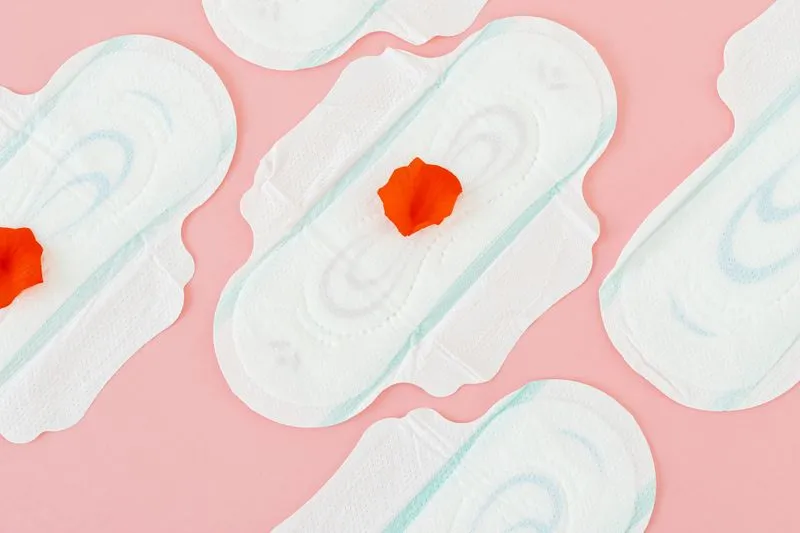
| Pads (regular flow, individually wrapped) | 2 or 3 | The simplest product for a beginner. |
| Spare knickers (and tights in winter) | 1 pair | A first period is often discovered on pants that are already stained. |
| Small opaque zip bag | 1 | To carry stained underwear home discreetly. |
| Pocket tissues | 1 pack | To wrap a used pad before it goes in the bin. |
| A short note in your handwriting | 1 | What to do and who to ask. |
Pick a plain pouch that looks like any other pencil case. At eleven, discretion matters far more than the pattern. Better still, let her choose it herself.
Make two kits. One lives in her school bag (or PE bag); the other stays in the bathroom, somewhere she knows. For a residential trip, add a full packet of pads and two extra pairs of knickers to her wash bag — even if it seems unlikely. Nobody will know they're there except her.
Pads, period pants, tampons or a menstrual cup: what suits a beginner?
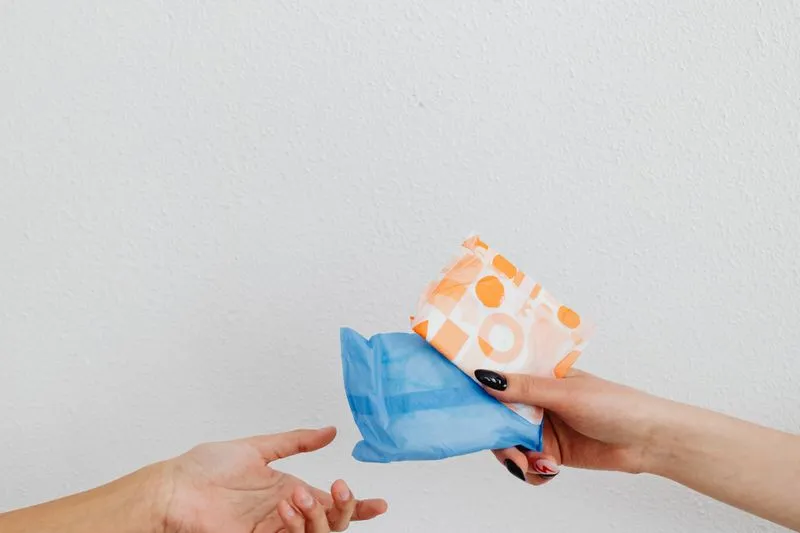
For a first period, pads remain the easiest place to start. They stick into underwear, need no practice and can be worn overnight. The NHS suggests pads for the very first period, because tampons and cups can take some getting used to — but it also states that tampons, menstrual cups, disposable or reusable pads and period pants are all safe and suitable for someone who has just started. Experimenting until she finds what suits her is part of the process.
| Product | Why it suits a beginner | What to know |
|---|---|---|
| Disposable pads | No practice needed, sold everywhere, fine for nights. | Can't be worn for swimming. |
| Reusable pads | Easy to use, cheaper over time. | Need washing and drying, plus a bag to carry used ones. |
| Period pants | Worn like normal knickers, good for nights. | Higher upfront cost; VAT was scrapped on them in January 2024. |
| Tampons | Allow swimming; can't be felt when inserted correctly. | Change every 4 to 8 hours, lowest absorbency for the flow. |
| Menstrual cup | Reusable, allows swimming. | Takes practice; she'll need somewhere to rinse it. |
On cost, two changes help families. The "tampon tax" (VAT on period products) was abolished on 1 January 2021. And since 1 January 2024, VAT no longer applies to period pants either — HM Treasury put the saving at up to £2 on a £12 pair.
For tampons, the instructions in UK leaflets follow the UK Code of Practice for Tampons — a voluntary code drawn up by manufacturers and shared with the government's Office for Product Safety and Standards. It asks them to tell users to change tampons every 4 to 8 hours (more often if needed), to use the lowest absorbency for their flow, and to wash their hands before and after. For night-time use, the code advises putting in a fresh tampon just before sleep and changing it first thing in the morning. That said, for a beginner, pads at night keep things simple.
Can a tampon get lost inside her? No. The NHS answers this directly: a tampon stays in the vagina, and its string stays outside the body so it can be removed. If one is forgotten and can't be pulled out, a GP or a sexual health clinic can remove it.
Toxic shock syndrome: the rule to pass on with the first box of tampons
Toxic shock syndrome (TSS) is rare, but it's worth explaining the day your daughter starts using tampons. The NHS page on toxic shock syndrome describes it as "a rare but life-threatening condition caused by an infection", which can happen when using a tampon or menstrual cup. Symptoms develop quickly, and urgent treatment is needed.
The warning signs to know: a high temperature, feeling shivery with aching muscles, feeling sick or dizzy, and a rash that feels rough, like sandpaper. The UK tampon code adds vomiting, diarrhoea, a sore throat and a sunburn-like rash to the list printed in every leaflet — and points out that not all the symptoms may appear together.
The rule to pass on is short. Wash your hands before and after. Follow the leaflet, and never leave a tampon in longer than recommended. Use the lowest absorbency that copes. Copy it onto the kit note the day she moves on to tampons.
Period pain in teenagers: what's normal and what isn't
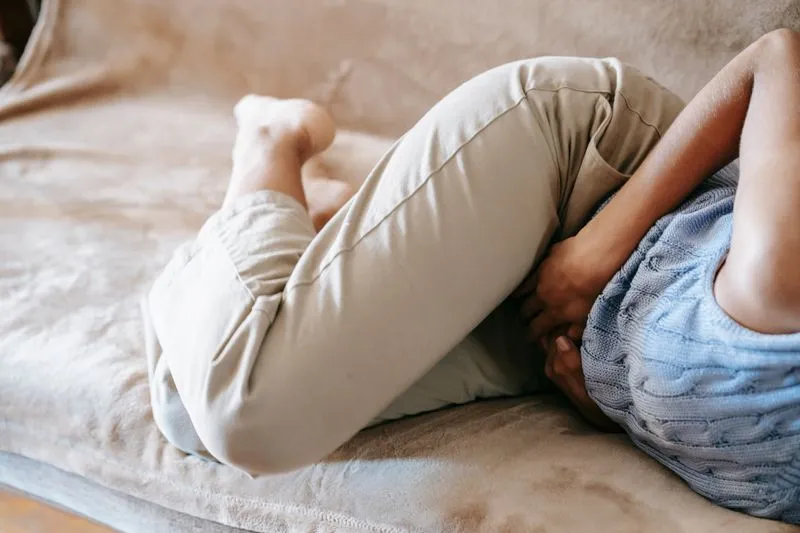
Period pain is common in the teenage years; missing school because of it shouldn't be. The NHS guide to period pain describes the usual pattern — cramps in the tummy that can spread to the back and thighs, around the start of a period, usually lasting up to three days. And the impact on school is real: in the Plan International UK poll, two thirds of girls (66 per cent) reported missing part or all of a school day because of their period.
For ordinary pain, several things help: a hot water bottle wrapped in a tea towel, a warm bath or shower, massaging the tummy and back, gentle exercise (walking, swimming, cycling or yoga). Painkillers such as paracetamol or ibuprofen can be used — at the dose on the packet for her age.
The point to act on is specific. The NHS advises an urgent GP appointment (or NHS 111) if period pain is severe or worse than usual and painkillers haven't helped. A routine GP appointment is the right step if periods become more painful, heavier or irregular. Severe pain can sometimes come from a condition such as endometriosis, where tissue similar to the womb lining grows elsewhere — one more reason not to dismiss it. To prepare for that appointment, our guide to endometriosis symptoms and diagnosis suggests a pain diary kept over two or three cycles.
First periods at school and on residential trips: what's available
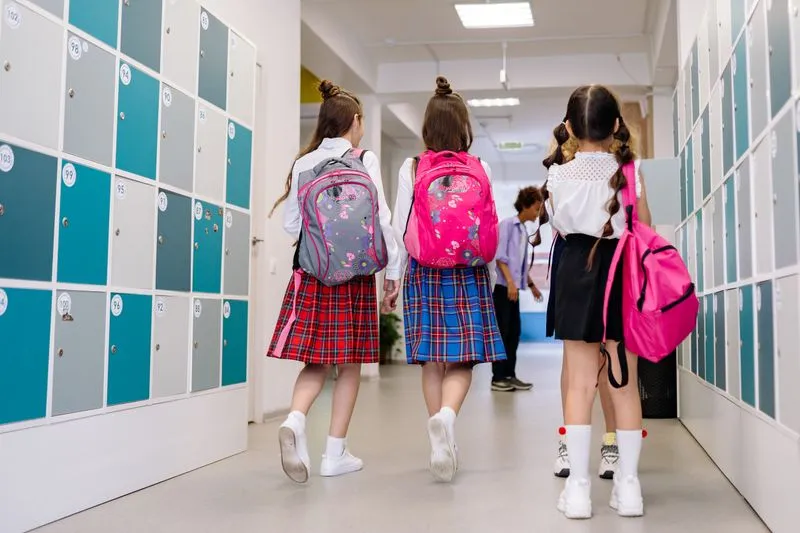
If her period starts in class, your daughter won't be on her own. Since January 2020, a Department for Education scheme has offered free period products to state schools and colleges in England. The minister who launched it put the aim plainly: "Periods are a normal part of everyday life and we do not want young people missing out on lessons because of them."
The subject is also part of lessons. Health education has been compulsory in state primary and secondary schools in England since September 2020. The Department for Education's statutory guidance asks primary schools to cover the key facts about puberty — particularly from age 9 to 11 — including menstrual wellbeing and the menstrual cycle, and ideally before periods start. Ask the school what's been covered, and when, so you can pick up the thread at home.
Those lessons complement what you say; they don't replace it. And teasing still happens. In the same Plan International UK poll, one girl in five (20 per cent) had been teased or bullied about her period — two thirds of it at school.
For a residential trip, one simple step makes a big difference. Let the group leader know, discreetly, that your daughter might start her period while she's away — and tell your daughter which adult knows. She won't have to explain anything; she'll just need to find that person. If the idea embarrasses her, respect that and rely on the kit.
The day her first period arrives: how to react
On the day her period starts, your reaction matters more than all the preparation. A girl who tells you there's blood in her knickers looks at your face first. A calm, almost ordinary tone tells her everything is fine. A wave of emotion — even a happy one — can make her squirm. Some families mark the day (a small present, a favourite dinner of her choosing), others prefer not to. Let her set the tone.
On the practical side, three things are enough. Check she has a pad on and knows when to change it. Show her how to deal with stained knickers (a cold-water rinse first, then the wash). And suggest she notes the date — in a diary, or with an online period calendar, which the NHS mentions as a way to work out when the next one is due.
Then there's privacy. It's her decision who knows — her dad, her brothers and sisters, her grandparents. An announcement over Sunday lunch without asking her first can leave a memory that's hard to shake off. Just ask her.
If she has a phone, she'll look things up online. Rather than stopping her, point her to reliable sources such as the NHS and Brook — and keep in mind the ground rules for a healthy balance with screens, which apply to these searches as well.
Go back to the kit list on the fridge. Add one line by hand, right at the bottom: "red pouch (in wash bag)". Your daughter will know what it means. Nobody else needs to.
Frequently asked questions about first periods
My daughter is 9 and her breasts are starting to develop: will her period start soon?
Not necessarily straight away. A first period usually arrives about two years after breasts begin to grow, and most girls start at around 12. Signs of puberty from the age of 8 are within the normal range. Before 8, see a GP.
Can a first period arrive with no warning at all?
Yes. Discharge, breast development and a growth spurt tell you it's getting closer, but never give a date. That's why the NHS suggests carrying pads before they're needed — and why the kit should be in her school bag well ahead of time.
Can she use tampons from her very first period?
Yes. The NHS says tampons, menstrual cups, pads and period pants are all safe and suitable when periods have just started, though pads are often easier for the very first one. The safety rule doesn't change with age: the lowest absorbency for her flow, changed every 4 to 8 hours or as the leaflet says.
Her second period came three months after the first. Should I worry?
Not at this stage. It can take the body some months to settle into a regular pattern, and most girls have regular periods by 16 to 18. Keep a note of the dates. If her periods stop altogether after settling, or become heavier or more painful, see the GP.
Does she need to stop sport or swimming during her period?
No need to stop sport — gentle exercise can even ease cramps. Swimming depends on the product: pads don't work in water, whereas tampons and cups do. If she doesn't feel ready for a swimming lesson, have a word with her teacher.
Does she need to see a gynaecologist after her first period?
Not routinely. The GP is the first port of call for most questions, and can refer her to a specialist (usually a gynaecologist) if needed — for very early or very late puberty, pain that keeps her off school, or very heavy periods.
Sources
- NHS — Starting your periods
- NHS — Periods
- NHS — Early or delayed puberty
- NHS — Toxic shock syndrome
- NHS — Period pain
- NHS — Heavy periods
- Brook — Puberty
- AHPMA — UK Code of Practice for Tampons
- GOV.UK — Free period products for all schools and colleges (2020)
- GOV.UK — Relationships and sex education (RSE) and health education: statutory guidance
- GOV.UK — Tampon tax abolished from today (2021)
- GOV.UK — VAT on period pants scrapped (2024)
- Plan International UK — One in five UK girls teased or bullied because of their period (2019)