
"Sleeves, I can shorten. Shoulders, never."
The alterations lady on my road said it without looking up — two pins between her lips, thumb pressed on my left shoulder seam. Saturday just gone, 5.40pm, in a Hackney alterations shop the size of a changing room: one sewing machine, a rail of trousers waiting for hems, the smell of steam and wet pavement. I was wearing a beige trench I'd found an hour earlier in a vintage shop round the corner. Heavy cotton, lining intact, belt present (a small miracle, second-hand). And two centimetres too much on each shoulder.
"Two centimetres doesn't sound like much," she added. "But to take them in, I'd have to unpick the collar, the sleeves and the back. It'll cost you more than the coat." She took out the pins and filed my left shoulder under lost causes.
I left with the coat over my arm and a lesson I really should have known. I've spent years telling you that the trench is the one wardrobe basic worth splashing out on — and I'd just bought mine backwards. You choose a trench by the shoulders. Then by the length. Then by the fabric. Colour, buttons and the name on the label come after — long after.
April is trench season — jumper in the morning, T-shirt by lunch, and a shower somewhere in between (never on the day you packed an umbrella). Here's the guide I wish I'd read before walking into that shop: fabric, length, quality details, real prices and six ways to wear it. Buy a trench once — and keep it for years.
Shoulders first: the one flaw no alteration will fix
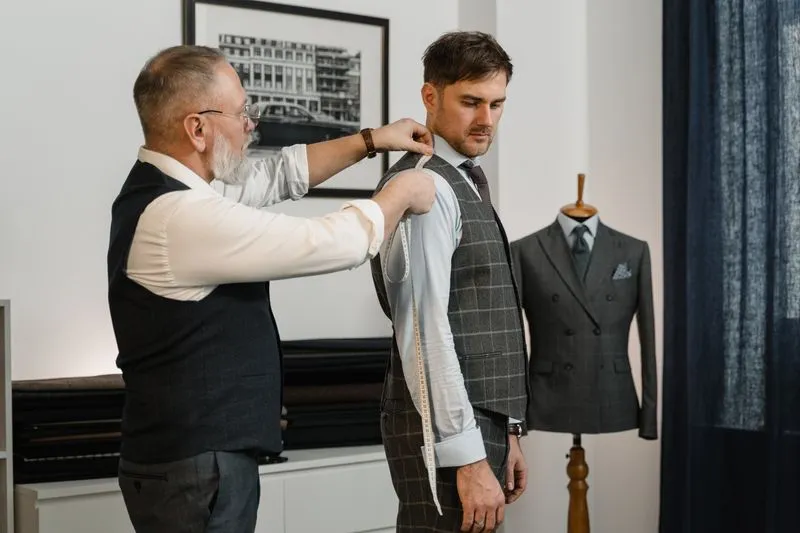
A trench coat is judged on the shoulders first, because they're the one area you can't correct after buying. Sleeves can be shortened, hems taken up. But a shoulder that's too wide (or too narrow) means unpicking the collar, the sleeves and sometimes the back yoke — the whole coat, in other words.
The rule fits in one sentence: the shoulder seam should sit right at the edge of your shoulder (on that little bony point you can feel under your fingers). A centimetre beyond it is fine — on a deliberately oversized cut. Two centimetres, and the coat looks borrowed. Literally.
In the fitting room, do four things before you even look at yourself head-on:
- Cross your arms in front of you. If the back pulls between your shoulder blades, it's too tight.
- Raise both arms. The hem should only ride up a few centimetres — and your wrists shouldn't shoot out of the sleeves.
- Sit down, buttoned up. The lower buttons shouldn't strain across your hips.
- Close the collar all the way up. If you can't breathe, you'll leave it open on windy, wet days — and then what's the point?
From the Western Front to your wardrobe: what each trench detail is for
Every detail on a classic trench once did a military job — and knowing which helps you judge a copy. BBC News's piece on the trench coat's forgotten First World War roots explains that it was never standard issue for every soldier. It was worn by officers, "who, unlike other ranks, were allowed to procure their own clothes from tailors and outfitters". A mark of rank, right from the start.
The same article explains four of the details that survive on today's trench — and why they were there:
- The epaulettes (the buttoned straps on the shoulders): they displayed an officer's rank.
- The gun flap (the extra layer buttoned over the chest): it gave a little additional protection in combat.
- The D-rings on the belt: map cases and other equipment hung from them.
- The storm shield across the upper back: it let rain run off the coat cleanly.
The cuff straps close the sleeve against wind and rain, and the throat latch buttons the turned-up collar under your chin.
Cinema did the rest — Humphrey Bogart in Casablanca, Audrey Hepburn in Breakfast at Tiffany's, Catherine Deneuve in The Umbrellas of Cherbourg, Meryl Streep in Kramer vs Kramer — and the trench left the trenches to dress detectives, spies and women in a hurry (I'm firmly in the last group). My take? A "clean" trench with no epaulettes or storm shield has lost what made it useful — so it has to earn its place through the cut or the fabric.

Gabardine, cotton, wool or polyester: which fabric for a trench?
Dense cotton gabardine hangs crisply, ages well and copes with a short shower: it's the benchmark fabric for a trench. According to the BBC, Hampshire draper Thomas Burberry developed gabardine in 1879 as "a tightly woven, water-repellent cloth". You can spot it by its fine diagonal ribs.
The original trick was clever. As British Vogue puts it, Burberry's gabardine was "a technique that sees individual strands of cotton and wool fibre waterproofed, rather than the finished textile". Most classic trenches today are cut from cotton gabardine — that's how Burberry describes its own Heritage coats. So the word "gabardine" on a label means very little without the fibre composition.
How the fabrics you'll find in shops behave:
| Fabric | To wear | In the rain | Over time |
|---|---|---|---|
| Dense cotton gabardine | Crisp drape, a bit stiff for the first few weeks | Copes with drizzle and a short shower | Softens and ages beautifully |
| Light cotton poplin or canvas | Fluid, cool | Soaks through quickly | Creases, wears at the cuffs |
| Wool gabardine | Soft, warmer, gorgeous drape | Handles drizzle well | Dry clean only, moths love it |
| Cotton-polyester blend | Light, almost crease-free | Dries fast | Breathes less, can bobble |
| 100% polyester | Often shiny and rigid | Doesn't absorb water, but traps heat and damp | Puckers at the seams, ages badly |
My pick for a first trench? Dense cotton gabardine — no polyester. A cotton-poly blend is nothing to be ashamed of (it's handy for travel), but it lacks that slightly dry, crisp drape that gives a trench its attitude. And 100% polyester looks like a changing-room raincoat — and ages like one.
What trench coat length suits your height?
The right trench length depends less on your height than on where the hem lands on your leg. Three zones work: just above the knee, just below it, and mid-calf. One zone almost always fails — a hem that cuts across the widest part of your calf, which squashes any figure.
- Under 5ft 3in: aim for the knee or just above. A long trench can work — as long as you wear it open, with trousers and shoes in the same shade (the line carries on and the eye doesn't stop).
- 5ft 3in to 5ft 7in: almost anything works, and just-below-the-knee is the most versatile — it covers a pencil skirt and a midi dress alike.
- Over 5ft 7in: long and mid-calf is your territory. A short trench will wear like a jacket on you (which is no bad thing).
And the cropped trench that stops at the hip? I love one — as a second trench. As a first, it covers too little and dates faster than a knee-length coat.
To stop getting it wrong online, measure a coat you love on yourself (from the base of the collar to the hem) and compare it with the length on the product page. For example: Burberry's product page for its Long Chelsea Heritage trench gave a length of 107cm in a UK 10, worn by a model of 5ft 11in. On a woman of 5ft 4in, those centimetres land much further down the leg — and the photo will never tell you that.
Short body, long legs, or the other way round? My guide to dressing for your body type, with no shame included will help you place the hem in the right spot.
Double- or single-breasted, raglan or set-in: reading a trench's cut
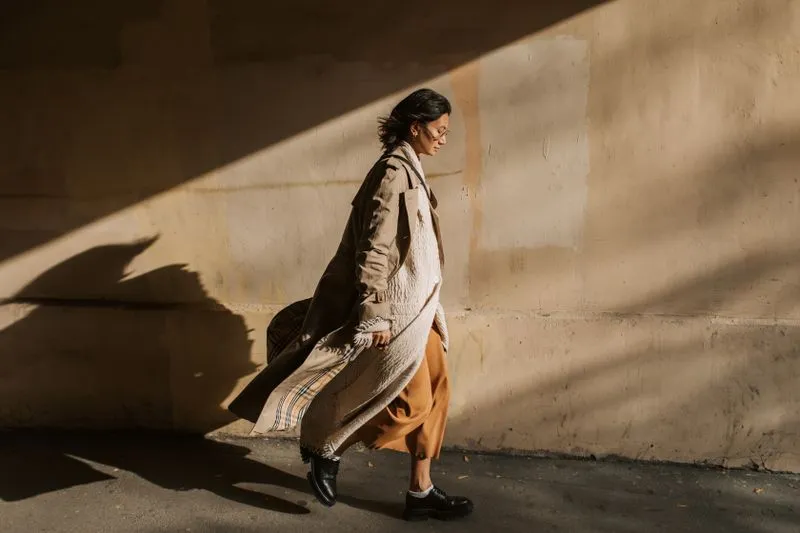
Count the rows of buttons, then look at how the sleeve meets the shoulder: those two details are enough to read a trench's cut. Burberry's page on how its Heritage trenches are made sums up the options neatly: one coat is "A shape steeped in history, with raglan sleeves inspired by our early trench designs", another "A classic trench rooted in tradition, with narrow set-in sleeves for a streamlined silhouette".
Double- or single-breasted. Double-breasted (two rows of buttons) is the original. It structures the chest and adds volume to a small bust; on a fuller bust it bulks things up. Wear it open, or go single-breasted — buttons often hidden under a placket, cleaner and more urban.
Raglan or set-in sleeves. A raglan sleeve (it runs diagonally from collar to armpit, with no shoulder seam) leaves room for a jumper and forgives narrow shoulders — it's the one I recommend for sloping ones. A set-in sleeve (sewn into the curve of the shoulder) draws a sharp, tailored line — stunning on square shoulders, merciless if the size is wrong.
Fitted or oversized. An oversized trench can take a slightly dropped shoulder, not sleeves that swallow your hands. If it's designed to be roomy, the product page says so; if it's just too big, you say so — by leaving it in the fitting room.
The details that give away a well-made trench
You can tell a well-made trench by its collar, its buttons and its seams — long before you check the label. Burberry gives a sense of what's possible at the top end. On its Heritage page, the brand explains that "From buttons to belt loops, details are stitched on by hand", and that the collar is "Made up of eight parts and up to 200 stitches". You don't need a 200-stitch collar. But now you know where to look first.
My checklist in the shop (and when a parcel arrives):
- The collar. Flip it up, fold it down, repeat. It should settle back on its own — symmetrical, without the under-collar peeping out.
- The buttonholes. Neat, tight, no loose threads. One sloppy buttonhole out of six, and the rest of the coat usually follows suit.
- The buttons. Sewn on with a little thread shank — it leaves room for the thickness of the fabric. On the inside, a small backing button stops them tearing through.
- The inside seams. Short, even stitches, edges finished (topstitched or bound) rather than left raw.
- The lining. It shouldn't pull anywhere. In the sleeves, a slippery lining saves you a wrestling match with your jumper — on Burberry's Chelsea, it's viscose.
- The belt. Same fabric, lined and topstitched, with a sturdy buckle and loops sewn on firmly.
- The back. The storm shield should lie flat — and the back vent should stay closed as you walk.

Honey, khaki, navy or black: which trench colour to choose?
For a first trench, pick the colour that works with most of your wardrobe — not the one you love most on the hanger. Khaki came first, for practical reasons. As fashion historian Amber Jane Butchart told the BBC, "Khaki is the Hindi word for dust", and by the First World War it had become vital for soldiers not to stand out. Today the palette is wider:
- Honey beige, the undisputed classic. It warms up denim, black, navy and white. Its one flaw: it can drain some complexions near the face.
- Stone or sand, softer, but it shows the grime at the cuffs and collar.
- Khaki, the original. More relaxed, perfect with denim and off-white.
- Navy, my city wildcard. It doesn't show the grime, goes with everything — and it's the most flattering option for anyone beige turns grey.
- Black, sharper, but without the brightness that makes a trench so lovely in spring.
Shower-resistant, waterproof, PFAS: what a trench can really handle
A trench isn't a cagoule. Dense gabardine beads off drizzle and copes with a short shower — but in an hour of proper British rain, it will eventually soak through. Even Burberry describes its cotton gabardine as "shower-resistant", not waterproof. Two words not to confuse in the shop:
- Water-repellent (or shower-resistant): water forms droplets and rolls off, thanks to the tight weave (and often a surface finish). The fabric breathes.
- Waterproof: water doesn't get through at all, thanks to a coating or membrane. The fabric breathes far less (you'll notice the second the sun comes out).
That water-repellent finish deserves a question at the till. PFAS (the "forever chemicals") have long been used to make fabrics repel water and oil. In its March 2023 analysis of regulatory options for PFAS, the Health and Safety Executive notes that fluorinated polymers are used in coatings for textiles. It concludes that PFAS are extremely persistent, and recommends preparing the ground for possible UK restrictions on consumer articles — "textiles, upholstery, leather, apparel" included.
In practice, the simplest move is to ask whether the finish is "PFC-free" or "fluorocarbon-free" — brands that have made the switch usually say so on the product page. No information? I lean towards dense untreated gabardine — it won't shrug off a downpour quite as well, but it isn't shedding anything persistent into the environment.

New or second-hand: how much should you spend on a trench?
A new trench costs anything from under £50 to four figures. In January 2025, Grazia's round-up of the best trench coats ran from £49.99 at New Look to £1,890 for a leather trench by Mackage, with & Other Stories at £165 and Tôteme at £640 in between. In classic cotton gabardine, Burberry's Long Chelsea Heritage trench was listed at the same £1,890 in early March 2025: 100% cotton gabardine, a cotton lining, calf leather buckles, made in Yorkshire. That's a top-end benchmark — not a requirement.
What separates a £50 trench from a £1,890 one is the density of the fabric, the construction, where it's made — and the name. Burberry's goes back decades: British Vogue's March 2023 guide to the Burberry trench notes that "By 1965, one in five coats exported from Britain was a Burberry". To decide, I ask one question: does this coat pass the seven checks (collar, buttonholes, buttons, seams, lining, belt, back)? A well-made mid-range trench in dense cotton gabardine beats a famous name stamped on flimsy canvas.
The sum I always do is cost per wear — the price divided by the number of times you'll put it on. And wearing a coat for longer counts for more than you'd think. WRAP's 2012 Valuing Our Clothes report found that "extending the average life of clothes by just three months of active use per item would lead to a 5-10% reduction in each of the carbon, water and waste footprints".
Second-hand changes everything: old trenches from great houses turn up in vintage shops, charity shops and resale apps, and good gabardine ages well. In its March 2023 guide to the Burberry trench, British Vogue listed a pre-loved Burberry trench at £615 on Lampoo and a double-breasted Burberry Prorsum at £800 on Hardly Ever Worn It. My complete guide to buying and selling second-hand covers the basics. For a trench, add these:
- The shoulders, always. Online, ask for the measurement from one shoulder seam to the other, and compare it with a coat that fits you.
- The belt. It often goes missing — and without it, the silhouette changes.
- Underarms, collar and cuffs. A yellowed ring on pale gabardine rarely comes out.
- The care label. If it's been cut out, you lose both the fibre content and the cleaning instructions.
Six ways to wear a trench coat (from April to October)
A trench works open or closed, belted or not, over pretty much anything — that's what makes it a basic. Just one rule, the belt rule: coat open, tie it behind your back or leave it loose in its loops (never a buckle dangling and clanking); coat closed, fasten the buckle or tie a simple knot at the front. No Christmas-present bows.
1. Straight jeans, Breton top and loafers
The classic, at any age and in any city. Coat open, sleeves turned back once, a structured bag: the outfit looks considered, even though it took you four minutes.
2. Knitted dress, tights and ankle boots
For chilly April mornings and the whole of autumn: a fine-knit dress, black semi-opaque tights (my trusty 40 to 60 denier), block-heel ankle boots. Closed and belted, the trench nips in the waist. My rules for wearing tights with style all year round apply here as they are.
3. Tailored trousers and a white shirt
The office version. Coat closed, wide trousers falling over a slim shoe — the most serious look of the six, and the easiest to pull off when you've no time to think.
4. Hoodie and trainers
The mix that takes the prim edge off a trench: hood pulled out over the collar, well-cut jeans, clean trainers. It's my favourite weekend look — the one for the Saturday market and a coffee outside when the sun can't make up its mind.
5. Buttoned up, worn as a dress
On the first warm days, a trench buttoned to the top becomes a coat dress: bare legs, flat sandals or mules. Just check the back vent behaves when you sit down (the Tube test is compulsory).
6. Over a black dress, in the evening
Beige trench, little black dress, heels, a red lip: the simplest elegance there is. Leave it open — it dresses up an evening without looking like you tried.

Caring for a trench coat so it lasts for years
A well-kept trench gets cleaned rarely and brushed often. Start with the label: for the Chelsea, Burberry's instruction is "Specialist dry clean". Machine-washing it is a gamble: gabardine, lining and interfacing may not react the same way to water and heat — and a warped collar can't be rescued.
Between trips to the dry cleaner:
- Brush it after any dusty outing (especially the hem and cuffs).
- Deal with a stain straight away, dabbing with a damp cloth (no rubbing).
- Dry it on a hanger, away from the radiator — gabardine dried too fast can mark.
- Store it on a thick hanger. A wire dry-cleaning hanger will dig two bumps into the shoulders within weeks.
- Keep the belt in its loops. A belt stored "somewhere safe" is a belt you'll never see again.
And my vintage-shop trench? I kept it. I took it back to the alterations lady on the Monday: she shortened the sleeves, the shoulders are still too wide, and I wear it open — owning its slightly borrowed-from-someone-else's-wardrobe look. The next one, I'll choose in the right order. As for you: this weekend, put on the trench you already own and do the four fitting-room moves. You'll know within a minute whether it deserves to stay.
Frequently asked questions
What's the difference between a trench coat and a raincoat?
A trench is a cut: usually double-breasted, with a belt, lapels, epaulettes and a storm shield across the back. A raincoat is a function: it keeps water out, thanks to a coating or membrane. A cotton gabardine trench is shower-resistant, not waterproof in heavy rain.
Cotton gabardine or polyester for a first trench?
For a first trench, dense cotton gabardine: a crisp drape, a fabric that breathes and a lovely patina over the years. A cotton-poly blend is lighter and almost crease-free. Pure polyester dries fast, but breathes poorly and ages less well.
What trench length works if you're petite?
Under 5ft 3in, a trench that stops at the knee or just above is the easiest to wear. A long one can still work, worn open, with trousers and shoes in the same colour. Avoid a hem that cuts across the widest part of your calf.
Can a trench coat be altered?
Yes for the sleeves and the hem, as long as the tailor respects the back vent and the cuff straps. In practice, no for the shoulders: it would mean unpicking the collar, the sleeves and the back yoke, and the work often costs more than the coat.
Double- or single-breasted for a fuller bust?
A single-breasted trench lightens the chest. A double-breasted one adds two rows of buttons across the bust: it looks better worn open. Either way, sit down in it and check the buttons don't pull.
How do you tie a trench coat belt?
Coat open: tie the belt behind your back, or leave it loose in its loops. Coat closed: fasten the buckle, or tie a simple knot at the front, slightly off-centre. Skip the bow — it bulks up the waist.
Can you machine-wash a trench coat?
Only if the care label allows it. Many trenches (Burberry's Chelsea, for one) say specialist dry clean: lining, interfacing and gabardine can react differently to water.
Should I worry about PFAS in a water-repellent trench?
PFAS have long been used to make fabrics repel water, and the Health and Safety Executive describes them as extremely persistent. In its March 2023 analysis, it recommended preparing the ground for possible restrictions covering consumer articles, apparel included. If it matters to you, ask for a PFC-free finish.
Sources
- BBC News — The trench coat's forgotten WW1 roots (5 October 2014)
- British Vogue — The Burberry trench coat (9 March 2023)
- Burberry — Made in the UK: Heritage Trench (February 2025)
- Burberry — Long Chelsea Heritage Trench Coat, product page (March 2025)
- Grazia — The best trench coats for women (updated 24 January 2025)
- Health and Safety Executive — Analysis of the most appropriate regulatory management options for PFAS (March 2023)
- WRAP — Valuing Our Clothes: the true cost of how we design, use and dispose of clothing in the UK (2012)