
Thursday 13 February, 6.35pm, the self-checkouts at our local supermarket. My daughter — three and a bit, hat askew, a packet of rice cakes clutched against her coat — wanted to scan the yoghurt herself. I was in a hurry. I scanned it for her. That single beep was enough. Within three seconds she was flat on the grey floor, heels drumming, producing a scream so piercing that the assistant at the self-checkout area spun round. Behind me, a man in a suit sighed loudly enough for me to hear it, and the machine chose that exact moment to announce an unexpected item in the bagging area. I felt my cheeks burn. For one long second, I had a single idea in my head: make the noise stop. Promise anything, bargain, open the chocolate buttons I had put in the basket for the weekend (they were right there, and she knew it).
I didn't. Not out of virtue — because a few weeks earlier I had read what the research says about these meltdowns. It's the first thing I'd like to pass on if you are, tonight, the mother turning red at the tills: what your child is doing is ordinary. In Lauren Wakschlag and colleagues' study of 1,490 preschoolers, published in 2012, 83.7% had tantrums sometimes, while only 8.6% had them every day. And the NHS page on temper tantrums puts it plainly: they usually start at around 18 months and are very common in toddlers.
For everyday boundaries, praise and consequences, our practical guide to positive parenting sets out the framework; what follows deals only with the tantrum itself, from 2 to 6.

Toddler tantrums: what happens in a child's brain between 2 and 6
A tantrum is, above all, an overflow — the emotion arrives faster than the tools to contain it. In adults, a region at the front of the brain (the prefrontal cortex) acts as a brake: it lets us hold back a reaction, wait our turn, move on when a plan falls through. The Center on the Developing Child at Harvard University describes these skills as being "like having an air traffic control system at a busy airport". Researchers call them executive function — working memory, mental flexibility and inhibitory control (the ability not to do the first thing that comes into your head).
That brake is built slowly. In the Center's Working Paper 11 (2011), the researchers describe prefrontal regions that develop from infancy through late adolescence, with "ages 3 to 5 providing a window of opportunity for dramatic growth in these skills". So your two-year-old already has the full emotional intensity of a human being — but still very few of the tools to regulate it. This is not a parenting failure. It is a brain under construction.
Until that brake is in place, your child needs a borrowed brain — yours. Your calm (even if it's acted, even if it's fragile) is what they lean on. The NHS makes a similar point from the parent's side: you probably feel angry yourself at times, but unlike your child, you can express it in other ways.
What does a tantrum look like, minute by minute? Michael Potegal and Richard Davidson coded, in 30-second slices, parents' written accounts of tantrums in 335 children aged 18 to 60 months. Their findings, published in 2003 in the Journal of Developmental and Behavioral Pediatrics, show two curves that cross. Anger rises quickly, peaks at or near the beginning of the tantrum, and declines thereafter. Distress — crying, comfort-seeking — slowly increases across the episode.
At the start, the child is pure anger — reasoning, explaining, threatening, nothing gets through. Towards the end, they tip into sadness (and that is often when they hold out their arms). Many parents miss that moment because they are still arguing with the first phase, while the child is already looking for a safe harbour. The same authors noticed another useful sign: when a child stamped or dropped to the floor in the first 30 seconds, the tantrum was likely to be shorter.

How many tantrums are normal for a child aged 2 to 6?
Short, occasional tantrums are part of normal development — and the research figures back that up.
| Benchmark | What the studies found | Study |
|---|---|---|
| Children affected | 83.7% of preschoolers have tantrums sometimes. | Wakschlag et al., 2012 (1,490 children). |
| Daily tantrums | 8.6% of children. | Wakschlag et al., 2012. |
| Most common length | 30 seconds to 1 minute. | Potegal et al., 2003 (335 children aged 18 to 60 months). |
| Tantrums of 5 minutes or less | 75% of tantrums. | Potegal et al., 2003. |
| Length that should raise a flag | More than 25 minutes on average. | Belden et al., 2008 (279 children aged 3 to 6). |
The most violent outbursts fade with age. In the first part of their analysis, Potegal and Davidson found that high-intensity anger decreased with age while low-intensity anger increased. In everyday life, that often looks like a five-year-old who sulks or protests where the two-year-old used to throw themselves on the floor. That shift shows the brake is coming online. The NHS adds that once a child can talk more, they're less likely to have tantrums — and that by the age of 4, tantrums are far less common.
To tell ordinary tantrums from worrying ones, look at the context and how long they last. Wakschlag's team found that milder behaviours tend to reflect frustration in expectable contexts (a "no", tiredness), whereas the concerning signs are unpredictable, prolonged or destructive. A spectacular meltdown at the supermarket after a long day at nursery? First category. Anger with no visible trigger, several times a day, lasting half an hour? The second.
Hunger, tiredness, transitions: what sets a tantrum off
Most tantrums have an identifiable trigger — good news, because you can work on it. The NHS suggests starting there: find out why the tantrum is happening, because if your child is tired or hungry, the solution could be simple. Five triggers come up again and again:
- Hunger and tiredness. Late afternoon, a skipped nap, a snack that came too late — a three-year-old's reserve of patience runs dry long before yours.
- Transitions. Leaving the park, getting out of the bath, switching off a cartoon — every one of them demands exactly the mental flexibility that is still missing. If screens are your daily flashpoint, our rules for a healthy balance with screens explain how to prepare the switch-off.
- Thwarted independence. "Me do it" — scanning the yoghurt, closing the door, pressing the lift button. Every "no" collides with that brand-new discovery.
- Missing words. According to the NHS, toddlers want to express themselves but find it difficult, and the frustration comes out as a tantrum.
- Overload. Noise, harsh lighting, crowds — big supermarkets and family parties pile it all on.
Harvard's Working Paper 11 sums up the logic: adjusting the demands placed on children so as not to overtax their capabilities is much more helpful than punishment for difficult behaviour. Moving the big shop from 6pm to 10am counts as prevention.
During a tantrum: the steps that actually help
Once a tantrum has started, your aim becomes getting through it without damage — to your child, to you, or to the bond between you. Four steps, in this order.
1. Calm yourself first, even for three seconds
The NHS is blunt: losing your temper or shouting back will not end the tantrum. One long breath out, shoulders down — you are already more useful. The same page suggests ignoring the looks from people around you and concentrating on staying calm.
2. Keep them safe without restraining them
A child who throws themselves backwards can hit something hard (a table corner, a step, a trolley). Move dangerous objects away, move your child to a clear space if needed — then stay close. As long as nobody is in danger, wait.
3. Name the feeling without judging it
Putting a word to what your child is feeling helps them find their bearings. The NHS suggests phrases such as "I know you're feeling angry about…", which show you recognise their frustration and help them name their own feelings. One sentence is plenty: at the peak of a tantrum, a child mostly picks up your tone.
4. Stay close and offer comfort — without giving in
The NHS notes that some parents find firmly holding their child during a tantrum helpful, and that it usually works when the child is more upset than angry — exactly the distress phase Potegal describes. Comfort answers the distress; the "no" still stands. Some children, on the other hand, refuse any contact at the height of a meltdown. If so, stay a metre away, visible and available, and respect that refusal — it is also a chance to teach your child that their body belongs to them, a principle you can start passing on very early.

Responding to a tantrum by age: 2, 3 to 4, 5 to 6
The basic steps stay the same from 2 to 6. What changes is what your child can understand, say and do. This table brings together the markers in this guide and everyday parenting experience — it does not replace watching your own child, who may be ahead of or behind these markers.
| Age | What the child can do | What helps most | What doesn't work |
|---|---|---|---|
| 2 | Few words, frustration expressed through the body. | Distraction, safety, three-word sentences. | Long explanations. |
| 3 to 4 | More words, a strong need to decide for themselves. | Naming the feeling, offering two choices, warning before transitions. | Bribes and threats. |
| 5 to 6 | Starting to calm down alone and talk about what they felt. | Talking it over later, planning a calm-down routine together. | Shaming, or retelling the tantrum in front of others. |
At 2: distraction first
Before a tantrum takes hold, distraction often works. The NHS advises finding something to distract your child with straight away, and gives a lovely example: "Look! A cat". Make yourself sound as surprised and interested as you can. Once the tantrum is in full swing, however, distraction rarely works — stay present and let the peak pass.
At 3 to 4: words and choices
This is the window of dramatic growth in executive function described by Harvard's Center on the Developing Child. Your child now understands warnings ("in five minutes, we're leaving the park") and can choose between two options that both suit you ("do you want to climb into the car like a lion or like a cat?"). Giving them some control over the how avoids a lot of battles over the what.
At 5 to 6: repairing and planning together
By 5 or 6, tantrums have usually become much rarer — the NHS notes they are far less common from the age of 4 — and many children can start to talk about what they felt. That's the time to talk tantrums over once everyone is calm, in the evening or the next day: what made you so cross? What would help next time? Some children pick a corner with a cushion and a glass of water. That corner helps them build their own tools.
At home: defusing a tantrum before it explodes
Home is where prevention works best — you control the setting and the timing. Three levers do most of the work.
Predictable routines. A child who knows that bath comes after tea, and a story after the bath, negotiates far less at each step. Routines take dozens of small decisions off your child's plate (and yours) every day.
Transitions announced in advance. A warning five minutes before — then one minute before — gives the brain time to get ready. A kitchen timer works beautifully: the bell ends the game for you (a distinction that matters enormously at three).
A calm-down option for you. The NHS suggests that at home you can try going into another room for a while — making sure your child cannot hurt themselves first. Door open, within earshot. The aim is simply to stop yourself from boiling over.

At the supermarket: handling a public tantrum without giving in or shouting
The public meltdown is the most dreaded one, for a precise reason: it adds shame to anger. The NHS names it — tantrums often happen in shops, "This can be embarrassing, and embarrassment makes it harder to stay calm." And embarrassment pushes us towards two reflexes that make everything worse — giving in quickly to silence the child, or raising our voice to show onlookers that we're "in charge".
Before you go
- Pick your moment. Never at nap time or just before a meal (a snack eaten before you go in helps a great deal).
- Keep it short. The NHS advice is to keep shopping trips as short as possible — a short list, one shop, no detour past the toy aisle.
- Give them a job. Finding the bananas, carrying the pasta, ticking off a picture list. The NHS suggests involving your child by talking about what you need and letting them help.
- State the rule before you go in. "Today we're not buying sweets, but you get to choose the fruit for snack time." A rule set in advance is easier to hold than a "no" improvised in front of the shelf.
During the meltdown
First, make your child safe — away from passing trolleys and glass displays, ideally in a quieter aisle. Crouch down to their level, say your one sentence, and wait. Forget the audience: most adults watching have lived through the same scene. If it drags on, leave the trolley with customer services and step outside for a few minutes. No shopping list is worth a parent falling apart in aisle seven.
That Thursday in February, my daughter's tantrum lasted just under four minutes — I checked the time on the card machine. It fell squarely within the three-quarters of tantrums lasting five minutes or less in Potegal's study. At the time, it felt like half an hour.
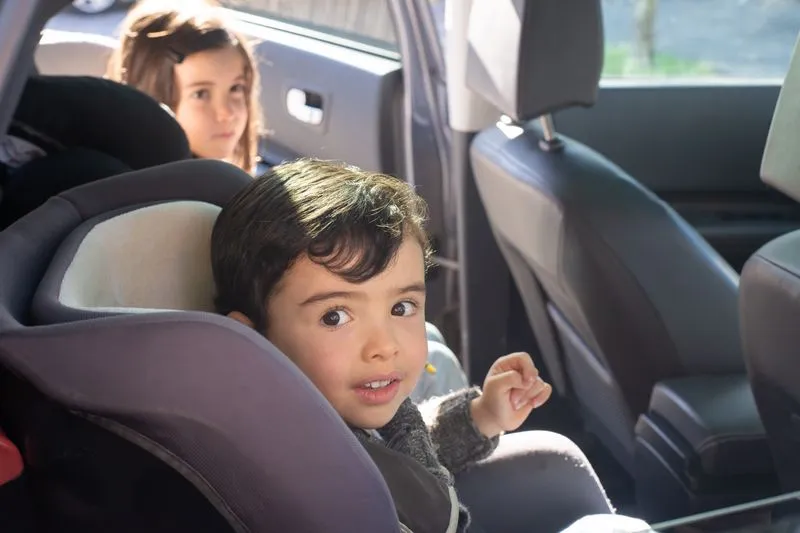
In the car: when a tantrum hits mid-journey
The car poses a particular problem: you can't reach your child or pick them up, and your attention has to stay on the road. The real danger isn't the child — it's the distracted driver who turns round or reaches into the back for a dropped toy.
If you're driving, speak calmly, without turning round, until you reach somewhere safe to stop — a services, a car park, a quiet side street. Once you've parked with the engine off, deal with the tantrum as you would at home. Never unbuckle your child to comfort them while the car is moving. If another adult is on board, the tantrum is theirs to handle.
A common meltdown is about the car seat itself: the child refuses to be strapped in, arches their back, screams. That rule is not up for negotiation — which is precisely what makes it easier to hold. On GOV.UK's page on child car seats, the law is clear: children must normally use a child car seat until they're 12 years old or 135 centimetres tall, whichever comes first. Say it in one sentence ("in the car, we're always strapped in"), wait for the anger to subside, buckle up, then set off. Five minutes late beats a journey started with a child who isn't properly strapped in.
For long journeys, prevention does most of the work — set off at nap time, keep a snack and water within reach without your help, download some audiobooks, plan regular breaks. A small bag that only comes out in the car (stickers, little figures) keeps its appeal precisely because it's rare.
Your own anger at tantrums: the other half of the story
We talk a lot about children's anger and far less about parents'. Yet every parent of a toddler knows the moment when the patience runs out. What the law says depends on where in the UK you live. In Scotland, the Children (Equal Protection from Assault) (Scotland) Act 2019 abolished the defence of reasonable chastisement, with effect from November 2020. In Wales, the Welsh Government's page could not be clearer ("All physical punishment is illegal in Wales"), and the Welsh Act that abolished the defence has applied since 21 March 2022. In England, the defence of "reasonable punishment" still exists, although under section 58 of the Children Act 2004 it cannot justify a smack that causes actual bodily harm. Northern Ireland is in the same position: the defence remains, but under article 2 of the Law Reform (Miscellaneous Provisions) (Northern Ireland) Order 2006 it cannot justify battery of a child that causes actual bodily harm.
Whatever the law where you live, the science points the same way. Harvard's Working Paper 11 notes that adjusting what we ask of children is much more helpful than punishment for difficult behaviour. And the NHS page on tantrums, in its section on hitting and biting, is clear: do not hit, bite or kick back, because it could make your child think it's acceptable.
So what do you do when you feel your own anger rising? Put your child somewhere safe, step into the next room for a moment, breathe. If there's another adult at home, hand over. And if you did shout, say sorry to your child afterwards — apologising shows them how to repair things.
Tiredness plays a huge part in these moments: a parent who sleeps badly, juggles work and home and never gets a break has less patience, and exhaustion alone often explains it. If that imbalance sounds familiar, our guide to balancing work and family life without the guilt has practical ways to lighten the load.

When a tantrum is a reason to see your GP
The vast majority of tantrums need no appointment at all. Some patterns, though, are worth raising with your GP or health visitor — the NHS says to talk to them if you're seriously concerned about your child's behaviour. In 2008, Andy Belden and Joan Luby's team compared the tantrums of 279 children aged 3 to 6, some healthy, some with depression or disruptive behaviour disorders. From this, the authors drew five tantrum "styles" that should raise a flag:
- Consistent aggression: the child lashes out at the caregiver or violently breaks things in more than half of their recent tantrums.
- Self-injury: the child deliberately hurts themselves during tantrums, however often they happen.
- Frequency: 10 to 20 tantrums on separate days at home within a month, or more than 5 a day on multiple days outside the home.
- Duration: more than 25 minutes on average.
- Being unable to calm down: the child almost always needs an adult to bring them out of it.
The researchers point out that these thresholds have not been validated as diagnostic tools — they are a reason to ask for an opinion, without putting a label on your child. Add common sense to the list (tantrums that start suddenly after an upheaval, that get worse rather than easing off, or that stay intense well past 6) and your own instinct — if you are running on empty, that is reason enough to book an appointment.
Breath-holding: frightening but usually harmless
Some children, at the height of a tantrum, stop breathing, turn pale, blue or grey — and may faint. This is breath-holding. According to the NHS page on breath-holding in babies and children, it's usually harmless and your child should grow out of it by the age of 4 or 5. An episode usually lasts less than a minute. During it, lie your child on their side rather than picking them up, stay with them, and don't shake them or tell them off — they're not doing it deliberately. The NHS says to call 999 if your child faints and cannot be woken up, is stiff, shaking or jerking, or if their lips, tongue, face or skin suddenly turn pale, blue or grey — these can be breath-holding, but they can also point to something more serious. If a doctor has not previously told you it's breath-holding, it's important to get it checked immediately.

Frequently asked questions about toddler tantrums
At what age do tantrums stop?
Gradually, as they change shape. The NHS notes that by the age of 4, tantrums are far less common. Potegal and Davidson's work shows high-intensity anger giving way to milder forms (sulking, protesting) as children grow. Intense, frequent tantrums that carry on well past 6 are worth discussing with your GP.
Should I ignore my child during a tantrum?
Ignore the demand, yes; ignore the child, no. The NHS advice is to wait for it to stop while staying calm, and not to change your mind. Stay nearby, say little, don't give in on what started it — and offer comfort once the anger starts to fade.
Should I hold my child during a tantrum?
It depends on the moment. The NHS says some parents find firmly holding their child helpful, but that it can be hard to hold a struggling child, and that it usually works when the child is more upset than angry. In practice, that means later in the tantrum, once the sobbing has taken over from the screaming — and only if your child accepts it.
I gave in during a tantrum. Have I undone everything?
A single slip doesn't undo everything — what builds the habit is repetition. If screaming regularly gets results, your child learns that the strategy works. Hold the line calmly from the next tantrum onwards.
Does the naughty step help after a tantrum?
Not as a punishment. Harvard's Center on the Developing Child found that adjusting what we ask of children is much more helpful than punishment for difficult behaviour. A calm corner chosen together with your child, outside tantrums, where they can go on their own to settle, works differently: it's a tool they make their own.
My child hits or bites during tantrums. Should I worry?
The NHS notes that most young children occasionally bite, hit or push, and that this does not mean they will grow up to be aggressive. Protect yourself and others, say clearly "I won't let you hit me" — and don't hit back. Belden's study does suggest seeing your GP if aggression towards adults or objects features in more than half of your child's tantrums.
Sources
- NHS — Temper tantrums (reviewed November 2022)
- NHS — Breath-holding in babies and children (reviewed March 2023)
- Center on the Developing Child, Harvard University — Working Paper 11 on executive function (2011)
- Potegal, Kosorok and Davidson — Tantrum duration and temporal organization (2003)
- Potegal and Davidson — Behavioral composition of tantrums (2003)
- Belden, Thomson and Luby — Tantrums in healthy versus depressed and disruptive preschoolers (2008)
- Wakschlag et al. — Defining the developmental parameters of temper loss in early childhood (2012)
- legislation.gov.uk — Children (Equal Protection from Assault) (Scotland) Act 2019
- Welsh Government — The law on physical punishment in Wales
- legislation.gov.uk — Children (Abolition of Defence of Reasonable Punishment) (Wales) Act 2020, section 1
- legislation.gov.uk — Children Act 2004, section 58 (reasonable punishment: England)
- legislation.gov.uk — Law Reform (Miscellaneous Provisions) (Northern Ireland) Order 2006, article 2
- GOV.UK — Child car seats: the law