"Is Alfie with you?"
Bethan called it across the lawn just as her partner, Rob, came back from the barbecue with a plate of sausages. He didn't look up. "No — I thought he was with you." It was twenty past four on the Sunday of the late May bank holiday weekend, in her parents' garden. Eighteen people. A radio playing somewhere. The smell of charcoal and cut grass — and, at the bottom of the garden, half hidden behind a row of lavender, her dad's pond.
Bethan is 35 and a pharmacist, and she told me the rest a couple of weeks later, while I was preparing this piece, her voice still slightly shaky. She ran. She found Alfie (he's three) kneeling on the stone edge of the pond, one sleeve soaked to the elbow, reaching for a plastic boat that had drifted out among the lily pads. He wasn't crying. He wasn't calling anyone. He was just leaning, a little further with every try.
It ended well. But that one sentence — "I thought he was with you" — sums up how many young children end up in water. It isn't a lack of love. It's a gap between several adults about who is watching whom. And the pond is no coincidence: according to RoSPA's pond safety advice, garden ponds are involved in one in four (26%) of all child drownings in the home.
This guide covers the situations where the risk is highest (ponds, baths, paddling pools, holiday pools, beaches and rivers), the measures that genuinely protect and the ones that only reassure. Then the question most parents ask before the summer holidays: at what age can your child learn to swim — and what are the steps along the way?
Why are under-fives so vulnerable around water?
Under-fives combine three vulnerabilities — they can't swim, they can't judge danger, and they can slip out of sight in seconds. The NHS is blunt about how little water it takes. On its page about bathing a baby, it warns that babies of any age can drown very quickly in just a few centimetres of water, with no noise or struggle. That last part matters most. A small child in trouble doesn't splash or shout. They go quiet.
For young children in the UK, the danger sits mostly at home — CAPT notes that babies and small children mostly drown in the bath or in the garden. According to RoSPA, garden ponds are involved in one in four (26%) of all child drownings in the home; the bath is the other main danger.
Across all ages, the latest national data (from WAID, the Water Incident Database) puts things in proportion. The National Water Safety Forum's WAID summary for 2024 (published in May 2025) records 193 accidental water-related deaths in the UK that year. Most of them were men (84%), and 61% happened at inland waters — rivers, canals, lakes, reservoirs. Adults dominate these numbers. For toddlers, the water that matters is much closer to the kitchen door.
Worldwide, the World Health Organization (WHO) published its first global status report on drowning prevention in December 2024. It counts around 300,000 drowning deaths in 2021 — a quarter of them among children under five. Yet the global drowning death rate has fallen by 38% since 2000. These deaths drop when people take them seriously.
Ponds, pools and hot tubs: what actually protects a small child?
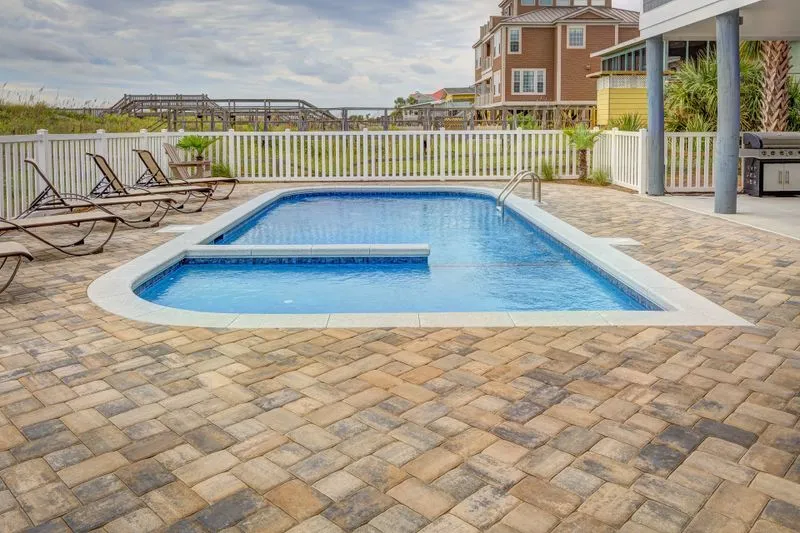
A garden pond can be made safe in three ways, and RoSPA sets them out clearly. You can cover it with a rigid metal grille (flimsy chicken wire isn't up to the job) and check it regularly. You can fence it (at least 1.1 metres high), with gates kept locked. Or you can fill it in until your children are older, turning it into a flowerbed or a sandpit. RoSPA's own verdict on the last option: if you want peace of mind, this is the one to go for.
| Option | What it does | The catch |
|---|---|---|
| Rigid metal grille | Keeps a child out of the water while the pond stays in place. | It needs checking regularly. Chicken wire won't do. |
| Fence and locked gate | Keeps a child away from the edge (at least 1.1 m high). | Young children are good climbers. A gate left open undoes it. |
| Filling it in | Removes the risk entirely. | You lose the pond — for a few years. |
| Pool fence on all four sides | Separates a swimming pool from the house and garden. | Only works if the gate is shut every single time. |
Fencing is the one measure with a formal review behind it. The Cochrane review by Thompson and Rivara on pool fencing found no randomised trials — only three case-control studies, which point the same way. A fenced pool carries a much lower risk of drowning or near-drowning than an unfenced one (odds ratio 0.27). The authors add a key detail: a fence that isolates the pool on all four sides beats one that encloses the whole property, because the house itself then opens straight onto the water (odds ratio 0.17 compared with three-sided fencing).
Hot tubs follow the same logic as pools. A hot tub with its lid on and locked is closed water; with the lid off, it's open water like any other. And whatever you choose — grille, fence, lid — nothing replaces an adult. As the Child Accident Prevention Trust (CAPT) puts it, children under eight still need to be actively supervised in and around water.
Baths, paddling pools and buckets: why is a few centimetres enough?
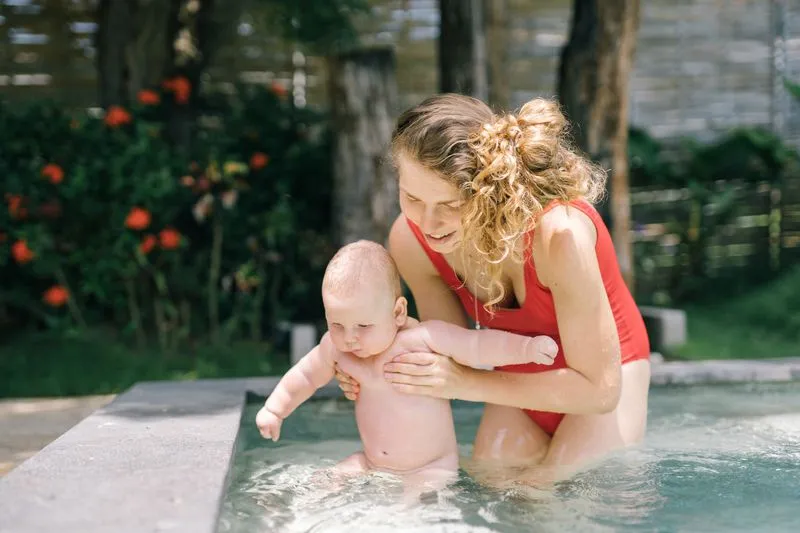
The bath is where the smallest children are most exposed, and the NHS guidance on washing and bathing your baby leaves no room for doubt: "Never leave your baby alone in the bath, even for a second." It adds that older children should not be allowed to look after a baby in the bath, and that babies of any age should always be supervised by adults. Get everything you need ready before bath time (towel, nappy, clean clothes) so there's no reason to step away.
Bath seats deserve a special mention. The same NHS page notes that RoSPA recommends baby bath seats are not used at all: they can come away from the bath. CAPT adds that a baby can slip out of one, and makes the point in plainer words — a bath seat is a support, not a safety device. If you use one, you stay within arm's reach, just as you would without it.
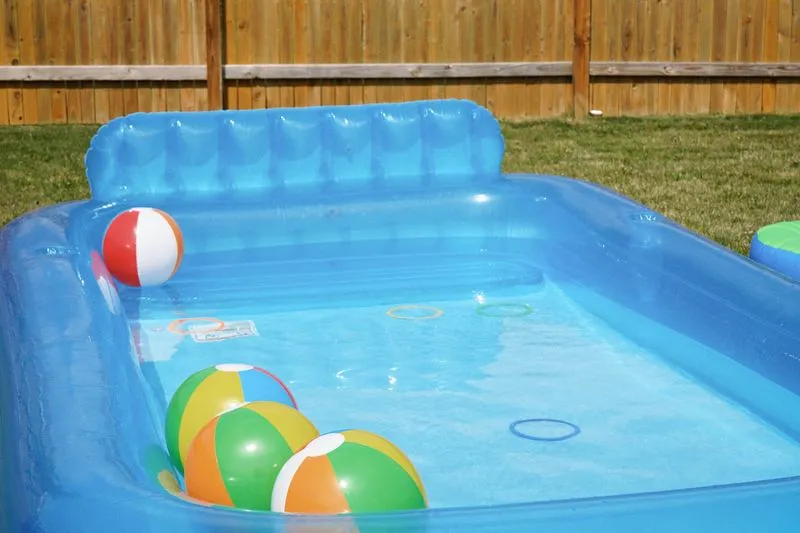
Paddling pools and buckets are the summer version of the bath. RoSPA's advice is to watch toddlers the whole time they're paddling and to empty the paddling pool straight after use (heavy rain could refill it). CAPT gives the same advice: empty the paddling pool out after you've used it.
Beaches, rivers and lakes: how do the risks change with age?
Open water changes the picture. RoSPA's summer water safety advice points out that around half of all drowning deaths happen in June, July and August. It also notes that rivers, lakes and lochs close to home are the most frequent location for drowning deaths — which the WAID figures confirm, with 61% of accidental deaths at inland waters in 2024.
Calm water can be deceptive. There are no waves, no visible current — and it's easy to relax, adults included. Cold is the other trap. As the RNLI explains, water below 15°C can trigger cold water shock, which makes you lose control of your breathing and movement; the average sea temperature around the UK and Ireland is just 12°C, and lakes, rivers and reservoirs can be colder, even in summer. RoSPA urges families to choose lifeguarded beaches and swimming spots, where lifeguards help you avoid rip currents, tidal cut-offs and offshore winds.
As children grow and swim further out, the sea brings its own risks. The RNLI's beach safety advice is to choose a lifeguarded beach and always swim between the red and yellow flags. Rip currents are one reason: the RNLI describes them as powerful currents that run out to sea, and they can be difficult to spot. If anyone gets into difficulty in the water, the RNLI's advice is to Float to Live.
Supervising properly: one adult, one child, no distractions
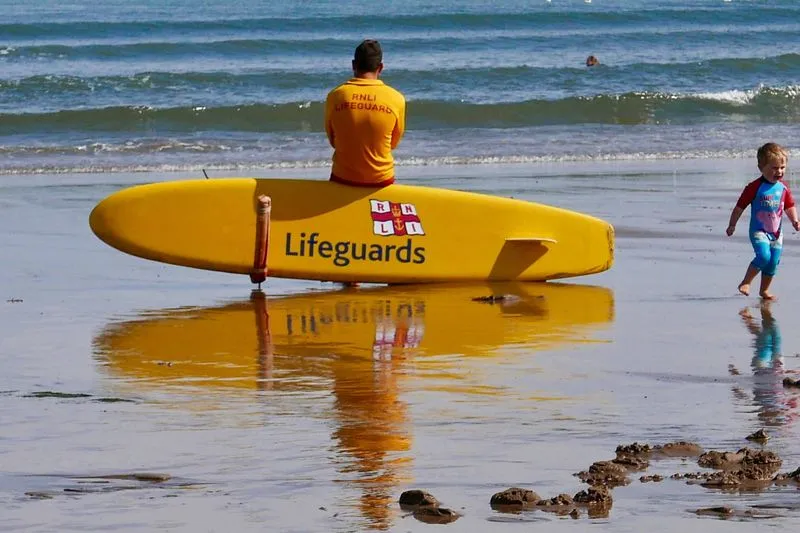
Supervising a child in water — properly — isn't glancing up from a sun lounger. RoSPA calls staying within arm's reach the single most important thing you can do to keep a small child safe in the bath, and the principle carries over to every pool and paddling pool. One adult (clearly designated) watching and doing nothing else.
Babies of any age should always be supervised by adults while in the bath.
The reason is simple, and CAPT spells it out: children don't cry out and wave to be rescued. They slip under the surface, often unseen. So "keeping half an eye" doesn't work. Neither does a phone. We set screen rules for our children (see screen rules for a healthy balance at every age) — by the water, the rule flips, and it's the adult who puts the phone away.
On Saturday mornings at our local pool, my daughter (she's at nursery) splashes about in the learner pool. I'm in the water with her, within arm's reach — and my phone stays in the locker. It's the only way I've found not to "just check one message".
Armbands, rings and swim vests: what really helps your child?
Arm jackets and swim jackets can help a child stay afloat while playing — RoSPA says as much, with one condition: make sure your child is wearing the right size. Inflatable rings and pool toys are another matter. They are toys, not safety equipment. At the beach, CAPT warns that inflatables can be swept out to sea when the wind is blowing — keep children off them when the orange windsock is flying.
None of these makes a child a swimmer, and none replaces an adult in the water beside them. There's a subtler point, too. Buoyancy aids keep a child up; they don't teach them to float on their own. That's why water safety charities keep coming back to the same skill. The RNLI encourages parents to help children learn to float — and to practise it often, somewhere safe like a local swimming pool.
A child who has only ever known water with armbands on can also get a false sense of confidence (and jump into the deep end the day they come off). The fix is to practise the other thing — floating, turning, getting back to the side — with a teacher, without the aids.
At what age can a child learn to swim?
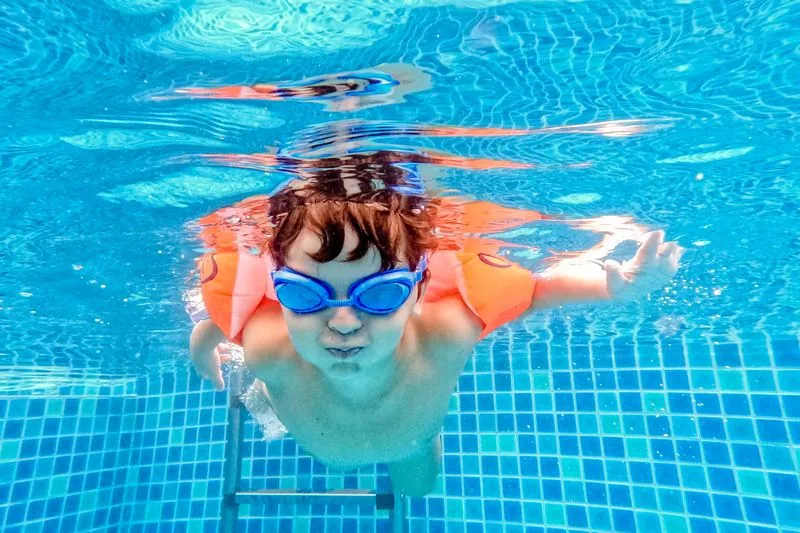
There's no single starting age. Babies can get used to water very early; the research on formal lessons looks at 1- to 4-year-olds; and in England every school must teach swimming in key stage 1 or key stage 2, between the ages of 5 and 11.
Getting used to water isn't the same as learning to swim, though. Parent-and-baby sessions sit alongside the other activities matched to your child's age: they're about confidence (and fun) in the water. For structured lessons, RoSPA's advice is to always learn with a qualified swimming teacher.
Do lessons help the youngest? A US case-control study gives a figure — and it's encouraging. The study by Brenner and colleagues, published in 2009 in the Archives of Pediatrics & Adolescent Medicine, interviewed 88 families of children who drowned (between 2003 and 2005) and 213 control families. Among 1- to 4-year-olds, 3% of the children who drowned (2 of 61) had taken formal swimming lessons, against 26% of the controls (35 of 134). The authors link lessons with an 88% reduction in drowning risk. They are candid that the estimate is imprecise — the confidence interval runs from a 3% to a 99% reduction. It's an association, not proof of cause. It still points the right way.
In England (Scotland, Wales and Northern Ireland set their own curricula), school takes over the formal part. The national curriculum for physical education states that all schools must provide swimming instruction either in key stage 1 or key stage 2. By the end of primary school, pupils should be able to swim at least 25 metres, use a range of strokes and perform safe self-rescue.
What are the milestones, from first splash to 25 metres?
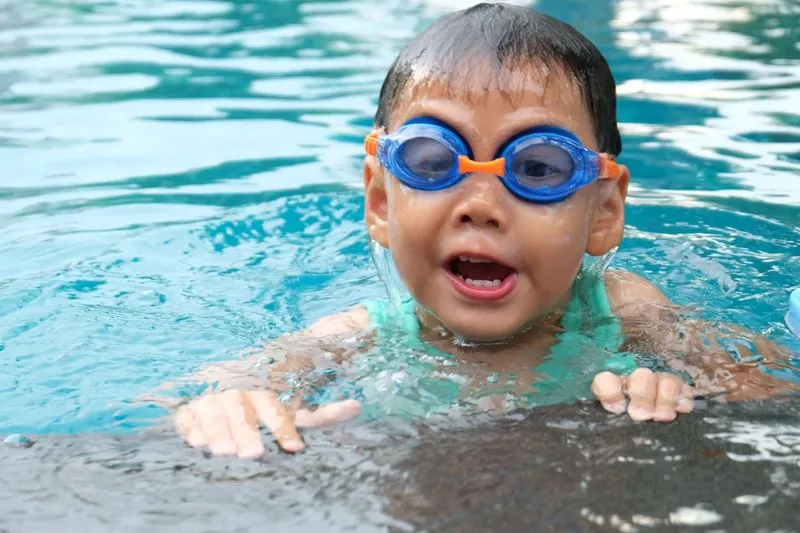
Learning to swim safely isn't about speed. It builds in stages — first being at ease in water, then floating, then covering a distance and getting yourself out of trouble. The table below is a simple way to picture it, with the key stage 2 standard as the finish line.
| Stage | What your child learns to do |
|---|---|
| Water confidence | Get in and out of the pool. Put their face in the water. Move about without panicking. |
| Floating | Lie back with ears under water. Breathe calmly. Use hands to stay up (the RNLI's Float to Live). |
| Key stage 2 standard | Swim at least 25 metres. Use a range of strokes. Perform safe self-rescue. |
Float to Live is worth teaching early, because it works for adults too. The RNLI's steps are short: relax and try to breathe normally, tilt your head back and submerge your ears, use your hands to help you stay afloat — then, once your breathing is under control, call for help or swim to safety.
The 25-metre standard isn't met by every child. Swim England's response to the 2023-24 Active Lives survey reported in December 2024 that only 70% of Year 7 pupils (aged 11 to 12) could swim 25 metres unaided — down from 77% in 2017-18. Its chief executive, Andy Salmon, warned: "There's a very definite risk of us having a generation of children who do not learn to swim." Three in ten children start secondary school without the standard.
Planning a holiday near water: what should you check before you go and when you arrive?
For many British families, the private pool question comes up on holiday — a villa in Spain, a gîte in France, a lodge with a hot tub. Check before you book, not when you arrive. Ask the owner what protection the pool has (a fence, an alarm, a safety cover) and how it works. An alarm whose reset code nobody gave you won't help on the first evening.
When you arrive, walk round the whole place — before you even unpack. Note every bit of accessible water: pool, hot tub, ornamental pond, the neighbours' pool, the river at the end of the lane. Then agree, on day one, who watches when. With several families, one named adult on duty avoids the "I thought he was with you".
Talk to your children about the rules too — simply, without frightening them. We never go near the water without a grown-up. We don't run round the pool. We get out when the grown-up says so. The principles of positive parenting fit well here: a short rule, explained, repeated calmly. And if getting out of the pool sets off tears (see how to respond to toddler tantrums), the rule still isn't up for negotiation.
After swimming: which signs should worry you?
There's a difference between a splash in the face and a child who has actually been under the water. RoSPA's advice is unambiguous: if you suspect a drowning event — a child has been submerged for any period of time — seek medical advice, even if they appear well. They may need to be observed in hospital for a short while.
In an emergency, call 999 (at the coast, ask for the coastguard, as the RNLI advises). Explain the situation as clearly and calmly as you can. If you know how, start CPR.
That last step is worth preparing well before the summer. RoSPA advises parents to take a first aid course and learn how to perform CPR and rescue breaths — and the WHO lists rescue and resuscitation training among the measures that bring drowning deaths down. A few hours on a Saturday, for a skill you hope you'll never use: book it before you go away.
Frequently asked questions
Do baby swimming classes teach babies to swim?
Not in the sense of keeping themselves safe. Parent-and-baby sessions build confidence and enjoyment of water. The research linking lessons with a lower drowning risk concerns formal lessons for 1- to 4-year-olds — and even then, supervision stays exactly the same.
Are armbands enough to keep my child safe?
No. Correctly sized armbands or a swim vest help a child stay afloat, but they can slip, deflate or be pulled off. They never replace an adult in the water, within arm's reach.
Should I use a baby bath seat?
The NHS notes that RoSPA recommends not using baby bath seats: they can come away from the bath, and babies can drown very quickly in a few centimetres of water. If you do use one, treat it as a support, never a safety device.
My child went under but seems fine. What should I do?
If your child has been submerged for any period of time, RoSPA advises seeking medical advice even if they appear well — they may need a short period of observation in hospital.
What does the national curriculum require for swimming?
In England, all schools must provide swimming instruction in key stage 1 or key stage 2. Pupils should be able to swim at least 25 metres, use a range of strokes effectively and perform safe self-rescue in different water-based situations.
How many children leave primary school unable to swim 25 metres?
According to Swim England's reading of the 2023-24 Active Lives survey (run by Sport England), only 70% of Year 7 pupils could swim 25 metres unaided — so around three in ten could not.
Do I need to fill in my garden pond?
Not necessarily. RoSPA's options are a rigid metal grille, a fence at least 1.1 metres high with locked gates, or filling it in until the children are older. Filling it in is the only option that removes the risk entirely.
Sources
- NHS — Washing and bathing your baby
- RoSPA — Keeping kids safe: drowning prevention and water safety
- RoSPA — Pond safety
- RoSPA — Summer water safety
- Child Accident Prevention Trust — Drowning
- RNLI — Beach safety
- RNLI — Float to Live
- National Water Safety Forum — WAID UK 2024 Summary (May 2025)
- Swim England — 'Real concern' at drop in Year 7 pupils able to swim (6 December 2024)
- GOV.UK — National curriculum in England: physical education programmes of study
- GOV.UK — The national curriculum
- Brenner R. A. et al. — Association between swimming lessons and drowning in childhood: a case-control study (2009)
- Thompson D. C., Rivara F. P. — Pool fencing for preventing drowning in children, Cochrane (2000)
- World Health Organization — Drowning deaths decline globally, but the most vulnerable remain at risk (13 December 2024)