Contents
- The myths holding women back — and why they're wrong
- The proven benefits of strength training for women
- Foundational exercises: the 8 movements that change everything
- Progressive programme: 12 weeks for beginners
- Technique and safety: the non-negotiable rules
- Nutrition and strength training: eating to progress
- The mental game: overcoming gym intimidation
- Recovery and rest: the invisible half of progress
- Adapting the programme to your goals
- FAQ — Strength training for women
The day Pauline, 32, a comms manager at a tech firm, first pushed open the door to the weights section, she stood frozen in the doorway for forty-five seconds — she counted, because counting stopped her panicking. Before her: rows of machines she'd only ever seen in Instagram montages, men in vests lifting loads with methodical grunts, and a single mirror reflecting the image of a woman in Primark leggings clutching a water bottle like a talisman.
She nearly left. Three times in forty-five seconds. Then a woman — fiftyish, sculpted shoulders, quiet smile — walked up to the squat rack, loaded 80 kilos onto the bar and executed five impeccable reps. No grunting. No audience. With the serene focus of someone who knows exactly what she's doing.
Pauline thought: I want to be that woman in twenty years.
Eighteen months on, Pauline squats 65 kilos. She doesn't look like a bodybuilder — she looks like Pauline, only stronger, with a back that no longer aches at her desk and a self-confidence that, in her own words, "has changed the way I walk into a room."
This guide is the guide Pauline wishes she'd had on the day of those forty-five seconds. Not a programme of "gentle toning" or "light resistance with tiny pink dumbbells." A real strength-training programme — progressive, structured, grounded in the science of movement — for women who want to get stronger. Full stop.
The myths holding women back — and why they're wrong

Women's strength training is the fitness domain where misinformation is most entrenched. Decades of gendered fitness marketing have built a parallel universe where dumbbells heavier than 3 kg are treated with suspicion and the word "muscle" rhymes with "masculine." Let's knock down those walls.
Myth 1: "Lifting will make me bulky"
This is the founding myth — the one that has kept millions of women away from a barbell. The biochemical reality is stark: women produce on average 15 to 20 times less testosterone than men (NHS data). Testosterone is the primary hormone driving muscle hypertrophy. Without hormonal supplementation (anabolic steroids), it is physiologically impossible for a woman to develop the muscle mass of a male bodybuilder.
The female bodybuilders you see in fitness magazines have years of intensive daily training, nutrition calibrated to the gram — and, in many cases, recourse to banned substances. That won't happen from lifting weights three times a week.
What will happen: a firmer body, muscles defined beneath the skin (not swollen above it), a more athletic silhouette, better posture. Body-image research shows that women who weight-train are significantly more satisfied with their appearance — not less (Hausenblas & Fallon, 2006).
The reassuring figure: a beginner woman can expect to gain between 0.5 and 1 kg of muscle per month in the early months, then 0.25-0.5 kg thereafter. That's a slow, gradual, controllable gain — not an explosion.
Myth 2: "Women should do high reps with light weights"
This myth spawned the concept of "toning" — a term that doesn't exist in exercise physiology. A muscle doesn't "tone": it hypertrophies (grows) or atrophies (shrinks). What people call "toning" is simply mild hypertrophy combined with fat loss — exactly what a standard strength programme produces.
ACSM recommendations are the same for both sexes: 6-12 reps per set, with a load that makes the last reps challenging. "30 reps with 1 kg" stimulates neither muscle growth nor strength — it trains muscular endurance, which is a different goal.
Myth 3: "Cardio is enough to be fit"
Cardio (running, cycling, swimming) is excellent for cardiovascular health. But it does almost nothing for muscle mass, bone density and functional strength — three parameters that become critical with age. After 30, women lose on average 3-5% of muscle mass per decade (sarcopenia). Strength training is the only proven antidote.
Myth 4: "Weights are dangerous for joints"
The opposite is true. Strength training, performed with correct technique and appropriate progression, strengthens joints by developing stabiliser muscles, tendons and ligaments. Studies show that weight-training women have a lower injury risk than female runners (Hamill, 2014).
The exception: incorrect technique with excessive loads is dangerous. That's why this guide insists on learning technique before progressing load. The rule: master the movement unloaded before adding weight.
Myth 5: "After a certain age, it's too late"
The scientific data is categorical: the benefits of strength training are measurable at any age. A study in Medicine & Science in Sports & Exercise (2022) shows significant strength gains in women aged 65-80 after 12 weeks of resistance training. Prevention of osteoporosis, falls and sarcopenia is even more important after 50 — making strength training a public health imperative, not a hobby.
The proven benefits of strength training for women
Beyond aesthetics — a perfectly legitimate benefit — strength training produces measurable health effects that cardio alone cannot deliver.
Bone density
Strength training stimulates osteoblasts (bone-building cells) through mechanical loading. The WHO recommends muscle-strengthening exercises at least twice a week to prevent osteoporosis — which affects 1 in 3 women over 50 in the UK (Royal Osteoporosis Society).
Resting metabolism
Muscle is metabolically active tissue: each kilo of muscle burns roughly 13 calories per day at rest, versus 4.5 for a kilo of fat. Gaining 3 kg of muscle — realistic in a year of training — increases your resting metabolism by 40 calories/day. Not a caloric revolution, but over a year, that's the equivalent of 2 kg of fat.
Mental health
Strength training reduces anxiety symptoms (d = 0.31, Gordon et al. meta-analysis, 2017) and depression (d = 0.66, Gordon et al., 2018). The effect is independent of physical improvement: it involves neurochemical mechanisms (endorphin and BDNF release) and psychological ones (sense of competence, self-efficacy).
Functional quality of life
Carrying shopping, lifting a child, moving furniture, opening a jar: functional strength transforms daily life. Women who weight-train report significantly greater physical autonomy — a quality-of-life factor that becomes critical with advancing age.
The unexpected benefit: according to a study in Psychology of Sport and Exercise (2019), women who regularly weight-train report significantly improved body image — not because their body "matches standards" but because their relationship with their body shifts from aesthetic evaluation to functional appreciation. They value what their body can do rather than what it looks like.
Foundational exercises: the 8 movements that change everything
Forget complex isolation machines — the exercises that produce the best results are compound movements: those engaging multiple muscle groups simultaneously. These are the foundations of every effective programme.
1. The squat
Muscles targeted: quadriceps, glutes, hamstrings, core
Execution: feet shoulder-width apart, toes slightly turned out. Lower by pushing hips back, as if sitting on an invisible chair. Knees track over toes, weight in heels, chest up. Descend until thighs are parallel to the floor (or as low as your mobility allows).
Progression: bodyweight → dumbbells by your sides → barbell on shoulders (goblet squat then back squat).
2. The deadlift
Muscles targeted: posterior chain (glutes, hamstrings, spinal erectors), quadriceps, forearms
Execution: bar on the floor, feet beneath it, hip-width apart. Grip the bar (hands just outside the knees), flat back, chest up. Lift by driving the floor away with your feet, keeping the bar close to the body. Hips and shoulders rise together.
Note: this is the most technical exercise. A rounded back under load = lumbar injury risk. Learn the movement with an empty bar or a broomstick before adding weight.
3. The lunge
Muscles targeted: quadriceps, glutes, hamstrings (unilateral)
Execution: step forward, lower until both knees form 90° angles. The rear knee hovers above the floor without touching. Push through the front foot to stand. Alternate legs.
Progression: bodyweight → dumbbells in hands → walking lunges → Bulgarian split squats (rear foot elevated on a bench).
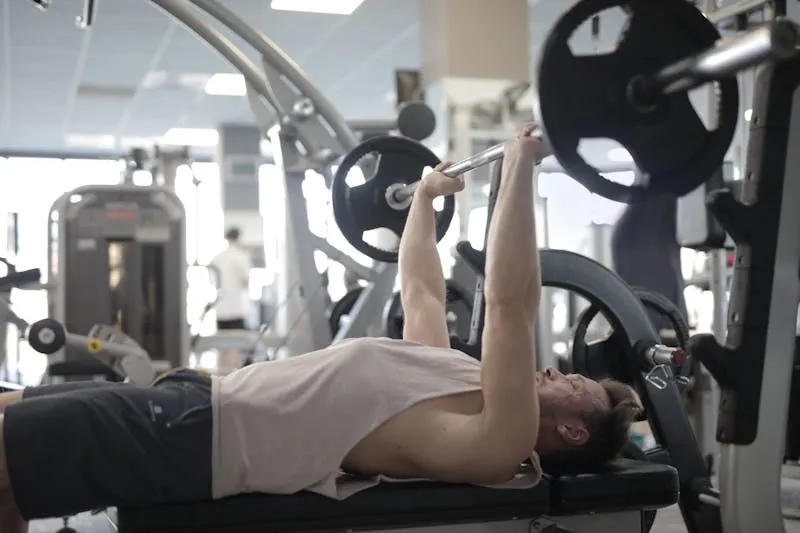
4. The bench press
Muscles targeted: pectorals, anterior deltoids, triceps
Execution: lying on a bench, feet on the floor, bar above the chest. Lower the bar to mid-chest under control. Press to return. Wrists stay straight, elbows at 45° to the body.
Beginner alternative: press-ups (knees down if needed) or dumbbell press.
5. The row
Muscles targeted: lats, rhomboids, trapezius, biceps
Execution: bent forward, flat back, one knee and one hand on a bench. Pull a dumbbell towards the hip, squeezing the shoulder blade. Lower under control.
Why it's essential: the back is often neglected. Yet a strong back corrects posture, prevents neck pain and compensates for hours spent sitting at a screen.
6. The overhead press
Muscles targeted: deltoids, triceps, upper trapezius
Execution: standing or seated, dumbbells at shoulder height. Press towards the ceiling until arms are straight. Lower under control.
7. The hip thrust
Muscles targeted: glutes (primarily gluteus maximus), hamstrings
Execution: upper back against a bench, feet on the floor, barbell across the hips. Drive hips towards the ceiling, squeezing the glutes. Hold 1 second at the top.
Why it matters: the most effective exercise for glute development, validated by EMG data (Contreras et al., 2015). Strong glutes aren't just aesthetic — they're essential for pelvic stability, lower back pain prevention and locomotion power.
8. The plank
Muscles targeted: transverse abdominis, obliques, spinal erectors
Execution: on forearms and toes, body in a straight line from head to heels. Brace the core as if someone were about to punch your stomach. Breathe normally.
Duration: 20-60 seconds, 3 sets. If you can comfortably hold for over 60 seconds, increase difficulty (side plank, plank with arm lift) rather than duration.
Golden rule: technique always comes before load. No exceptions. No negotiation. A perfect squat at 20 kg produces better results (and fewer injuries) than a wobbly squat at 50 kg. If your technique degrades, reduce the weight — not the other way round.
Progressive programme: 12 weeks for beginners
This programme follows the principle of progressive overload — the only proven mechanism for building strength: gradually increasing difficulty to force the body to adapt.
Weeks 1-4: Technical learning (3 sessions/week)
Goal: master foundational movements with light weights or bodyweight.
Session A (Monday) — Lower body:
- Bodyweight squat: 3 × 12
- Alternating lunges: 3 × 10 (each leg)
- Glute bridge (floor): 3 × 15
- Plank: 3 × 20-30 seconds
Session B (Wednesday) — Upper body:
- Press-ups (knees if needed): 3 × 8-10
- Dumbbell row: 3 × 10 (each arm, 4-6 kg)
- Seated shoulder press (3-5 kg dumbbells): 3 × 10
- Side plank: 2 × 15-20 seconds (each side)
Session C (Friday) — Full body:
- Goblet squat (6-8 kg dumbbell): 3 × 10
- Dumbbell row: 3 × 10
- Walking lunges: 3 × 8 (each leg)
- Press-ups: 3 × max
- Glute bridge: 3 × 12
Weeks 5-8: Introducing load (3 sessions/week)
Goal: progressively add weight whilst maintaining technique.
Same exercises, but: squats with dumbbells or empty barbell (20 kg); lunges with dumbbells (5-8 kg per hand); hip thrust with barbell or heavy dumbbell; adding Romanian deadlift with dumbbells (8-12 kg).
Progression rule: when you achieve 3 × 12 with a given load and the final reps aren't tough, increase by 2.5-5 kg.
Weeks 9-12: Intensification (3-4 sessions/week)
Goal: increase intensity, slightly reduce reps, work on strength.
Upper/lower split: Monday: lower body; Tuesday: upper body; Thursday: lower body (different variations); Friday: upper body (different variations).
Rep scheme: 4 × 8-10 (loads that make the last 2 reps challenging).
The training log: record every session — exercise, load, reps, how it felt. It's the only way to measure progress objectively. Without data, you're guessing. With data, you know that last month you squatted 30 kg and today you're at 40 — and that visible progress is the best motivation fuel.
Technique and safety: the non-negotiable rules
Warm-up: 5-10 compulsory minutes
- Light cardio activation (5 min) — rower, bike or brisk walk
- Joint mobility (3 min) — hip, shoulder, wrist, ankle rotations
- Warm-up sets — before each heavy exercise, 1-2 sets at 50% of working weight
Breathing under load
Universal rule: exhale on the effort (concentric phase), inhale on the release (eccentric phase). Example in the squat: inhale going down, exhale coming up. Never hold your breath across multiple reps — it's a vasovagal risk factor.
Tempo: control every phase
A 2-1-2 tempo is ideal for beginners: 2 seconds for the eccentric (lowering), 1 second pause, 2 seconds for the concentric (lifting). Control eliminates momentum — and uncontrolled momentum causes injuries.
When to stop an exercise
- Joint pain (distinct from the muscular burning sensation) — stop immediately
- Loss of technique — if your back rounds on deadlift or knees cave on squat, put the bar down
- Dizziness or nausea — rest, hydrate, reduce intensity
Never sacrifice technique for ego: in a gym, nobody judges you by your loads — and if someone does, that's their problem, not yours. Experienced lifters respect those who train with clean form, regardless of the weight.
Nutrition and strength training: eating to progress

Nutrition for strength training isn't a diet — it's fuel. The body can't build muscle without building materials. Here are the essentials, without overthinking.
Protein: the building material
Scientific recommendation for women who weight-train: 1.6-2.2 g of protein per kg of bodyweight per day (Morton et al. meta-analysis, British Journal of Sports Medicine, 2018). For a 65 kg woman: 104-143 g protein/day.
In practice: one egg = 6 g; 100 g chicken = 31 g; 100 g cooked lentils = 9 g; a Greek yoghurt = 10 g; 30 g whey = 24 g.
Whey isn't a "bodybuilding product" — it's concentrated milk protein. Convenient, not magical. If you hit your needs through food, it's unnecessary.
Carbohydrates: energy for effort
Carbs aren't the enemy. They're the primary fuel for intense muscular effort. Cutting carbs while strength training is like driving a car without petrol. Good sources: rice, pasta, sweet potatoes, oats, fruit.
Fats: hormones and recovery
Fats are essential for hormone production (including hormones supporting muscle building). Minimum: 0.8-1 g per kg of bodyweight. Sources: olive oil, avocados, nuts, oily fish.
Hydration
Drink at least 2 litres daily, plus 500 ml per hour of training. Dehydration reduces muscle strength by 10-20% — that's significant.
The simple rule: if you only remember one thing about strength-training nutrition, remember this: eat enough protein and don't skip meals. The details (meal timing, supplements, gram-precise macros) are 5% optimisations for advanced athletes. 95% of results come from consistency, not precision.
The mental game: overcoming gym intimidation
The number-one obstacle to women's strength training isn't physical — it's psychological. According to a Women's Health survey (2022), 65% of women avoid the free-weights area of their gym through intimidation. Let's address it.
Impostor syndrome
"I don't know what I'm doing." "Everyone's watching me." "I'm taking someone's spot who knows better." These thoughts are near-universal among beginners — and near-universally false. The reality: most gym-goers are focused on their own session and pay you a tenth of the attention you imagine.
Practical strategies
Go at off-peak times. Tuesday at 2pm is less daunting than Monday at 6pm. Use the first weeks to familiarise yourself with the space when it's quieter.
Have a written plan. Walking in with a programme on paper (or phone) eliminates wandering and the feeling of "not knowing what to do." You're following a list — like shopping, but with dumbbells.
Headphones. Not just for music — to signal that you're focused and not available for unsolicited small talk.
A gym induction. Most gyms offer a free induction session with a trainer. Take it: they'll show you the equipment, spaces and etiquette.
Unsolicited advice in the gym
Let's name the elephant in the room (literally): unsolicited tips. "Your back's not straight enough." "You should do it like this." "For girls, it's better to…" If the advice comes from a certified gym instructor, listen. If it comes from a stranger who wasn't asked — a simple "thanks, I've got a programme" will do. You don't owe anyone a justification for your presence.
Recovery and rest: the invisible half of progress

Here's a concept many beginners miss: muscle is built during rest, not during training. Training creates micro-tears in muscle fibres. Rest and nutrition allow repair and adaptation — and that adaptation is what produces strength and size.
Rest between sessions
Minimum 48 hours' rest between sessions targeting the same muscle groups. That's why the programme alternates upper and lower body. Training daily without rest leads to overtraining — chronic fatigue, strength regression, injury risk.
Sleep
Growth hormone (GH), essential for muscle repair, is produced primarily during deep sleep. Target: 7-9 hours per night. Sleep deprivation reduces muscle protein synthesis by 18% (Dattilo et al., 2011).
Stretching and mobility
Static stretching after a session (not before — data shows it reduces muscle strength if done pre-exercise) helps maintain range of motion. 5-10 minutes of targeted stretching post-session is sufficient. A weekly yoga or yin yoga class is an excellent complement.
DOMS (Delayed Onset Muscle Soreness)
DOMS is normal, especially in the first weeks. It appears 24-48 hours after training and resolves in 3-5 days. It is not an indicator of training quality — its absence doesn't mean your session was ineffective.
Adapting the programme to your goals
Pure strength
Reduce reps (3-6), increase loads, extend rest (3-5 min between sets). Focus on compound lifts (squat, deadlift, bench press).
Body composition ("shaping")
Stay in the 8-12 rep zone, moderate rest (60-90 seconds). Add isolation exercises for target areas (hip thrusts for glutes, lateral raises for shoulders). Combine with a mild caloric deficit if fat loss is also a goal.
Health and wellbeing
2-3 sessions of 30-40 minutes per week, full-body exercises, moderate loads. This is the WHO minimum — and it's already enough to capture 80% of strength training's health benefits.
Complementary sport
If strength training supplements another sport (running, swimming, martial arts), focus on exercises that improve performance in your primary sport. A runner doesn't need the same strength work as a swimmer.
FAQ — Strength training for women
Will strength training make me gain weight?
Muscle is denser than fat — you can gain scale weight while losing volume. That's why the scales are a poor progress indicator in strength training. Prefer photos, measurements or how your clothes fit. If your jeans are tighter at the thighs but looser at the waist, your body composition is improving — whatever the scales say.
Can I train during my period?
Yes. Studies show no medical reason to stop training during menstruation. Some women report lower energy on days 1-2 — adjust intensity if needed, but don't stop unless discomfort is significant. Interesting fact: exercise reduces menstrual cramps (ACSM, 2019).
How long before I see results?
Strength gains: 2-4 weeks (primarily neural at first). Visible changes: 8-12 weeks. Noticeable transformation: 6-12 months. Strength training is a medium-term investment — results aren't instant, but they're lasting.
Should I take whey or creatine?
Whey is a handy supplement if you're not meeting protein needs through food — it's not mandatory. Creatine monohydrate (3-5 g/day) is the most studied supplement in sports science: it increases strength and power by 5-15%. It's safe, cheap, and equally effective in women and men. The rest (BCAAs, fat burners, pre-workout) is mostly marketing.
Is strength training compatible with yoga?
Perfectly. The two are complementary: strength training builds power and force; yoga develops flexibility, mobility and stress management. Many athletes combine both. A yin yoga session after an intense weights session is particularly beneficial for recovery.
Can I train at home without a gym?
Absolutely. With a set of adjustable dumbbells (or resistance bands), a folding bench and a mat, you can perform 80% of this programme's exercises. The initial investment is recouped in 3-4 months of saved gym membership.
I have a condition (back, knees, shoulders). Can I still train?
In most cases, yes — with adaptations. Strength training is actually recommended in rehabilitation for many conditions (lower back pain, knee osteoarthritis, shoulder instability). But: see a sports doctor or physiotherapist before starting, to identify exercises to adapt or avoid.
Sources and references
- NHS – Strength and Flexibility Exercises Guide
- WHO – Global Recommendations on Physical Activity, 2020
- ACSM – Guidelines for Exercise Testing and Prescription, 11th Edition
- Morton et al. – Protein Requirements for Strength Athletes, British Journal of Sports Medicine, 2018
- Gordon et al. – Resistance Exercise and Anxiety/Depression, Sports Medicine, 2017-2018
- Contreras et al. – EMG Analysis of the Hip Thrust, Journal of Applied Biomechanics, 2015
- Hausenblas & Fallon – Exercise and Body Image, Psychology & Health, 2006
- Royal Osteoporosis Society – Osteoporosis Facts and Figures