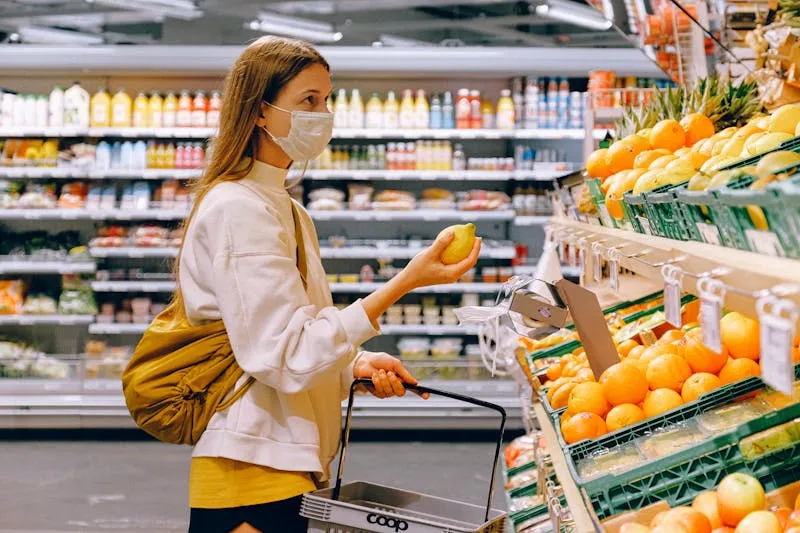
Last Wednesday, a patient — let's call her Sarah, 38, communications manager — walked into my clinic with a shopping bag. Not just any bag. A bag she'd assembled with obsessive care: nothing but products labelled "no added sugar," "high in fibre," "source of protein." She looked rather pleased with herself. "I was really careful this time." We spent forty-five minutes dissecting each package. By the end, Sarah was staring at her "healthy salad" box — 14 g of fat per serving, glucose-fructose syrup as the third ingredient — with the expression of someone who's just been told Father Christmas isn't real.
Sarah is neither gullible nor ignorant. She's an intelligent, educated woman who simply never learnt to read a food label. And why would she? Nobody teaches us. Not at school, not at the GP surgery, and certainly not in adverts. Food packaging is the result of decades of marketing engineering designed to make us buy. Not to inform us.
This guide is the one you should receive at the entrance of every supermarket. Not a biochemistry lecture — a practical toolkit to take back control of what goes into your trolley, and into your body.
In this guide
- Anatomy of a food label: what's mandatory (and what isn't)
- The ingredient list: where the real story is
- Hidden sugars: 61 names for the same trap
- Food additives: the E-numbers — should you panic?
- The nutrition table: reading the real numbers
- Marketing claims: what the law allows (and what it hides)
- Traffic light labels and NOVA: useful but imperfect
- Scanning apps: an honest comparison
- The 30-second method at the shelf
- Frequently asked questions
Anatomy of a food label: what's mandatory (and what isn't)
Under UK Food Information Regulations 2014 (and EU Regulation No. 1169/2011, which the UK retained post-Brexit), every pre-packed food product must display certain information. Except that "mandatory" doesn't mean "readable" — and the industry knows it perfectly well.
Mandatory information:
- Name of the food — what the product actually is ("chicken-flavoured processed meat" vs "chicken nuggets")
- Ingredients list — in descending order of weight
- Allergens — emphasised in the ingredients (bold, underlined, or capitals)
- Net quantity — in grams or millilitres
- Date marking — "Use by" (safety) or "Best before" (quality)
- Storage conditions — "Keep refrigerated after opening"
- Manufacturer or packer's name and address
- Country of origin — mandatory for meat, fruits, vegetables, honey, olive oil
- Nutrition declaration — per 100 g or 100 ml
- Alcohol content — if above 1.2% ABV
Diana's tip — The legal name is often in small print, far from the brand name. A "Garden Vegetable Soup" can legally be a "Dehydrated soup mix." It's this legal name that tells you what you're actually buying.
What's NOT mandatory (but often displayed when it helps sales):
- Front-of-pack traffic light labels — voluntary, though widely adopted in the UK
- Nutritional claims ("source of fibre") — regulated but not required
- Origin of all ingredients — only certain products must declare this
- Percentage of a highlighted ingredient — only if it appears in the name or illustration
Translation: when a manufacturer chooses to display non-mandatory information, it's because it helps sell. When they don't display it, it's because it might make you think twice.
The ingredient list: where the real story is
Of everything on a food package, the ingredient list tells the true story of the product. The nutrition table tells you how much. The ingredient list tells you what — and that's infinitely more important.
The golden rule: ingredients are listed in descending order of weight. The first ingredient is the one present in the largest quantity. If sugar, palm oil, or starch appears in the top three, you have your answer.
Warning — A "premium pork pâté" whose first ingredient is "pork fat" rather than "pork liver" is perfectly legal. But it's not exactly what the rustic farmhouse image on the packaging led you to believe.
Red flags for ultra-processing:
A product with more than five ingredients deserves your attention. But the real warning sign is ingredients you'd never find in a kitchen:
- Modified starches — industrial thickeners (not regular cornflour)
- Milk proteins, protein isolates — added for texture, not nutrition
- Glucose-fructose syrup — cheap liquid sugar, metabolically problematic
- Hydrogenated or partially hydrogenated oils — source of trans fats
- Flavourings (without further detail) — the word "natural" guarantees nothing reassuring
- Dextrose, maltodextrin, rice syrup — sugar under a pseudonym
Diana's tip — Pick up the product, turn it over. If the ingredient list reads like an organic chemistry exam paper — put it back. A good product doesn't need fifteen lines to justify itself.
The splitting trick:
A manufacturer can break a single ingredient into several names so it drops down the list. Sugar can appear as "sugar, glucose syrup, dextrose, honey, concentrated apple juice" — five entries which, added together, would place it first. This is perfectly legal.
Check the total carbohydrates in the nutrition table, line "of which sugars." If sugars exceed 15 g per 100 g in a savoury product, something is off.
Hidden sugars: 61 names for the same trap

The World Health Organisation recommends no more than 25 g of free sugars per day — roughly 6 teaspoons. The average British adult consumes between 55 and 70 g. The gap isn't down to the sugar consciously stirred into tea. It's hidden sugars.
The food industry has a remarkable talent for concealing sugar. Not by physically hiding it — by renaming it. There are at least 61 different names for added sugars on a label.
The obvious names: sugar, sucrose, glucose, fructose, lactose, maltose, galactose.
The technical names: dextrose, dextrin, maltodextrin, isoglucose, trehalose.
The "natural" names: honey, agave syrup, maple syrup, coconut sugar, raw cane sugar, muscovado, panela, rapadura, concentrated fruit juice.
The industrial names: glucose syrup, glucose-fructose syrup, HFCS (High Fructose Corn Syrup), rice syrup, wheat syrup, caramel.
Warning — Agave syrup, often marketed as a "healthy" alternative, has a low glycaemic index but contains 70–90% fructose. This free fructose, metabolised exclusively by the liver, has the same metabolic effects as high-fructose corn syrup. "Natural" does not mean "better for you."
Where do hidden sugars lurk?
The most deceptive products aren't sweets — we expect sugar there. They're savoury or "health" products:
- Shop-bought pasta sauces — 7 to 12 g of sugar per 100 g (as much as a biscuit)
- "Light" salad dressings — less fat, but compensated with sugar
- Sliced bread — 4 to 8 g of sugar per serving
- Carton soups — 3 to 6 g of sugar per bowl
- "Fitness" cereals — 20 to 30 g of sugar per 100 g (as much as cake)
- Fruit yoghurts — 12 to 16 g per pot (of which 8 to 10 g added)
- Shop-bought smoothies — 25 to 35 g per bottle (more than a fizzy drink)
- "Light" ready meals — fat reduction compensated by sugars and starches
Diana's tip — In the nutrition table, find the "of which sugars" line. For a savoury product, above 5 g per 100 g, ask yourself: why does this product need sugar? For a sweet product, compare it against plain yoghurt (4.7 g of natural lactose per 100 g). Anything above that is added sugar.
Food additives: the E-numbers — should you panic?
Food additives carry a reputation as industrial poisons. This is both excessive and not entirely unfounded — which makes the subject particularly difficult to discuss honestly.
Let's start with facts: an additive is a substance intentionally added to food to perform a technological function — preservation, colouring, emulsification, thickening, flavour enhancement. Every additive authorised in the UK carries an E-number, evaluated by the FSA and previously by the EFSA.
What the E-number tells you:
- E100–E199 — Colourings
- E200–E299 — Preservatives
- E300–E399 — Antioxidants (including E300 = vitamin C)
- E400–E499 — Thickeners, stabilisers, emulsifiers
- E500–E599 — pH regulators
- E600–E699 — Flavour enhancers (including E621 = MSG)
- E900–E999 — Sweeteners, waxes, propellant gases
Innocent additives that get demonised:
- E300 (ascorbic acid) — it's vitamin C
- E330 (citric acid) — naturally found in citrus fruits
- E500 (sodium bicarbonate) — the bicarb in your kitchen cupboard
- E160a (beta-carotene) — the natural pigment in carrots
- E406 (agar-agar) — plant-based gelling agent from seaweed
Those that warrant genuine caution:
- Nitrites (E249, E250) and nitrates (E251, E252) — cured meat preservatives, classified as "probably carcinogenic" (Group 2A, IARC) when they form nitrosamines. Public health advice: limit processed meat to 70 g per day (NHS).
- Titanium dioxide (E171) — white colourant banned in food across the EU since 2022 (precautionary principle, gut barrier effects observed in animals). Not yet banned in the UK but under review.
- Emulsifiers (E433, E466, E407) — studies suggest impact on gut microbiome and intestinal permeability. Research is ongoing.
- Intense sweeteners (E951 aspartame, E955 sucralose) — IARC classified aspartame as "possibly carcinogenic" (Group 2B) in 2023. The FSA maintains the ADI. Prudence suggests avoiding massive daily consumption.
Warning — Rejecting all additives isn't more rational than accepting them blindly. Vitamin C (E300) and bicarbonate (E500) are additives. The real criterion: is the additive there to preserve a simple food (acceptable), or to give an appearance, flavour, or texture to a food that shouldn't have them (suspect)?
The nutrition table: reading the real numbers

The nutrition table displays, per 100 g or 100 ml: energy (in kJ and kcal), fat (of which saturates), carbohydrate (of which sugars), fibre, protein, and salt.
The manufacturer may also show values "per serving." And this is where things get complicated.
The portion trap:
Serving size is defined by the manufacturer, not by an independent body. Result: a serving of cereal can be 30 g (who eats 30 g of cereal?), a serving of crisps 25 g (five crisps), a serving of juice 200 ml when the bottle holds 750.
"Per serving" figures systematically minimise the actual amount of sugar, salt, and calories. It's mathematically inevitable — and that's the point.
Always compare on a per-100g basis. It's the only reliable way to compare two products.
Key benchmarks per 100 g (UK traffic light system):
| Nutrient | Low (green) | Medium (amber) | High (red) |
|---|---|---|---|
| Fat | ≤ 3 g | 3–17.5 g | > 17.5 g |
| Saturates | ≤ 1.5 g | 1.5–5 g | > 5 g |
| Sugars | ≤ 5 g | 5–22.5 g | > 22.5 g |
| Salt | ≤ 0.3 g | 0.3–1.5 g | > 1.5 g |
These thresholds come from the UK's Food Standards Agency traffic light system — the most widely used front-of-pack labelling in Britain.
Diana's tip — For an ultra-quick assessment in the aisle: check saturated fat and sugars. If either exceeds 15 g per 100 g, it's a treat product, not an everyday staple. Nothing wrong with that — as long as you're aware.
Salt: the forgotten nutrient
British adults consume an average of 8.1 g of salt daily — the NHS recommends no more than 6 g. Most of this comes from processed foods, not the salt shaker. The biggest contributors: bread (the single largest source by volume), processed meats, cheese, ready meals, sauces, and — surprisingly — breakfast cereals.
One gram of salt contains 400 mg of sodium. Some tables display sodium rather than salt. To convert: salt = sodium × 2.5.
Marketing claims: what the law allows (and what it hides)
Claims on food packaging are regulated by retained EU Regulation 1924/2006. In theory, a manufacturer can't write anything they like. In practice, the line between information and manipulation is thin — and marketing teams know it intimately.
Nutrition claims (measurable, verifiable):
- "Source of fibre" = ≥ 3 g fibre per 100 g
- "High in fibre" = ≥ 6 g fibre per 100 g
- "Reduced fat" = at least 30% less fat than the reference product
- "No added sugar" = no added mono/disaccharides (but natural sugars still possible)
- "Source of protein" = ≥ 12% of energy from protein
- "High in protein" = ≥ 20% of energy from protein
These claims are true. But they're selective — highlighting one positive aspect without mentioning the rest.
Misleading wording (legal but manipulative):
- "Traditional recipe" — no legal definition, purely evocative
- "Homemade style" — can mean "assembled on site from industrial components"
- "Natural" — no regulatory definition in food (unlike cosmetics)
- "Pure" — no obligation beyond absence of mixing
- "Artisan" — protected in some contexts (bakery) but not all
- "Authentic" — pure marketing, no legal value
- "Non-GMO" — in the UK, the vast majority of food products are non-GMO. Displaying it creates a false differentiator
- "No preservatives" + "no colourants" — may still contain other additives (emulsifiers, enhancers, flavourings)
Diana's tip — A simple rule: if a claim makes you feel virtuous, it's designed to. Turn the product over and read the ingredients. The front is the advert. The back is the contract.
Traffic light labels and NOVA: useful but imperfect
The UK traffic light system uses colour-coded labels (red, amber, green) to show at a glance whether a product is high, medium, or low in fat, saturates, sugars, and salt per 100 g. It's the most intuitive labelling system available.
What it does well:
- Provides instant visual comparison between products
- Encourages reformulation — many UK retailers have reduced sugar and salt in own-brand products
- Research shows consumers make better choices with traffic light labels than with nutrition tables alone
Its real limitations:
- Based on per-100g — nobody eats 100 g of olive oil (all red) vs 100 g of diet fizzy drink (mostly green)
- Doesn't account for degree of processing — an ultra-processed ready meal can show mostly green
- Doesn't cover additives or pesticides
- Voluntary — products with poor scores simply don't display it
The NOVA classification complements traffic lights by evaluating not composition but degree of processing:
- NOVA 1 — Unprocessed or minimally processed (fruit, veg, eggs, rice, fresh meat)
- NOVA 2 — Processed culinary ingredients (oil, butter, sugar, salt, flour)
- NOVA 3 — Processed foods (cheese, bread, tinned vegetables, traditional cured meats)
- NOVA 4 — Ultra-processed products (UPPs) — containing industrial ingredients absent from a domestic kitchen
A BMJ study (2019, 105,000 participants from the NutriNet-Santé cohort) found a 10% increase in cardiovascular disease risk for every 10% increase in UPPs in the diet. This result has been replicated across multiple international cohorts.
Diana's tip — Use traffic light labels to compare two similar products (two pizzas, two yoghurts). Use NOVA to decide whether the product deserves to be in your trolley. A NOVA 4 product with all-green traffic lights is still ultra-processed.
Scanning apps: an honest comparison

Several apps let you scan a barcode and instantly pull up a product's nutritional profile. Their popularity is phenomenal — Yuka alone claims over 50 million users worldwide. But they're not all equal.
Yuka
- Strengths: excellent interface, score out of 100 easy to understand, flags controversial additives, suggests better-rated alternatives
- Limitations: the weighting (60% nutritional, 30% additives, 10% organic) is debatable; the 10-point "organic bonus" has no solid nutritional justification; the business model incentivises "premium" product recommendations
- Verdict: good consumer tool, but not nutritional expertise
Open Food Facts
- Strengths: collaborative, open-source database (3 million products), transparent scoring, no commercial conflicts of interest, reusable data
- Limitations: less polished interface, sometimes incomplete data (volunteer-contributed), no built-in alternative recommendations
- Verdict: the most rigorous choice if you want raw data
myfitnesspal
- Strengths: massive database, excellent calorie tracking, useful for specific dietary goals
- Limitations: focused on macros rather than food quality, doesn't assess processing level, user-submitted data can be inaccurate
- Verdict: great for calorie counting, less useful for overall food quality assessment
My advice: install Open Food Facts AND Yuka. Scan with Yuka for the quick verdict — verify with Open Food Facts when the result surprises you. And never forget that no app replaces directly reading the ingredient list.
The 30-second method at the shelf

You're not going to spend ten minutes on every product. The good news: with a bit of method, 30 seconds is enough to know whether a product deserves to enter your trolley.
Step 1 (5 seconds): turn the product over. Ignore the front. It's designed to seduce, not to inform.
Step 2 (10 seconds): read the first three ingredients. They make up the bulk of the product. If the first is "water," "sugar," "oil," or "starch" when you're buying a ready meal or a "health" product, put it back.
Step 3 (10 seconds): check three numbers in the nutrition table (per 100 g):
- Sugars → if > 15 g in a savoury product = too sweet
- Saturates → if > 5 g = high
- Salt → if > 1.5 g = high
Step 4 (5 seconds): count the ingredients. More than 10 ingredients with names you don't recognise = ultra-processed. Walk away or accept it as an occasional treat.
Warning — This method is a quick filter, not an absolute verdict. An artisan cheese will have high saturated fat and significant salt — that's normal, and it's not an ultra-processed product. Context always matters. A NOVA 1 food with natural salt isn't comparable to a NOVA 4 product with the same amount of salt.
General shopping principles:
- Shop the perimeter of the supermarket — fresh sections (fruit, veg, butcher, fishmonger) are around the edges, ultra-processed is in the middle aisles
- A product that doesn't need a label (a piece of fruit, a vegetable, an egg) is almost always a better choice than one that does
- Simplicity signals quality: fewer ingredients means higher chance the product is honest
- Beware "light" versions — they almost always compensate with sugar, modified starch, or additives
- Price per kg is more informative than unit price — especially when comparing different portion sizes
Frequently asked questions
Is a product with all-green traffic lights necessarily healthy?
No. Traffic light labels assess nutritional composition, not degree of processing or additive content. An ultra-processed ready meal can show mostly green thanks to a decent nutrient balance while containing emulsifiers, flavourings, and modified starches. Use traffic lights to compare within a category, not as an absolute quality stamp.
Does "no added sugar" mean the product contains no sugar?
No. "No added sugar" means no sugars or sweeteners were intentionally added. But the product may contain naturally occurring sugars — a fruit juice with "no added sugar" contains the fruit's own sugars (fructose, glucose), typically 10–12 g per 100 ml. Always check the "of which sugars" line in the nutrition table.
Are organic additives safer than conventional ones?
Not necessarily. Organic certification allows roughly 50 additives (versus over 300 in conventional), which is more restrictive. But the permitted organic additives (E330 citric acid, E500 bicarbonate, E407 carrageenan) are chemically identical to their conventional versions. The real advantage of organic regarding additives is indirect: fewer permitted additives generally means less processed products.
Should I avoid all products with E-numbers?
No. This idea stems from misunderstanding the classification. E300 is vitamin C, E330 is citric acid, E500 is bicarbonate. The E prefix simply means the substance has been evaluated and authorised at European level. Focus your caution on additives where recent research suggests prudence: nitrites (E249–E252), certain emulsifiers (E433, E466), and intense sweeteners in daily heavy consumption.
Does "reduced fat" mean better for health?
Rarely. A "reduced fat" product must contain at least 30% less fat than the standard version. But to maintain taste and texture, manufacturers almost always compensate with sugar, modified starch, thickeners, or flavourings. Result: a more processed product, sometimes with similar calories. Always compare the nutrition tables of both versions — standard and reduced — per 100 g.
Can I trust Yuka to choose my products?
Yuka is a good first filter but not a nutritional expertise tool. Its score combines 60% nutritional, 30% additives, and 10% organic certification — this weighting is debatable (the organic bonus has no solid nutritional justification). Moreover, Yuka's business model incentivises recommending "premium" products. Use it to spot clearly problematic products, but verify with the ingredient list for borderline cases.
What's the difference between "use by" and "best before"?
"Use by" dates appear on perishable products (meat, fish, fresh products). Consuming after this date carries a real food safety risk. "Best before" dates appear on shelf-stable products (tins, pasta, biscuits). After this date, the product may lose some taste or texture quality but remains safe to eat. In the UK, WRAP estimates that confusion between these dates contributes significantly to household food waste.