In this article
- What makes a truly great brunch
- Quantities per person (the real numbers)
- Essential sweet recipes
- Savoury recipes that make the difference
- Drinks: from coffee to cocktails
- Timing: when to prepare what
- Presentation: setting a stunning spread
- Budget tips: a brunch that won't bankrupt you
- Frequently asked questions
Last Saturday, I got a message from my friend Pauline at 10:47pm: "What are you up to tomorrow morning? Fancy doing brunch? There'll be 8 of us." Eight people. The following morning. With a fridge containing three expired yoghurts, half a lemon, and an opened carton of oat milk.
Anyone else would have panicked. But not me — not this time. Because I've hosted so many disastrous brunches in my life that I've finally worked out exactly what works, what doesn't, and crucially, what you can pull together in record time when you know the fundamentals. By 11am the next day, the table was set, the pancakes were hot, the smashed avocado was perfect, and Pauline gave me that look that says "how do you do this?"
The honest answer: a successful brunch isn't about cooking talent. It's about organisation. You can be hopeless in the kitchen and still pull off a spectacular brunch if you know what to make, when, and how much. That's exactly what this guide will show you.
What makes a truly great brunch
Before we talk recipes, let's talk about what actually makes a brunch memorable. Because it's not always what you'd think.
Visual abundance
A brunch is, first and foremost, an impression of generosity. The table should look overflowing — even if the quantities are perfectly calculated underneath. Lots of small dishes beats three big ones every time. The "wow" effect comes from the number of offerings, not the size of portions.
The sweet-savoury balance
This is THE non-negotiable rule. A 100% sweet brunch makes people feel queasy after 20 minutes. A 100% savoury brunch is dull. The ideal ratio: 60% savoury, 40% sweet. People instinctively start with savoury and finish with sweet — every single time.
The relaxed pace
A brunch isn't a dinner party. There's no service, no courses arriving in a set order. Everything is laid out on the table (or as a buffet) and everyone helps themselves at their own pace. This self-service format is your greatest ally: it frees you from the kitchen and lets you sit with your guests.
The secret brunch restaurants won't tell you: Half of what's on the table isn't actually "cooked." Cheese, charcuterie, butter, jam, fresh fruit, yoghurt, shop-bought granola — all of that fills the table with zero preparation. The real work concentrates on 3-4 recipes max. Everything else is assembly.
Quantities per person (the real numbers)
It's the question everyone thinks but nobody asks aloud: "how much should I make?" Too much → waste and guilt. Too little → the disappointed gaze of the guest staring at the last slice of smoked salmon that someone else just took.
The basics per person
- Bread / pastries: 150-200g (about 2-3 items: a croissant + a slice of toast + a mini pain au chocolat)
- Eggs: 2 per person if eggs are the main savoury dish, 1.5 if you're also serving charcuterie
- Cheese / charcuterie: 50-80g each
- Smoked salmon: 40-50g (2-3 slices)
- Fresh fruit: 100-150g (a bowl of fruit salad or whole fruits)
- Pancakes: 2-3 per person
- Hot drinks: 2-3 cups per person (budget 500ml of water per person for filter coffee)
- Juice: 250-300ml per person
The pastry overdose: The classic homemade brunch mistake is buying too many pastries because they look gorgeous on the table. But between croissants, pancakes, bread, and toast… people eat far fewer standalone pastries than you'd imagine. 1.5 pastries per person is plenty. Leftover croissants don't keep — that's guaranteed waste.
Essential sweet recipes
Fluffy American pancakes (for 8 — makes 20)
THE brunch star. And the recipe is laughably easy.
- 300g plain flour
- 3 eggs
- 400ml whole milk (or oat milk — works beautifully)
- 50g caster sugar
- 2 tsp baking powder
- 30g melted butter
- Pinch of salt
Mix the dry ingredients. Make a well, add beaten eggs, milk, and melted butter. Stir until smooth but don't over-mix — a few lumps are fine and desirable (over-mixing develops the gluten and makes rubbery pancakes).
Non-stick pan, medium heat, tiny bit of butter. Pour a small ladleful, wait until bubbles form across the entire surface (about 2 minutes), flip, 1 minute on the other side. The pancake should be golden, not burnt.
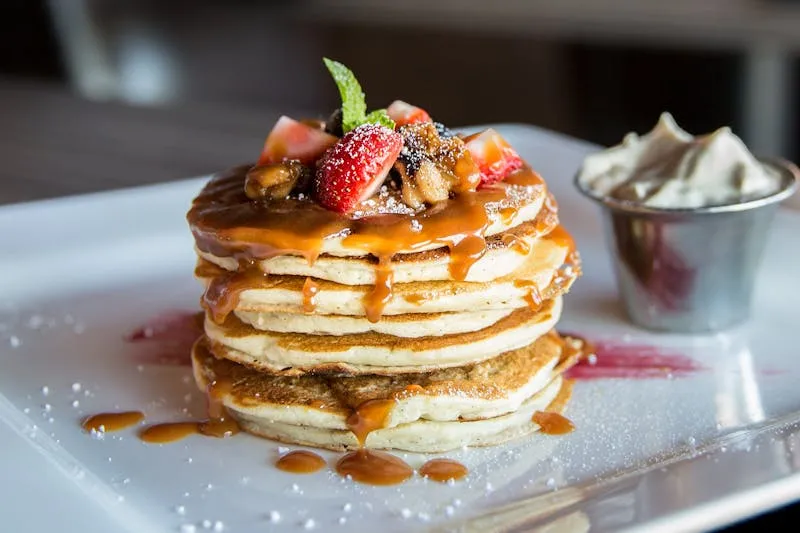
The trick for hot pancakes all at once: Don't serve pancakes as you make them — they go cold before you've finished the batch. Instead, stack them on a baking tray in the oven at 80°C/175°F between sheets of baking parchment. When the whole batch is done, bring the stack out in one go. Everyone eats them hot.
Homemade granola
300g rolled oats + 100g honey + 50g coconut oil + 50g crushed nuts (almonds, hazelnuts, pecans) + pinch of salt + cinnamon. Mix, spread on a tray, bake at 160°C/325°F for 20-25 minutes, stirring every 7-8 minutes. Cool completely (it crisps as it cools). Add dried fruit (cranberries, raisins) after baking. Keeps 2 weeks in an airtight jar — make it days in advance.
Seasonal fruit salad
Simplicity itself, yet so underrated. Fresh seasonal fruit cut into pieces that aren't too small (they should keep their identity). A drizzle of honey, a squeeze of lime, a few mint leaves. No added sugar if the fruit is ripe. Make it the same morning — 1 hour ahead maximum, otherwise the fruit releases its juices and goes soft.
Savoury recipes that make the difference
Creamy scrambled eggs (the chef's way)
Restaurant-style scrambled eggs — the ones that are creamy, almost custard-like — have nothing in common with the rubbery lumps from school canteens. The difference: heat and patience.
- 3 eggs per person, beaten with a fork (not a whisk — you don't want to incorporate air)
- 1 knob of butter per person
- 1 tablespoon of crème fraîche per person
Saucepan (not a frying pan). VERY low heat. Melt the butter, pour in the eggs. Stir slowly and constantly with a wooden spatula — scraping the base. The eggs should set gradually, forming creamy "ribbons." When they're still slightly too runny for your liking — take off the heat and stir in the crème fraîche. Residual heat finishes the job. Total: 8-10 minutes of slow cooking.
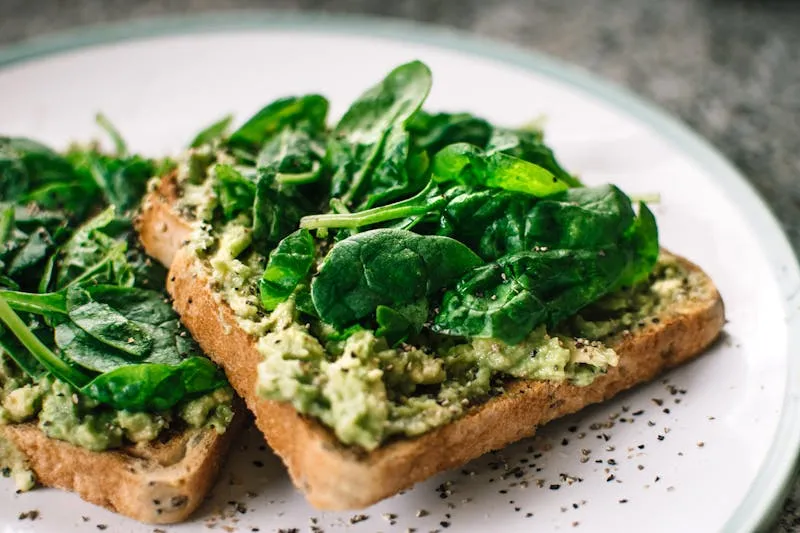
Avocado and smoked salmon toast on sourdough
The Instagram classic, done properly:
- Thick-cut sourdough, toasted
- 1 ripe avocado, roughly mashed with a fork (not blitzed — you want texture) + lemon juice + salt + chilli flakes
- 2-3 slices of smoked salmon draped in waves
- Sesame seeds, baby rocket, a drizzle of olive oil
Assemble at the last minute — avocado browns quickly. Lemon juice slows oxidation but doesn't eliminate the problem beyond 30 minutes.
Crustless vegetable quiche
A quiche filling poured straight into a buttered dish, no pastry base. Lighter, quicker, and honestly — nobody notices the missing pastry at brunch when there's already bread everywhere.
- 6 eggs + 200ml double cream + 150ml milk
- Filling of choice: spinach and feta, tomato and goat's cheese, leek and bacon
- Buttered dish, 180°C/350°F, 30-35 minutes
Make it the night before. Eats perfectly at room temperature — ideal for brunch.
Eggs Benedict (to impress)
If you want the "signature dish" of your brunch — the one people still talk about the following week — this is it. Poached eggs on a toasted English muffin, bacon or smoked salmon, and homemade hollandaise.
Simplified hollandaise: 2 egg yolks + 1 tbsp water + 100g melted butter (hot). Whisk the yolks and water over a bain-marie until thickened (3-4 minutes). Remove from heat. Pour the melted butter in a very thin stream, whisking constantly. Salt, pepper, lemon juice. It's easier than it sounds — promise.
Hollandaise that splits: If your sauce separates (the fat breaks away), the butter was either too hot or added too quickly. Don't panic: in a fresh bowl, add 1 tablespoon of cold water, and pour your split sauce back in very slowly while whisking vigorously. It will re-emulsify. This rescue works 9 times out of 10.
Drinks: from coffee to cocktails
Drinks account for at least 30% of a brunch's atmosphere. And it's not just about the coffee.
Coffee
A cafetière, a filter machine, or a pod machine — any will do. For an elevated brunch, offer two options: black coffee and lattes. Have plant milk available (oat or almond) for those who need it — it's become a basic expectation.
Tea
2-3 varieties are plenty: a classic black tea (English Breakfast), a green tea, and an herbal (peppermint or chamomile). Serve hot water in a teapot or thermos — never the microwave.
Juice
Freshly squeezed orange juice (if you're feeling ambitious), or a quality bottle from the chilled aisle. An artisan apple juice as an alternative. Present them in glass carafes — the effect is immediate.
The brunch cocktail (optional but festive)
Mimosa: 1/3 fresh orange juice + 2/3 prosecco or champagne. The simplest and most effective brunch cocktail in existence. Make a big jug and let people help themselves.
Brunch Spritz: Aperol + prosecco + sparkling water + orange slice. Lighter than a mimosa, perfect for summer.

Infused water: A jug of water with lemon slices, mint leaves, and raspberries. Prep time: 30 seconds. Effect on the table: immediate. It's the free detail that takes your brunch from "nice" to "thoughtfully curated." Make it the night before so the flavours have time to infuse.
Timing: when to prepare what
Organisation is what separates the calm brunch from the stressful one. Here's the battle plan.
Up to 1 week before
- Homemade granola (keeps 2 weeks)
- Finalise your shopping list
The evening before
- Crustless quiche → baked, covered, fridge
- Pancake batter → bowl, covered, fridge (makes perfectly well the night before)
- Infused water → jug in fridge
- Fruit salad → washed and chopped, bowl in fridge
- Set the table (yes, the night before!)
- Lay out serving dishes, carafes, bowls
The morning (1h30 before guests arrive)
- -1h30: Coffee on. Set oven to 80°C/175°F (to keep pancakes warm)
- -1h15: Cook pancakes, stack in oven between sheets of parchment
- -1h00: Everything out of the fridge: cheese, charcuterie, butter, jam, quiche
- -0h45: Arrange cold items on the table: fruit, granola, yoghurt, cheese, charcuterie
- -0h30: Prepare the avocado toasts (mash avocado, toast the bread)
- -0h15: Start the scrambled eggs (or poached if doing Benedicts)
- 0h00: Guests arrive, everything's ready, you're relaxed with a coffee in hand
Timing mistake #1: Starting too late. If guests arrive at 11am and you start cooking at 10:30, you're already behind before you've begun. 1h30 before is the minimum. And if you've prepped the night before (quiche, granola, pancake batter), that 1h30 is a gentle stroll, not a sprint.
Presentation: setting a stunning spread
How a brunch looks matters as much as how it tastes. And the good news is that it costs almost nothing.
The basic principles
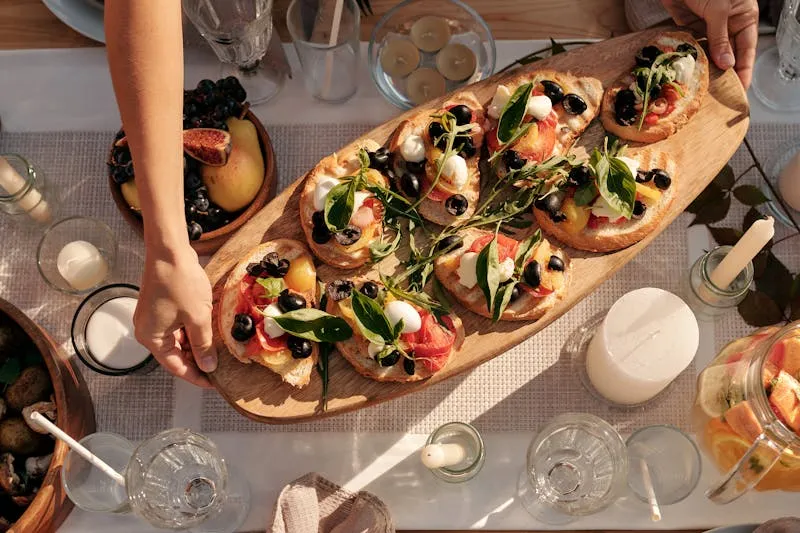
- Height: Create volume on the table. A cake on a raised stand, a fruit bowl on a book, wooden boards of different sizes — the eye should travel, not land flat
- Textures: Mix wood, ceramics, glass, wicker. Uniformity is the enemy of a beautiful spread
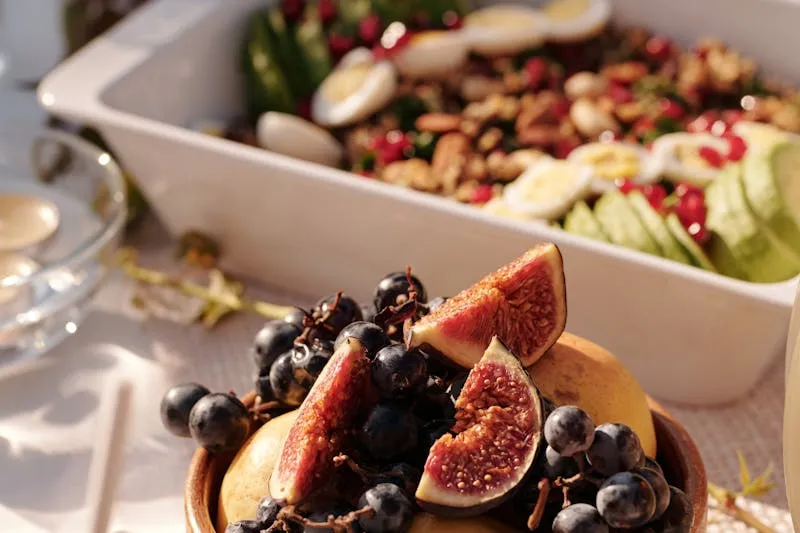
- Colours: Fruit is your best ally. Red strawberries, blue blueberries, orange slices — the colour comes from the food itself, not the decorations
- Small containers: Jam in a little bowl (not the industrial jar), butter in a ramekin, honey in a dish. Even shop-bought products look "homemade" when they're in pretty containers
Zone-by-zone layout
- Drinks zone: Separate, on a sideboard or worktop section. Coffee, tea, juice, water, glasses. People help themselves continuously — it needs to be accessible without blocking the table
- Savoury zone: One side of the table. Eggs, charcuterie, cheese, toasts, quiche
- Sweet zone: The other side. Pancakes, granola, yoghurt, fruit, pastries, jams
Budget tips: a brunch that won't bankrupt you
A brunch for 8 can cost a fortune — or be remarkably reasonable. It all depends on strategic choices.
What's expensive (and the alternatives)
- Smoked salmon: £20-30/kg for artisan. Alternative: smoked trout (£12-18/kg), just as delicious and often more sustainably sourced
- Bakery pastries: £1-1.80 each × 12 = adds up fast. Alternative: homemade pancakes (ingredient cost: £1.50 for 20) and buy just 4-6 croissants as a supplement
- The "cocktail" brunch: Champagne at £20+ a bottle. Alternative: prosecco at £6-9 — honestly, in a mimosa, nobody can tell
- Avocados in winter: £1-1.50 each. Alternative: homemade houmous (chickpeas, tahini, lemon — £1.50 for a big bowl) on the toast instead
Realistic budget for 8 people
- Generous version: £50-65 (smoked salmon, bakery croissants, fresh fruit, good coffee)
- Smart version: £30-40 (smoked trout, homemade pancakes, seasonal fruit, quiche)
- Student version: £15-25 (scrambled eggs, toast, homemade granola, fruit, no salmon)
That's £2-8 per person. Compare that with brunch at a restaurant: £18-30 per head. The maths speaks for itself.
The pot-luck approach: Suggest a "bring a dish" brunch. You handle the eggs, pancakes, and coffee. Someone brings pastries, another brings fresh juice, another brings fruit. The budget drops to almost nothing and everyone feels involved. It's also far less stress for one person.
Frequently asked questions
What's the ideal time to start a brunch?
Between 10:30 and 11:30am is the sweet spot. Late enough for everyone to have had a lie-in (especially at weekends), but early enough that people are still genuinely hungry. Before 10am, it's breakfast. After 12:30pm, it's lunch. Brunch occupies the space in between — and its magic lies precisely in being neither one nor the other.
How do I handle dietary requirements and intolerances?
Brunch is actually the easiest format for special diets, precisely because it's a buffet. Offer plant milk alongside regular milk. Granola is naturally gluten-free if you use certified oats. Eggs, fruit, and cheese (barring dairy intolerance) suit almost everyone. For vegans: houmous, avocado, fruit, granola + plant milk already makes a complete meal. Ask about restrictions in advance — a quick message is all it takes.
Can you host brunch for 15+ people without losing your mind?
Yes, provided you go full buffet-only. Beyond 10 people, individual plated dishes (poached eggs per person) become unmanageable. Focus on: one large quiche or frittata, a pancake stack, granola in bulk, a big charcuterie-and-cheese board, and fruit. All self-service. Plan 2 carafes of coffee instead of one. And above all: accept that you won't sit down for the first 30 minutes.
What are the best shop-bought items that still look homemade?
Granola (from the bulk aisle, tipped into a nice jar), artisan sourdough from a bakery, good jam (in a small bowl, label removed), houmous from a deli, frozen blinis (reheated for 2 minutes — nobody can tell), and juice in glass bottles (poured into a carafe). The rule: decant everything. Industrial packaging kills the vibe; the contents are often perfectly good.
Summer brunch vs winter brunch: what changes?
Summer: lean into fresh and raw. Abundant fruit salad, light toasts (goat's cheese with honey and figs, prawn and avocado), granola with yoghurt and berries, watermelon juice, infused water. The ratio shifts to 50-50 sweet-savoury. Winter: hot food takes centre stage. Scrambled eggs, pancakes, croque-monsieurs, warm quiche, hot chocolate alongside coffee. Seasonal fruit (clementines, kiwis, pears) replaces berries. More pastries, more butter, more comfort.
How do I make eggs for 8 people without doing them one at a time?
Scrambled eggs work brilliantly in large batches (12-16 eggs) in a big saucepan — same technique, just more cooking time (12-15 minutes). For fried eggs: use the oven. Butter a large oven dish, crack 8-12 eggs into it, bake at 180°C/350°F for 8-10 minutes. For large-batch poached eggs: use the cling-film method — each egg in a buttered square of cling film, tied up, dropped into simmering water. Far more reliable than the whirlpool method when you're doing more than 2.
Is brunch too rich from a nutritional standpoint?
A brunch replaces breakfast and lunch — it's not an additional meal. Viewed that way, the total calorie intake is comparable to two standard meals. The NHS recommends listening to your fullness signals rather than counting calories. The real risk at brunch isn't overall richness, but sugar overconsumption (juice + pastries + jam + pancakes drowning in syrup). Balance it by offering plenty of savoury options and protein (eggs, salmon, cheese).