Forty-two pounds. That's what a pharmacy charged me for a private prescription of my contraceptive pill, the month my GP surgery switched systems and my repeat prescription vanished in the changeover. Forty-two pounds, when contraception is free and confidential on the NHS. I was 26, in a permanent job but not yet financially comfortable. And there I was at the counter, card in hand, standing absolutely still. That evening I watched 4 Months, 3 Weeks and 2 Days by Cristian Mungiu for the first time — a 2007 Romanian film about an illegal abortion. Something clicked: these stories — of the body, of power, of the right to decide — belong exactly where they are: on screen.
This list brings together films about power, bodies and work. For each one you'll get the context and, where it can be documented, what it changed off screen. International Women's Day has been and gone, and so have the speeches. The films are still there, and you can watch one tonight.
What makes a film feminist?
A feminist film interrogates gendered power structures — showing, critiquing or replacing them; a heroine who fights back isn't enough on her own.
This way of reading films isn't new. Film studies have used it since Laura Mulvey's essay "Visual Pleasure and Narrative Cinema", published in the British journal Screen in autumn 1975. Yet we still slap the "feminist" label on any film where a woman throws a punch, wins, or walks out on a man. Is that enough? No. What counts is what the film does with power — and how it films the women on the receiving end.
A film can be directed by a man and be feminist (Thelma & Louise, Ridley Scott). A film can be directed by a woman and reproduce stereotypes. Feminism in cinema is a question of gaze: what we choose to show, and how. That's the only criterion for this list — what the film says, not the gender of whoever is behind the camera.
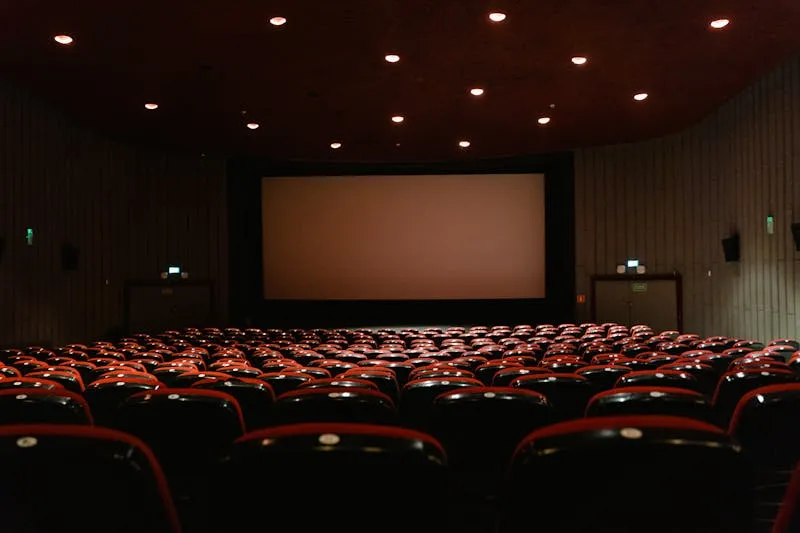
Feminist film landmarks, from Norma Rae to Portrait of a Lady on Fire
Thelma & Louise — Ridley Scott (1991)
The most cited, and for good reason. Two women flee a system that has crushed them and take to the road. The freedom, the violence, the solidarity between them: that road trip is as relevant now, more than thirty years on, as it was in 1991. Susan Sarandon and Geena Davis are extraordinary. The ending is a brave choice for a mainstream film.
Norma Rae — Martin Ritt (1979)
Sally Field as a textile worker who organises a union in the American South in the 1970s. It won her the Oscar for Best Actress, and deservedly so. You'll recognise the scene where she stands on her work table holding a "UNION" sign — and it has a real origin. In 1973, Crystal Lee Sutton was a 33-year-old mother of three, folding towels at J.P. Stevens in North Carolina for $2.65 an hour (she'd been at the plant for sixteen years). Fired for union activity, she climbed onto a table with her cardboard sign. Around her, co-workers shut down their machines. In 1974 the union won the right to represent 3,000 workers at seven Roanoke Rapids plants.
9 to 5 — Colin Higgins (1980)
Dolly Parton, Jane Fonda, Lily Tomlin: three office workers who end up kidnapping their sexist boss. It's a comedy, and also one of the most politically precise films about workplace sexism Hollywood has made. The scene where the boss lists his own failings (sexist, egotistical, lying, hypocritical) and Violet confirms it in a single word is worth the watch on its own. The film grew out of a real movement, started in the early 1970s by 9to5, a group of Boston secretaries. They wanted better pay, promotions and an end to sexual harassment — the basics, really. Forty-five years on, the film hasn't dated nearly as much as it should have: our state of play on gender equality at work in 2025 shows why.
Portrait of a Lady on Fire — Céline Sciamma (2019)
A film about gaze. Who has the right to look, who is looked at — and what happens to desire between two women in a society that denies it. The scene around the fire may be the most beautiful feminist metaphor of the decade. If you've never seen it, it's the one I'd put in your hands first.
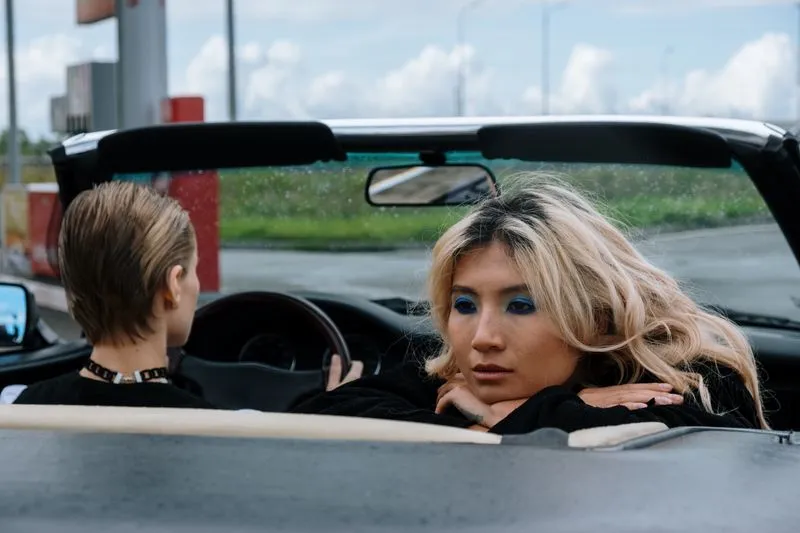
British and European feminist cinema
We Need to Talk About Kevin — Lynne Ramsay (2011)
Tilda Swinton as Eva, the mother of a teenage boy who commits a massacre at his school. She lives with guilt, grief and a community that holds her responsible. Motherhood, blame, and the crushing weight of what can't be explained. It isn't an easy watch. For me, one of the strongest British films of the century so far.
Suffragette — Sarah Gavron (2015)
Carey Mulligan as Maud Watts, a laundry worker drawn into the women's suffrage movement in 1912 London. Abi Morgan wrote the script, and Meryl Streep appears briefly as Emmeline Pankhurst (blink and you'll miss her). Watch it for the cost paid by ordinary women — and for the machinery that kept them from voting. The history behind it is less tidy than a happy ending: the Representation of the People Act 1918 only let women over 30 who met a property qualification vote. It took the Equal Franchise Act of 1928 for women over 21 to vote on the same terms as men.
The Favourite — Yorgos Lanthimos (2018)
Early 18th-century England. Three women, a queen, the court. Lanthimos portrays female power as a brutal game — manipulation, desire, survival. Olivia Colman, Rachel Weisz and Emma Stone are all superb (special mention for the queen's rabbits), and none of them is there to be likeable. Good.
Fish Tank — Andrea Arnold (2009)
Mia, 15, growing up on a council estate on the eastern edge of London, trapped between a difficult mother and a dangerously charismatic man. Arnold films female adolescence and desire with documentary honesty. Jury Prize at Cannes, then the BAFTA for Outstanding British Film. Brilliant, and bruising.
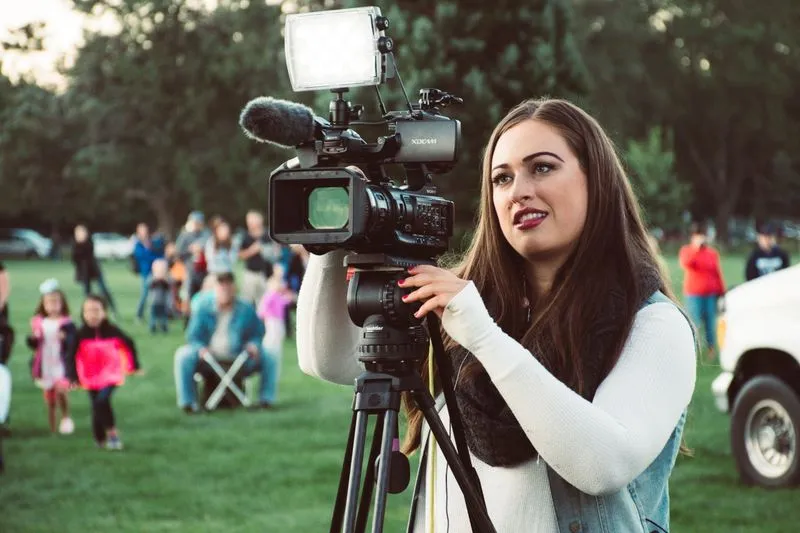
Rage and resilience: films that move things forward
Promising Young Woman — Emerald Fennell (2020)
Oscar for Best Original Screenplay. Cassie hasn't quite been the same since something terrible happened years before. The film is about consent, male complicity and the way we treat survivors. It makes its case with surgical precision and such strong style that the argument is very hard to brush aside.
Monster — Patty Jenkins (2003)
Aileen Wuornos killed seven men in 1989 and 1990 and was executed in Florida in 2002. Charlize Theron transformed herself for the role — she's unrecognisable — and won the Oscar for Best Actress. The film doesn't excuse the killings — you won't find any comfort here. It shows a woman the system ground down until she broke in return.
North Country — Niki Caro (2005)
Inspired by Lois Jenson, who started work at an iron ore mine in Minnesota in 1975. Charlize Theron again, facing co-workers who harass the handful of women on the site. The case is real. Jenson v. Eveleth Taconite became the first sexual harassment class action tried in US federal court. It took until the end of 1998 for a settlement: $3.5 million, shared among fifteen women. Twenty-three years after Jenson started at the mine.
She Said — Maria Schrader (2022)
Jodi Kantor and Megan Twohey, the two New York Times journalists who broke the Weinstein story. A journalism thriller in the tradition of Spotlight, about what it takes to end decades of predation protected by power and silence. Their October 2017 reporting, alongside Ronan Farrow's in The New Yorker, won the 2018 Pulitzer Prize for Public Service. The citation credits it with "spurring a worldwide reckoning about sexual abuse of women".
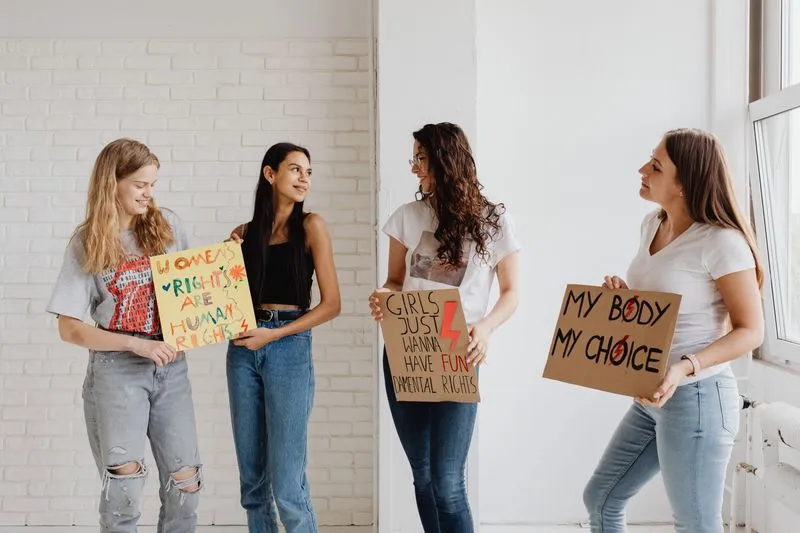
Feminist films about the body, desire and abortion
4 Months, 3 Weeks and 2 Days — Cristian Mungiu (2007)
The film from my forty-two-pound evening. Bucharest: two students, Otilia and Gabita, have an appointment in a hotel room with a Mr Bebe, who is to perform Gabita's abortion in secret. That one-line summary says nothing of the tension that holds right to the last shot. The film won the Palme d'Or at the 60th Cannes Festival, in 2007, and it was Jane Fonda who handed it over (yes, the Jane Fonda of 9 to 5).
Never Rarely Sometimes Always — Eliza Hittman (2020)
A teenager from Pennsylvania has to travel to New York City to get an abortion. No speeches, no explanations. Just the documentary reality of what it involves. The scene in the family planning clinic — the questions, the "never, rarely, sometimes, always" — is one of the most important in recent American cinema. Want the bigger picture? Our round-up of progress and setbacks for women's rights around the world covers where abortion access stands, including in the United States.
Mustang — Deniz Gamze Ergüven (2015)
Turkey. Five sisters, an innocent day at the beach with boys, and their family's reaction. The girls' bodies become a space of family and social control. It's one of the most beautiful films of the decade, and it was Oscar-nominated for Best Foreign Language Film.
Against the system: films that expose structures
Made in Dagenham — Nigel Cole (2010)
Sally Hawkins plays one of the sewing machinists at Ford's Dagenham plant who went on strike in 1968. The strike is real. On 7 June 1968, 187 women walked out of Ford's Dagenham plant. They weren't asking for equal pay as such: they wanted the skills they used to make seat covers graded at the same level as the men's. They didn't win that demand. But they got a pay rise and put huge pressure on the Wilson government. Barbara Castle then worked to pass the Equal Pay Act 1970 — limited in scope, but a start.
Bombshell — Jay Roach (2019)
The Roger Ailes affair at Fox News. The man who ran one of America's most powerful news channels was accused of harassment by the women who presented on it. Nicole Kidman, Charlize Theron and Margot Robbie play three women who decide, or don't, to speak. The mechanics of institutional silence, laid out scene by scene — you won't watch a news channel the same way again.
The Assistant — Kitty Green (2019)
A young assistant at a production company (you can't help thinking of Weinstein) begins to notice the signs. The film never directly shows the violence. It shows the machinery that makes it possible, and what it costs simply to ask a question.
Feminist films about Saudi Arabia, Iran and Senegal
Wadjda — Haifaa Al-Mansour (2012)
Wadjda, ten years old, dreams of a green bicycle — when riding bikes is frowned upon for girls. Haifaa Al-Mansour gets a political point across through a child's story. It was the first feature shot entirely in Saudi Arabia, a country with practically no public cinemas at the time, and its director is a Saudi woman. In 2013 it became Saudi Arabia's first-ever submission for the Best Foreign Language Film Oscar.
Persepolis — Marjane Satrapi & Vincent Paronnaud (2007)
Adapted from Satrapi's autobiographical graphic novels about her childhood in Iran during the Islamic revolution. Black and white, stripped-back drawing, and a girl growing up while her country keeps shrinking her possibilities. One of the great political animated films. It hasn't aged a day.
Atlantics — Mati Diop (2019)
Senegal. Workers leave by sea for Europe, and disappear. Their spirits return inside the bodies of the women who loved them (a ghost story, yes, and one of the most concrete films on this list). It won the Grand Prix at Cannes in 2019, and Diop had made history before the festival even opened: she was the first black woman to have a film selected for competition. About time.
What feminist films have changed: debates and polls
Nobody can properly measure what a film does to attitudes. What you can document is the argument a film starts. Thelma & Louise made the cover of Time on 24 June 1991, with a cover story on the "heated exercise in moral philosophy and sociological big-think" the film had set off. She Said tells the story of the reporting that came just before the MeToo wave.
You can also watch the canon shift. In the BFI's Sight and Sound critics' poll of December 2022, Chantal Akerman's Jeanne Dielman leapt from 36th place in 2012 to number one. It was the first film by a woman to top the poll in its 70-year history.
Feminist cinema doesn't convert the unconvinced in one sitting. But it puts words to mechanisms, and sometimes it shows you can live differently. Now and then that changes something — even if it's only the conversation you have on the way home from the cinema.
Frequently asked questions
Can a film directed by a man be feminist?
Yes. Feminism in cinema is about gaze, treatment, and what's shown — not the filmmaker's biography. Thelma & Louise (Ridley Scott), 9 to 5 (Colin Higgins), The Favourite (Yorgos Lanthimos): the criterion is the perspective adopted, not the director's gender.
What is the Bechdel test and is it actually useful?
The Bechdel test (also called the Bechdel-Wallace test) asks a simple question. Does a film contain at least two named female characters who talk to each other about something other than a man? It was popularised by a 1985 strip called The Rule in Alison Bechdel's comic Dykes to Watch Out For. It's useful as a starting point — but limited: a film can pass and be sexist, or fail and be feminist. It's a conversation tool, not a verdict.
What is the "male gaze" in cinema?
The concept comes from film theorist Laura Mulvey, in her 1975 essay "Visual Pleasure and Narrative Cinema", published in Screen. It describes mainstream cinema's tendency to adopt the viewpoint of a heterosexual male spectator. In practice, the camera frames female characters' bodies rather than their point of view. The angles objectify them — and the narratives define them in relation to men. Spotting the male gaze gives you a tool for analysing how films construct gender.
Where can I watch feminist films on UK streaming platforms?
Catalogues change every month, so check JustWatch UK before you plan a film night. It tells you whether a title is on a subscription service, on BBC iPlayer, or only available to rent. For arthouse cinema, MUBI is the most natural place to start browsing.
Is Promising Young Woman really a feminist film?
It's debated — and that's interesting. Supporters say it names the mechanisms of male complicity and treats trauma in an unconventional way. Its detractors find the ending ambiguous, even problematic. It's worth watching precisely because it doesn't give easy answers.
Are there feminist films appropriate to watch with teenagers?
Yes. Wadjda first: a ten-year-old heroine, a bicycle, and plenty to talk about. Persepolis from around 13, in my view. Suffragette is great for discussing with 14-year-olds and up, and 9 to 5 works for something lighter. For younger viewers, animation like Pixar's Brave or Disney's Moana offers heroines who choose their own path, without difficult content.
What is intersectional feminist cinema?
Intersectional feminism (a concept developed by legal scholar Kimberlé Crenshaw) recognises that oppressions accumulate — gender, race, class, disability, sexual orientation. Intersectional feminist cinema represents these overlaps. A few examples: Atlantics (Mati Diop) on African women and migration, Moonlight (not strictly feminist but intersectional on Black masculinity), or Ava DuVernay's work crossing race and gender.
Why is Jeanne Dielman considered a feminist film?
Jeanne Dielman is feminist in its very cinematic gesture. Chantal Akerman films a woman's domestic labour — peeling potatoes, doing the washing up, washing her hands. She gives it the same attention and the same static shots previously reserved for "historic" actions. It's a political statement: these gestures matter, they deserve the screen, an ordinary woman's life is worth watching for more than three hours. And when the routine breaks, in a single act, the effect is devastating. In 2022, the critics polled by Sight and Sound voted it the greatest film of all time.
Sources
- NHS — Where to get contraception
- Laura Mulvey, "Visual Pleasure and Narrative Cinema", Screen, vol. 16, no. 3, 1975 (Oxford Academic)
- NBC News (AP) — Inspiration for movie 'Norma Rae' dies at 68 (September 2009)
- PBS Independent Lens — 9to5: The Story of a Movement
- UK Parliament — Women get the vote
- MNopedia (Minnesota Historical Society) — Jenson v. Eveleth Taconite Co.
- The Pulitzer Prizes — The New York Times (Jodi Kantor, Megan Twohey) and The New Yorker (Ronan Farrow), Public Service 2018
- Festival de Cannes — Palme d'Or: 4 Months, 3 Weeks and 2 Days by Cristian Mungiu (2007)
- The National Archives — A letter by the women workers at Fords of Dagenham
- PBS NewsHour — Three firsts for Saudi Arabia (September 2013)
- The Guardian — Bong Joon-ho's Parasite wins Palme d'Or at Cannes film festival (May 2019)
- Time — Thelma & Louise cover, 24 June 1991
- BFI — Results of the 2022 Sight and Sound Greatest Films of All Time poll
- Bechdel Test Movie List — About the test