No, a Michelin star is not awarded for the tablecloths. Or the chandeliers, or the sommelier — or the waiter who refolds your napkin while you pop to the loo. When The Ritz picked up its second star at the Glasgow ceremony in February, my boyfriend's verdict from the sofa was instant: "Well, obviously. It's the service. Look at the place." (He said it with the confidence of a man who has never been inside.)
No. Michelin has been saying the opposite for years. In its own account of a day in the life of an inspector, the Guide puts it bluntly: "One of the great misconceptions of our guide is that we are somehow concerned with the colour of the curtains or the style of the service." And then, even better: "if the food is wonderful then we don't care if we're sitting on plastic chairs having queued outside for an hour."
The timing is good. On Monday 31 March, the French edition is unveiled in Metz, streamed live on YouTube and Facebook — the Guide's big night in its home country. Over here, the Great Britain & Ireland results landed on 10 February.
What a Michelin star actually rewards
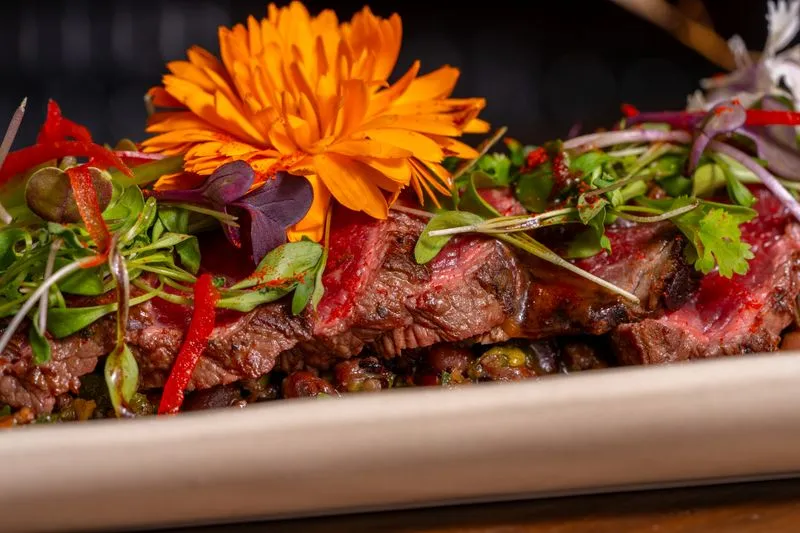
A Michelin star rewards one thing: the cooking served at a specific address. The décor, the comfort and the service — everything that makes a dining room feel "posh" — sit outside the calculation. "It's the food on the plate, nothing more," as the Guide's own feature on a day in the life of an inspector puts it.
The clearest proof comes from Singapore. When Michelin launched its Singapore guide in 2016, it gave a star to a hawker stall in the Chinatown Complex — Chan Hon Meng's Hong Kong Soya Sauce Chicken Rice and Noodle. No air-conditioning, plastic trays, a queue that, by the Guardian's account, stretched across the food court every lunchtime. A plate of soya sauce chicken and rice cost S$2 (£1.10) — less than half the price of a Big Mac, the paper noted. When the invitation to the Michelin gala arrived, the chef reportedly asked whether they were joking.
The reverse holds too: sumptuous surroundings can't rescue an average plate, because neither the chandeliers nor the designer crockery count towards the Guide's criteria.
One more point that surprises people: the star goes to the restaurant, not the chef. The Guide spells it out in its own myth-busting feature: "there's no such thing as a Michelin-starred chef", and "Chefs can't take off with the stars, nor do the stars transfer to another restaurant owned by the same chef." So a starred chef who moves on starts from scratch. Brutal? Logical, really (even if the chefs concerned rarely see it that way). It's also why chefs' careers read like a series of kitchens — something I explored in my piece on female Michelin-starred chefs and their journeys.

One, two or three stars: what each level means
Each star level answers a traveller's question. Should I stop? Should I make a detour? Should I plan the whole trip around this table (and book the day off)? The wording dates back to the 1930s and still stands — as CNN's history of the Michelin Guide sums it up, one star means "worth a stop", two "worth a detour" and three "worth a special journey".
Why the road-trip vocabulary? Because the Guide was born at a tyre company. In 1900, the brothers André and Édouard Michelin published a guide to get people driving: maps, tips on changing tyres, petrol stations, garages and hotels, in a first run of 35,000 copies. Early editions were given away free. According to the Guardian, the Guide started charging in 1920 and introduced its one-to-three-star ranking in 1931.
In numbers, the 2025 Great Britain & Ireland selection, unveiled at Kelvingrove Art Gallery and Museum in Glasgow on 10 February, lists 1,147 restaurants — 220 of them starred. The pyramid is steep (and that's the point):
| Award | What it means | Restaurants in GB & Ireland (2025) |
|---|---|---|
| One star | Worth a stop | 181 |
| Two stars | Worth a detour | 29 |
| Three stars | Worth a special journey | 10 |
| Total starred | — | 220 |
The newest member of the three-star club is Moor Hall, where chef Mark Birchall and his team won the Guide over — bringing the total to ten. The Ritz, Humble Chicken in Soho and hide and fox in Kent moved up to two stars, and Cardiff got its first-ever star (Gorse). Plates London became the first fully plant-based restaurant in the UK and Ireland to win one.
The five criteria Michelin inspectors use
Michelin inspectors judge a plate on five criteria, and they're the same in London, Paris or Tokyo. As CNN lists them, they are:
- The quality of the produce. The starting point — and the easiest to grasp: no chef can rescue a tired vegetable.
- Mastery of cooking techniques. Timing, seasoning, texture — where the craft shows.
- Harmony of flavours. Every element on the plate works with the others rather than fighting them (acidity cutting through richness, bitterness keeping sweetness in check).
- The chef's personality, expressed on the plate. You should recognise a signature, a dish you haven't already seen a hundred times on social media.
- Consistency. The same standard from dish to dish, service to service — and season to season.
The fifth one is what keeps chefs up at night. "You're inspected two or three times a year, you never know when," the French chef Sébastien Bras told AFP, as reported by the BBC. Every day, any one of the 500 meals leaving his kitchen could be the one being judged. Michelin's inspectors confirm the method: they'll try a place on a Friday night, then a Tuesday lunch, then at another time of year, because "it's the consistently good ones that we want to point out".
One bad night happens. An inconsistent kitchen doesn't keep its star.
Who are the Michelin inspectors?
Michelin inspectors are anonymous professionals who book under assumed names and want to be treated like any other customer. The Guide compares the job to being a radio host: "everyone knows what you do but not many people know what you look like – and we'd like to keep it that way." According to CNN, every inspector has at least ten years' experience in hospitality before being trained in the Guide's methods.
Their day? Lunch and dinner out, almost every working day, with a detailed report after each meal. "So fussy eaters need not apply," the Guide adds (fair enough). Between meals comes research — who's opening what, where the scene is moving — and a new territory every year. And they don't only eat in starred restaurants: pubs, neighbourhood bistros and grand dining rooms all go through the same process.
Emily, a UK inspector interviewed by the Guide in 2022 after eight years in the job, remembers a different kind of test. When she started, walking into restaurants with a male colleague, "I didn't get given the wine list or the bill as often as my male counterparts" — happily, she added, that happens much less now.
The only time I thought I'd spotted an inspector was a weekday lunch at a one-star in London, where I'd taken my mum. At the next table, a man on his own — notebook open, phone out — photographed every single course. Mum whispered "that's the inspector" with the face of someone who'd just seen a film star. Except that's exactly what a real inspector avoids. According to CNN, an actual inspector would likely never bring a notebook, because it would blow their cover. Our neighbour was probably just an enthusiast (or a food blogger, which is nearly the same thing).

How a Michelin star is decided
A star is decided over several visits and by several people, never on a single meal. It starts with a list of places to try, fed by local and national media, social media and word of mouth — Gwendal Poullennec, the international director of the Michelin Guides, explained this to CNN. A restaurant in contention then receives several different inspectors, who decide as a team (nobody decides alone).
The word that keeps coming up is collective. "All the selections that make up the Guide are the result of collective decisions," one inspector told the Guide in 2022. Emily, the UK inspector interviewed in 2022, describes the meetings as "always animated and tremendously detailed". The visits run all year, but the stars are handed out only once, at the annual ceremony.
In practice, that means three things for you:
- A new opening can win a star, as long as several visits confirm the standard (longevity isn't one of the criteria).
- The results sum up months of visits. They don't reflect one night's mood — they're the outcome of a series of meals compared against each other.
- Stars are presented once a year. In Britain and Ireland that happened in Glasgow on 10 February; France's turn comes on 31 March, in Metz.
Why restaurants lose Michelin stars
A restaurant loses a star when inspectors decide its cooking no longer meets the standard, when it closes, or when it stops being open to the public. No star is permanent — ever. When the late Paul Bocuse's Auberge du Pont de Collonges near Lyon was downgraded in 2020, the Guardian's report on the controversy quoted Gwendal Poullennec insisting that stars were not "inherited" and "must be earned every year".
Even monuments fall. The Auberge had held three stars since 1965 — fifty-five years. The year before, three French restaurants had already dropped out of the three-star club: the Auberge de l'Ill in Alsace (three stars for half a century), L'Astrance in Paris and Marc Veyrat's La Maison des Bois in the Alps.
The Veyrat affair turned into a soap opera. His third star, awarded in 2018, was taken away in the 2019 edition. He claimed an inspector had mistaken the saffron in his soufflé for cheddar (the English cheese, horror of horrors), demanded the inspectors' bills and notes, and sued for a symbolic one euro in damages. In December 2019, a court in Nanterre dismissed the case: he hadn't produced "a single piece of evidence" of real harm, the Guardian reported. More recently, in 2023, Guy Savoy — three stars since 2002, and named best chef in the world by La Liste — lost his third star too. Poullennec told AFP, in a report carried by France 24, that such decisions are carefully considered and backed by numerous inspector visits throughout the year.
Stars can also vanish for reasons that have nothing to do with the food. In 2019, Tokyo's Sukiyabashi Jiro — three stars every year since 2007 — was dropped because it no longer took reservations from the general public. "Michelin's policy is to introduce restaurants where everybody can go to eat," a spokeswoman told the Guardian.
Can a chef hand back a Michelin star?
Yes — a chef can ask to leave the Guide, but Michelin decides, and it doesn't always agree. The most British example is a small one. In 2018, the owners of the Checkers in Montgomery, Powys, handed back their Michelin star to put their family first. Between them they had five young children and years of split shifts. "It was great for trade and brilliant for the town," said Sarah Francis. "But more for us, it's about taking the business in a new direction and putting our family first."
The landmark case, though, is French. In 2017, Sébastien Bras asked for his three-star restaurant Le Suquet, in Laguiole, to be removed from the Guide — he no longer wanted to cook under the "huge pressure" of being judged. Michelin agreed, and the BBC called it the first time the Guide had ever allowed a restaurant to bow out. "It is difficult for us to have a restaurant in the guide which does not wish to be in it," a Michelin spokesperson said. Did it last? Not quite: a year later, the Guardian notes, Le Suquet was back in the Guide — with two stars.
And sometimes the answer is no. In 2019, Marc Veyrat asked for his restaurant to be removed from the listings entirely rather than appear with two stars — something the editors refused to do, the BBC reported. By January 2025 he had opened a new place in Megève, with a sign on the door telling inspectors they weren't welcome. "I'm turning 75 this year," he told CNN, as quoted by the Guardian. "I don't want to be taking exams and getting ranked." A chef who leaves the Guide by choice doesn't suddenly cook worse, though: check what they're serving now before crossing them off your list.
The Bib Gourmand: Michelin's great-value award
The Bib Gourmand flags good cooking at a fair price. It answers a different question from the stars: is it worth the money? Named after Bibendum (the official name of the Michelin Man), the distinction "highlights restaurants offering great quality, great value cooking", as the Guide put it when it announced its 2024 British and Irish Bibs. In February, 36 more restaurants across the UK and Ireland joined them. Back in 2016, the Guide's myth-busting feature put a number on it: in the UK and Ireland, a Bib meant three courses for no more than £28.
The profile of these places often looks a lot like bistronomy — a short menu, seasonal produce, a chef who cooks rather than performs. If you want to know where that style came from, I've written about the history of the bistronomie movement and its pioneers.
My view: the Bib Gourmand is the most useful award in the Guide for everyday life. A star is for an occasion (a birthday, a promotion, a peace offering). A Bib you can slot into a Tuesday night without checking your banking app first — and without compromising on quality.
The Green Star: what it tells you (and what it doesn't)
The Green Star recognises environmental commitment and leaves the standard of cooking aside. When it announced its 2024 British and Irish Green Stars, the Guide described these restaurants as places that pair culinary excellence with outstanding eco-friendly commitments. It doesn't replace the red stars and it isn't an extra rung on the ladder: it's a different kind of information.
In practice, the Guide lists some very down-to-earth habits: working directly with growers, farmers and fishermen; foraging in hedgerows and woodlands; growing plants and rearing animals; no-dig vegetable gardens. In 2024, six restaurants in Great Britain and Ireland were newly awarded a Green Star, taking the full list to 33 — ANNWN in Narberth, in Wales, among them. Every one of those habits is about how the kitchen is run, from sourcing to the vegetable patch.
What the Green Star won't tell you: whether you'll love the food, or whether it's expensive. For me, it's a brilliant tie-breaker between two restaurants of the same standard (especially if you care about short supply chains), and I'd keep it for exactly that.
What a star does to the bill
For the restaurant, a star fills the dining room. For you, it doesn't set a price — but starred cooking rarely comes cheap, especially at dinner. CNN spoke to two newly starred American chefs. At one (a contemporary Mexican restaurant near San Diego), the next month's reservations were fully booked the morning after the announcement. At the other (a French restaurant on Manhattan's Upper West Side), covers went from 80–100 a night to 120–140.
Even the hawker in Singapore felt it. After his star, Chan Hon Meng was working 17-hour days and selling 180 chickens a day — 30 more than before, according to the Guardian. And yet a star isn't everything. When Marc Veyrat went to court over his lost third star, he admitted that business was booming anyway. The downgrade hadn't emptied his dining room.
For diners, the price depends on the chef, the place and, above all, the time of day. Here are a few published reference points to give you a sense of scale (dated examples, to read as orders of magnitude):
| Restaurant | Published price | Year |
|---|---|---|
| Starred hawker stall, Singapore (soya sauce chicken rice) | £1.10 a plate | 2016 |
| Mana, Manchester (one star) | £65 midweek lunch, £105 evening tasting menu | 2019 |
| Le Suquet, Laguiole (three stars) | set menus up to £202 | 2018 |
| Sukiyabashi Jiro, Tokyo | at least £285 for the chef's selection | 2019 |
| Marc Veyrat's new restaurant, Megève (outside the Guide by choice) | £380 a head for dinner | 2025 |
The Manchester line is my favourite, because of what happened next. When the Guardian reported that Mana's £65 lunch was its bid "to remain accessible to locals", a reader from Bristol wrote in: "£65? Accessible?" Fair point. But the logic holds — at lunchtime, many starred kitchens serve a shorter menu for a fraction of the evening price. It's the entry ticket I recommend to everyone.
If the bill puts you off, there's another route: steal the techniques. A lot of what separates a chef's plate from a home cook's comes down to methods you can reproduce in your own kitchen — layered seasoning, precise cooking, emulsions. I've gathered ten of them in my guide to pro chef techniques you can master at home.

Booking a starred restaurant without nasty surprises
Book a starred restaurant the way you'd book a trip — by reading the terms before you pay. Here's my checklist — the one I wish I'd had before taking my mum to lunch at a starred restaurant.
- Aim for a weekday lunch. That's often where the most affordable menu hides (and the dining room is calmer).
- Read the menu and prices on the restaurant's website before you book, not when you arrive. Some places only serve a single set menu — better to know in advance.
- Mention allergies and dietary needs when you book. A serious kitchen preps a lot ahead: told the day before, it adapts — told at the table, it improvises.
- Clear your evening (or afternoon). A tasting menu takes time. It's not something to squeeze in before the cinema.
- Ask questions. Front-of-house staff love talking about the produce and the chef.
When I took my mum to lunch at a one-star in London, we had the short lunch menu. She still mentions it, far more often than the man with the notebook at the next table.
Frequently asked questions
How many Michelin-starred restaurants are there in the UK and Ireland?
The 2025 Michelin Guide Great Britain & Ireland, unveiled in Glasgow on 10 February 2025, lists 220 starred restaurants: 181 with one star, 29 with two and 10 with three. Moor Hall is the newest three-star.
How can you spot a Michelin inspector?
You can't — and that's the point. Inspectors book under assumed names, sometimes dine alone and behave like any other customer. Contrary to popular belief, a real inspector would likely never bring a notebook, CNN reports, because it would give them away. The lone diner with an open notebook is probably just an enthusiast.
Does a Michelin star belong to the chef or the restaurant?
To the restaurant, not the chef. In the Guide's own words, "there's no such thing as a Michelin-starred chef": stars go to restaurants, for the quality of the food they serve. A restaurant can lose its stars if it closes during the year of assessment, and a chef who opens somewhere new has to earn them again.
Can a restaurant lose a star from one year to the next?
Yes. The selection is reviewed every year and no star is held for life. Paul Bocuse's Auberge du Pont de Collonges, three-starred since 1965, lost its third star in 2020; Guy Savoy's restaurant in Paris lost its third in 2023.
What's the difference between a Bib Gourmand and a star?
A star measures the standard of the cooking, whatever it costs — the Bib Gourmand flags great quality at great value. The Bib isn't a compulsory step towards a star: they answer two different questions.
Is the Green Star an extra star?
No. The Green Star recognises a commitment to sustainable gastronomy (local growers, kitchen gardens, foraging). It sits alongside the other awards and says nothing about the standard of the cooking or the price.
Does the Michelin Guide ever make mistakes?
Yes, and once quite spectacularly. In February 2017, the French Guide's website mistakenly gave a star to Le Bouche à Oreille in Bourges (a bar-restaurant where regulars paid £10 for beef bourguignon) instead of its starred namesake in Boutervilliers. According to the Guardian, it took nearly a week to fix the website; the printed guide and the app were correct.
How much does a Bib Gourmand meal cost in the UK?
The Guide's published benchmark for the UK and Ireland dates from 2016: three courses for no more than £28. It's a dated figure, so check the menu on the restaurant's own website before you book.
Sources
- MICHELIN Guide — A Day in the Life of an Inspector (2019)
- MICHELIN Guide — Great Britain & Ireland 2025: all the awards
- MICHELIN Guide — An Interview with a Michelin Guide Inspector (2022)
- MICHELIN Guide — The Inspector's Word: Confessions of a Connoisseur (2022)
- MICHELIN Guide — 20 New Bib Gourmands Announced for 2024
- MICHELIN Guide — 6 New Green Stars for Great Britain & Ireland 2024
- MICHELIN Guide — 5 Myths About the MICHELIN Guide Debunked (2016)
- MICHELIN Guide — Moselle Territory Will Host the MICHELIN Guide Ceremony France 2025 (2024)
- CNN — Michelin Guide history (2024)
- BBC News — French chef Bras gives up Michelin stars (2018)
- BBC News — Marc Veyrat loses court case over removed Michelin star (2019)
- The Guardian — Michelin 2020 guide and the Bocuse downgrade
- The Guardian — Cheddargate chef loses court battle over Michelin downgrade (2019)
- The Guardian — Why a leading French chef is turning down Michelin stars (2025)
- The Guardian — Welsh restaurant hands back Michelin star to put family first (2018)
- The Guardian — Michelin star for a Singapore hawker stall (2016)
- The Guardian — Letters: An 'accessible' lunch can leave a bad taste (2019)
- The Guardian — Sukiyabashi Jiro dropped from the Michelin Guide (2019)
- The Guardian — Michelin mistake makes a humble restaurant a star (2017)
- France 24 — Guy Savoy stripped of Michelin star (2023)