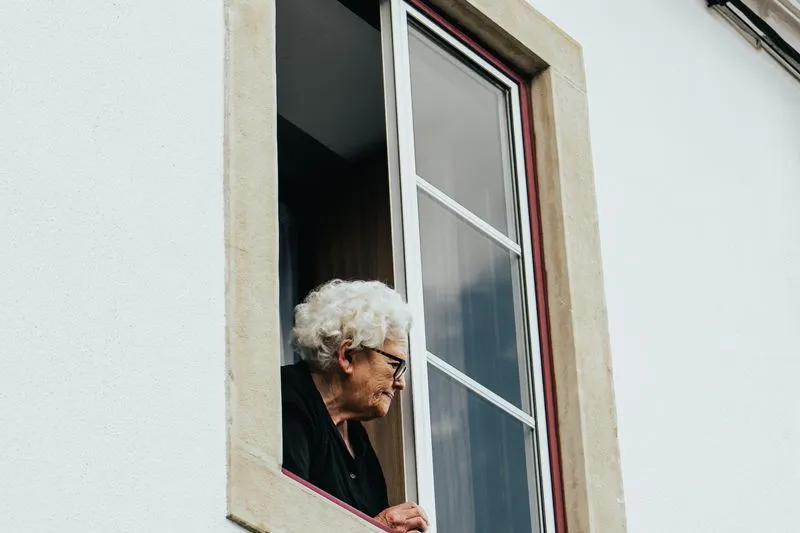
Last Thursday, at about half past five, walking back from nursery pick-up with my daughter, I looked up at the front of our building. Every window on the sunny side had its blinds down (it was that sort of afternoon) — except Maureen's. My neighbour across the landing had hers wide open, curtains pulled back, on a wall that bakes all afternoon. On my balcony, the little thermometer wedged between the two cherry tomato plants read 31°C in the shade.
Maureen is 86 — widowed, on her own, sharp as a tack. She walks to the corner shop for her paper every morning — rain or shine — and hates being fussed over. I knocked anyway. She opened the door in a wool cardigan (yes, a cardigan, in that heat) — the front room flooded with light, the windows open onto air that was hotter than the flat. On the table sat a half-full glass of water. "That's from lunch," she said, with a shrug. "I'm not thirsty, love. Never been much of a drinker."
We drew the curtains, filled a jug, soaked a flannel (she let me, which told me something). Then I rang her son — he lives five hours away by train and had left me his number last winter, "just in case". On the other end of the line I heard exactly what I would have felt in his place: relief and guilt, in equal measure. "I spoke to her at lunchtime. She said she was fine." And she had meant it. That is the whole trap.
It's one story from one landing, not evidence. But Maureen's afternoon matches, almost point for point, what public health bodies describe — older people feel the heat later, notice thirst less and rarely complain. In England, according to the UK Health Security Agency's summary of its 2024 heat mortality report, there were 1,311 heat-associated deaths during four periods of heat last summer. The highest mortality rates were in people aged 85 and over, followed by those aged 75 to 84.
This guide is for you if you have an older parent, whether they live two streets away or five hours up the line: why their body copes less well with heat, which medicines to watch, how to get them on the right radar, what to do at home and on the phone — and the signs that mean dialling 999.
Why older people are most at risk in a heatwave
Older people aren't simply "more delicate" in hot weather — their cooling system works less well. The UK Health Security Agency (UKHSA) puts it plainly — older people, babies and young children are more likely to become unwell in hot weather because their bodies are less able to regulate temperature. Age UK adds that our bodies find it harder to adapt to extreme temperatures as we age, and that heat can worsen existing conditions, particularly those affecting the heart or lungs.
The key mechanism is sweat. In its June 2025 explainer, UKHSA describes it in one sentence worth reading as written:
When the temperature outside the body is higher than the temperature of the skin, the only effective way to lose heat is through sweating.
Anything that reduces sweating can therefore make the body overheat. UKHSA lists dehydration, a lack of breeze, tight-fitting clothes, certain medications (more on those below) and conditions that affect the body's ability to sweat. Several of those tick boxes for an 86-year-old in a sunny flat — all at once.
Thirst is the second weak point. The NHS notes that babies, children and older adults are more at risk of dehydration, and Age UK's advice is to drink throughout the day "even if you aren't thirsty". That little phrase says a great deal: thirst alone is not a reliable guide.
The figures follow the same pattern year after year. According to UKHSA's July 2024 post on Heat-Health Alerts, the summer of 2022 — the one with record-breaking temperatures — recorded the highest number of heat-associated deaths. Summer 2023 still brought five heat episodes (two amber, three yellow) and more than 2,000 heat-associated deaths, most of them in older age groups, particularly people over 75.
Isolation makes everything worse — quietly. The Office for National Statistics' 2023 families and households bulletin found that half of the 8.4 million people living alone in the UK were aged 65 or over. Among those aged 75 and over who live alone, 68% are women — a widowhood that also has a financial side, explored in our guide to women and the path to financial independence.
For the heat, remember one thing: if your mum lives alone, nobody will notice on her behalf that she hasn't had a drink since lunch.
Why yellow alerts and warm nights still matter
Yellow alerts matter because, in summer 2024, UKHSA found significant heat-associated deaths in 3 of the 4 heat episodes, although only yellow alerts had been issued. UKHSA's June 2025 summary puts it bluntly: "Heat doesn’t have to be record-breaking to be dangerous for some."
Those alerts come from the Heat-Health Alert system (HHA), run by UKHSA with the Met Office. When it launched, the government announced colour-coded alerts (yellow, amber or red) and a core alerting season for heat between 1 June and 30 September, with a particular focus on people over 65 and those with pre-existing health conditions. Yellow is the lowest threshold, so it's tempting to shrug at it. Please don't.
Nights count as much as days (sometimes more). UKHSA points to warm nights as one of the factors that make it harder for the body to cool down and recover, intensifying the impact of a heatwave. A flat that never cools after dark gives an older body no break at all.
UKHSA's 2024 report also noted that more deaths occurred in the heat episodes earlier in the summer than in the later ones. In practice, the first hot spell of June deserves as much attention as the big one in August — and a parent who "coped fine" in the first days still needs checking after several hot days and nights, and for as long as their home stays hot after the alert ends.
The medicines that make hot weather harder to cope with
Some everyday medicines — the kind that sit in a weekly pill organiser — reduce the body's ability to handle heat. UKHSA's December 2024 guidance, "Supporting vulnerable people before and during hot weather: healthcare professionals", lists the families of drugs that increase risk. The table below follows that list; the plain-English glosses in brackets are ours.
| Type of medicine | Why it matters in hot weather (UKHSA) |
|---|---|
| Diuretics ("water tablets"), especially loop diuretics. | Can lead to dehydration and electrolyte abnormalities. |
| Antihypertensives and antianginal drugs. | Interfere with cardiovascular responses. |
| Anticholinergics and beta blockers. | Interfere with sweating. |
| Medicines that cause diarrhoea or vomiting. | Can lead to dehydration. |
| Medicines that can impair kidney function, such as non-steroidal anti-inflammatories (ibuprofen, for example). | Listed among those that increase risk. |
| Lithium, digoxin, antiepileptics. | Their levels can be affected by dehydration. |
| Hypnotics, anxiolytics and analgesics. | Alter states of alertness. |
| Neuroleptics (antipsychotics) and serotoninergic agonists. | Can interfere with the brain's control of body temperature. |
| Thyroxine. | Increases the basal metabolic rate. |
This table doesn't say "stop" — it says "ask". The government's public advice, "Beat the heat", is clear that people should keep taking all their prescribed medicines unless a medical professional advises otherwise. The same guidance reminds us that some medicines need to be stored below 25°C or in the fridge — worth checking in a flat that hits 30°C.
Before the heat: the home and the paperwork
The most effective prevention happens before the first alert, while nobody is exhausted. Age UK suggests identifying the coolest room in the house, so your parent knows exactly where to go when the heat builds.
This checklist is worth a Saturday visit in June.
- Find the coolest room and put a comfortable chair, a glass and a jug in it.
- Check that blinds, curtains or blackout linings actually close on the sunny windows.
- Have a fan, a water spray bottle (a plant mister does the job) and a couple of flannels ready.
- Stick a sheet by the phone, in large letters, with the key contacts: family, GP surgery, carers, the neighbour with a spare key.
- Keep the latest prescriptions, letters and test results together in one place.
- Slip some ice lollies into the freezer.
The paperwork sounds dull (it isn't). When a paramedic walks in, the list of medicines and the name of the person to ring are there in thirty seconds.
These preparations are no longer a one-off. UKHSA warns that annual global temperatures continue to rise, which could lead to even more heat-associated deaths. If back-to-back hot summers feed a wider worry for you, our guide to eco-anxiety and taking action at your own level may help you turn it into something practical.
Getting your parent on the radar: alerts, helplines, neighbours
Around an older parent, the safety net is largely yours to weave. Heat-Health Alerts are the first layer: UKHSA explains that anyone can sign up to receive them by email (the alerts cover England). Pick your parent's area rather than yours, and you'll know about the heat before they mention it — or don't.
Frequency is the part families underestimate. UKHSA's guidance for health professionals sets a clear benchmark for people at high risk: "Anyone in a high-risk category (see above) who is living alone is likely to need at least daily contact, whether by care workers, volunteers, or informal carers." Informal carers means you, a sibling, a neighbour — and it helps to decide in advance who does which day.
Save the helplines in your phone now. The Age UK Advice Line (0800 678 1602) is free to call, from 8am to 7pm, 365 days a year. For health questions that aren't emergencies, NHS 111 is the number to use. It's also worth asking your parent's local council or local Age UK what checks exist in their area, as arrangements differ from place to place.
The GP surgery and the pharmacy should be in the loop too: let them know your parent lives alone and that you're the contact — especially if they take several of the medicines in the table above.
During a heatwave: the routine at home, morning to night
The public health advice follows a simple logic: keep the heat out, help the body lose what it builds up, and avoid unnecessary exposure. Here it is laid out over a typical hot day.
Early morning. Open the windows and get air moving while it's cooler outside than in (the earlier, the better). It's also the best time for errands or a short walk.
Once the outside warms up. Age UK's advice is to keep curtains and blinds closed in rooms that catch the sun and to shut the windows during the day; the NHS adds that they should be opened at night, once the temperature outside has gone down. Skip the oven — salads and cold plates will do. Stay in the coolest room and keep out of the sun between 11am and 3pm.
Through the day. Wear loose, light-coloured cotton. Age UK suggests splashing cool water on the face and putting a damp cloth on the back of the neck to help regulate temperature. A cool shower or a sponge-down helps too, if mobility allows. (Maureen's cardigan deserved a gentle word: removing unnecessary clothing is one of the NHS cooling steps.)
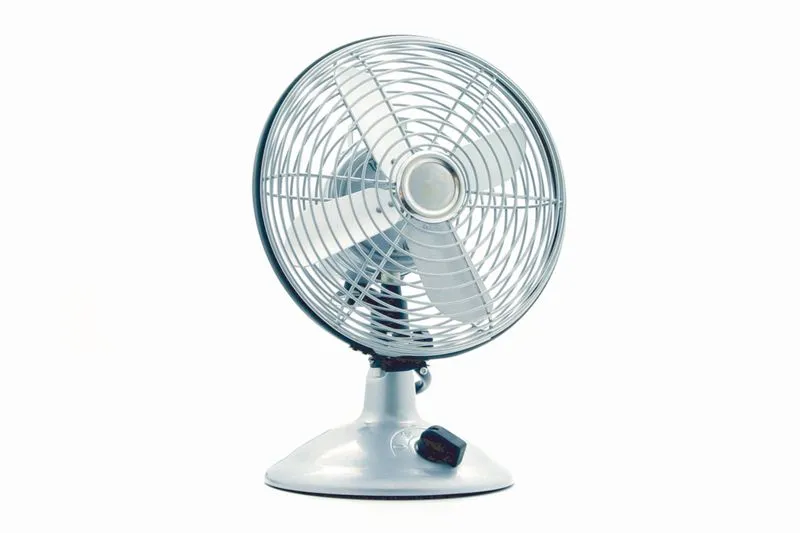
With a fan. Fans help — within limits. UKHSA's guidance for professionals says to use fans when the ambient temperature is below 35°C, because above that they can raise body temperature. "Beat the heat" adds that the fan shouldn't be aimed directly at the body.
Evening and night. Reopen windows once the air outside is cooler than inside, and get a through-draught going if it's safe to do so.
Keeping an older parent hydrated
"Drink plenty" is advice everyone knows — and exactly the advice older people follow least, because the thirst doesn't come. Age UK's wording is the one to repeat on the phone: drink lots of water throughout the day, even if you aren't thirsty, and limit alcohol, which increases the risk of dehydration.
The NHS gives a simple gauge (it works at any age): drink enough during the day for your pee to be a pale colour. Dark yellow, strong-smelling pee, or peeing less often than usual, are among the symptoms of dehydration it lists.
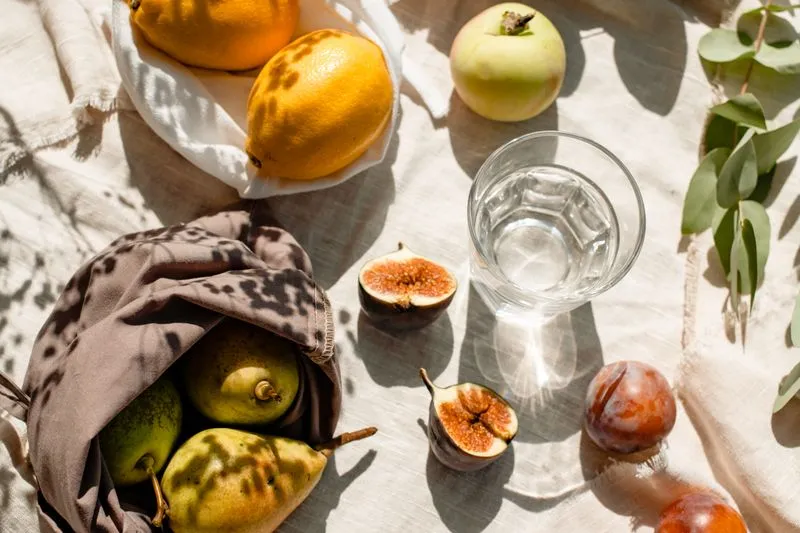
Variety helps, especially for someone who "doesn't like water". Age UK's guide to keeping cool lists water, diluted squash or fruit juice as good options, and advises to keep eating even without much appetite. Soup and watery fruit bring fluid too — a bowl of chilled melon at four o'clock often goes down better than a fourth glass of tap water.
One delicate subject deserves a frank conversation. If you suspect your parent drinks less to avoid dashing to the loo, raise it gently — and suggest a word with the GP. Rationing water in a heatwave is the wrong answer to a bladder problem.
Protecting a parent from afar: calls, relays and visits
You can't always be there — and that isn't a failing (whatever the guilt says). What protects your parent in a heatwave is a network: regular calls, one or two people who can drop round quickly, and professionals who know the situation. UKHSA's 2024 advice is to check on older neighbours, those living alone and people with underlying health conditions.
Daily calls are your eyes. During the hot spell, ring at least once a day, at a set time. And swap "Are you all right?" (the answer will always be yes) for questions that ask for facts.
- "What have you had to drink since this morning?"
- "What does the thermometer in the bedroom say?"
- "Are the curtains shut on the sunny side?"
- "What did you have for lunch?"
- "Have you been to the loo today?"
That last one isn't intrusive: peeing less often than usual is one of the NHS signs of dehydration. Listen to the voice, too. Slower speech, muddled answers or unusual confusion mean sending someone round straight away.
The relays matter just as much: a neighbour with a key, a warden (in sheltered housing), a carer, the district nurse who already visits. Tell them you're counting on them and leave your number. Maureen's son rang me back the next morning; we agreed I would knock on her door every late afternoon for as long as the heat lasted.
If you share the job with brothers or sisters, split the calls and visits in advance rather than on the first day of an alert. When the organising gets tense, the principles in couple communication techniques that actually work translate surprisingly well to siblings. And if you're carrying it all alone, keep an eye on your own tiredness: our look at women's mental health and concrete solutions can help you spot the moment to ask for backup.

The warning signs: dehydration, heat exhaustion, heatstroke
In an older person, heat-related illness is often quiet (and sometimes misleading). The table below brings together what the NHS describes on its pages about dehydration and heat exhaustion and heatstroke.
| Situation | Signs listed by the NHS | What to do |
|---|---|---|
| Dehydration. | Feeling thirsty, dark yellow and strong-smelling pee, peeing less often, feeling dizzy or light-headed, feeling tired, dry mouth, lips and tongue, sunken eyes. | Drinks, a cool room, rest. An urgent GP appointment or NHS 111 if they seem confused, unusually tired or dizzy on standing. |
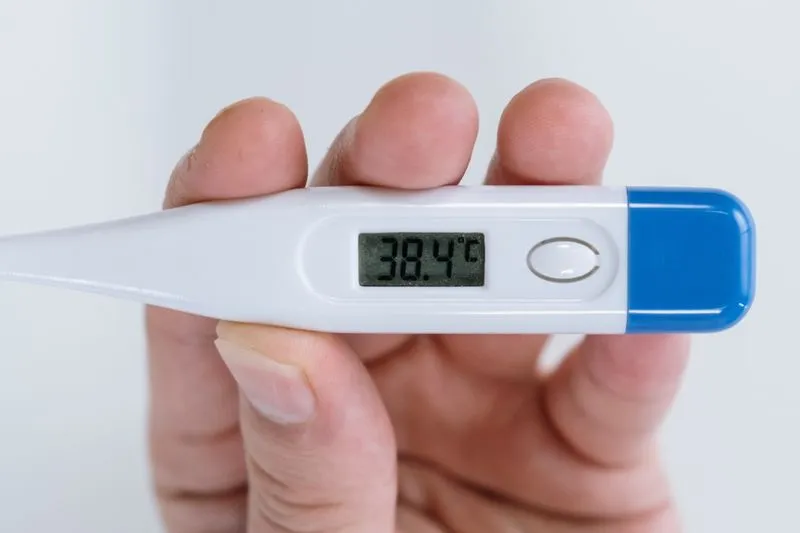
| Heat exhaustion. | Tiredness, dizziness, headache, nausea or vomiting, excessive sweating, pale clammy skin, cramps, a high temperature, being very thirsty. | Cool them down straight away (see below). They should feel better within 30 minutes. |
| Heatstroke. | A very high temperature, hot skin that's not sweating, a fast heartbeat, fast breathing, confusion and lack of coordination, a seizure or fit, loss of consciousness. | Call 999 immediately. |
Two nuances matter with an older parent. Confusion features in the NHS list of heatstroke signs (and Age UK lists mild confusion among signs of dehydration), yet it's easy to put down to tiredness or age. And a parent who feels "a bit off" in a heatwave should be treated as possibly dehydrated until proven otherwise — a drink and a cool room cost nothing.
When to call 999, and what to do while you wait
Heatstroke is a medical emergency, not a bad case of tiredness. The NHS says to call 999 if someone shows signs of it: a very high temperature, hot skin that isn't sweating, a racing heart, fast breathing, confusion, a fit or loss of consciousness. If in doubt, call anyway — the call handler (not you) assesses the situation.
For heat exhaustion, and while you wait for help with heatstroke, the NHS cooling steps are simple:
- move the person somewhere cool;
- remove unnecessary clothing, like a jacket or socks;
- get them to drink a sports or rehydration drink, or cool water;
- cool their skin — spray or sponge them with cool water and fan them.
One common-sense precaution sits alongside that list: only give drinks to someone who is fully awake and able to swallow easily.
The next morning, Maureen's son told me he felt awful for not having "picked up on it" when they spoke at lunchtime. There was nothing to pick up on — Maureen herself hadn't felt a thing (that's the point). Protecting an older parent rests on routines and precise questions, not on intuition.
So tonight, before the next hot spell, do three things. Save the number of one of your parent's neighbours in your phone. Check that the contact sheet is next to their phone. And sign up for Heat-Health Alerts for their region, so the next warning reaches you first.
Frequently asked questions
At what age is someone considered at higher risk in hot weather?
UKHSA's public guidance names older people aged 65 and over among the groups at higher risk, alongside babies and young children, people with long-term health conditions and people who live alone. Risk climbs steeply with age: in 2024 the highest heat-associated mortality rates were among people aged 85 and over, followed by those aged 75 to 84.
My dad refuses any help: what can I do?
Respect the choice, and build the safety net more discreetly: a daily call at a set time, a neighbour with a spare key, a word with his GP surgery. Frame it as your peace of mind rather than his frailty — people often accept for someone else's sake what they would refuse for their own.
How much should an older person drink in a heatwave?
The NHS gauge is simple: enough for pee to stay a pale colour. Age UK advises drinking throughout the day even when not thirsty, and limiting alcohol. Soup, yoghurt and watery fruit count too. If a GP has set a fluid limit, ask them how to adapt it in hot weather.
Is a fan enough to keep an older person safe?
Not on its own. UKHSA advises using fans when the air temperature is below 35°C, as above that they can raise body temperature, and not pointing them directly at the body. If the home stays very hot, a few hours somewhere cooler matters more than any fan.
Should my parent stop any medicines during a heatwave?
No, not without advice. "Beat the heat" is clear that people should keep taking all prescribed medicines unless a medical professional says otherwise. Some medicines raise the risk in hot weather, so ask the GP or pharmacist for a review — ideally before summer — and check storage instructions, as some need to stay below 25°C.
What should I do if my parent doesn't answer the phone during a heatwave?
Try once more, then call your nearest relay straight away: the neighbour or relative with a key. If nobody can get there quickly and you fear they've been taken ill, don't wait until the morning — call 999 and explain that it's an older person living alone, out of contact, during a heatwave.
Sources
- UK Health Security Agency — Heat Health: what you need to know for summer (11 June 2025)
- UK Health Security Agency — How Heat-Health Alerts contribute to keeping the vulnerable safe this summer (30 July 2024)
- GOV.UK — UKHSA launches new alerting system in collaboration with the Met Office (1 June 2023)
- GOV.UK — Supporting vulnerable people before and during hot weather: healthcare professionals (19 December 2024)
- GOV.UK (UKHSA) — Beat the heat: staying safe in hot weather
- NHS — Heat exhaustion and heatstroke
- NHS — Dehydration
- NHS — Heatwave: how to cope in hot weather
- Age UK — Looking after yourself in a heatwave (27 June 2024)
- Age UK — How to keep cool in hot weather
- Office for National Statistics — Families and households in the UK: 2023 (8 May 2024)