In this article
- The philosophy: impress without exhausting yourself
- Canapés: 3 show-stopping nibbles
- Starter: smoked salmon and beetroot verrines
- Main: roast turkey with chestnuts and winter veg
- The cheese board: the art of composition
- Dessert: homemade chocolate & chestnut Yule log
- The 7-day countdown: day by day
- Express alternatives (under 2 hours total prep)
- Wine pairings without breaking the bank
- Frequently asked questions
Last Christmas, my mum did what she's done every year for thirty years: got up at 5am to start cooking, spent the entire day standing at the stove, served a magnificent dinner at 8:30pm — and fell asleep on the sofa before pudding, too exhausted to enjoy any of it. Dad ended up serving the Yule log on his own while the children unwrapped presents without her.
Every year, the same scenario. Every year, the same promise: "Next year, I'll keep it simple." And every year, the same spiral: an over-ambitious menu, zero forward planning, and a host who spends the evening in the kitchen instead of at the table with the people she loves.
This menu is designed to break that cycle. Dishes that genuinely impress — but that rely on smart organisation rather than marathon cooking. The secret isn't cooking better on the day. It's cooking less on the day because you've done the heavy lifting in the days before. Result: you spend Christmas dinner at the table, not behind the hob.
The philosophy: impress without exhausting yourself
A good Christmas menu rests on three principles that professional caterers know inside out but home cooks forget every single year:
1. Maximum ONE technical dish
You're allowed ONE dish that demands skill and attention on the day. Everything else should be either made in advance or disarmingly simple. If your starter, main AND dessert all require tight timing and precise cooking — you're heading for disaster.
2. Contrasts make the meal
Alternate hot/cold, crunchy/melt-in-the-mouth, sweet/acid, rich/light. A menu that's 100% creamy will be sickening by the second course. A meal that alternates textures and temperatures stays exciting from the first bite to the last.
3. The plate eats with the eyes first
A simple dish beautifully presented impresses more than a complex dish badly plated. A sprig of rosemary, a pop of colour, a handsome serving dish — these details transform dinner into an event.
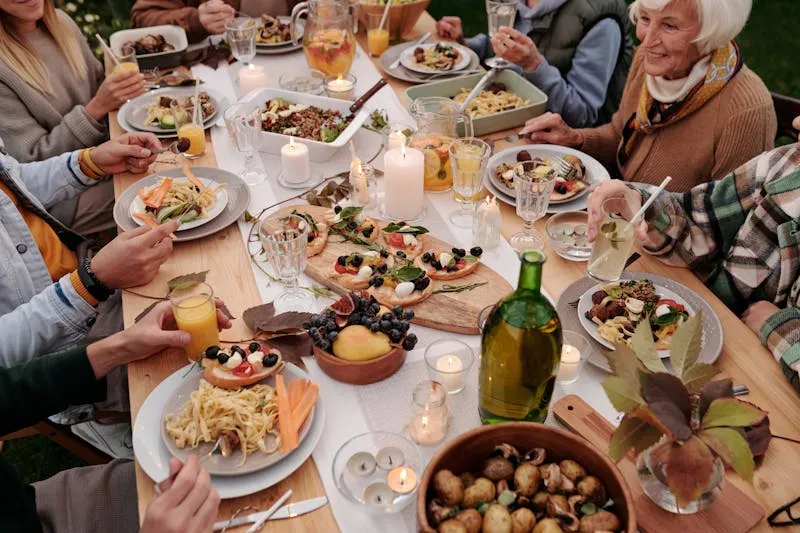
The menu I'm proposing: 3 cold canapés (made the day before), smoked salmon and beetroot verrines (assembled 2h before), roast turkey with chestnuts (the only hot, technical dish), cheese board (bought, just arranged), chocolate-chestnut Yule log (made 2 days ahead). Result: on the day, you manage ONE oven and ZERO stress.
Canapés: 3 show-stopping nibbles
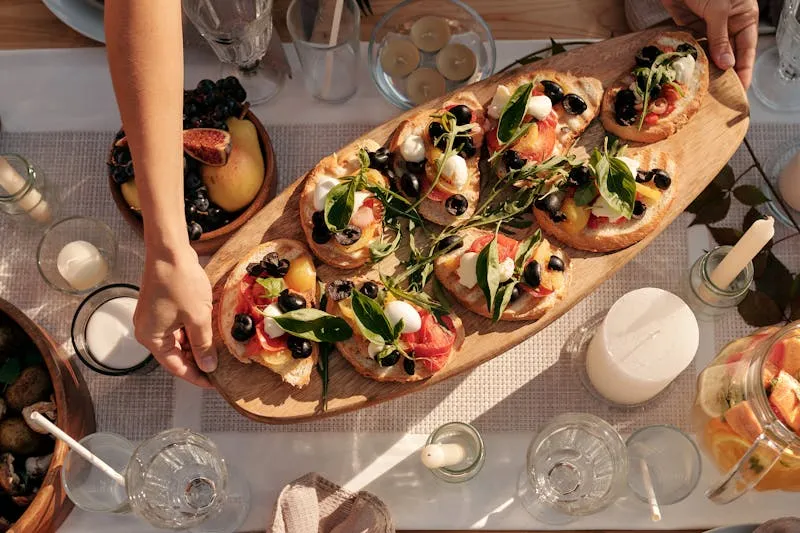
The canapés set the tone for the evening. And the good news is that the most impressive nibbles are often the simplest to prepare — provided you make them the day before.
Homemade blinis with lemon cream and trout roe
The blinis are made the evening before and reheated for 2 minutes in the oven. The cream: crème fraîche + lemon zest + snipped dill + salt. Assembly takes 30 seconds per blini. The trout roe adds the luxury touch for surprisingly little (around £4 per jar at the supermarket).
Quick pâté mousse verrines
200g of good duck or chicken liver pâté + 100ml of double cream, softly whipped. Blitz the pâté, gently fold in the cream. Spoon into small verrines, cover with cling film, fridge overnight. Next day: a spoonful of fig chutney on top and it's pure magic. Actual prep time: 8 minutes.
Cheese straws with mustard and Gruyère
1 sheet of ready-rolled puff pastry (absolutely no shame in that). Spread with wholegrain mustard, scatter with grated Gruyère, roll into a spiral, slice into 1cm rounds, bake at 200°C for 15 minutes. Made the day before, stored in the fridge, reheated for 5 minutes before serving. The effort-to-impression ratio is unbeatable.
Starter: smoked salmon and beetroot verrines
This starter ticks every box: it's beautiful, it's fresh (perfect contrast before the rich, hot main), it's made in advance, and it requires zero cooking.
For 8 people
- 4 cooked beetroot (vacuum-packed from the chilled aisle — not from a tin)
- 200g smoked salmon
- 200g cream cheese
- Juice of one lemon
- 2 tablespoons crème fraîche
- Fresh dill, salt, pepper
- A drizzle of extra-virgin olive oil
The method
Blitz the beetroot with the cream cheese and lemon juice until smooth — a vivid, shocking pink that looks spectacular in glass. Season. Pour the beetroot cream into verrines (fill two-thirds). Arrange smoked salmon strips on top. Add a spoonful of crème fraîche, a sprig of dill, a grind of pepper, a drizzle of olive oil.
Assemble the beetroot cream into verrines the evening before. Salmon and garnishes: 2 hours before the meal. Cover with cling film, fridge.
Watch for allergies: Smoked salmon is one of the most common allergens during festive meals. ALWAYS ask your guests about allergies or dietary requirements — ideally when you invite them, not the night before. Fish-free alternative: swap the salmon for ripe avocado cubes and pomegranate seeds.
Main: roast turkey with chestnuts and winter veg
For most British households, turkey is the undisputed king of the Christmas table. A well-cooked turkey is magnificent — the challenge is keeping the breast meat juicy while cooking the legs through. For 8 people, you'll need a turkey of around 4.5-5.5 kg (10-12 lbs).
Preparation (the day before)
- Take the turkey out of its packaging and pat dry inside and out
- Season generously inside and outside (10g of salt per kg)
- Slip under the breast skin: softened butter mixed with chopped tarragon, crushed garlic, and lemon zest
- Stuff the cavity with half a lemon, thyme sprigs, 2 whole garlic cloves
- Cover with cling film, fridge overnight. The salt penetrates the meat and makes it incredibly tender
Cooking (the day)
- Remove the turkey 1 hour before cooking — it must come to room temperature
- Preheat oven to 220°C/425°F. Place the turkey breast-side down for the first 30 minutes — the juices run towards the breast, keeping it moist
- Reduce to 160°C/325°F, flip breast-side up. Baste every 30 minutes with the pan juices
- Total time: approximately 40 minutes per kg. For a 5 kg turkey: around 3h15-3h30
- The turkey is done when a probe thermometer inserted into the thickest part of the thigh reads 74°C/165°F
- Resting is mandatory: 30-45 minutes under foil, oven door ajar. This redistributes the juices and is the single biggest factor in juicy vs. dry meat
Chestnuts and winter vegetables
During the turkey's resting time, crank the oven to 200°C/400°F. Spread on a large tray: pre-cooked chestnuts (from a jar), carrot chunks, parsnip batons, whole shallots. Olive oil, salt, thyme. 25-30 minutes — they should be caramelised and crispy at the edges.
The gravy: NEVER discard the pan juices. After removing the turkey, place the roasting tin on the hob. Deglaze with 150ml of white wine + 150ml of chicken stock. Scrape up all the caramelised bits. Reduce by half. Strain through a sieve. Whisk in a knob of cold butter. In 5 minutes, you've got gravy that makes the stuff from packets taste like dishwater.
Internal temperature is NON-NEGOTIABLE. An undercooked turkey poses a real food safety risk (salmonella). The Food Standards Agency recommends 74°C/165°F minimum at the thickest point. Invest in a probe thermometer (£8-12) — it's the only reliable way to guarantee both perfect and safe cooking. Colour of the juices alone is not a reliable indicator.
The cheese board: the art of composition
The cheese course is the transition between savoury and sweet — and also the moment to breathe between two rich courses. You don't need 12 cheeses: 5 well-chosen ones are perfect.
The rule of 5 styles
- Soft and creamy: Brie or a ripe Camembert
- Washed rind: Époisses, Stinking Bishop, or a ripe Vacherin Mont d'Or (in season in December — perfect)
- Hard: Aged Comté, Manchego, or a mature Cheddar with crystals
- Blue: Stilton (quintessentially British for Christmas) or Roquefort
- Goat's cheese: Aged chèvre log or individual crottins
Accompany with: walnuts, hazelnuts, grapes, a pot of chestnut honey, and slices of fig bread or oatcakes. Take the board out of the fridge 1 hour before serving — cold cheese has no flavour.
Dessert: homemade chocolate & chestnut Yule log
The Yule log — or bûche de Noël — has one enormous advantage: it's made 2 days ahead. On the day, you take it out of the fridge, decorate, and serve.
The chocolate sponge (Day -2)
- 4 eggs, 100g caster sugar, 40g plain flour, 30g cocoa powder
- Whisk yolks and sugar until pale and thick. Fold in sifted flour and cocoa. Whisk whites to stiff peaks, fold in gently
- Spread onto a lined baking tray (1cm thick maximum)
- Bake at 180°C/350°F for 10-12 minutes — the sponge should be springy, not crisp
- Roll it immediately in a damp tea towel (the heat makes it pliable). Leave to cool rolled up
The chestnut cream filling
- 250g chestnut purée (sweetened)
- 200g mascarpone
- 100g dark chocolate, melted and cooled
- Mix chestnut purée with mascarpone. Add the lukewarm melted chocolate. Whisk until smooth and silky
Assembly
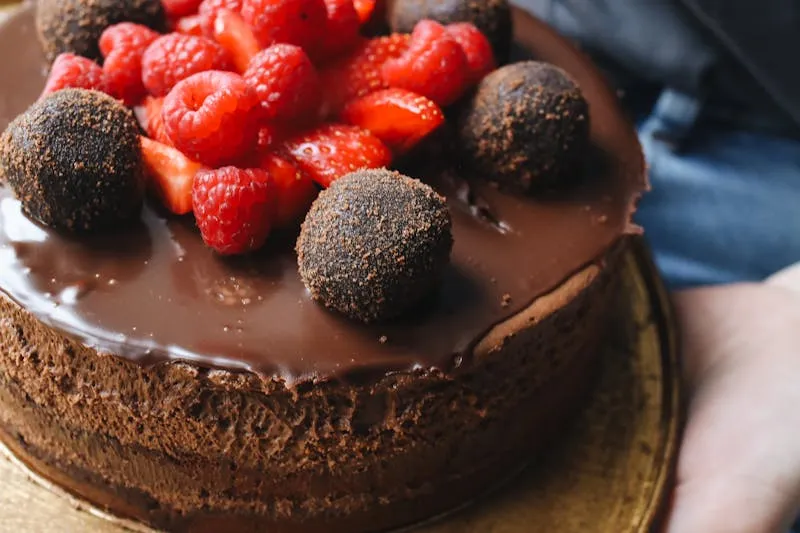
Unroll the sponge. Spread the filling thickly (keep a third back for the coating). Re-roll. Coat the outside with the remaining filling. Score with a fork to create bark lines. Cling film, fridge for at least 48 hours — the flavours develop beautifully.
Decoration (the day)
Dust with icing sugar (the snow), place a few rosemary sprigs (more elegant than plastic holly), scatter some candied chestnut pieces if you fancy the luxury. Meringue mushrooms if you've got time — but honestly, icing sugar alone looks stunning.
The sponge that cracks when rolling: The universal nightmare. Two fixes: 1) Roll it while still warm in a damp tea towel (the steam softens it). 2) If you unroll it and it cracks anyway, spread the filling, roll as best you can, and coat generously — nobody will see the fissures beneath the frosting. The best-kept secret in patisserie: decoration hides everything.
The 7-day countdown: day by day
This is your secret weapon. This plan transforms a marathon on the day into a gentle stroll. Print it, stick it on the fridge, tick off each step.
Day -7: store-cupboard shop
Buy everything that keeps: flour, sugar, chocolate, spices, jarred chestnuts, frozen puff pastry, wine. Check you've got enough cling film, baking parchment, and foil.
Day -5: order the fresh items
Order the turkey from your butcher. Reserve the cheeses. Buy the smoked salmon if you're going artisan.
Day -2: the Yule log
Make the sponge, the filling, assemble and coat the log. Wrap, fridge. It's DONE. Don't touch it again until serving.
Day -1 morning: fresh shop
Beetroot, crème fraîche, fresh herbs, salad, fruit for the cheese board, fresh bread or crackers.
Day -1 afternoon: prep work
- Prepare the turkey (salt, butter under skin, aromatics in cavity, fridge)
- Make the pâté mousse verrines → fridge
- Make the cheese straws → tray in fridge, ready to bake
- Make the beetroot cream → verrines in fridge
- Make blinis if doing them from scratch
- Set the table (yes, the night before — one less thing to worry about)
The day — hour by hour
- -4h00: Take the turkey out of the fridge
- -3h00: Turkey goes in at 220°C/425°F breast-side down
- -2h30: Reduce to 160°C/325°F, flip, start basting
- -1h30: Take cheese board out of fridge
- -1h00: Assemble the salmon-beetroot verrines
- -0h45: Prep the winter veg for roasting
- -0h30: Turkey out, resting under foil. Oven up to 200°C/400°F, in go the veg and cheese straws
- -0h15: Make the gravy. Reheat blinis for 2 min
- 0h00: Drinks are served! And you're at the table with a glass of fizz

The golden rule: When guests arrive, you should have only ONE thing in the oven (the turkey or the veg, never both simultaneously if your oven's a single deck). Everything else is either cold or reheat-able in 5 minutes. If you find yourself juggling 3 hot preparations at once, your menu is too ambitious.
Express alternatives (under 2 hours total prep)
No time or no inclination to spend 3 days cooking? Zero judgement. Here's an equally festive express menu:
Express starter: scallop tartare with lime
12 fresh scallops diced small + juice of 2 limes + olive oil + snipped chives + flaky sea salt. Mix, rest 15 minutes in the fridge. Serve on Chinese spoons or in small dishes. 10 minutes of prep, guaranteed impact.
Express main: beef fillet in mustard crust
1.2 kg beef fillet for 8. Sear on all sides for 2 minutes. Brush with wholegrain mustard and herbs. Wrap in puff pastry. Bake at 200°C/400°F for 25-30 minutes. Rest 10 minutes. Slice thickly. Total: 45 minutes including only 10 of active prep.
Express dessert: berry pavlova
Buy ready-made meringue nests (absolutely no shame). Whip 400ml of very cold double cream to soft peaks. Layer meringues, cream, and mixed berries (frozen, thawed) in a spectacular pile. 10 minutes. The visual effect is show-stopping.
Wine pairings without breaking the bank
You don't need to spend £40 a bottle for a successful pairing. Here are the fundamentals:
- Aperitif: Crémant d'Alsace or English sparkling wine (£10-15) — excellent alternative to Champagne, and most guests won't tell the difference
- Starter (salmon-beetroot): Chablis or Sancerre (£10-15) — the minerality cuts through the richness of the salmon
- Main (turkey): A lighter Burgundy red like Givry (£12-18), or a full white like a Viognier if you're staying white all evening
- Cheese: Continue the red, or switch to a Gewurztraminer (£9-13) which pairs brilliantly with strong cheeses
- Dessert: Pedro Ximénez sherry or Maury (£8-12 for a half bottle) — sweet fortified wines are the perfect match for chocolate
Total wine budget for 8: £45-70, that's £6-9 per person for a full set of pairings. Ask your local wine merchant for advice — good independents love the challenge of a tight budget.
Frequently asked questions
Turkey, goose, or capon: how to choose?
Turkey is the classic British choice — available in sizes to feed anywhere from 6 to 20 people, relatively affordable, but the breast can dry out if you're not careful with basting. Goose produces gloriously rich, dark meat and extraordinary fat for roasting potatoes, but it's fattier and more expensive, and feeds fewer people than you'd expect for its size. Capon (a large castrated cockerel) is the French favourite — exceptionally tender and flavourful, ideal for 8-10 people. For a classic Christmas with fail-safe results, turkey with the dry-brining method above is your best bet.
How far in advance can you make the Yule log?
The log keeps perfectly for 3 days in the fridge, well wrapped in cling film. Some pastry chefs make it up to 5 days ahead — the flavours develop with resting. It also freezes for up to a month without any loss in quality. Take it out 30 minutes before serving so it reaches the right eating temperature (not fridge-cold). Decoration (icing sugar, fragile elements) should be done on the day, just before serving.
How do I cater for vegetarian guests without cooking two meals?
Rather than doubling your workload, plan a single vegetarian centrepiece alongside the turkey. A mushroom and chestnut Wellington can be prepared the day before, cooks at the same time as the turkey, and impresses just as much. The starter and dessert from this menu are already adaptable: swap the salmon for avocado in the verrines, and the Yule log is naturally vegetarian. Just make sure to factor the alternative into your countdown plan.
What budget should I plan for this menu (8 people)?
Realistic estimate for 2024: turkey (£30-50), smoked salmon (£12-18), cheeses (£20-30), Yule log ingredients (£10-12), starter and canapés (£12-18), vegetables and garnishes (£8-12). Total food: £95-140, or roughly £12-18 per person. Add the wine (£45-70) and total budget is £140-210 for a complete, high-quality festive dinner. That's roughly 30% less than a caterer.
How do I avoid waste with leftovers?
Christmas leftovers are a gift, not a problem. Cold turkey in a Boxing Day salad or sandwich, the carcass simmered into stock for soup, roasted veg blitzed into a velouté, Yule log sliced into individual portions and frozen. WRAP estimates that 4.2 million Christmas dinners' worth of food is wasted in the UK each year — with a bit of planning, you can get yours to nearly zero. It's also becoming perfectly normal to send guests home with leftovers — nobody refuses.
Can you prep the turkey the night before and cook it on the day?
Not only can you, you absolutely should. Prepping the turkey the day before (salt, herb butter under the skin, aromatics in the cavity) and leaving it uncovered in the fridge overnight is the best thing you can do for flavour and tenderness. The salt penetrates deep into the meat overnight — this is the dry-brining technique used by every professional chef. Simply take it out an hour before cooking to let it come to room temperature.