In this article
- 1. Chopping without losing a finger (or crying)
- 2. Pan-frying: the technique that changes everything
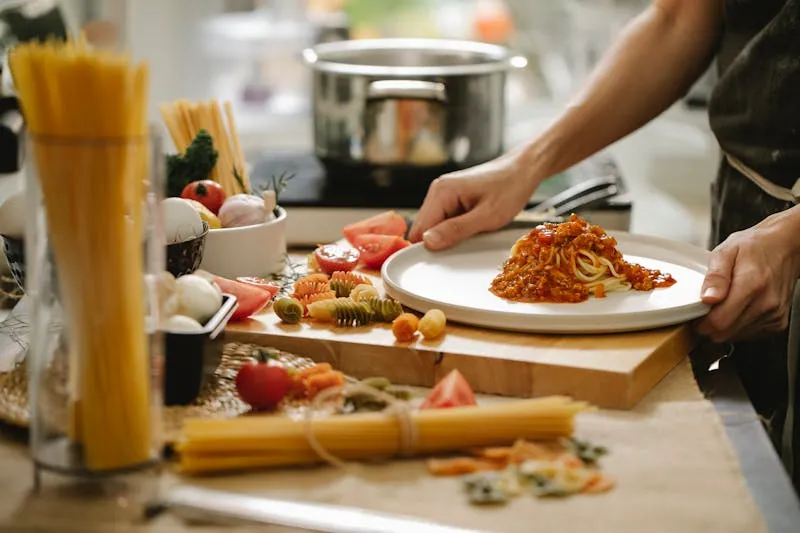
- 3. Perfectly al dente pasta every single time
- 4. A proper sauce in 5 minutes flat
- 5. Seasoning at the right moment, in the right amount
- 6. Searing meat without butchering it
- 7. Cooking an egg every which way
- 8. Rice that doesn't stick (finally)
- 9. Homemade shortcrust pastry in 10 minutes
- 10. The perfect vinaigrette — ditch the bottles
- Frequently asked questions
I have a confession. For my first three years of "adult" life, my absolute culinary speciality was buttered pasta. Not butter-browned-with-parmesan-and-freshly-ground-black-pepper pasta — no, the "I put a lump of butter on overcooked fusilli and called it dinner" version. My flatmate at the time, Tom, once watched me eat my conchiglie porridge with an expression usually reserved for natural disasters.
The truth is, nobody actually teaches us how to cook. We watch 30-second TikTok videos of someone dicing an onion at the speed of light, think "that looks easy," and end up in A&E with a plaster on our finger and our ego in tatters. Or we follow recipes without understanding why we're doing things — and the moment we go off-script, it's sheer panic.
These 10 techniques are ones I learned over the years — sometimes from friends, sometimes from work experience, often from failing spectacularly. They won't make you a Michelin-starred chef. But they'll make you someone who walks into the kitchen with confidence rather than dread. And honestly? That's already massive.
1. Chopping without losing a finger (or crying)
Let's start with the skill you use most often — and probably do worst. Dicing an onion, slicing carrots, mincing garlic, chopping herbs: it's the foundation of 90% of all cooking. And the difference between a proper chop and a haphazard hack is the difference between vegetables that cook evenly and a dish where some pieces are charred while others are still raw.
The safety position
Before we even discuss technique, let's talk about your fingers. The "claw grip" — fingertips curled inward, knuckles forward — is the only position that protects you. The blade slides along your knuckles like a rail. It feels odd at first, but within a week, it becomes second nature.
The onion without tears (or nearly)
Cut the onion in half lengthways. Lay each half flat. Make horizontal cuts, then vertical ones, keeping the root intact — it holds everything together. Then slice perpendicular to your cuts. The dice fall apart on their own. To minimise tears: chill the onion in the fridge for 30 minutes beforehand, use a sharp knife (a sharp blade crushes fewer cells, releasing less irritating gas), and don't have a fan blowing vapour straight at your face.
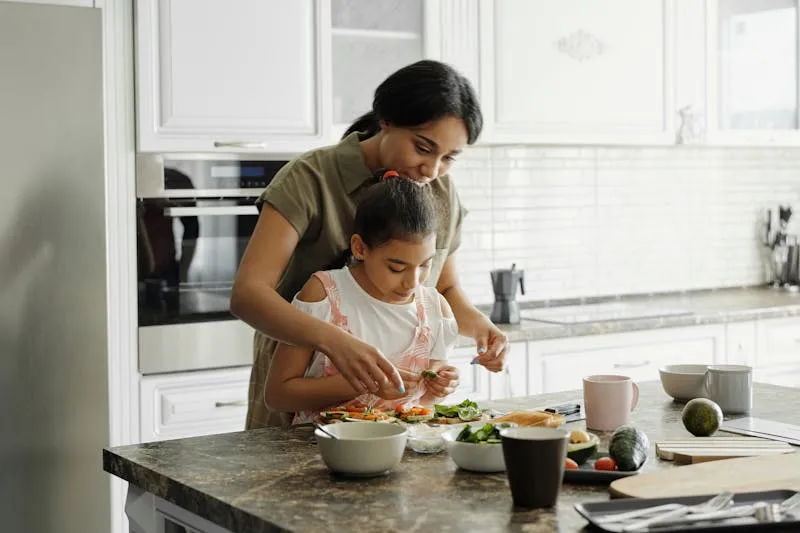
The uniformity rule: It doesn't matter what size you chop to — what matters is that all the pieces are the same size. A 3mm brunoise or 2cm cubes, both work perfectly. But a mix of different sizes = a mix of textures and cooking times. Uniformity is the professional secret nobody mentions.
2. Pan-frying: the technique that changes everything
"Sautéing" doesn't mean "stirring frantically with a wooden spoon." It's a precise technique: cooking quickly over high heat in minimal fat, tossing the food to turn it without crushing it.
The 3 golden rules
- The pan must be HOT before adding anything. Hold your hand 10 cm above — you should feel the heat rising. Add the fat, wait until it shimmers (the oil creates little "waves"), then add your food
- Don't overcrowd the pan. If the food pieces are touching, they steam instead of searing. Two batches beats one crammed pan. This is THE most common mistake
- Don't touch. Leave your food alone. It needs time to develop a golden crust (Maillard reaction) before you flip it. If it's sticking, it's not ready — give it another 30 seconds
Smoking oil = danger. If your oil is smoking, it's exceeded its smoke point and is breaking down — it becomes bitter and potentially harmful. Remove the pan from heat, discard the oil, wipe clean, start again. For high-heat cooking, use sunflower, rapeseed, or groundnut oil. Save olive oil for gentle cooking and dressings.
3. Perfectly al dente pasta every single time
Pasta is the dish "everyone can cook" — and nearly everyone cooks badly. Water not salty enough, pasta sticking together, overcooked to mush… It's a universal classic.
The foolproof method
- 1 litre of water per 100g of pasta — minimum. Pasta needs room to swim freely, otherwise it clumps
- 10g of salt per litre — yes, that's a lot. The water should taste like the sea. This is the only chance you get to season the pasta itself, not just the sauce. Under-salt and no sauce in the world will save it
- Rolling boil — not a timid simmer. The pasta needs the turbulence to keep moving
- 2 minutes before the packet time: taste. When there's a tiny white dot at the centre of the pasta when you bite through — that's al dente. It'll finish cooking in the sauce
- Save a mugful of cooking water before draining. That starchy water is liquid gold: it binds sauces and gives them body
NEVER add oil to the cooking water. It's a persistent myth: oil floats on the surface and does nothing to prevent sticking (it's the water movement that does that). But it WILL prevent sauce from clinging to the pasta after draining. Stir the pasta during the first 2 minutes of cooking — that's when it's most likely to stick.
4. A proper sauce in 5 minutes flat
A sauce is what transforms a "decent" dish into a "wow" one. And contrary to popular belief, basic sauces are disarmingly simple. If you master the concept of deglazing, you've mastered 80% of French sauces.
Deglazing: the magic technique
You've just seared some meat or veg. At the bottom of your pan, there are golden, caramelised residues stuck to the surface — the fond. That's pure concentrated flavour. To capture it:
- Remove the meat/veg, keep the pan hot
- Pour in a cold liquid: white wine, red wine, stock, cream, even water. The thermal shock unsticks the fond instantly
- Scrape with a wooden spoon as the liquid reduces
- When the liquid has reduced by half, add a knob of cold butter while stirring — this gives the silkiness and shine
There you go. You've just made a restaurant-quality sauce in 4 minutes.

3 simplified mother sauces
- Beurre blanc: shallots + white wine + cream + cold butter whisked in. For fish
- Tomato sauce: softened onions + crushed tomatoes + garlic + olive oil + basil. 20 minutes and done
- Vinaigrette: 1 part vinegar to 3 parts oil + mustard + salt + pepper. That's it
Cream sauce "splitting": If your cream sauce goes lumpy or separates, the heat's too high. Remove from heat immediately, add a spoonful of cold cream, and whisk vigorously. 9 times out of 10, it recovers. Double cream (48% fat) is far more stable for cooking than single cream — always use it for hot sauces.
5. Seasoning at the right moment, in the right amount
Seasoning is the invisible border between "not bad" and "incredible." And the secret isn't quantity — it's timing.
Salt: layer by layer
Don't salt everything at the end. Salt at every stage: the pasta water, the vegetables at the start of cooking (it draws out moisture and concentrates flavours), the meat just before searing, the sauce as it reduces. Each layer of salt penetrates the food at a different point and creates depth of flavour — impossible to achieve by salting at the end alone.
Pepper: at the end
Unlike salt, pepper loses its aromatics with prolonged cooking. Salt during, pepper after. And use freshly ground peppercorns — the difference from pre-ground jar pepper is as vast as freshly ground coffee versus instant.
Acid: the chef's secret
Your dish tastes good but something's "missing"? It's probably acid. A squeeze of lemon, a splash of vinegar, a dash of white wine — acid lifts every other flavour and adds brightness. Start with a few drops, taste, adjust. It's the trick that chefs don't share nearly enough.

You can always add more, never take it away. Season gradually and taste between each addition. If you've over-salted: add volume (more vegetables, more liquid, more starch). The myth about potatoes "absorbing salt" is only partially true — they absorb salted water but don't significantly reduce the overall salt concentration. NHS guidelines recommend no more than 6g of salt per day; all the more reason to measure carefully.
6. Searing meat without butchering it
Searing is the most gratifying technique — and the most anxiety-inducing. Yet once you understand what's happening in the pan, it's blindingly logical.
Before the pan
- Take the meat out of the fridge 20-30 minutes before cooking. Cold meat at its centre = uneven cooking (burnt outside, raw inside)
- Pat the surface dry with kitchen paper. Moisture is the enemy of searing — it creates steam instead of a crust
- Salt just before (not an hour ahead, otherwise salt draws water to the surface)
In the pan
- Cast iron or stainless steel pan — not non-stick. You want intense heat and a surface that creates fond
- High heat. The oil should be almost smoking
- Place the meat and DON'T TOUCH IT. 3-4 minutes per side for a 2cm steak. Flip once only — when you see the edge browning halfway up
- The finger test: press the meat. Soft like the fleshy base of your thumb at rest = rare. Like the base when touching your index finger = medium. Firm = well done
After the pan: resting
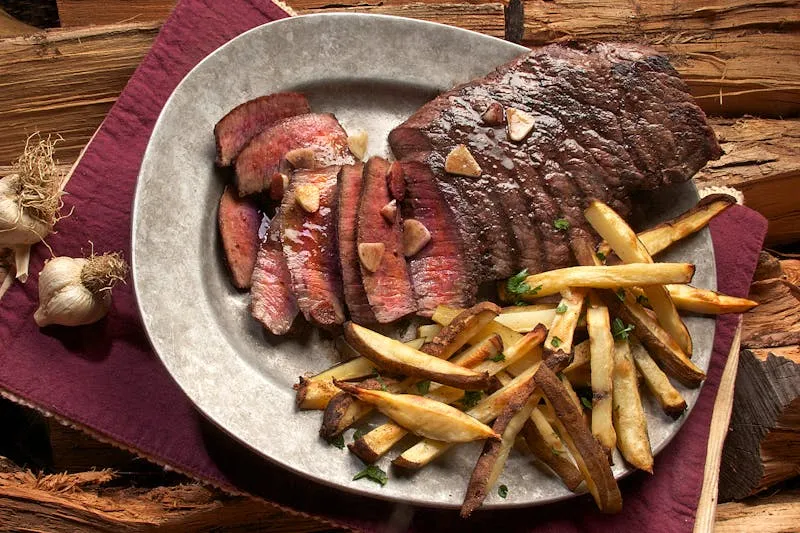
This is the step everyone skips. Let your meat rest for 5 minutes under a loose piece of foil. During cooking, the juices concentrate at the centre. Resting redistributes them throughout the entire piece. If you cut immediately, the juices flood out onto the plate instead of staying in the meat. Those 5 minutes literally make the difference between a juicy steak and a dry one.
7. Cooking an egg every which way
The egg is the ultimate test of a cook. Simple in appearance, treacherous in execution. A Michelin-starred chef once said the first thing he asks a new commis to do is cook an egg — because it immediately reveals their command of heat.
The perfect fried egg
Non-stick pan, LOW heat. A drizzle of olive oil or a knob of butter (not both). Crack the egg into a small bowl first (to catch any shell), then pour gently. The white should set slowly, the yolk stay runny. Cover with a lid for the last 30 seconds to set the top of the white without cooking the yolk. 3-4 minutes, no more.
Hard-boiled (and soft-boiled, and dippy eggs)
Start with boiling water (not cold). Lower the eggs in gently with a spoon. Strict timing:
- Dippy / soft-boiled: 5-6 minutes — set white, runny yolk
- Jammy / medium: 7 minutes — firm white, creamy yolk
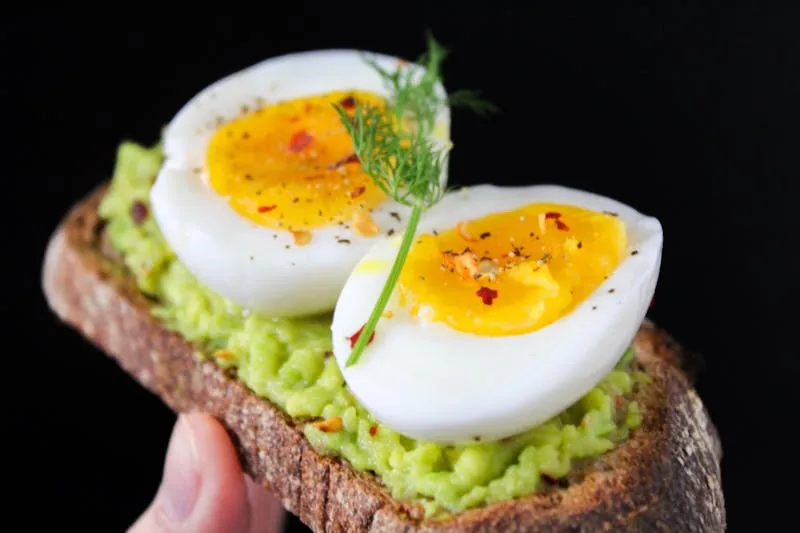
- Hard-boiled: 10 minutes — everything set, yolk stays bright yellow (not grey-green)
Plunge immediately into ice-cold water to stop the cooking. The green ring around the yolk? That's iron sulphide — harmless but a sign of overcooking. If your yolk's gone green, shave 1-2 minutes off next time.
The poached egg
The final boss. Gently simmering water (not boiling — otherwise the white shreds), a splash of white vinegar (it helps the white coagulate faster), create a whirlpool with a spoon, drop the egg into the centre. 3 minutes. Lift out with a slotted spoon. It's normal to botch the first 5 — after that, it clicks.
The freshness test: Drop an egg into a glass of water. If it sinks and lies flat = very fresh (perfect for poaching). If it tilts slightly upright = a few days old, ideal for hard-boiling. If it floats = off, bin it. This works because the air pocket inside the egg grows larger over time.
8. Rice that doesn't stick (finally)
If you grew up eating rice that resembled wallpaper paste, this section is about to change your life. And no, it's not complicated — it's just that nobody ever explained the right proportions to you.
Pilaf method (the most reliable)
- Rinse the rice under cold water until the water runs clear — you're removing excess starch, the culprit behind stickiness
- Toast the dry rice for 1-2 minutes in a little oil or butter over medium heat. The grains become slightly translucent — this creates a barrier that prevents starch from escaping during cooking
- Add the liquid (water or stock): 1.5 times the volume of liquid to rice for basmati. 2 times for short-grain
- Bring to the boil, reduce to the lowest heat, cover, and DON'T TOUCH IT for 12 minutes
- Turn off the heat, leave for 5 minutes with the lid on. Then fluff with a fork (not a spoon)
Every grain separate, tender, fragrant. Every single time.
DO NOT lift the lid during cooking. The rice cooks by steam — if you open it, the steam escapes and the rice will be dry on top and gluey at the bottom. Trust the process. 12 minutes, lid on, lowest heat. That's it.
9. Homemade shortcrust pastry in 10 minutes
"I haven't got time to make pastry from scratch" — yes, you have. 10 minutes of prep, 30 minutes resting in the fridge, and you've got pastry that utterly outclasses anything from the supermarket chiller aisle. And for pennies: flour + butter + salt + water. Under 50p for one tart base.
The foolproof recipe
- 250g plain flour in a bowl
- 125g very cold butter cut into small cubes — the cold is crucial
- A pinch of salt
- 3-4 tablespoons of ice-cold water
Rub the flour and butter together with your fingertips — visible butter lumps should remain, as they're what creates the flaky layers. Add the water in one go, mix quickly until a ball forms (do NOT knead — otherwise the gluten develops and the pastry becomes elastic and tough). Flatten into a disc, wrap in cling film, fridge for 30 minutes.
The food processor shortcut: If you've got a stand mixer or even a basic food processor, shortcrust takes 30 seconds. Flour plus cold butter cubes: a few pulses until it resembles coarse breadcrumbs. Add the water: 2-3 pulses, stop. Done. The machine has the advantage of not warming the dough with your hands — resulting in even flakier pastry.
10. The perfect vinaigrette — ditch the bottles
Throwing out bottles of shop-bought dressing was one of the best culinary decisions of my life. Not for reasons of gastronomic purity — simply because homemade vinaigrette is better, cheaper, and ready in 45 seconds. Literally.
The basic formula
- 1 part vinegar (red wine, white wine, balsamic, cider — each vinegar changes the character)
- 3 parts olive oil (or a blend of olive and rapeseed for more mildness)
- 1 teaspoon of Dijon mustard — it acts as an emulsifier, binding the oil and vinegar together
- Salt and pepper
Put everything in a small glass jar. Close. Shake for 10 seconds. Done. The jar keeps for a week in the fridge — just re-shake before each use.
Variations that change your life
- Asian: soy sauce + sesame oil + lime juice + honey + grated ginger
- Caesar: mayonnaise + grated Parmesan + blitzed anchovies + lemon + garlic
- Honey mustard: wholegrain mustard + honey + cider vinegar + olive oil
- Tahini: tahini + lemon juice + warm water + garlic + salt — divine on grain bowls
Frequently asked questions
What's the difference between sautéing, pan-frying, and browning?
Sautéing: quick cooking over high heat with little fat, food is regularly tossed or stirred. For thinly cut vegetables, prawns, strips of meat. Pan-frying: cooking with a moderate amount of fat, less movement, often with a lid at some point — closer to gentle cooking. For chicken pieces or fish fillets. Browning/searing: colouring strongly on all sides over high heat without a lid, creating a thick crust. For joints of meat before braising. In practice, most home recipes use a combination of sautéing and searing.
How do I know if my pan is hot enough?
The water drop test: flick a few drops of water into the dry pan. If the water sizzles and evaporates within seconds, the pan's at a good temperature. If the water forms beads that "dance" across the surface (Leidenfrost effect), it's too hot for most cooking — turn it down slightly. If the water sits there motionless, it's not hot enough. This test only works on stainless steel or cast iron pans, not non-stick.
Why are my omelettes always dry?
Two classic errors: heat too high and cooking too long. The ideal omelette is cooked over medium-low heat for 2-3 minutes maximum. The centre should still be slightly wobbly when you fold it — residual heat finishes the job. Eggs continue cooking even off the heat. If the omelette looks perfect in the pan, it'll be overcooked on the plate. Chef's trick: a touch of crème fraîche in the beaten eggs retains moisture beautifully.
Can I use olive oil for everything?
No. Extra-virgin olive oil has a smoke point around 190-210°C — sufficient for gentle and medium-heat cooking. But for high-heat searing (smoking-hot pan), it'll burn and turn bitter. Use sunflower, rapeseed, or groundnut oil (smoke point 220-230°C) for intense cooking. Save good olive oil for vinaigrettes, marinades, and finishing dishes — that's where its flavours truly shine.
How do I rescue an over-salted dish?
Add volume: more liquid (water, stock, cream), more starch (rice, pasta, potatoes), or more vegetables. A splash of lemon or vinegar can also "mask" the perception of salt. The myth of the potato absorbing salt is only partially true — it absorbs salty water but doesn't significantly reduce overall salt concentration. The real solution: prevent it by salting gradually and tasting between each addition.
Should I wash mushrooms or just brush them?
Good news: you can wash them. The "mushroom sponge" myth has been debunked — tests show that a mushroom soaked for 5 minutes absorbs only 2% of its weight in water. The real problem is surface moisture preventing proper searing. Solution: wash quickly under running water, pat thoroughly dry with kitchen paper, and sauté over high heat in a hot pan in small batches. They'll brown instead of boiling.
How do I get roast vegetables that aren't soggy?
Three secrets: cut into uniform-sized pieces, spread on the tray WITHOUT piling up (they need space so steam can escape), and use a very hot oven (220-230°C/430-450°F). Olive oil, salt, oven, that's it. Turn only once, halfway through cooking. If your veg are soft and pale, the tray was too crowded — moisture creates steam instead of caramelisation. Contact with the tray surface is crucial for crispness.