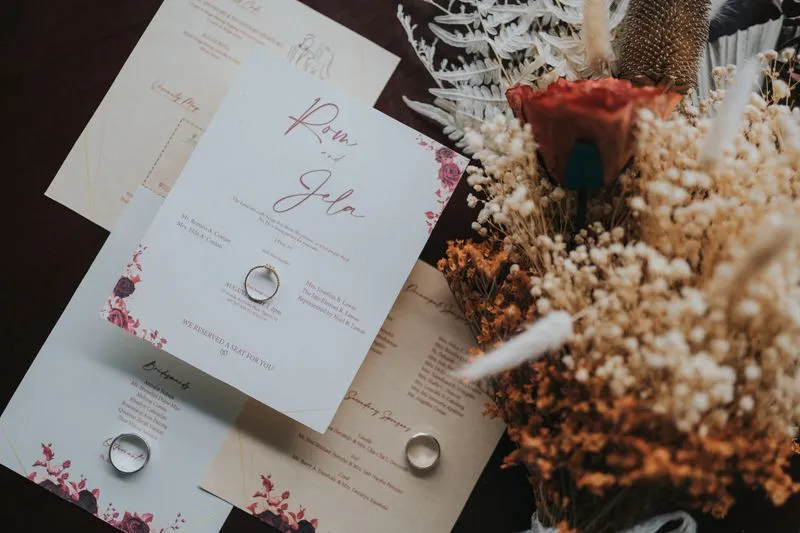
On Saturday 30 July 2022, 3,608 couples got married in England and Wales. That was the single busiest wedding day of the year, according to the ONS bulletin on marriages in England and Wales in 2021 and 2022 — and it wasn't a fluke. The same bulletin notes: "In recent years either the first Saturday in September or last Saturday in July tend to be the most popular days on which to get married."
Now do the maths for this year. Between 1 May and 30 September 2025, the calendar holds exactly 22 Saturdays.
Twenty-two. Not one more.
So your invitation isn't a pretty piece of card first — it's a booking. Your favourite people have cousins, colleagues and university friends getting married this summer too, all aiming at the same Saturdays you are (and with the August bank holiday falling on Monday 25 August in England and Wales, guess how many couples have spotted Saturday the 23rd). The first envelope through the letterbox claims the Saturday. The rest get a text: "Oh no, we've already got a wedding that day — but we'll come to the evening do!"
It's mid-March. If you're getting married in late June or July, your invitations need to go out now — not "when the printer's finished", now. After covering dozens of weddings for the magazine (and keeping every invitation I receive in a shoebox in my Hackney flat — yes, every single one), I've learnt what separates an invitation that gets replies from one that gets texts asking "what time is it again?". Further down: a dated timeline for a wedding on 23 August and fifteen wordings to copy.
The wedding invitation timeline at a glance
Wedding invitations go out three to four months before the day — preceded by save the dates six to eight months before — with an RSVP deadline six weeks before the wedding. That's the short version. The long version fits in this table, built around a real example: a wedding on Saturday 23 August 2025, the August bank holiday weekend in England and Wales.
| Step | When | For a wedding on Saturday 23 August 2025 |
|---|---|---|
| Save the dates | 6 to 8 months before (9 to 12 for a wedding abroad or on a bank holiday weekend) | August to November 2024 (bank holiday weekend: 9 to 12 months) |
| Order the invitations | 5 to 6 months before | March 2025 |
| Post the invitations | 3 to 4 months before | Late April 2025 |
| RSVP deadline | 6 weeks before | Saturday 12 July 2025 |
| Chase late replies | 2 days after the deadline | Monday 14 July 2025 |
| Final numbers to the caterer | The date written in your contract | July 2025 |
| Thank-you cards | Within 2 to 3 months | By the end of November 2025 |
Why six weeks for the RSVP deadline, and not a fortnight? Because between the deadline and the wedding there's still everything else to do. Chasing the stragglers (there will be stragglers — there always are). Giving your caterer a number. Building the table plan, adjusting the drinks order, printing the place cards — and breathing.
The date that runs the whole show isn't your wedding date, by the way. It's the date your caterer wants final numbers. It's in your contract — usually in the small print — next to the cancellation terms you went through line by line when choosing your wedding suppliers and negotiating their prices. Find it before you print anything. If you're starting from scratch, our 12-month wedding planning countdown slots these mailings into everything else.
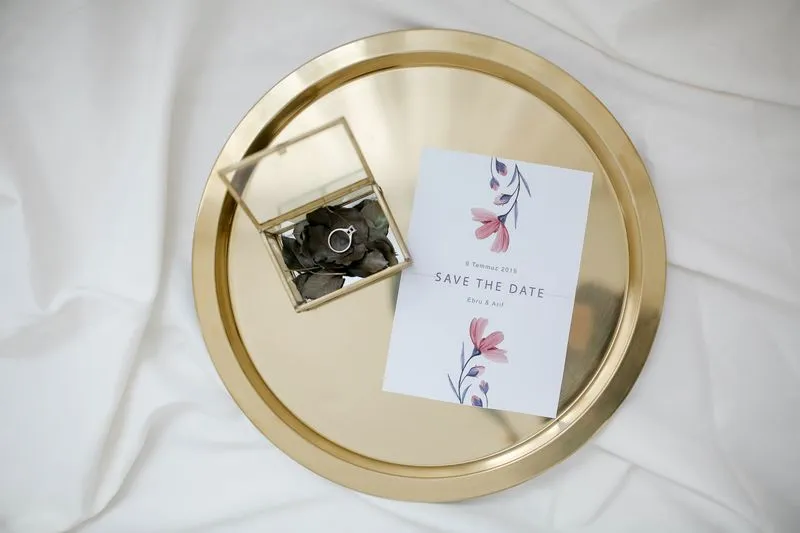
Save the dates: six to eight months before (sometimes twelve)
Save the dates go out six to eight months before the wedding, as soon as the date and the town are certain. Their only job? Getting a Saturday blocked. They don't give timings, the exact venue or the menu — just the couple's names, the date, the town or region, and the promise that an invitation will follow.
When should you push it to nine or even twelve months? In three specific cases.
- A wedding abroad, or far from most of your guests. There are flights to book and annual leave to request — and airfares won't wait for your invitation.
- A bank holiday weekend. In England and Wales, 2025's bank holidays fall on 5 May, 26 May and 25 August (in Scotland, the summer one is Monday 4 August). Those are the weekends your guests book their holidays for — early — unless you got there first.
- A wedding spread over several days (welcome drinks, the day itself, a Sunday barbecue). Nobody books two days off on two months' notice (not without sighing, at least).
On the other hand, a 30-guest wedding where everyone lives within an hour's drive doesn't need save the dates at all — an invitation posted four months ahead does the job. And never send a save the date to someone you're not sure you'll invite. No. A save the date is a commitment. Sending one and then "forgetting" the invitation is a family feud — for the next ten Christmases.
Format-wise, anything goes — and this is where you can save money. A digital card, a well-written message, a postcard with a photo of the two of you — or the old favourite, a fridge magnet (because it stays in sight for six months). The wording fits on three lines:
Ellie & Sam are getting married! Saturday 23rd August 2025, near Bath. Save the date — invitation to follow.
Save the date. Jess and Callum, 6th September 2025, in the Lake District. Keep the weekend free for us — we'll handle the rest.
Invitations: three to four months before the wedding
Wedding invitations go out three to four months before the ceremony — four months if you skipped save the dates, three if everyone has already blocked the date. Any later than two months and you put your guests in an awkward spot (your caterer too). Any earlier than five and the envelope ends up under a pile of post, and nobody remembers the RSVP deadline.
For a summer wedding, that means invitation season is now. Mid-March to the end of April for July weddings. April and May for August and September. Running late? Don't panic — but don't do things by halves either. Send every guest a message this week with the date, the venue and the RSVP deadline, then post the invitations the moment they arrive from the printer.
Now work backwards from the printer. An invitation ordered from a stationer or an online printer goes through a design, a proof to approve, printing and delivery. Allow plenty of time — there's always a typo spotted on the third read and an envelope delivered in the wrong size. To post in mid-March, the design has to be signed off in January.
One last timing rule, and not the least important: every invitation goes out on the same day. All of them. Every family has someone who compares the postmark on their envelope with the one next door (you know exactly who I mean) — post them together and the question never comes up.
The RSVP deadline and chasing late replies (without becoming a nag)
The RSVP deadline sits six weeks before the wedding, and it's written out in full, day included: "Kindly reply by Saturday 12th July". Not "as soon as possible". Not "ASAP". Not "by mid-July". A vague date gets vague replies — and three weeks before the wedding you're adding up a pile of "should be fine".
Let's be honest: you will chase. Even with the most beautiful reply card in the world, some guests won't reply on time — and it's often the closest ones (the ones who think "you know we're coming"). So plan the chase from the start, with a simple routine:
- Two days after the deadline: an individual message — never a group chat message, which drowns in the scroll.
- Five days after: a phone call. Yes, an actual phone call.
- A week after: a non-reply counts as a no — and you say so, kindly.
Keep the message light and precise — a chase works when it gives a reason and a deadline:
Hiya! We're finalising numbers with the caterer this week — will you be with us on the 23rd? If so, let us know about any allergies or dietary needs too. A reply by Thursday would be perfect.
Quick nudge from Ellie and Sam: if we haven't heard from you by Sunday, we'll count you as a no (sad, but organised). Are you coming?
Can't face twenty phone calls? Delegate. The time I was a witness, I made the chasing calls myself — and the bride got three evenings back (at least). Chasing late replies is one of the favours you can ask of your wedding party without blushing, along with the jobs covered in our guide to what a wedding witness really does.
What a wedding invitation must say
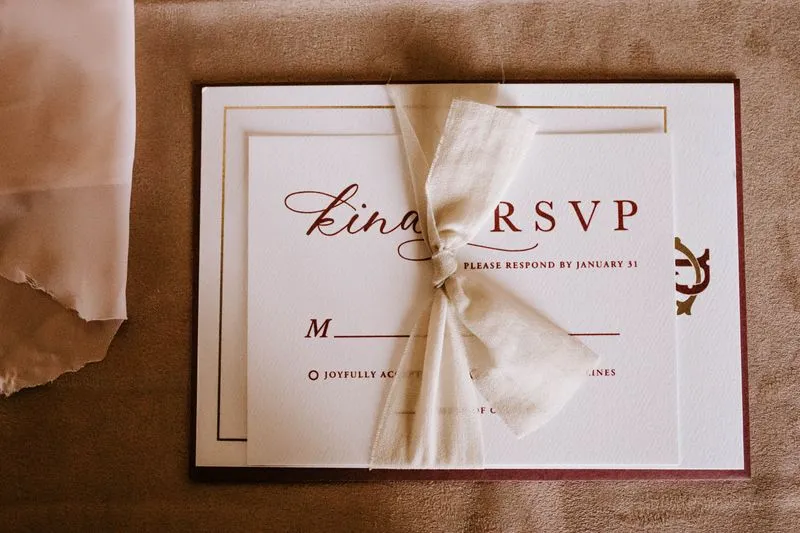
A wedding invitation has to answer five questions without the guest needing to send a text: who's getting married, when, where, which part of the day they're invited to, and how to reply. Everything else (dress code, website, gift list) is useful — but it's a bonus.
- The hosts and the couple's names — the parents' too, if they're hosting (see the traditional wording below).
- The full date, day of the week included: Saturday 23rd August 2025. The day works as a safety net — write "Saturday 24th August 2025" and someone will notice, because 24 August 2025 is a Sunday.
- The ceremony time and venue, with the town.
- The reception: wedding breakfast, speeches, evening party — with timings and a postcode the sat nav understands.
- The RSVP deadline and how to reply: card, website, form, phone.
- The practical bits: accommodation, transport, parking, the Sunday barbecue — ideally on a separate details card or a wedding website.
If you're marrying outdoors, say so on the invitation. Outdoor civil ceremonies at licensed venues in England and Wales were made permanent in 2022 — the government announcement on outdoor civil weddings explains that "Couples can now have the whole ceremony outside in the venue's grounds". Lovely for the photos. Less lovely for the guest in stilettos who finds out on the lawn.
A dress code needs one line: "Garden party dress — flat shoes welcome, the ceremony is on the grass." It helps everyone. Your guests will wonder anyway — so answer before they reread the rules for what to wear as a wedding guest for the tenth time.
And the gift list? Never on the invitation itself. It goes on a small separate card or on the wedding website — one discreet line. If you're still torn between a honeymoon fund, a charity donation and a classic list, the modern alternatives to a traditional wedding list will help you decide before printing (not after, or you'll be reprinting).
Day guests, evening guests: who gets what?
In Britain, the real split isn't between invited and not invited — it's between day guests and evening guests. Day guests come to the ceremony, the drinks reception, the wedding breakfast and the party. Evening guests join later — usually after the speeches — for the buffet and the dancing. Two groups, two invitations, one golden rule: everybody knows exactly what they're invited to.
| What you send | To whom | What it says |
|---|---|---|
| Day invitation | Family and close friends | The whole day, from the ceremony to the last song |
| Evening invitation | Wider friends, colleagues, neighbours | The party, from a set time |
| Wedding announcement card, afterwards | People who weren't invited to a small wedding | "We got married on…" |
One last rule, and the most underrated: the envelope says who's invited. "The Patel family" means parents and children. "Priya and Dev Patel" means the two adults, not the kids. "Priya Patel" on her own means no plus-one. Nobody reads the small print at the bottom of the card. Everybody reads their name on the envelope.
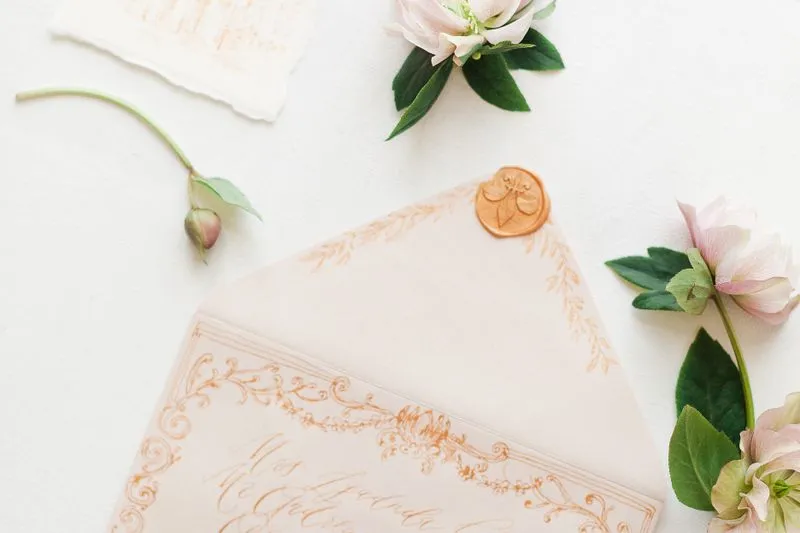
Evening invitation wording
An evening invitation uses the same hosts and the same tone as the day invitation — only the start time changes.
Mr and Mrs David Harper request the pleasure of your company at an evening reception to celebrate the marriage of their daughter Eleanor and Samuel Okafor, at [venue], [town], on Saturday 23rd August 2025 from half past seven. RSVP by Saturday 12th July 2025.
Ellie & Sam are getting married — come and celebrate with us from 7.30pm at [venue]. Dancing, food and a very long playlist. RSVP by 12th July at [website].
Traditional wedding invitation wording
Traditional British wording names the hosts first — classically the bride's parents — who "request the pleasure of your company". It's formal, yes. But it settles the question of the families in one go — and your nan will recognise it at a glance. The guest's name is traditionally handwritten in the top left-hand corner.
The bride's parents host
Mr and Mrs David Harper request the pleasure of your company at the marriage of their daughter Eleanor to Mr Samuel Okafor at [venue], [town], on Saturday 23rd August 2025 at two o'clock, and afterwards at [reception venue]. RSVP by Saturday 12th July 2025 to [address].
Church weddings traditionally swap "the pleasure of your company" for "the honour of your presence". And if both families are hosting, both couples go at the top: "Mr and Mrs David Harper and Mr and Mrs Emeka Okafor request the pleasure of your company at the marriage of Eleanor and Samuel…"
Etiquette used to call for "Mr and Mrs David Harper" — the husband's first name for both. I'll be blunt: in 2025, "Helen and David Harper" is every bit as elegant — and your mum no longer disappears behind your dad's first name.
The couple host
Eleanor Harper and Samuel Okafor request the pleasure of your company at their marriage on Saturday 23rd August 2025 at two o'clock, at [venue], [town]. Reception to follow.
A church ceremony and a separate reception
[…] at St [name]'s Church, [town], on Saturday 23rd August 2025 at two o'clock, and afterwards at [reception venue], from half past four.
Notice the gap between the two — confetti, photos, the drive, guests hunting for a parking space. An invitation that promises the church at two and drinks across the county at three is a bride sprinting across a car park.
Modern, funny and intimate invitation wording
Modern invitations sound like the couple. They're chatty (between friends, that's what feels right), they dare to be funny — and they're happy to leave the parents out of it. Just one rule: the practical details stay as clear as on a traditional invitation. Joke at the top, address at the bottom — never the other way round.
Modern and simple
Ellie & Sam. We're getting married on Saturday 23rd August 2025, and we'd really love you to be there. Ceremony at [venue] at 2pm, then dinner and dancing until the small hours. RSVP by 12th July at [website].
Funny
After nine years, three flat moves and one flat-pack wardrobe built without instructions, Ellie and Sam have decided to sign something other than a tenancy agreement. Join us on Saturday 23rd August 2025 at 2pm at [venue]. The bar will take care of the rest (and so will the dance floor).
Rustic or boho
Under the oak trees at [venue], we're saying "I do" on Saturday 23rd August 2025 at 3pm. Bring shoes that don't mind grass, a jumper for later and your best dance-floor energy.
Intimate: a very small wedding
We're getting married in a tiny ceremony on Saturday 23rd August 2025. Because you matter to us, we wanted you to hear it from us rather than from the photos. We'll celebrate with you over drinks in the autumn — date to follow.
Humour, yes — on one condition: your great-aunt still has to work out where to go and when. One joke per invitation is plenty (two is a stand-up routine — and the routine makes people forget the address). Save your best material for the speeches.
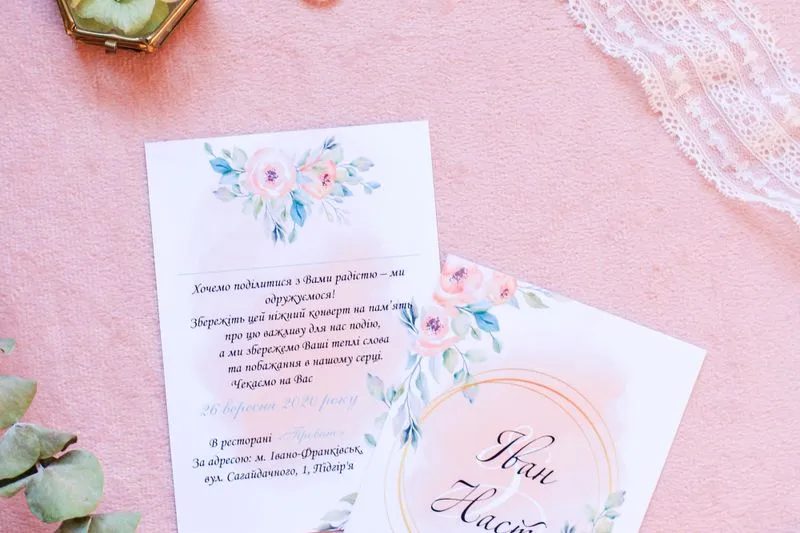
Wording for the tricky situations
Every tricky situation on a wedding invitation is solved the same way: one short, positive sentence, placed with the practical details — never a justification.
A child-free wedding
The envelope already does half the work (no "family", just the adults' names) — the other half is one line on the details card:
Our celebration is adults only — here's to a night off with no bedtime!
If you're making an exception (babes in arms, the bridesmaids' children), make it clear — and own it. A vague exception means twenty separate negotiations.
Divorced parents or a blended family
Each parent gets their own line, under their current name: "Mrs Helen Harper", "Mr David Harper and Ms Claire Webb". If the balance turns into a diplomatic puzzle, switch to the version where the couple host: nobody takes offence at not being named when nobody is named.
Plus-ones
If you're allowing a guest, write it on the envelope ("Priya Patel and guest") and ask for their name on the reply card for the table plan. If you're not, write nothing but your guest's name — the envelope speaks for you.
A small register office wedding, a party later
Ellie and Sam said "I do" on 23rd August 2025 in a tiny ceremony. They'd love you to celebrate with them on Saturday 20th September from 7pm at [venue]. RSVP by 31st August.
Guests travelling from abroad
Send them the save the date first and earliest — by email as well as by post — along with the nearest airport and a couple of places to stay. Overseas post takes longer, and flights won't wait.
Paper, digital and stamps: sending wedding invitations in practice
The combination that works best in 2025: digital save the dates, paper invitations and online RSVPs. Digital saves time where it matters (blocking a date, collecting replies, sharing a map). Paper keeps its role as the keepsake — the one that goes on the fridge or into a shoebox (guilty).
Fully digital works brilliantly among well-connected thirty-somethings. For your grandparents' generation, though, an invitation by WhatsApp can feel second-rate — print at least those copies. A discreet QR code on the back of the card — linking to the RSVP form — brings the two worlds together.
Postage has quietly got a lot pricier. According to MoneySavingExpert's breakdown of the October 2024 stamp price rise, a first class stamp went from £1.35 to £1.65 on 7 October 2024, while second class stayed at 85p. And the next rise is already booked: from 7 April 2025, first class goes to £1.70 and second class to 87p, and a first class large letter jumps from £2.60 to £3.15 (second class large stays at £1.55), according to MoneySavingExpert's guide to the April 2025 stamp price rise. Stamps marked 1st or 2nd with no price stay valid after a rise — buy yours before 7 April. For 80 invitations sent second class, that's £68 before 7 April, £69.60 after — as long as every envelope still counts as a standard letter.
That's the catch. The Post Office guide to sending a letter sets a standard letter at a maximum of 24cm by 16.5cm and 0.5cm deep. A thick card, a reply card and its envelope, a ribbon and a wax seal can easily push you past 5mm — and then it's a large letter, at £1.55 second class or £3.15 first class from 7 April. Posted in late April, your 80 invitations jump from £69.60 to £124 in second class. For a wax seal.
The invitation mistakes that cost you
The invitation mistakes that cost the most are about information: a date, an address, an envelope. Here are the ones I've seen most often — in my own letterbox and in the stories of the brides I've interviewed.
- A day and a date that don't match. "Saturday 24th August 2025" — half your guests remember the Saturday, the other half the 24th. Check it on a calendar, then get someone else to check it.
- An incomplete venue address. The name of the house without the village (or the village without the postcode). The result: guests driving in circles down single-track lanes.
- No RSVP deadline. Without a date, replies arrive whenever they arrive.
- "The Patel family" on the envelope of a child-free wedding. The envelope always beats the small print.
- An RSVP link that doesn't work. Test the QR code and the website address on three phones before printing.
- An overloaded invitation. Taxis, gift list, the Sunday barbecue — all of that goes on a details card or the website.
And while we're on typos: RSVP stands for "répondez s'il vous plaît", so "please RSVP" says please twice. Nobody will turn you away for it — but on a card printed 80 times, you might as well write it properly.
Now grab your caterer's contract, a calendar and a pencil. Circle the final-numbers date and step back two weeks: that's your RSVP deadline. Step back three to four months from the wedding (four if you skipped save the dates): that's your posting day. The paper, the font, the ribbon — they can all wait ten more minutes.
Frequently asked questions
How far in advance should you send wedding invitations?
Wedding invitations go out three to four months before the wedding: four months if you didn't send save the dates, three if guests have already blocked the date. Save the dates go out six to eight months before — nine to twelve for a wedding abroad, over several days or on a bank holiday weekend.
What RSVP deadline should you put on a wedding invitation?
Set the RSVP deadline six weeks before the wedding, written out in full with the day of the week. Above all, make sure it falls at least two weeks before the date your caterer needs final numbers: that gap is what gives you time to chase late replies.
Should evening invitations go out at the same time as day invitations?
Yes. Post day and evening invitations on the same day, with the same care. Evening guests who receive their invitation weeks after everyone else will work out why — and a same-day send avoids that awkward moment entirely.
Is it OK to send wedding invitations by email or WhatsApp?
Yes, and it's widely accepted among friends, especially for save the dates. For older guests, print a few paper copies all the same — they're also the ones that end up in the album. The most practical combination is a paper invitation with online RSVPs through a QR code.
How do you word "no children" on a wedding invitation?
Start with the envelope — the adults' names only, never "family". Then add one positive line on the details card, such as "Our celebration is adults only — here's to a night off with no bedtime!". No justification, no apology.
Who should be named as hosts: the parents or the couple?
Both are correct. Traditional wording names the hosts — classically the bride's parents — who "request the pleasure of your company". Having the couple host is simpler for blended families, second marriages, or when the couple are paying for the wedding themselves.
How much does it cost to post wedding invitations in 2025?
Until 6 April 2025, first class costs £1.65 and second class 85p; from 7 April 2025, £1.70 and 87p, according to MoneySavingExpert. A large letter costs £1.55 second class, and first class goes from £2.60 to £3.15 on 7 April. Have one fully assembled invitation weighed and measured at the Post Office before buying your stamps.
Sources
- Office for National Statistics — Marriages in England and Wales: 2021 and 2022
- GOV.UK — Marriages and civil partnerships in England and Wales: give notice
- GOV.UK — Outdoor civil weddings and civil partnerships made permanent
- MoneySavingExpert — First-class stamp price rise from 7 October 2024
- MoneySavingExpert — Stamp price rise from 7 April 2025
- Post Office — How to send a letter in the UK