
It's 11.17pm and Lucy is scrolling. It's no longer really a choice — it's a reflex, like scratching a mosquito bite. For twenty minutes she's been swiping through photos of a woman she doesn't personally know but whose life she follows like a series: the aesthetically plated brunch, the trip to Japan, the flat stomach after "just two months of Pilates." Lucy closes the app with a diffuse sense of unease. Not jealousy, not exactly. More like the impression that her own life — decent, normal, perfectly functional — is somehow insufficient. That something is missing. That she is missing something.
This feeling has a name in social psychology: upward comparison. And social media has industrialised it on an unprecedented scale. This report doesn't demonise platforms — they have genuine virtues. It examines, with research to back every claim, the mechanisms by which they affect our self-esteem, and offers protection strategies validated by evidence.
Social comparison: the central mechanism
Psychologist Leon Festinger formulated Social Comparison Theory in 1954: human beings evaluate their abilities and opinions by comparing themselves to others. It's a fundamental, unavoidable mechanism, and in itself neither good nor bad. What changes everything is the direction and frequency of comparison.
Upward vs downward comparison
Upward comparison (comparing yourself to someone perceived as "better" — more attractive, wealthier, more accomplished) generates inspiration in some people but envy and self-deprecation in the majority. Downward comparison (comparing to someone perceived as "worse off") generates temporary relief but also guilt.
Social media platforms are upward comparison machines. By design. Every feed is composed of highlights: the best moments, the best angles, the best versions of reality. You don't see the difficult morning, the argument with a partner, the Sunday slump — you see the brunch, the sunset and the perfect smile. The result is a systematic distortion: you compare your complete everyday life to everyone else's curated best of.
The volume effect
Before social media, your comparison points were limited: your family, your colleagues, a few celebrities in magazines. Today, a teenager is exposed to hundreds of comparison points per day, from across the globe, all optimised to appear desirable. The human brain is simply not wired to handle this volume of social comparison without damage.
The asymmetry bias: you know that your own life contains highs and lows. But for others, you only see the highs — carefully selected, filtered and staged. This informational asymmetry creates a cognitive distortion: you systematically underestimate other people's normality and overestimate your own shortcomings. It's a bug, not a truth.
The dopamine loop: why we can't stop
Social media platforms aren't merely a distorting mirror — they're also a neurochemical trap. Every interaction (like, comment, share, new follower) activates the reward circuit in the nucleus accumbens, releasing a micro-dose of dopamine. This mechanism is identical — not analogous, identical — to that of slot machines.
Intermittent reinforcement
The key to behavioural addiction isn't constant reward — it's intermittent and unpredictable reward. You never know when the next like will arrive, whether your post will "go viral" or sink without trace. This uncertainty keeps the dopaminergic circuit on permanent alert — and brings you compulsively back to the app to check.
Externalised validation
The deeper problem is the outsourcing of self-esteem. When your mood depends on the number of likes under your latest photo, you've externalised your validation — you've entrusted it to strangers. This mechanism is particularly destructive because it's invisible: you don't consciously decide to let 200 strangers determine your worth. It happens gradually, like after like, day after day.
The 24-hour test: the next time you post something, note your mood. Then note it again at 2 hours, 6 hours and 24 hours later. Observe the correlation between engagement received and your emotional state. If the link is strong, it's a sign that your self-esteem has become partially externalised — valuable information for recalibrating your relationship with platforms.
Infinite scroll: a design choice, not an accident
Infinite scroll, video autoplay, push notifications, pull-to-refresh — none of these are design accidents. They're the product of engineering teams whose KPI is time spent on the app. Aza Raskin, the inventor of infinite scroll, has publicly stated he regrets his creation, estimating it collectively consumes 200,000 human lifetimes per day in captured time.
Filters, retouching and digital dysmorphia

Instagram, TikTok and Snapchat beauty filters don't merely smooth skin or enlarge eyes. They create an alternative version of yourself — a face you will never see in a mirror. And it's this version, impossible to achieve in reality, that gradually becomes your reference standard.
Snapchat dysmorphia
The term "Snapchat dysmorphia" was coined in 2018 by American plastic surgeons to describe a new phenomenon: patients arriving for consultations not with celebrity photos as reference, but with their own filtered selfies. They were asking to look like their "filtered" version — a version that never existed. JAMA Facial Plastic Surgery published an alarming editorial on the phenomenon, calling it "a new form of body dysmorphic disorder."
FaceTune and the normalisation of retouching
FaceTune, downloaded more than 200 million times, lets you retouch a selfie in seconds: slim the jaw, whiten teeth, erase a wrinkle, cinch the waist. Retouching, once the preserve of magazines with Photoshop, has become a daily act — to the point where posting an unretouched photo is perceived as an act of bravery rather than the norm.
Documented consequences:
- 150% increase in rhinoplasty requests among 18-25-year-olds between 2015 and 2023 (ISAPS)
- 49% of teenage girls say filters influence their perception of their own "real" face (Girlguiding UK survey, 2022)
- Significant correlation between FaceTune use and body dysmorphic disorder symptoms (Boston University study, 2021)
The toxic cycle: use a filter → appreciate the filtered version → reject the real version → use the filter more → growing gap between perceived image and real image. This self-deprecation cycle is self-sustaining and can, in severe cases, evolve into clinical body dysmorphic disorder requiring professional support.
What the landmark studies say
Research on social media and self-esteem has exploded since 2015. Here are the most important studies — and what they actually demonstrate (nuances included).
Meta/Facebook's internal study (2021)
The "Facebook Papers," leaked by whistleblower Frances Haugen, revealed that Meta had known since 2019 that Instagram had a negative impact on teenage girls' body image. Internal research concluded: "We make body image issues worse for one in three teen girls." For 32% of teenage girls surveyed, when they felt bad about their bodies, Instagram made the feeling worse. Meta disputed the interpretation but did not dispute the data.
The University of Pennsylvania study (2018)
Hunt et al. conducted a randomised controlled trial — the gold standard of research — on 143 students. Result: limiting social media use to 30 minutes per day for three weeks produced a significant reduction in loneliness and depression. The effect was particularly pronounced in participants with the highest baseline depression levels.
The APA advisory (2023)
The American Psychological Association issued a landmark health advisory in 2023, concluding that social media poses a significant risk to adolescent mental health, particularly for girls. Ten recommendations included: limiting screen time, banning comparison features (filters, like counters) and requiring platform transparency regarding algorithms.
The #StatusOfMind study (RSPH, 2017)
The Royal Society for Public Health ranked the five main social media platforms by their impact on young people's mental health. Result: Instagram is the most harmful for body image, sleep, FOMO (fear of missing out) and cyberbullying. YouTube was the only platform with a net positive impact.
Read the studies, not the headlines: media coverage of social media research is often sensationalist. Correlations are not causation. Effects vary considerably by age, gender, pre-existing psychological state and type of use (active vs passive). What is established: passive consumption (scrolling without interacting) is significantly more harmful than active use (commenting, creating, participating).
The specific impact on teenage girls
If social media affects adults, their impact on teenage girls operates on an entirely different scale. Three reasons converge:
1. The adolescent brain is under construction
The prefrontal cortex — the seat of judgement, perspective-taking and emotional regulation — doesn't reach maturity until around age 25. Teenagers therefore process social information more emotionally, less critically. A negative comment or the absence of likes on a photo can trigger a neurobiological reaction disproportionate to the actual stakes.
2. Identity is being formed
Adolescence is the period of identity construction (Erikson). "Who am I? Am I acceptable? Am I desirable?" These fundamental questions find in social media quantified answers — follower counts, likes, comments — that become proxy measures of personal worth.
3. Peer pressure is at maximum
Social media doesn't replace adolescent sociability — it extends it around the clock. Bullying no longer stops at the school gates. Group dynamics (exclusion, mockery, ranking) now play out in permanent public view. And FOMO — the anxiety of "missing out" — is sustained in real time by stories and ephemeral content.
The data is unequivocal:
- 46% of 13-17-year-olds say social media makes them feel worse about their bodies (Girlguiding UK survey, 2022)
- Girls who spend more than 3 hours/day on social media have double the risk of depression (JAMA Psychiatry study, 2019)
- Cyberbullying affects 1 in 5 teenage girls in the UK, compared with 1 in 10 boys
The silence of the data: many teenage girls don't report the impact of social media on their wellbeing. The normalisation of distress ("everyone does it") and the fear of losing access (the smartphone as social umbilical cord) prevent disclosure. Parents and educators must actively look for signs: withdrawal, irritability after use, compulsive notification checking.
The connection paradox: more connected, more alone
Social media promises connection. It often delivers the opposite. This paradox — documented as early as 1998 by Kraut et al.'s "Internet Paradox" study — has intensified with visual platforms.
The isolation mechanism
Passive social media use (scrolling, observing, consuming) decreases the sense of belonging and increases loneliness. The reason is counterintuitive: by seeing others socialise (parties, groups, events), you get the impression you're the only one who's alone — even when you're not. It's a salience effect: others' social moments are visible; your own solitude is invisible.
Replacing deep interactions
Time spent on social media partially displaces face-to-face interactions — the kind that genuinely nourish social bonds. A like doesn't replace a look. A comment doesn't replace a conversation. A share doesn't replace a hug. Digital connection creates an illusion of sufficient social contact, while fundamental needs for authentic human connection remain unmet.
The 3:1 ratio: for every hour spent on social media, try to spend at least 20 minutes in a real social interaction — a phone call, a coffee, a walk with someone. This ratio isn't scientifically calibrated, but it forces a conscious rebalancing between digital connection and human connection.
The real benefits of social media
This report would be dishonest if it didn't acknowledge the documented benefits of social platforms. Social media is not inherently toxic — it's the mode of use that determines the impact.
What's documented as beneficial
- Support communities: for LGBTQ+ people in hostile environments, people with chronic illnesses, survivors of violence — platforms sometimes offer the only safe space for self-expression.
- Information access: science, medical and psychological communication accounts reach audiences that traditional media do not.
- Creative expression: platforms enable creators to express themselves, find audiences and sometimes earn a living from their art.
- Social mobilisation: #MeToo, #BlackLivesMatter, feminist movements — social media has amplified causes that struggled to surface in mainstream media.
- Maintaining ties: for expats, distant families, long-distance friendships — platforms facilitate connections that would otherwise be difficult to sustain.
The key nuance: active use (creating, commenting constructively, participating in communities) is associated with neutral or even positive effects. It's passive use (scrolling, observing, comparing) that concentrates the bulk of negative effects.
Evidence-based protection strategies
The solution, for most people, isn't deleting all social media. It's transforming unconscious use into conscious use. Here are the strategies with documented effectiveness:
1. Limit passive time to 30 minutes/day
The University of Pennsylvania study (2018) established this threshold as significantly beneficial. Use your phone's built-in timer (Screen Time on iPhone, Digital Wellbeing on Android) to set a daily limit per app.
2. Curate your feed
Your feed is the product of your follows and the algorithm. You control the former:
- Unfollow any account that makes you feel "less than"
- Follow accounts that genuinely inspire you (not through social obligation), that make you laugh, or that teach you something
- Diversify: break the echo chamber by following perspectives different from your own
3. Disable addictive features
- Notifications: turn off all push notifications (except direct messages if necessary). You decide when to open the app — the app doesn't summon you.
- Like counts: Instagram allows you to hide like counts. Use this feature — it reduces the quantification of validation.
- Autoplay: disable automatic video playback in each app's settings.
4. Practise active rather than passive use
Comment, create, join conversations — rather than simply scrolling. Active engagement significantly reduces the negative effects associated with passive comparison.
5. Anchor a "screen-free" routine
- The first 30 minutes of the day: no phone. Starting the day with social media is the best way to sabotage your mood before you've even built it.
- The last hour before bed: blue light AND stimulating content disrupt sleep onset. Set "Do Not Disturb" at a fixed time.
- Meals: phone out of sight. The mere presence of a smartphone on the table reduces conversation quality — even when it isn't being used (Ward et al., 2017).
The follow audit: once a quarter, review your following list. For each account, ask yourself: "Does following this person make me feel good?" If the answer is no, lukewarm, or "I don't know" — unfollow. Your feed is your mental space. Curate it as you would tidy your home.
Guiding teenage girls: a parents' guide
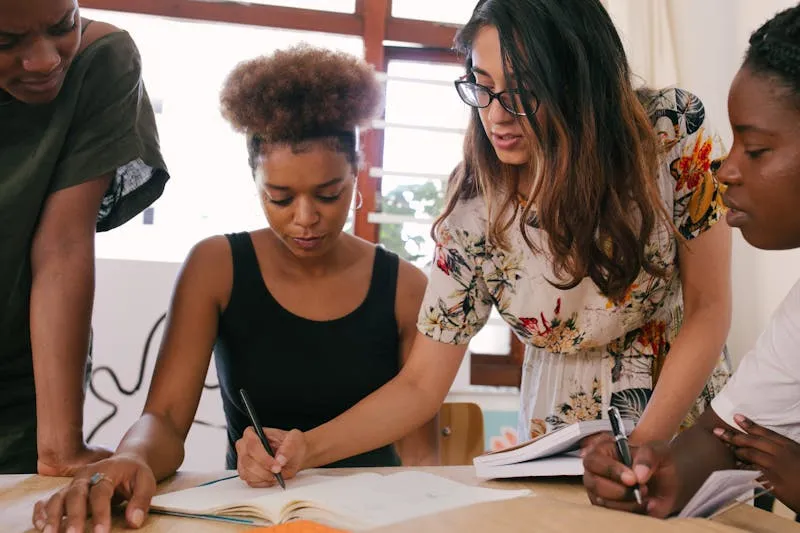
If you're the parent of a teenage girl, the question isn't "should I ban social media?" (that's counterproductive after 13) but "how do I support healthy use?" The APA (2023) proposes a five-axis framework:
- Set clear rules — phone-free zones (bedroom at night, dinner table), time limits, no sharing intimate content
- Model the behaviour — if you're scrolling compulsively at the table, your guidelines are inaudible. Lead by example.
- Build critical thinking — teach them to spot retouched photos, sponsored partnerships, manipulation mechanics. Make it a game, not a lecture.
- Keep the dialogue open — no interrogation ("what are you doing on your phone?") but warm curiosity ("show me what's making you laugh at the moment")
- Watch for warning signs — withdrawal, irritability after use, compulsive checking, sleep disturbance, negative comments about their own body.
The "smartphone contract": when the first smartphone arrives, create a written agreement together (not imposed). Hours of use, permitted apps, conditions for parental oversight, consequences for breaching the terms. A negotiated framework is better respected than a unilateral ban — and it teaches digital responsibility.
FAQ — social media and self-esteem
Does social media cause depression?
Research shows a significant correlation between intensive use (>3h/day) and depressive symptoms, particularly in teenage girls. However, causality isn't unidirectional: depressed people also tend to use social media more (avoidance mechanism). What's established: intensive passive use worsens pre-existing depressive symptoms and can contribute to triggering an episode in vulnerable individuals.
Is Instagram more harmful than TikTok?
Data on TikTok is still limited. Instagram remains the most studied and most associated with body image issues (RSPH, 2017). TikTok presents specific risks: a highly addictive recommendation algorithm, exposure to extreme content (pro-anorexia, dangerous challenges) and attention fragmentation. BeReal, which bans filters and limits retouching, appears less harmful, but studies are still scarce.
Does "digital detox" actually work?
Temporary pauses (a week without social media) show beneficial effects on mood and anxiety. However, these effects disappear rapidly upon return if usage habits remain identical. The most effective strategy isn't temporary abstinence but lasting habit modification: limiting time, curating your feed, disabling notifications.
At what age should I give my child a smartphone?
The APA recommends delaying access to social media at least until age 13, with active oversight continuing until 16-18. The smartphone itself can be given earlier (for calls and safety) but without access to social platforms. Age is less determining than emotional maturity and the quality of parental support.
Do likes really affect self-esteem?
Yes, in documented ways. Neuroimaging studies show that receiving likes activates the same brain areas (nucleus accumbens, ventral striatum) as receiving money or eating chocolate. The absence of expected likes produces measurable disappointment. Hiding like counts reduces this effect — Instagram offers this option in settings.
What should I do if I feel bad after scrolling?
First step: acknowledge the feeling without judging it ("I feel inadequate after scrolling — that's normal"). Second step: identify the trigger (which account, what type of content?). Third step: act on the trigger (unfollow, limit time). Fourth step: re-anchor in reality — call someone, go for a walk, do something that reminds you of your intrinsic worth.
Should beauty filters be banned?
Several countries (Norway, France, UK) have legislated or are considering legislation requiring disclosure of retouched images in advertising. Extension to personal filters is debated. The argument for: filters fuel dysmorphia, especially in minors. The argument against: freedom of expression and the playful aspect. A consensus is emerging on banning "realistic beauty" filters (those that resemble a real face) for underage users.
Sources and references
- APA, "Health Advisory on Social Media Use in Adolescence," May 2023
- Hunt, M.G. et al., "No More FOMO: Limiting Social Media Decreases Loneliness and Depression," Journal of Social and Clinical Psychology, 2018
- Meta/Facebook, internal research on Instagram and teens, leaked documents 2021
- Royal Society for Public Health, "#StatusOfMind: Social media and young people's mental health and wellbeing," 2017
- Ramsey, L.R. & Horan, A.L., "Picture this: Women's self-sexualization in photos on social media," Personality and Individual Differences, 2018
- Ward, A. et al., "Brain Drain: The Mere Presence of One's Own Smartphone Reduces Available Cognitive Capacity," Journal of the Association for Consumer Research, 2017